
Music-related visual culture
Retrowave is associated with contemporary music and imagery that revisit ideas of the 1980s and 1990s. In visual work it is a flexible cultural reference, closely overlapping with Synthwave, rather than a historical movement with one fixed palette.
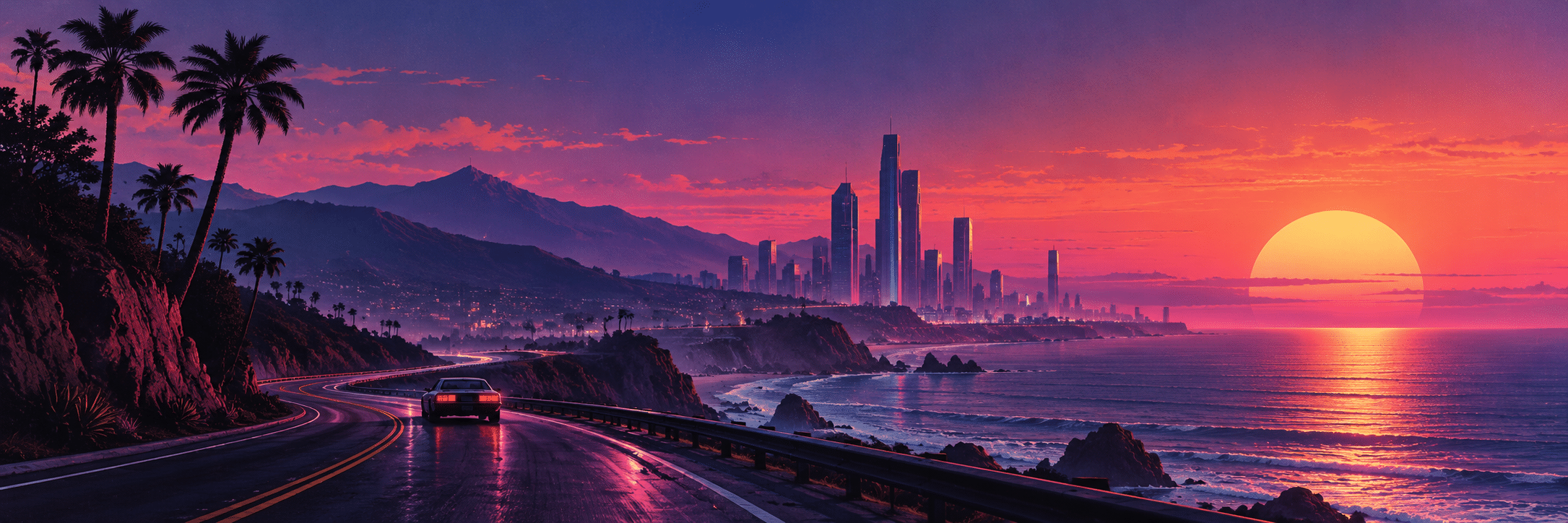
A visual introduction
Seven new AI-generated studies explore Retrowave across a coastal road, architectural space, objects, portraiture, abstraction and a quiet poolside scene. The earlier illustration is retained.
Select an image for a closer look. Use the thumbnails, arrow keys or a swipe to compare examples. Zoom in to inspect details, or share the image that inspires you.


Creative toolbox · take this style further
Choose an input and a destination. Search sends your words to the chosen site; Copy & open puts them on your clipboard to paste there.
Create with AI
Turn your chosen input into an image prompt or a new creative direction.
ChatGPT
Copy your input and paste it into a ChatGPT conversation or image request.
Copy & open ChatGPT (new tab)Claude · Anthropic
Develop an image prompt or explore the style in a new Claude conversation.
Copy & open Claude · Anthropic (new tab)Midjourney
Paste your input into the Imagine bar on the Create page.
Copy & open Midjourney (new tab)Adobe Firefly
Copy your input, open Firefly, and paste it into the prompt field.
Copy & open Adobe Firefly (new tab)Leonardo.Ai
Copy your input, open Leonardo, and paste it into the generation field.
Copy & open Leonardo.Ai (new tab)Image search
Find visual references. Short, concrete keywords usually work best.
Lexica
Search AI images and prompts using your selected input.
Search with this input Lexica (new tab)Pexels
Search the photo and video library. Short keywords often work best.
Search with this input Pexels (new tab)Pixabay
Search photos, illustrations and other images.
Search with this input Pixabay (new tab)Unsplash
Search photographs using the style name or your own keywords.
Search with this input Unsplash (new tab)Wikimedia Commons
Search photographs, artworks and historical images. Check each file for its source and reuse terms.
Search with this input Wikimedia Commons (new tab)Art & research
Explore artists, collections and the ideas behind a style.
Wikipedia
Search for background reading. A style may not have its own article.
Search with this input Wikipedia (new tab)WikiArt
Copy your input into WikiArt’s search to explore artists and artworks.
Copy & open WikiArt (new tab)Europeana
Paste your keywords into the search to explore European museum, library and archive collections.
Copy & open Europeana (new tab)Inspiration
Discover portfolios and visual ideas from creative communities.
Instagram hashtags
Search a hashtag made from your input: spaces and punctuation are removed. Instagram may require sign-in.
Search with this input Instagram hashtags (new tab)ArtStation
Paste your input into artwork search for concept art, environments, characters and visual development.
Copy & open ArtStation (new tab)Behance
Paste your input into project search for illustration, design and visual storytelling.
Copy & open Behance (new tab)A closer look
Simplified silhouettes, deliberate color contrast and selected retro media cues can support a scene; nostalgia works best when tied to a specific visual idea.
A contemporary act of selection
NewRetroWave describes itself as a network promoting a music scene and a culture drawing on earlier decades. Its account also explains the importance of curated visuals in creating a mood. This is evidence of a contemporary cultural practice, not proof that all the imagery authentically comes from the period it evokes.
Ask which past is being remembered or imagined. An arcade, an album sleeve and a science-fiction film offer different visual references. Combining them can be creative, but the mixture should be intentional.
Choose a compositional anchor
A skyline, object, figure or horizon can organize the image. Establish its silhouette and value relationship before adding glow, grain or chromatic effects. Strong graphic structure keeps a retro treatment from becoming a layer of decoration over an unresolved scene.
Use a limited number of competing accents. One saturated color against a quieter field can feel more purposeful than equal neon intensity everywhere. Test the image in a small preview to see whether the focal point remains clear.
Media cues should have a role
Scan lines, print texture and soft color edges suggest different kinds of reproduction. Select a reference and apply it consistently. A heavy mixture of every possible artifact can obscure the subject without producing a convincing relationship to any medium.
Leave some passages clean enough to establish the scene. Compare versions with and without each effect. Keep the ones that support the intended memory, rhythm or atmosphere, and remove those that only reduce clarity.
Keep the neighboring labels flexible
Retrowave, Synthwave and Outrun overlap in online and musical use. The separate AOI pages offer different points of emphasis rather than claiming universally agreed boundaries. This article concentrates on the visual act of selecting and recombining retro references.
For an original study, choose a less familiar subject than the standard sports car and sunset. A quiet observatory, workshop or transit stop can carry the same interest in a remembered future while developing an identity of its own.
Build a palette around a light source
Color becomes more convincing when it has a job. A coral horizon can explain warm reflections on water, while a cyan lamp separates an interior from the outside. Keep the shadow family dark enough to preserve the difference. Magenta, cyan and violet are useful choices, but a restrained amber-and-blue scheme can communicate a remembered future just as clearly.
Decide where the brightest area belongs before adding atmospheric glow. In a skyline, it may sit behind the buildings; in a still life, it may be a narrow reflection on an instrument. Let nearby surfaces pick up that light selectively. When every edge glows at equal strength, depth and material differences become harder to read.
Seven new images, several kinds of nostalgia
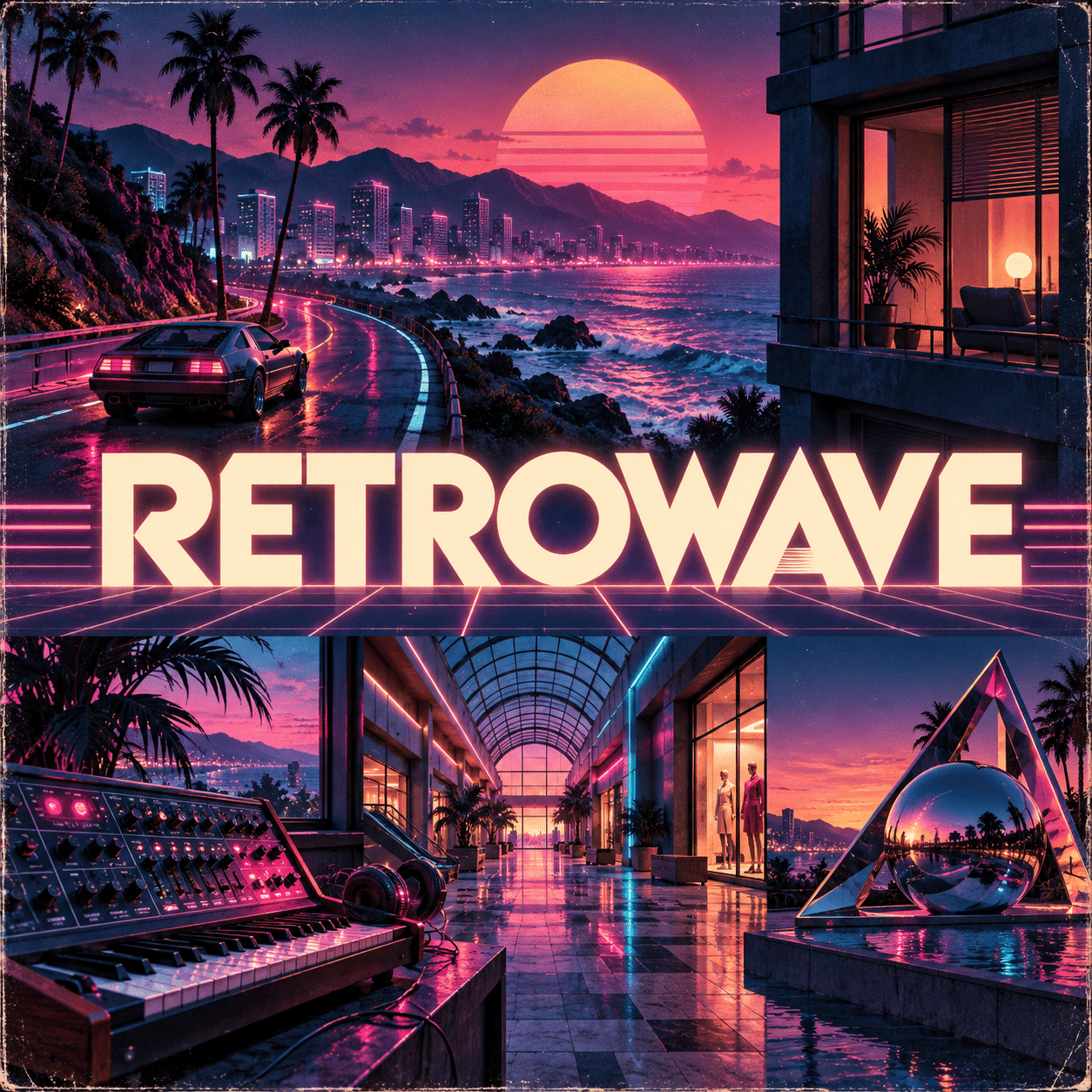
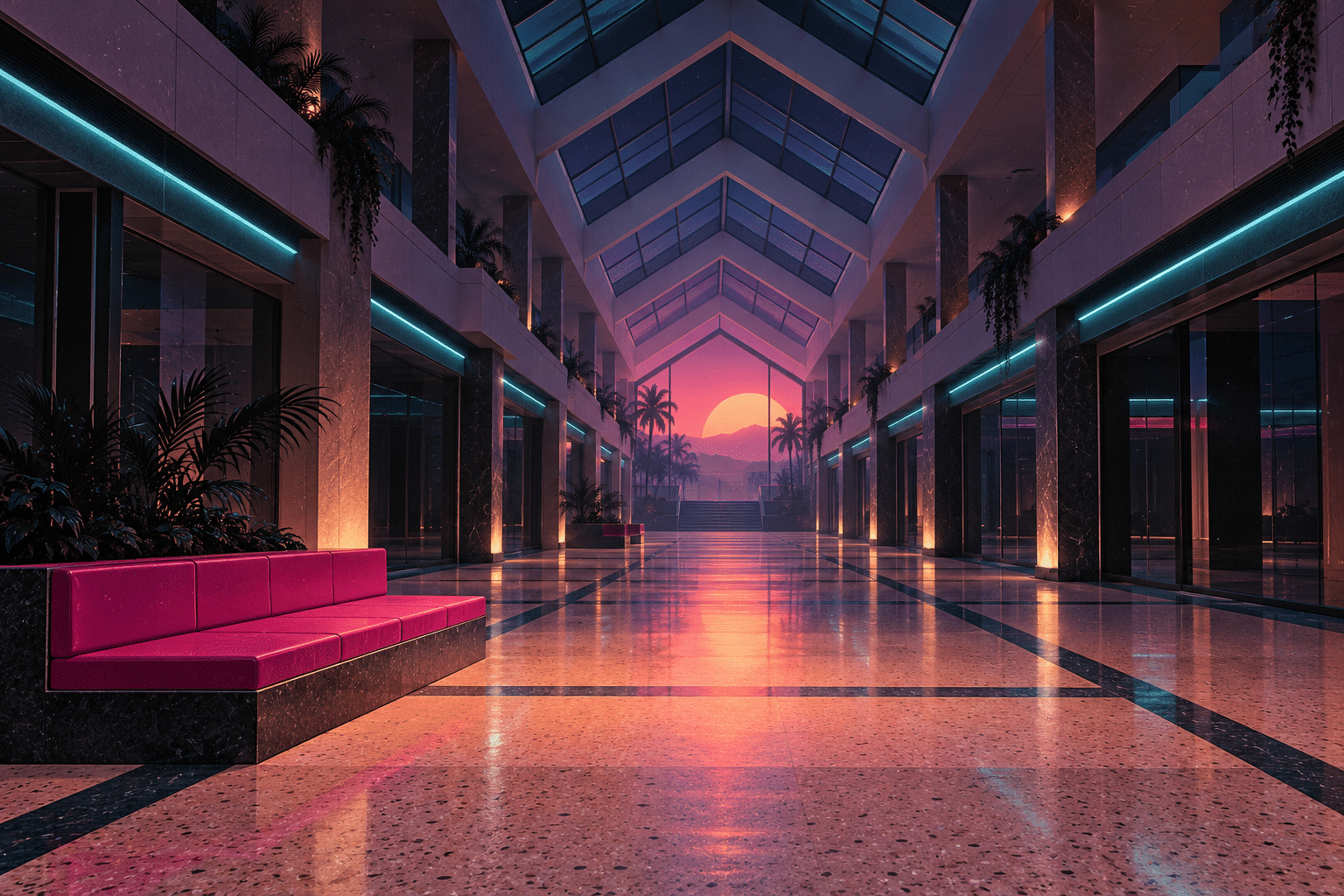
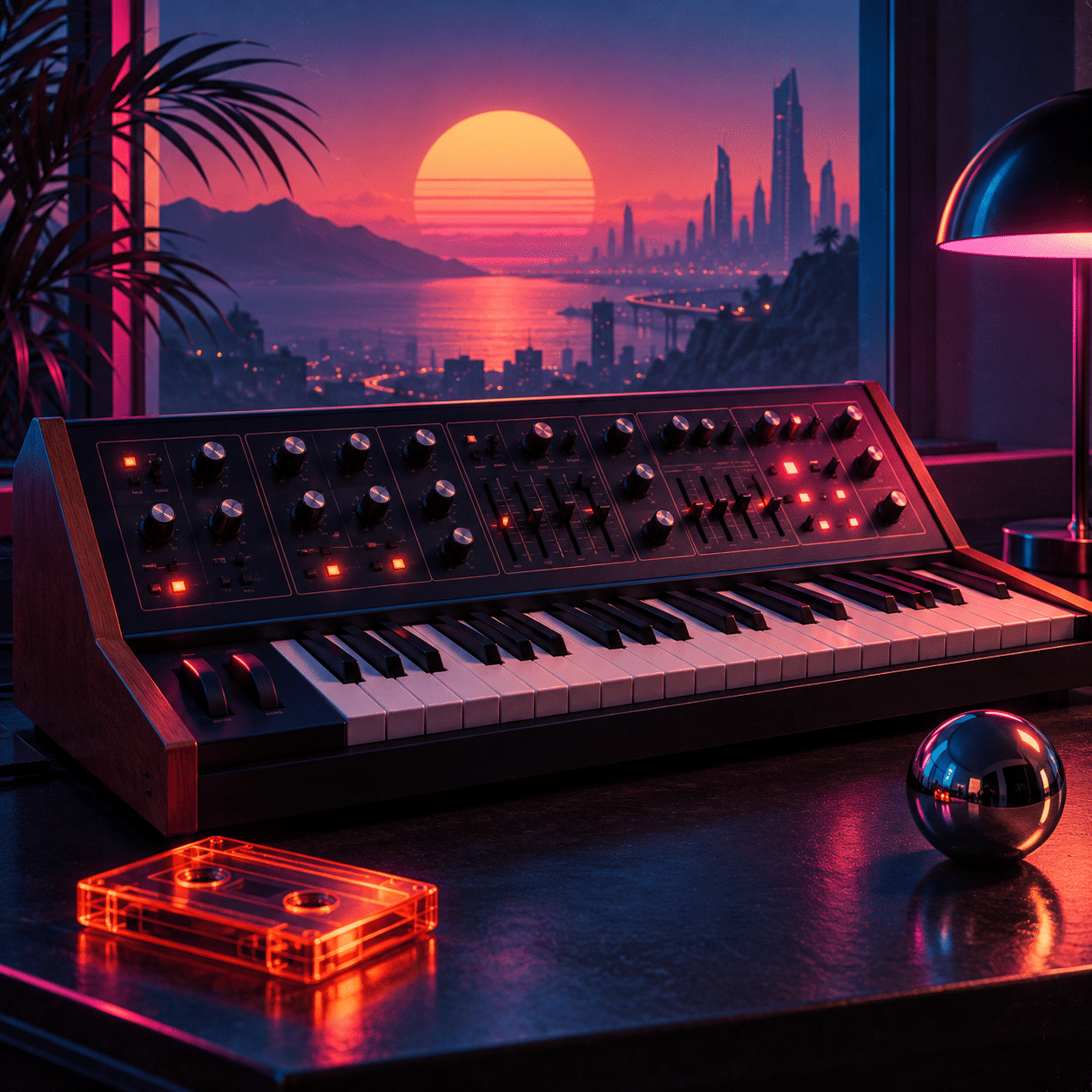
The coastal-road banner uses a familiar vehicle-and-horizon arrangement to establish the theme. The titled collage then opens that vocabulary into different settings. The arcade study builds a scene from angular architecture and colored light, while the synthesizer still life makes nostalgia tactile through keys, a cassette and a reflective sphere. These are imagined objects and spaces, not records of particular products or venues.
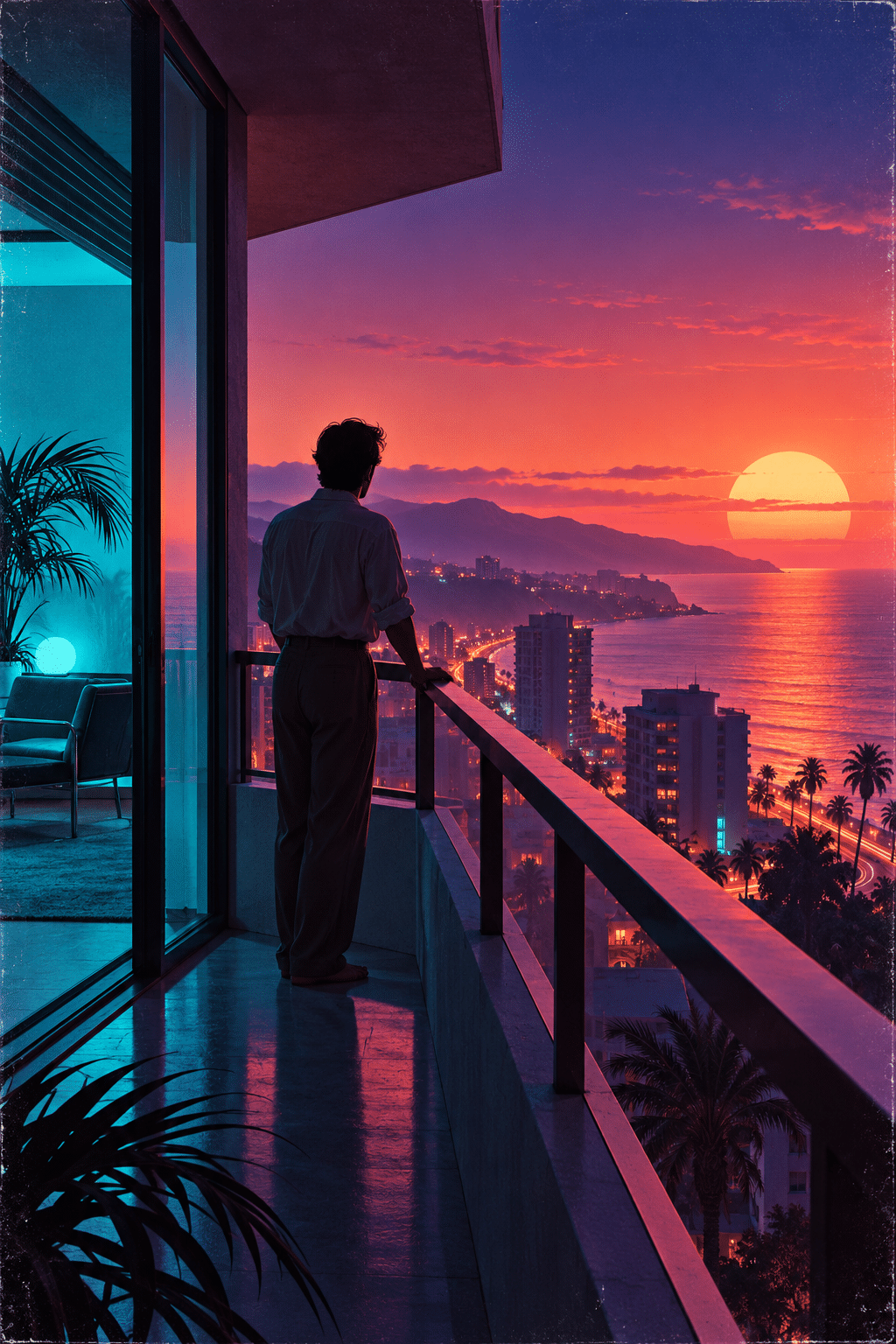
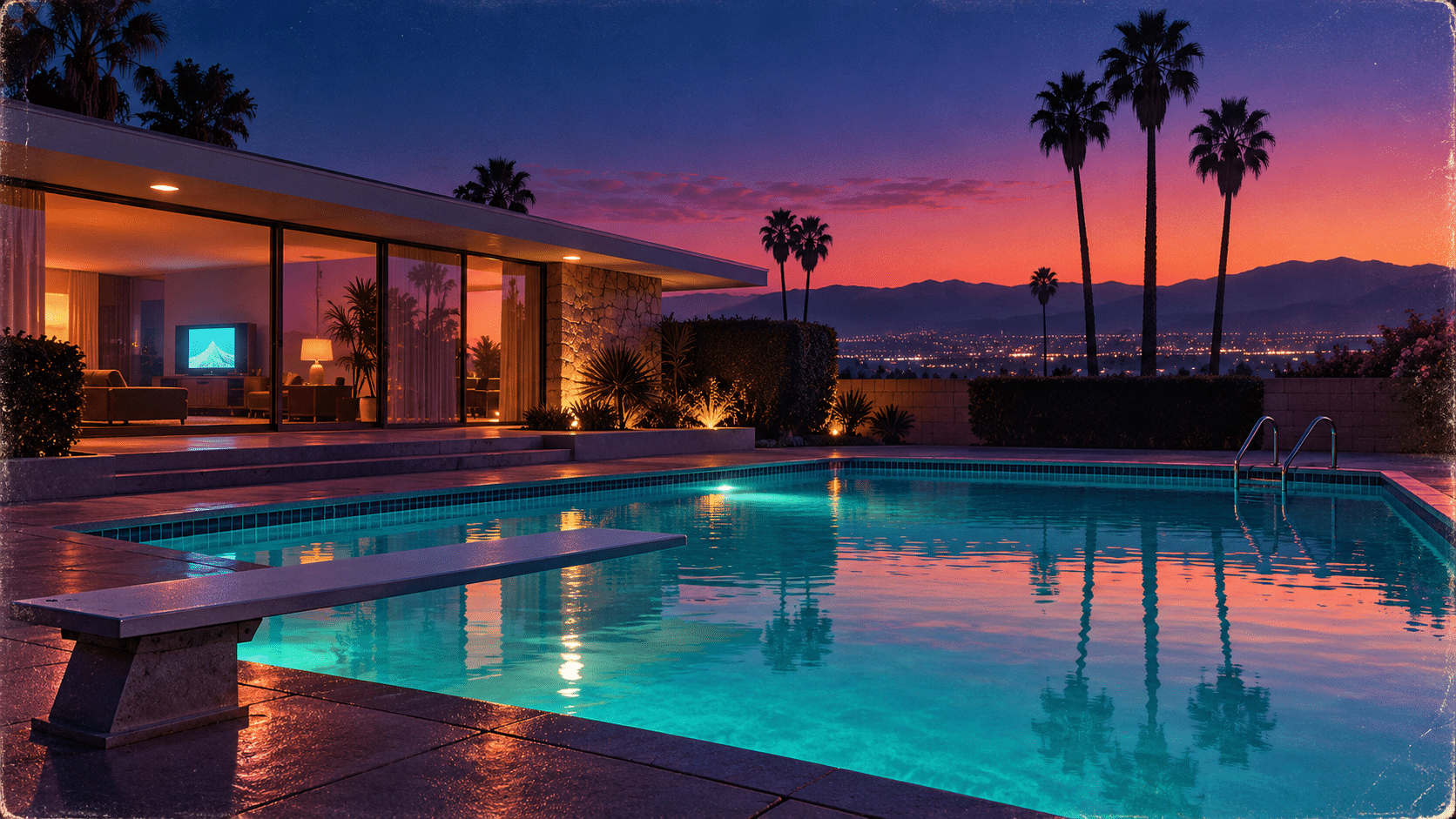
The balcony portrait places a person between an intimate interior and a distant coastal city. Its scale and pause change the mood from speed to longing. The chrome torus and pyramid remove everyday narrative entirely: reflection, weight and impossible suspension carry the image. The poolside study uses warm domestic light, cool water and an empty diving board to suggest an evening after the activity has ended.
All seven images are newly generated interpretations. Their worn borders and surface textures are visual devices, not evidence of age. The older gallery image remains available for comparison. The variety matters because a useful Retrowave vocabulary should work across people, places, objects and abstraction rather than depend on a single stock scene.
Compose for a particular use
For an album cover, give the image a strong shape that survives a thumbnail and leave intentional space for typography. A banner needs a broader path for the eye and a subject that tolerates cropping. A poster can support a more deliberate relationship between a central object and its surrounding negative space. Avoid letting a richly detailed background compete with every other element.
For moving imagery, consider what can change without destroying the composition: a pulse of light, a passing reflection or slow cloud movement may be sufficient. Constant movement in every layer can flatten an otherwise contemplative image. The same principle helps still images: a quiet area makes the saturated accent feel more purposeful.
Prompt vocabulary and useful constraints
Describe a subject, an imagined period reference, a spatial arrangement and a lighting relationship. Terms such as dark indigo shadows, coral horizon, chrome reflection, smoked glass, restrained print grain and clean silhouette are more actionable than a long chain of genre labels. Choose only the material cues that belong to the scene.
A useful revision changes one dimension at a time. Replace the coastal city with an inland observatory, move the viewpoint from street level to a balcony, or exchange magenta light for warm amber. Keep the structure that works while testing the new choice. For historical communication, verify specific clothing, devices and architecture separately; this aesthetic deliberately recombines references and cannot certify period accuracy.
Positive editorial assessment — AI-authored
Retrowave is effective when selective color and silhouette give an imagined past an immediate emotional shape. The balcony and pool studies are especially useful additions because they bring stillness and human scale to a vocabulary often associated with speed. The abstract study demonstrates that the atmosphere can survive without a vehicle or skyline as its main subject.
Critical editorial assessment — AI-authored
The vocabulary can become repetitive when a sunset, palms and chrome substitute for an idea. The new set still uses familiar signs, and its surface wear should be understood as a designed effect. Further development would benefit from less frequently pictured places and experiences, while preserving the clear lighting and graphic organization that make these images readable.
Neutral editorial assessment — AI-authored
Retrowave is a flexible visual reference connected with contemporary retro music culture. Its boundaries with Synthwave and related labels remain porous. These examples are practical studies in mood, palette and composition rather than a definitive taxonomy or a collection of historical artifacts. Select the vocabulary according to the image’s purpose and the memory it is meant to evoke.
A small poetic detour
Original words from the AOI studio.
Poetry
After the Last Track
The pool holds one unfinished sky,
the window keeps its amber square.
A distant road bends out of sight;
we almost know what waits us there.
No decade owns this violet hour,
no tape can bring its evening back.
We build a future out of light
and leave some silence on the track.
The prompt workshop
Original creative exercises. These prompts create new illustrations, not documentary evidence.
A quiet future
Original retrowave-inspired observatory exterior at dusk, strong silhouette, limited cyan and warm coral accents and a restrained print-like finish.
Retro workshop
Original imagined electronics workshop with carefully selected late-twentieth-century design references, coherent light and one focal object, no brand logos.
Transit memory
Original retro-futuristic transit-stop illustration, clean graphic geometry, a readable human scale and subtle media texture rather than excessive glitch.
A smile from the studio
Jokes
The chrome sphere joined the band. It was excellent at reflecting on the eighties.
Sources and further exploration
NewRetroWave — the scene’s own account of music and visual curation