
AOI creative concept
Recursive Pulse Design is an invented AOI concept for making repetition visibly change with scale. A form returns inside itself, branches into smaller relatives, or recedes across the frame. The goal is a readable rhythm, not a claim that every repeating pattern is a mathematical fractal.
An AOI creative concept, not an established historical movement.
A visual introduction
Open any image to look closer, then browse the examples.
Creative toolbox · take this style further
Choose an input, adjust it, then open a tool. Search links pass your text to the destination. Copy & open copies it for you to paste into the generator; you start generation there.
ChatGPT
Copy your input and paste it into a ChatGPT conversation or image request.
Copy & open ChatGPT (new tab)Claude · Anthropic
Develop an image prompt or explore the style in a new Claude conversation.
Copy & open Claude · Anthropic (new tab)Midjourney
Paste your input into the Imagine bar on the Create page.
Copy & open Midjourney (new tab)Adobe Firefly
Copy your input, open Firefly, and paste it into the prompt field.
Copy & open Adobe Firefly (new tab)Leonardo.Ai
Copy your input, open Leonardo, and paste it into the generation field.
Copy & open Leonardo.Ai (new tab)Lexica
Search AI images and prompts using your selected input.
Search with this input Lexica (new tab)Pexels
Search the photo and video library. Short keywords often work best.
Search with this input Pexels (new tab)Pixabay
Search photos, illustrations and other images.
Search with this input Pixabay (new tab)Unsplash
Search photographs using the style name or your own keywords.
Search with this input Unsplash (new tab)Wikipedia
Search for background reading. A style may not have its own article.
Search with this input Wikipedia (new tab)WikiArt
Copy your input into WikiArt’s search to explore artists and artworks.
Copy & open WikiArt (new tab)Instagram hashtags
Search a hashtag made from your input: spaces and punctuation are removed. Instagram may require sign-in.
Search with this input Instagram hashtags (new tab)A closer look
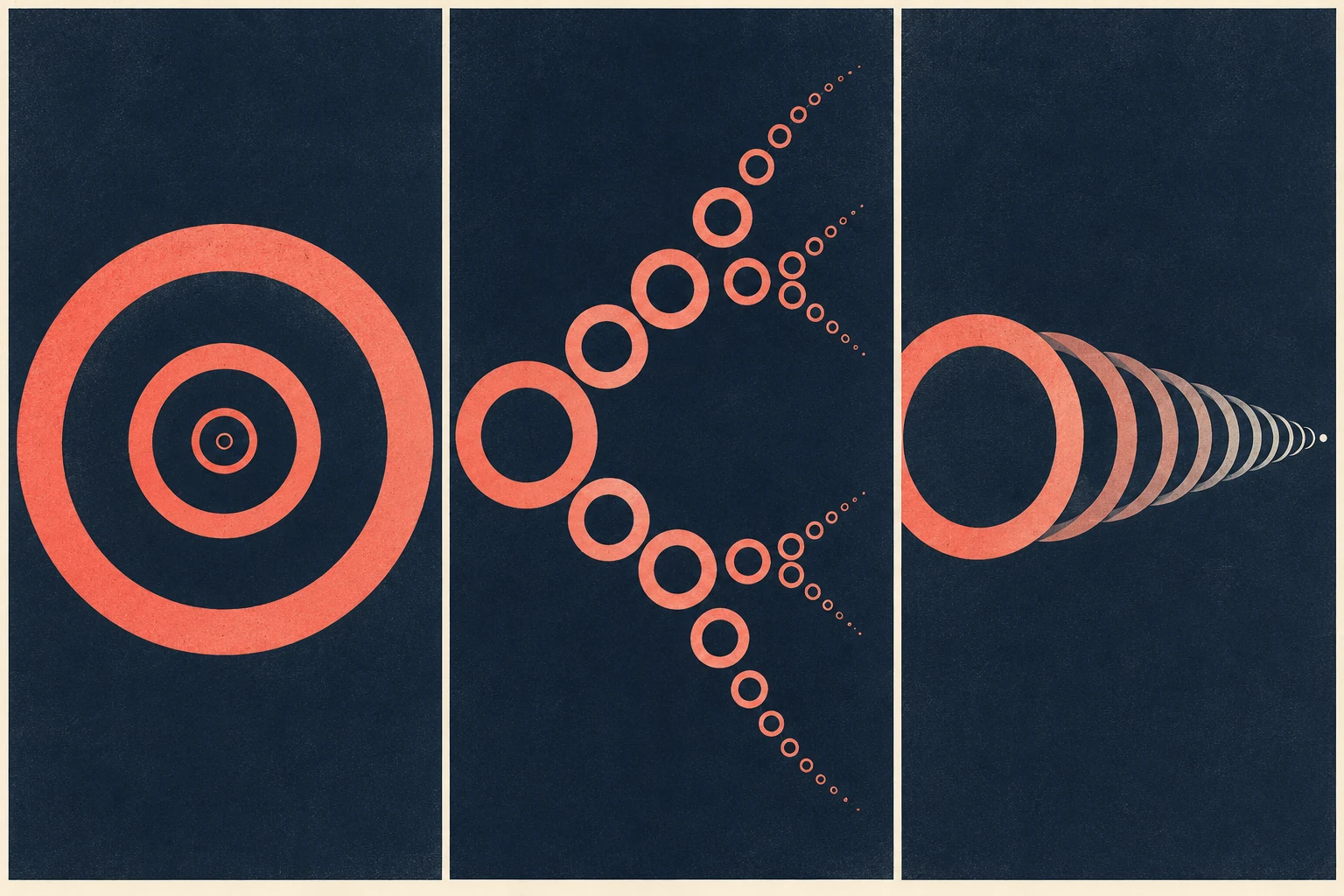
The triptych compares three arrangements of coral rings on dark blue: nesting, branching and a sequence diminishing into the distance. The repeated shape stays recognisable while its spatial behaviour changes. Ivory margins keep the three experiments distinct.
A rule that can survive another repetition
Choose one simple motif and one transformation. For example, draw a ring, place a smaller ring inside it, and repeat the same reduction several times. The transformation is the rule; the rings are its visible record. Decide when to stop before the smallest marks become indistinguishable. An image has a viewing distance and a physical resolution, even when the idea behind it seems endless.
Recursion and repetition are related but different ideas. A row of identical circles repeats a motif. A procedure that applies itself to a smaller version of its own structure is recursive. Our illustration places several kinds of repetition side by side for comparison. It is a design interpretation, not a proof that its generated geometry follows an exact algorithm.
Three ways to make a pulse
The nested rings on the left pull attention inward. The branching sequence in the middle sends it along several routes. The diminishing series on the right suggests recession and a gradual loss of force. None of these effects requires an elaborate palette: scale, interval and direction do most of the work.
A strong version retains an obvious relationship between parent and smaller forms. A weak version buries that relationship under texture. Inspect the image at thumbnail size, then close up. At the first distance, the route should be clear; at the second, the edges and intervals should reward attention. Detail that works only when enlarged is not automatically useful detail.
Build, check, revise
For a precise study, construct the motif in a vector editor or a short drawing program. Record the reduction ratio and number of iterations. Change only one of those values between versions. This makes the comparison repeatable and exposes the point at which the design becomes too dense.
An image model is better suited to exploring material, atmosphere and imperfect printed edges. It may alter the number of rings or their spacing. Use it for an illustration, and use a deterministic drawing method when exact geometry matters. Recursive Pulse Design has no verified founders or canonical artworks in the material reviewed here. Its value is the question it puts on the page: how little can change while the whole image starts moving?
The prompt workshop
Original creative exercises. These prompts create new illustrations, not documentary evidence.
One motif, three behaviours
Create an original screenprint-like triptych on dark navy paper. Compare nested coral rings, a branching sequence of progressively smaller rings, and rings diminishing along one route. Ivory margins, clear spacing, restrained texture. No formulas, labels, text or signatures; this is an illustrative design study, not a mathematical diagram.