
Historical avant-garde movement
Rayonism, also called Rayism, was an early twentieth-century Russian avant-garde movement associated with Mikhail Larionov and Natalia Goncharova. It used intersecting rays and colour planes to rethink the representation of light, energy and space.
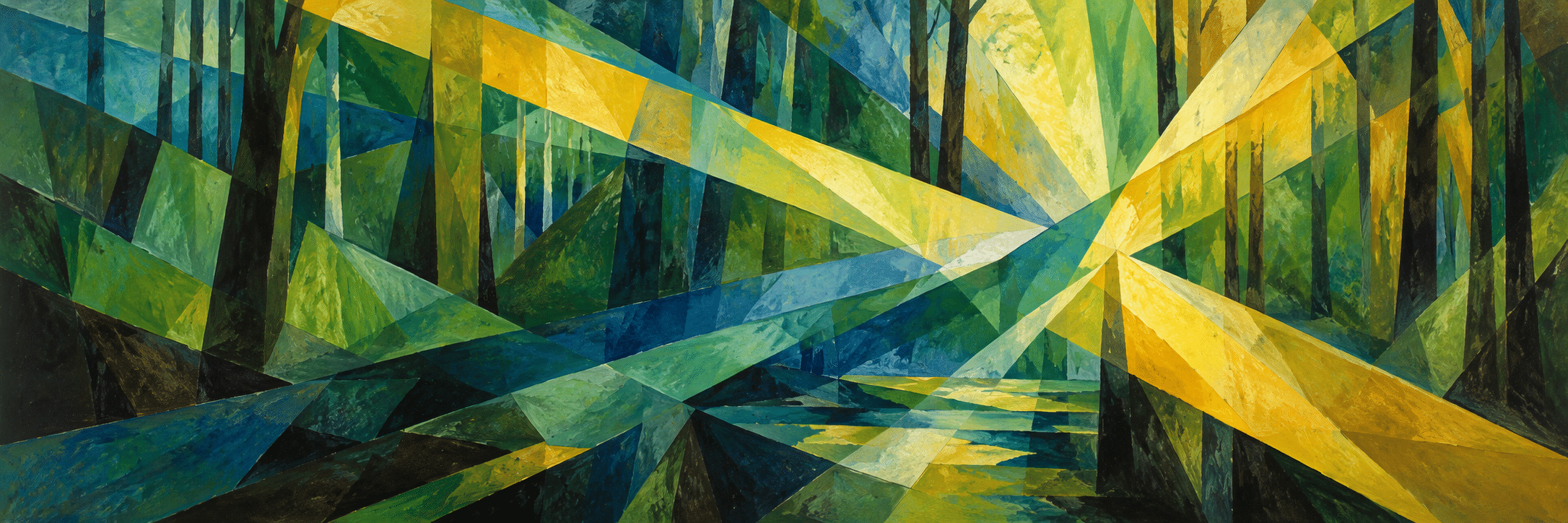
A visual introduction
Select an image for a closer look. Use the thumbnails, arrow keys or a swipe to compare examples. Zoom in to inspect details, or share the image that inspires you.


Creative toolbox · take this style further
Choose an input and a destination. Search sends your words to the chosen site; Copy & open puts them on your clipboard to paste there.
Create with AI
Turn your chosen input into an image prompt or a new creative direction.
ChatGPT
Copy your input and paste it into a ChatGPT conversation or image request.
Copy & open ChatGPT (new tab)Claude · Anthropic
Develop an image prompt or explore the style in a new Claude conversation.
Copy & open Claude · Anthropic (new tab)Midjourney
Paste your input into the Imagine bar on the Create page.
Copy & open Midjourney (new tab)Adobe Firefly
Copy your input, open Firefly, and paste it into the prompt field.
Copy & open Adobe Firefly (new tab)Leonardo.Ai
Copy your input, open Leonardo, and paste it into the generation field.
Copy & open Leonardo.Ai (new tab)Image search
Find visual references. Short, concrete keywords usually work best.
Lexica
Search AI images and prompts using your selected input.
Search with this input Lexica (new tab)Pexels
Search the photo and video library. Short keywords often work best.
Search with this input Pexels (new tab)Pixabay
Search photos, illustrations and other images.
Search with this input Pixabay (new tab)Unsplash
Search photographs using the style name or your own keywords.
Search with this input Unsplash (new tab)Wikimedia Commons
Search photographs, artworks and historical images. Check each file for its source and reuse terms.
Search with this input Wikimedia Commons (new tab)Art & research
Explore artists, collections and the ideas behind a style.
Wikipedia
Search for background reading. A style may not have its own article.
Search with this input Wikipedia (new tab)WikiArt
Copy your input into WikiArt’s search to explore artists and artworks.
Copy & open WikiArt (new tab)Europeana
Paste your keywords into the search to explore European museum, library and archive collections.
Copy & open Europeana (new tab)Inspiration
Discover portfolios and visual ideas from creative communities.
Instagram hashtags
Search a hashtag made from your input: spaces and punctuation are removed. Instagram may require sign-in.
Search with this input Instagram hashtags (new tab)ArtStation
Paste your input into artwork search for concept art, environments, characters and visual development.
Copy & open ArtStation (new tab)Behance
Paste your input into project search for illustration, design and visual storytelling.
Copy & open Behance (new tab)A closer look
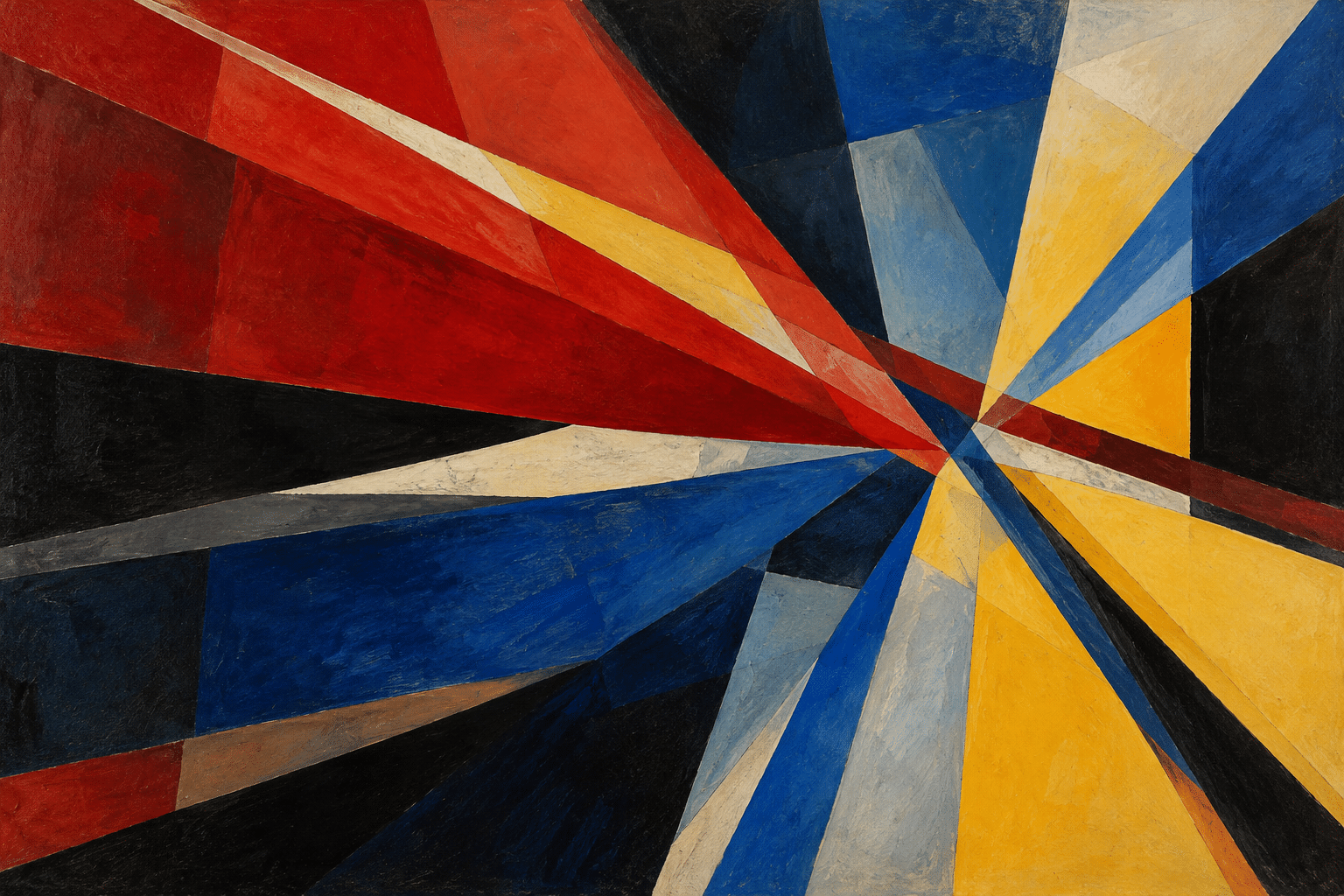
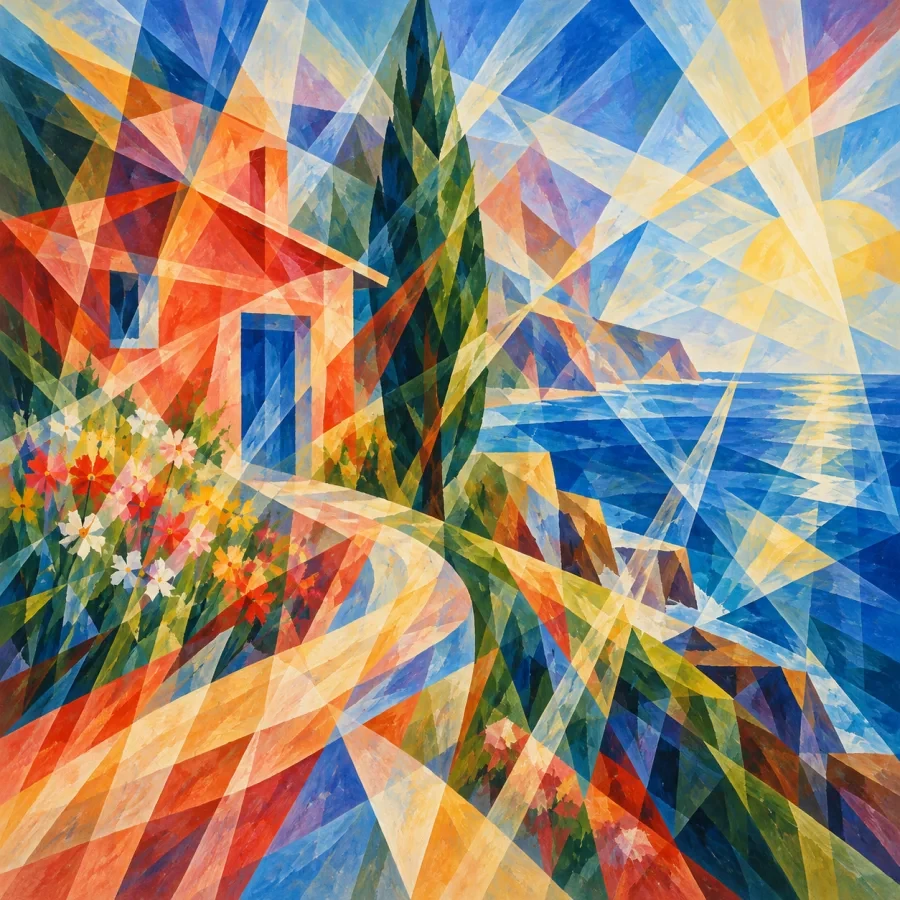
Oblique strokes, crossing bands, fragmented colour and partly submerged objects can make the image feel like a field of interactions rather than a collection of solid things.
A specific avant-garde experiment
MoMA dates the movement’s establishment to 1912 and connects its ideas with Cubism, Futurism and Orphism, alongside other sources. The National Galleries of Scotland identifies Larionov and Goncharova as its founders and emphasizes dynamically intersecting lines. These links place Rayonism within an active exchange of early modern ideas.
Its language of rays should be read as an artistic proposal. The paintings do not supply a scientific diagram of light or a literal measurement of energy. This distinction is especially important when making a contemporary image: coloured beams alone do not establish either the historical reference or physical accuracy.
Let interactions replace solid boundaries
Begin with a simple motif such as trees, glass vessels or a city edge. Then consider how directional marks might connect the motif to surrounding space. Some object clues may remain, while others dissolve into intersecting planes. The transition can be more interesting than either complete description or complete obliteration.
Choose a few dominant directions. If rays point everywhere with equal force, the composition may become a tangle. A principal diagonal and a contrasting group of shorter strokes can establish rhythm. Allow changes in density to reveal where the strongest interactions occur.
Colour must organize the crossings
Use colour groups to distinguish overlapping directions. A cool blue-green field can be interrupted by warm red or yellow strokes, while darker intervals keep the luminous areas from merging into one bright mass. The crossings should produce relationships that can be followed, not simply layers of transparent effects.
Keep some areas broader and quieter. A painting made entirely of equally narrow rays may feel mechanical. Varied widths, opaque patches and broken edges can preserve a painterly surface. The image should remain an artwork composed of marks rather than an illustration of a laser display.
Distinguish nearby ideas
Cubo-Futurism also uses fractured forms and directional energy, but the Rayonist emphasis on intersecting rays offers a different route through the image. Orphism foregrounds colour relationships in its own ways. These historical neighbours can clarify one another without being treated as interchangeable names.
For a practical exercise, make an observational sketch and identify its main directions. Build a second version from overlapping coloured bands, retaining only two or three recognizable clues. Compare how the object’s presence changes. This is a contemporary formal experiment, not a reconstruction of a specific historical method.
The new gallery and its limits
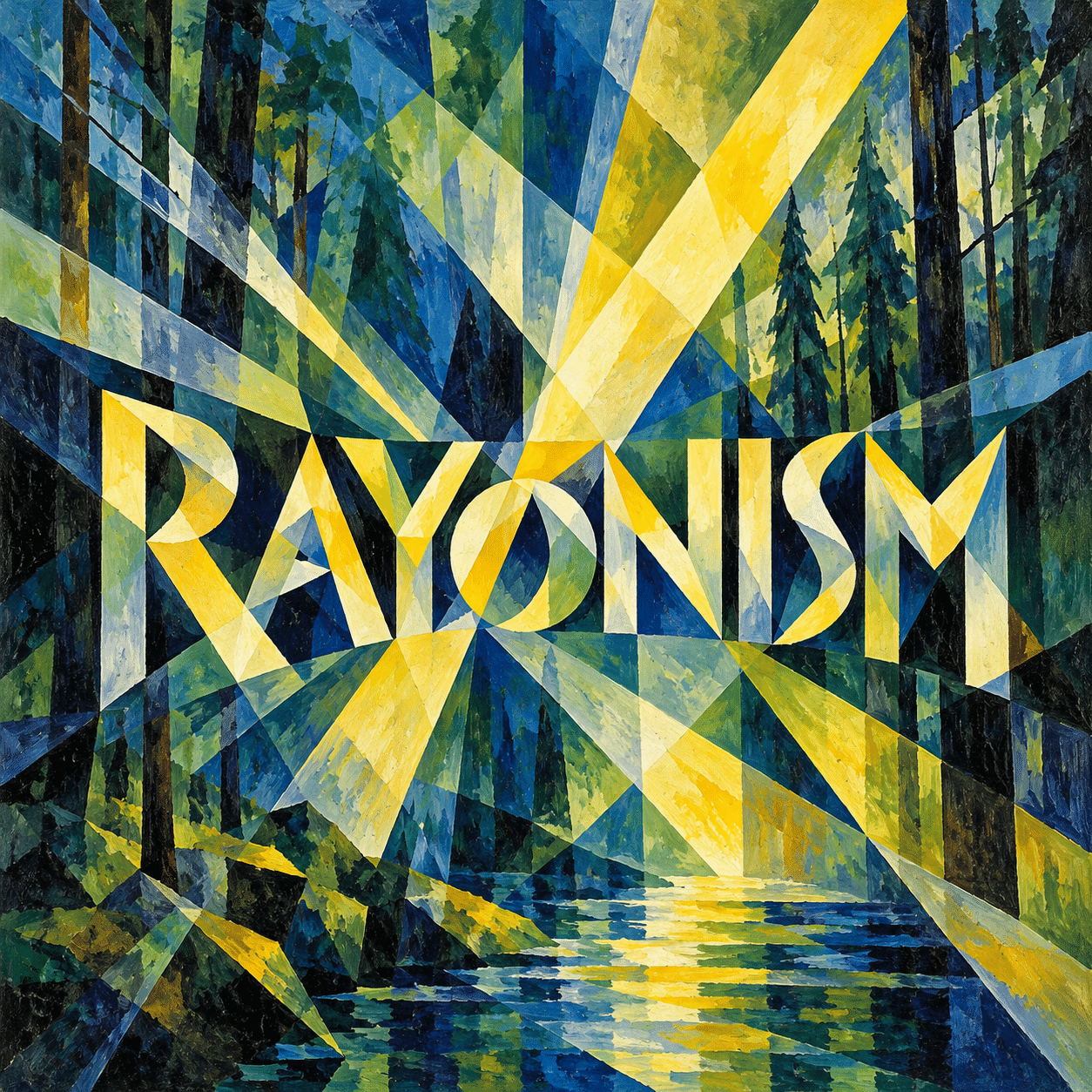
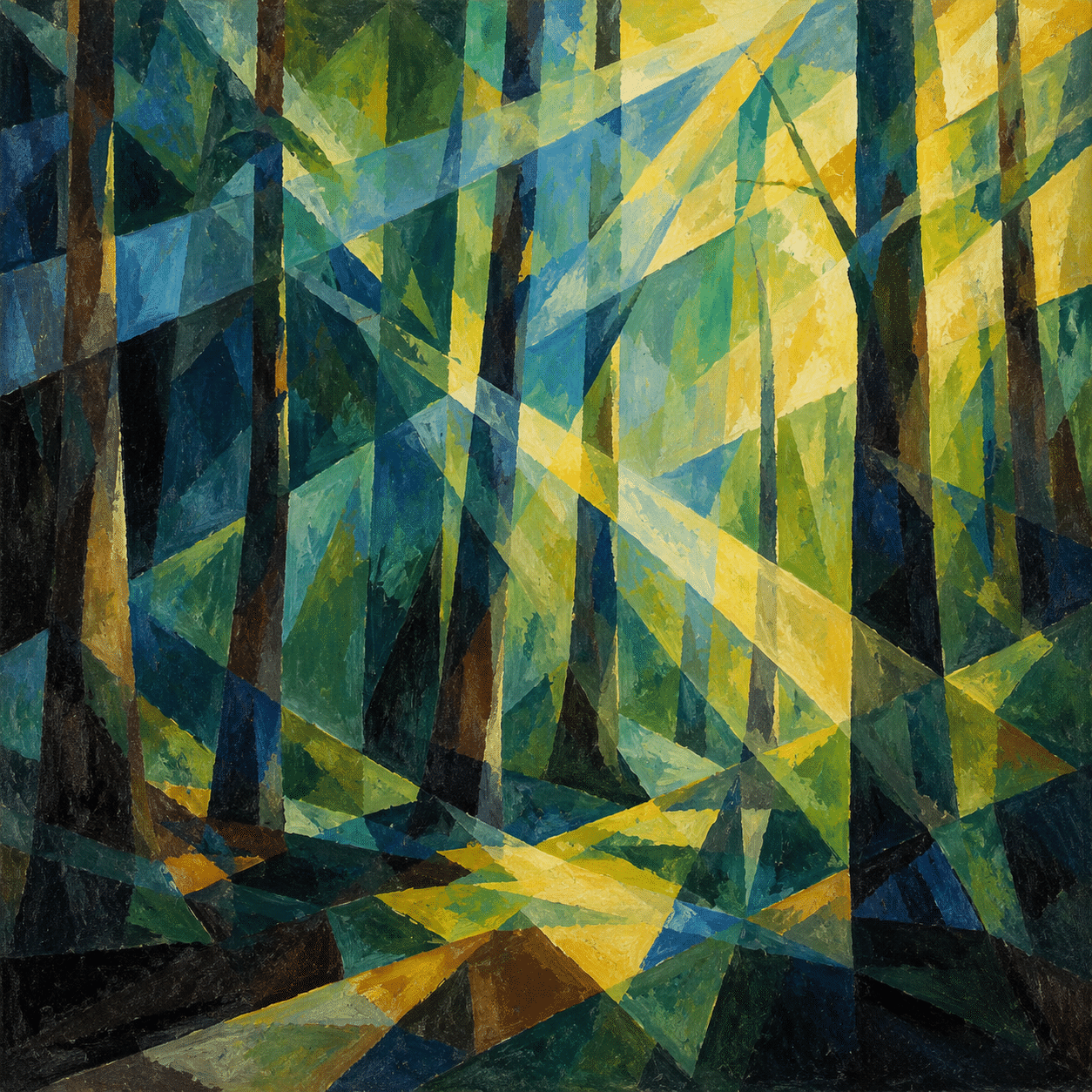
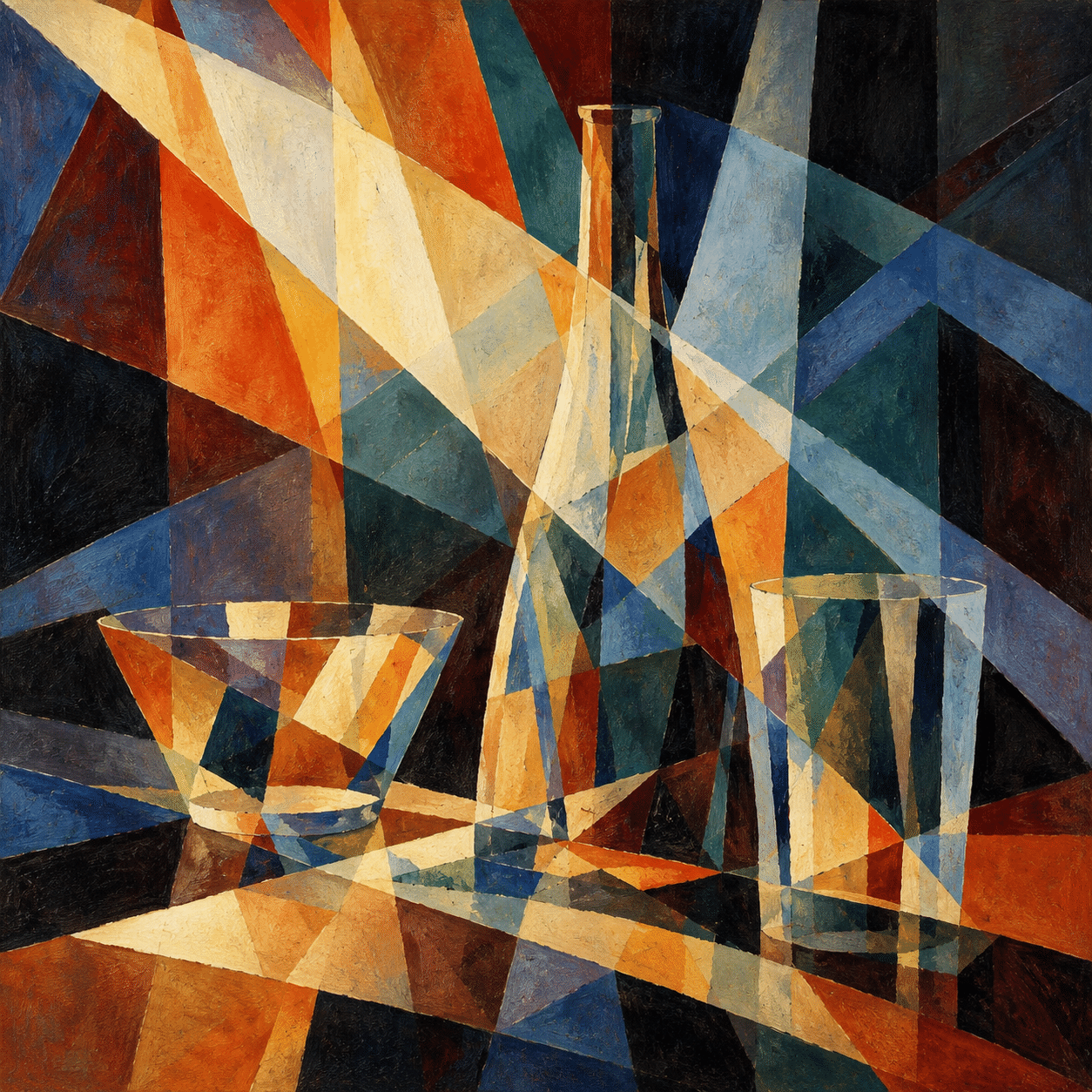
The forest study retains vertical tree clues within crossing blue-green and yellow marks. The glass-inspired still life uses intersecting planes around a few vessel shapes. The abstract study removes most object clues and concentrates on directional colour. All three are AI-generated interpretations, not works by the founders.
Avoid using lens flares or neon glow as the sole sign of Rayonism. Those effects can suggest light without addressing the relationship between object, ray and pictorial space. A stronger interpretation makes the crossings structurally necessary: remove them and the image’s organization should genuinely change.
A small poetic detour
Original words from the AOI studio.
Poetry
Where the Rays Meet
The glass is almost lost in blue;
a yellow path cuts through the green.
The object leaves a trace behind,
a place where crossing lights have been.
No beam explains the world alone—
the meeting makes a world its own.
The prompt workshop
Original creative exercises. These prompts create new illustrations, not documentary evidence.
A forest of crossings
Create an original Rayonism-inspired forest study with blue-green and yellow intersecting rays, a few retained vertical tree clues, varied mark widths and painterly texture. No copied historical work.
Glass and surrounding space
Create a Rayonist-inspired still life with faint vessel clues submerged in crossing warm and cool planes. Organize dominant directions and preserve dark intervals; no literal laser effects.
Directional colour
Create an abstract Rayonism-inspired painting with two dominant diagonal systems, varied red blue and yellow strokes, broad quiet areas and a coherent focal crossing.
A smile from the studio
Jokes
The still life asked where its outline had gone. The rays said it was now a shared responsibility.