
Historical painting movement
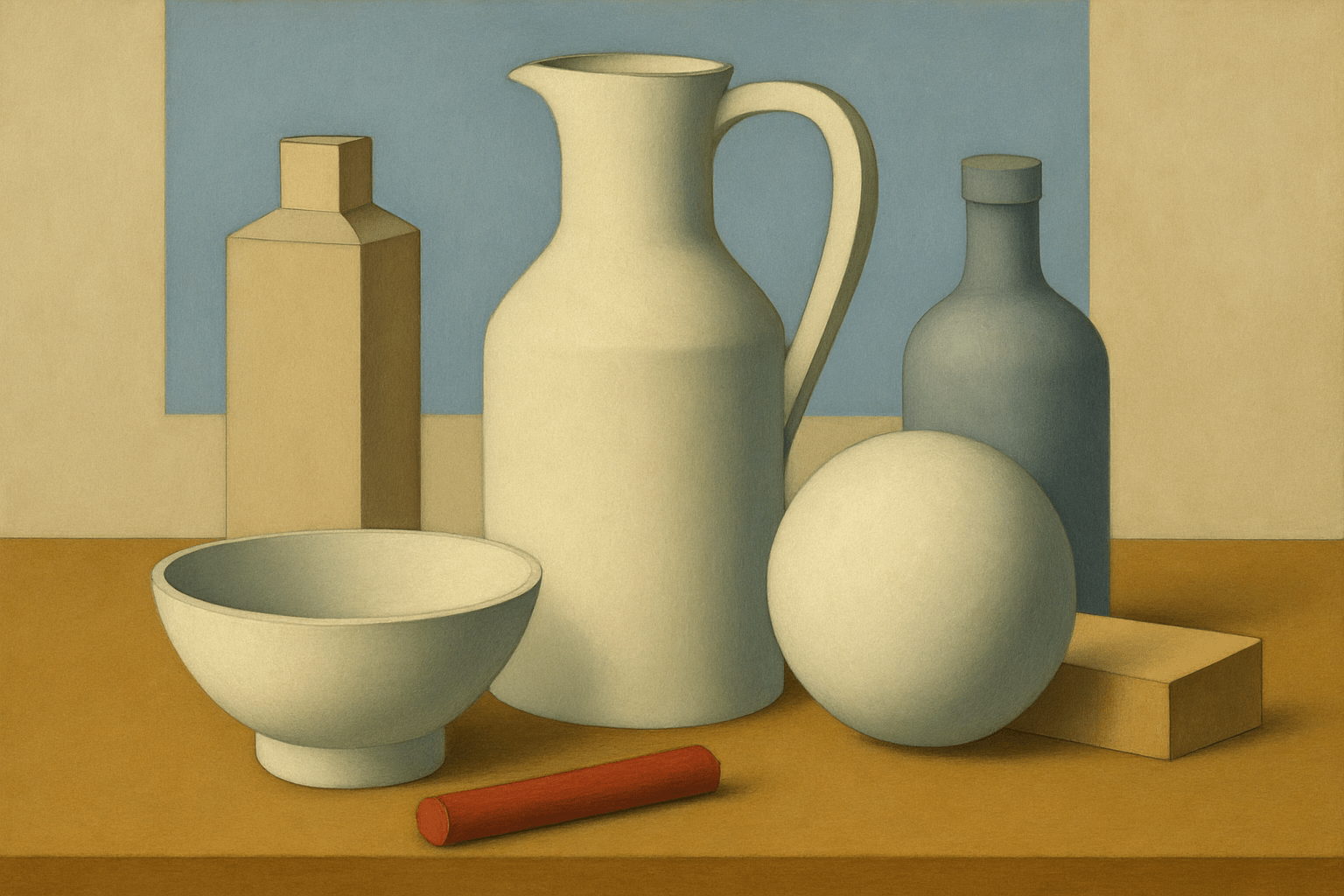
Purism is associated with Amédée Ozenfant and Le Corbusier. Its search for order concerns specific pictorial ideas, not moral purity or a synonym for Minimalism.
A closer look
For an original still life, select a few familiar vessels or tools and compare their main volumes.
Understanding the subject
The Fondation Le Corbusier records Ozenfant and Le Corbusier’s development of Purism, articulated in After Cubism in 1918 and subsequently in L’Esprit Nouveau. This history distinguishes the term from a generic preference for clean design. A useful visual study considers how ordinary objects can be simplified and related within an ordered composition. The movement’s name should not be used to judge other art as impure or inferior.
AOI looking and making workshop
For an original still life, select a few familiar vessels or tools and compare their main volumes. Simplify contours while retaining the features that make each object distinct. Use repeated curves and verticals to connect the forms, and keep the surrounding space deliberate. A limited palette can clarify the structure, but too little differentiation may make objects merge unintentionally. Test whether overlaps support the whole arrangement rather than merely fill the frame. The exercise is measured organization, not the removal of every irregularity or trace of material character.
The prompt workshop
Original creative exercises. These prompts create new illustrations, not documentary evidence.
Ordered vessels
Create an original Purist-inspired still life of a bottle, bowl and plain jug, simplified volumes, measured overlaps and a restrained cream-blue-earth palette. Keep each object recognizable without copying a historical painting.
Curves and verticals
Create an original geometric still life of everyday kitchen objects, repeated verticals linked by broad curves and a calm shallow space. Use clear contours and a few deliberate tonal differences.
Structure with a variation
Create an original ordered composition of three similar vessels and one irregular folded cloth, limited color and precise spacing. Let the cloth introduce a controlled variation within the stable arrangement.
Your next inspiration
Discover another art style
Follow a visual thread to the next subject.

Sources and further exploration
Creative studies to try
Explore these collected prompts as creative interpretations. They are starting points for image-making, not reproductions of historical artworks or evidence about a tradition.
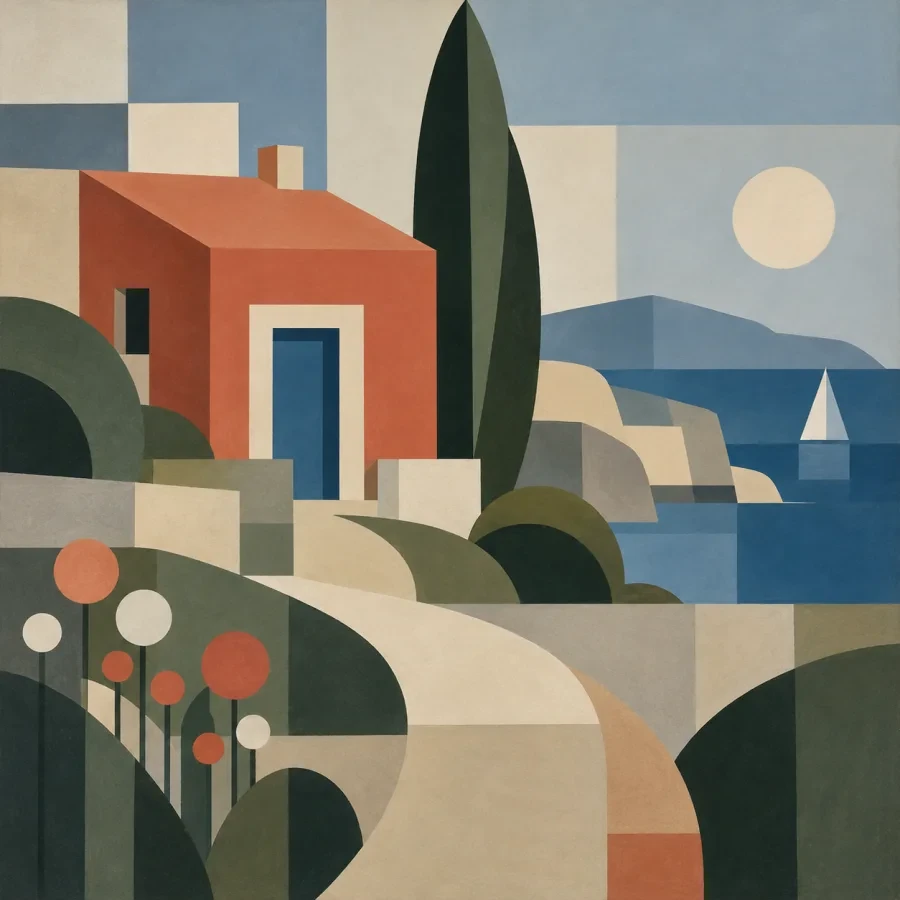
Visual cues: Stable objects in disciplined geometry
Study 1 — Purism
Apply the following visual approach to my subject or project, preserving its core content and purpose. Simplify the subject into clear rounded and rectilinear forms, with balanced proportions, muted colors, and carefully ordered overlaps. Treat this as a contemporary interpretation, not a historical artifact. Adapt the composition to my subject. Do not add text unless my project calls for it.
Prompt source: Emergent Mind Style Atlas. Select the text to copy, then adapt the subject and composition.