
Instant photographic system and visual reference
Polaroid refers to a particular history and family of instant-photography systems. The picture is both an image and a developing physical object, while its appearance varies with the camera, film, light and handling.

A visual introduction
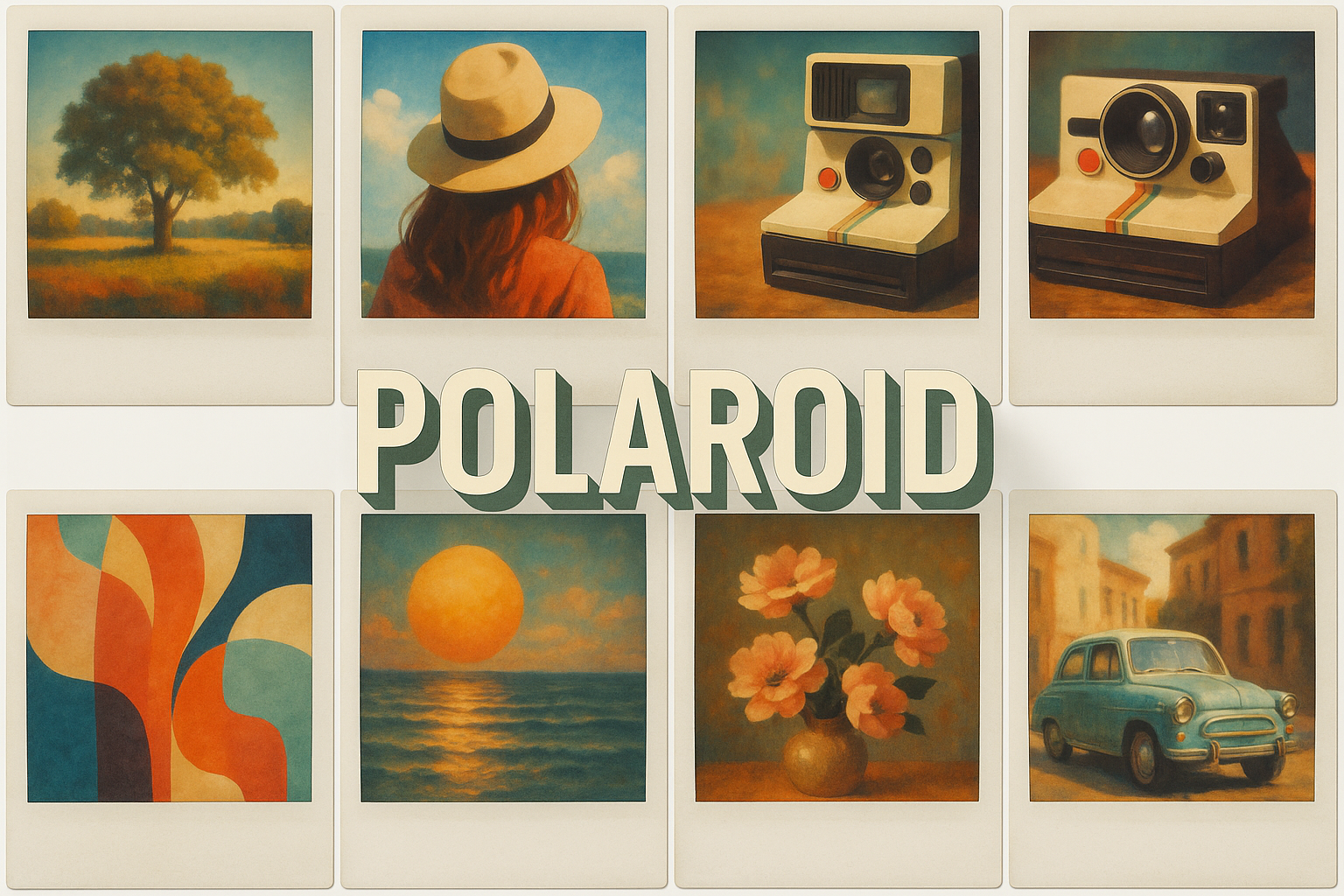
Seven new AI-generated, instant-photo-inspired studies explore portraiture, still life, landscape, sequence and the print as an object. They are not scans of physical film exposures. The earlier illustration is retained.
Select an image for a closer look. Use the thumbnails, arrow keys or a swipe to compare examples. Zoom in to inspect details, or share the image that inspires you.


Creative toolbox · take this style further
Choose an input and a destination. Search sends your words to the chosen site; Copy & open puts them on your clipboard to paste there.
Create with AI
Turn your chosen input into an image prompt or a new creative direction.
ChatGPT
Copy your input and paste it into a ChatGPT conversation or image request.
Copy & open ChatGPT (new tab)Claude · Anthropic
Develop an image prompt or explore the style in a new Claude conversation.
Copy & open Claude · Anthropic (new tab)Midjourney
Paste your input into the Imagine bar on the Create page.
Copy & open Midjourney (new tab)Adobe Firefly
Copy your input, open Firefly, and paste it into the prompt field.
Copy & open Adobe Firefly (new tab)Leonardo.Ai
Copy your input, open Leonardo, and paste it into the generation field.
Copy & open Leonardo.Ai (new tab)Image search
Find visual references. Short, concrete keywords usually work best.
Lexica
Search AI images and prompts using your selected input.
Search with this input Lexica (new tab)Pexels
Search the photo and video library. Short keywords often work best.
Search with this input Pexels (new tab)Pixabay
Search photos, illustrations and other images.
Search with this input Pixabay (new tab)Unsplash
Search photographs using the style name or your own keywords.
Search with this input Unsplash (new tab)Wikimedia Commons
Search photographs, artworks and historical images. Check each file for its source and reuse terms.
Search with this input Wikimedia Commons (new tab)Art & research
Explore artists, collections and the ideas behind a style.
Wikipedia
Search for background reading. A style may not have its own article.
Search with this input Wikipedia (new tab)WikiArt
Copy your input into WikiArt’s search to explore artists and artworks.
Copy & open WikiArt (new tab)Europeana
Paste your keywords into the search to explore European museum, library and archive collections.
Copy & open Europeana (new tab)Inspiration
Discover portfolios and visual ideas from creative communities.
Instagram hashtags
Search a hashtag made from your input: spaces and punctuation are removed. Instagram may require sign-in.
Search with this input Instagram hashtags (new tab)ArtStation
Paste your input into artwork search for concept art, environments, characters and visual development.
Copy & open ArtStation (new tab)Behance
Paste your input into project search for illustration, design and visual storytelling.
Copy & open Behance (new tab)A closer look
A direct encounter, compact composition and the relationship between image area and physical border can matter more than a fixed recipe of faded colors, light leaks or artificial damage.
A photographic system with an artistic life
Polaroid names a company and its photographic systems; it is not a single art movement or a generic name for every instant print. Cooper Hewitt’s account of the SX-70 describes its 1972 introduction and the importance of its folding design and self-contained instant-film system. It also notes the camera’s adoption by artists including Ansel Adams, Andy Warhol and Walker Evans. Their different practices already suggest why no single color treatment can define the medium.
An instant print joins an exposure to a tangible object that can be held, exchanged, arranged or revisited. A digital simulation can explore the appearance of that object, but its production history is different. Keeping the distinction clear makes both the photographic practice and the contemporary interpretation easier to discuss.
More than a white border
An instant photograph's appeal includes its physical presence and the short interval between exposure and seeing the result. Adding a white frame to a digital image can suggest that object, but it does not reproduce the photographic process. Different instant systems and films should not be treated as visually identical.
For an artistic study, decide whether the subject is the scene within the photograph, the print as an object or the relationship between several prints. Those choices lead to different compositions. A border should not become a substitute for an interesting image.
Light and distance shape the result
Polaroid's support guidance emphasizes appropriate light and the limits of built-in flash. A subject close to the camera and a large dark room behind it may produce a very different balance from a portrait near a bright wall. Check the requirements of the particular camera and film rather than assuming that all instant cameras handle a scene alike.
Keep the composition simple enough for the important gesture or object to remain readable at the print's size. Move distracting edges away from the subject. A small shift in position can matter more than adding a nostalgic color treatment afterwards.
The material conditions are real
The manufacturer's guidance explains that temperature can affect development and color. Storage and handling also belong to the photographic workflow. These are material variables to manage, not a guarantee that every result will have attractive accidental effects.
When evaluating a picture, separate a deliberate choice from an unintended failure. A color shift may be useful in one context and obscure the subject in another. Do not assume that scratches, stains and light leaks are necessary signs of authenticity.
Think in a small series
Make an original sequence around a repeated encounter: the same chair in changing light, objects exchanged between friends or one place visited at intervals. Keep some framing decisions consistent so that the differences become meaningful. The arrangement of prints can create a rhythm beyond the individual images.
For generated work, use “instant-photo-inspired” when that is what the image is. Avoid invented dates or handwritten claims that imply a real event was recorded. A contemporary interpretation can explore intimacy and objecthood without pretending to be a recovered family photograph.
Visual grammar: a small field of attention
The compact image area rewards a clear relationship between subject and surroundings. A face near a window can become the principal event, while a bright object at the edge may pull attention away. In a still life, a small group of objects often provides enough variation in shape and surface. The border establishes a second frame around that composition; it should support the image rather than rescue an unclear one.
A print photographed at an angle introduces another layer: paper thickness, cast shadow, reflection and the surface beneath it. Decide whether these are part of the work or simply its presentation. A clean scan emphasizes the image; an object photograph emphasizes the print’s presence in a place. Neither is automatically more authentic or more artistic.
Five examples, five visual problems
The new portrait uses a close encounter and window light, with a terracotta shirt balancing the green plant behind the figure. The oranges and blue bowl study relies on a compact arrangement and complementary color. The beach image moves the subject outward: a small blue hut anchors a broad, subdued sky and shoreline. These examples show that intimacy need not mean photographing only people.
The three-view chair sequence holds the room approximately constant while changing the apparent time of day. Its subject is the relationship between repeated framing and changing light. The cup-and-print still life puts an object beside its pictured counterpart, making representation itself visible. The banner and collage gather these different approaches without claiming a common film stock or a documented photographic session.
Every new gallery image is AI-generated and instant-photo-inspired. The white borders and simulated color response are part of those interpretations. They are not scans of physical Polaroid exposures, and the imagined people and settings are not presented as records of real events. The previous AOI illustration is retained for comparison.
Color, handling and editing decisions
There is no need to impose heavy fading on every image. A warm neutral interior, a blue-grey beach and a strongly colored still life can all support the small-print format. First establish a readable balance of light and dark. Then decide whether a subtle color shift contributes to the mood or merely makes important surfaces difficult to distinguish.
For actual film work, follow the instructions for the specific camera and film, including development and storage. For a generated concept, describe the intended visible result rather than inventing a film formula. Useful vocabulary includes compact framing, gentle highlight roll-off, direct window light, unmarked paper border and a restrained surface texture. Avoid fake dates or annotations that would imply a personal archive.
Positive editorial assessment — AI-authored
Instant photography offers a compelling connection between an image and a small, shareable object. The new studies communicate that intimacy without relying on conspicuous damage. The repeated chair sequence and the cup beside its image are particularly useful because they turn the format into a compositional idea rather than a decorative frame.
Critical editorial assessment — AI-authored
A simulated white border can become a shortcut to nostalgia. These generated studies cannot reproduce the contingency of an actual exposure, the development process or the social exchange around a physical print. Their polished surfaces may also understate the variety of real film results. They are most useful when their conceptual purpose and synthetic origin remain explicit.
Neutral editorial assessment — AI-authored
Polaroid photography encompasses different cameras, films and artistic uses. This article separates the physical practice from an instant-photo-inspired visual treatment and offers examples of framing, sequencing and object presentation. Use the manufacturer’s guidance for actual film handling, and evaluate the generated studies as illustrations rather than technical predictions.
A small poetic detour
Original words from the AOI studio.
Poetry
Small Enough to Hold
A square of sea, a kitchen chair,
a face that turns toward the light;
the border leaves a little room
for everything outside the sight.
The table keeps the afternoon,
the cup stands near its smaller twin.
A picture cannot hold the day,
but asks us once to look again.
The prompt workshop
Original creative exercises. These prompts create new illustrations, not documentary evidence.
An intimate small image
Original instant-photo-inspired concept of two adult friends exchanging a handmade cup by a window, compact readable composition, gentle natural color, clean physical-print border, no fabricated date or handwriting.
A purposeful sequence
Three fictional instant-photo-style images of the same empty chair in morning, afternoon and evening light, consistent framing and restrained differences, presented as contemporary concept studies.
The print as an object
An original instant-photo-inspired still life of a small print resting beside the object it depicts, coherent perspective and window reflection, tactile paper edge, no false archival provenance.
A smile from the studio
Jokes
The photograph asked for personal space. The white border said it had already taken care of that.