
Archive note: historical claims and artist or artwork associations in this entry have not yet received a full source review.
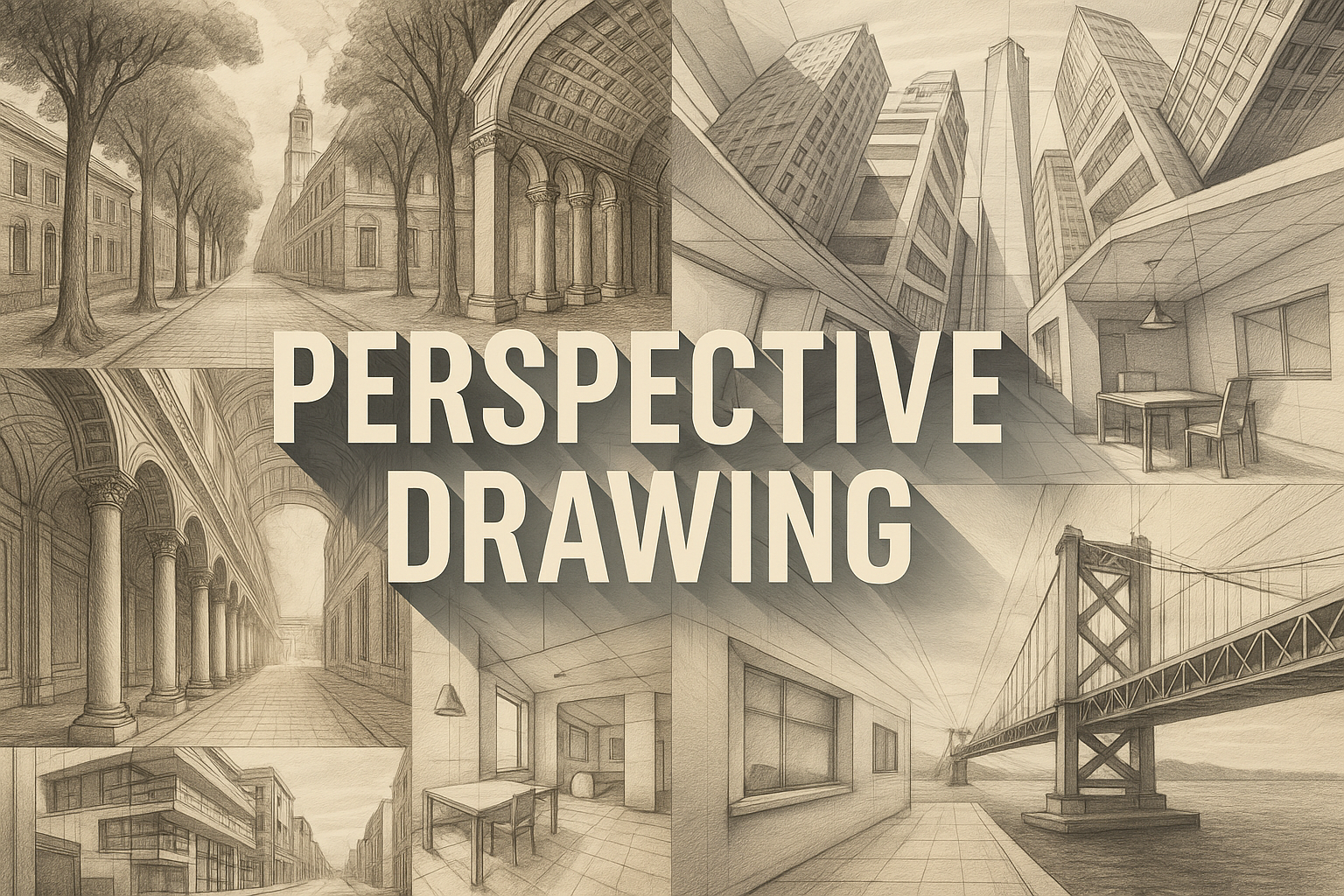
Perspective Drawing
The art style Perspective Drawing is characterized by its use of perspective to create the illusion of depth. This is done by drawing objects in a way that makes them appear smaller the further away they are from the viewer. This can be done by using a vanishing point, or by drawing objects at different sizes.
AOI thinking about Perspective Drawing [+_~]-/
Overview and quick facts
Perspective drawing is a type of drawing that is used to create the illusion of depth on a two-dimensional surface. This is done by using a variety of techniques, such as converging lines, foreshortening, and atmospheric perspective.
Can understand it also, as:
One-point perspective, two-point perspective, three-point perspective, isometric projection, oblique projection
Categorize it as:
Impressionism, Modernism
Detailed description
In the Renaissance, artists began to use a technique called perspective drawing to create the illusion of depth on a flat surface. Perspective drawing uses the principles of geometry to create the illusion of depth. The most important principle of perspective drawing is the law of perspective, which says that objects appear smaller the farther away they are from the viewer. Artists use perspective drawing to create the illusion of three-dimensional space on a two-dimensional surface. The most important tool for perspective drawing is the vanishing point. The vanishing point is a point on the horizon line where parallel lines converge. Famous artists who used perspective drawing include Leonardo da Vinci, Michelangelo, and Raphael. Some famous paintings that use perspective drawing include The Last Supper by Leonardo da Vinci and The Sistine Chapel by Michelangelo.
Archive notes — claims to verify
1. Perspective drawing is a type of drawing that shows objects in a three-dimensional (3D) space.
2. Perspective drawing can be used to create both realistic and abstract drawings.
3. The most common type of perspective drawing is one-point perspective, which uses a single vanishing point to create the illusion of depth.
4. Two-point perspective and three-point perspective are also common types of perspective drawing.
5. Perspective drawing can be used for both scientific and artistic purposes.
6. Artists often use perspective drawing to create the illusion of depth in their drawings.
7. Perspective drawing can also be used for architectural drawings and plans.
8. The term perspective comes from the Latin word perspectiva, which means view.
9. The word perspective was first used in the 15th century by the Italian artist and architect Filippo Brunelleschi.
10. Brunelleschi is credited with inventing the one-point perspective drawing system.
11. The principles of perspective drawing were later codified by the Italian artist and architect Piero della Francesca in his treatise On Perspective (1470).
12. Perspective drawing became increasingly popular in the 16th and 17th centuries as artists began to explore the possibilities of creating realistic illusions of depth on flat surfaces.
13. The English artist William Hogarth was one of the first artists to use perspective drawing for satirical purposes.
14. In the 18th century, the French artist Jacques-Louis David popularized the use of perspective drawing in history paintings.
15. In the 19th century, the English artist J.M.W. Turner was one of the first artists to experiment with the use of color in perspective drawings.
16. In the 20th century, the American artist Charles Eames popularized the use of perspective drawing in product design.
17. Today, perspective drawing is used by artists, architects, and designers to create both realistic and abstract drawings.
18. Perspective drawing can be used to create the illusion of depth, movement, and space.
19. Perspective drawing can be used to create both two-dimensional (2D) and three-dimensional (3D) drawings.
20. Perspective drawing is a type of drawing that can be used to create both realistic and abstract drawings.
Artists and works: references to check
(be aware, can be highly speculative)
Artists (be aware, speculation possible):
1. Albrecht Dürer (1471-1528) 2. Leonardo da Vinci (1452-1519) 3. Jan van Eyck (1390-1441) 4. Pieter Bruegel the Elder (1525-1569) 5. Hieronymus Bosch (1450-1516) 6. Sandro Botticelli (1445-1510) 7. Raphael (1483-1520) 8. Michelangelo (1475-1564) 9. Lucas Cranach the Elder (1472-1553) 10. Titian (1488-1576) 11. Rembrandt (1606-1669) 12. Jusepe de Ribera (1591-1652) 13. Diego Velázquez (1599-1660) 14. John Singleton Copley (1738-1815) 15. Benjamin West (1738-1820) 16. Jacques-Louis David (1748-1825) 17. Jean-Auguste-Dominique Ingres (1780-1867) 18. Eugène Delacroix (1798-1863) 19. Gustave Courbet (1819-1877) 20. Edouard Manet (1832-1883) 21. Claude Monet (1840-1926) 22. Pierre-Auguste Renoir (1841-1919) 23. Paul Cézanne (1839-1906) 24. Georges Seurat (1859-1891) 25. Paul Gauguin (1848-1903) 26. Vincent van Gogh (1853-1890) 27. Henri de Toulouse-Lautrec (1864-1901) 28. Paul Signac (1863-1935) 29. Georges Braque (1882-1963) 30. Pablo Picasso (1881-1973)
Artworks (be aware, speculation possible)
1. The Ambassadors, 1533, Hans Holbein the Younger 2. The Last Supper, 1495-1498, Leonardo da Vinci 3. The Hay Wagon, 1788, Jean-Baptiste-Camille Corot 4. View of Toledo, 1597, El Greco 5. The Arnolfini Portrait, 1434, Jan van Eyck 6. The Madonna of the Pomegranate, 1487, Sandro Botticelli 7. The Birth of Venus, 1486, Sandro Botticelli 8. The Annunciation, 1475-1480, Leonardo da Vinci 9. The Virgin and Child with Saint Anne, 1503, Leonardo da Vinci 10. The Mona Lisa, 1503-1506, Leonardo da Vinci 11. The Baptism of Christ, 1472-1475, Leonardo da Vinci 12. The Last Judgment, 1537-1541, Michelangelo 13. The Sistine Chapel Ceiling, 1508-1512, Michelangelo 14. The Sistine Chapel Frescoes, 1512-1541, Michelangelo 15. The School of Athens, 1510-1511, Raphael 16. The Transfiguration, 1516-1520, Raphael 17. The Wedding Feast at Cana, 1563, Paolo Veronese 18. The Battle of San Romano, 1438-1440, Paolo Uccello 19. The Hunt in the Forest, 1560s, Paolo Veronese 20. The Triumph of Venice, 1585-1588, Paolo Veronese 21. The Four Seasons, 1565-1568, Giuseppe Arcimboldo 22. The Night Watch, 1642, Rembrandt 23. The Milkmaid, 1658, Johannes Vermeer 24. The Girl with the Pearl Earring, 1665, Johannes Vermeer 25. The Hay Wagon, 1788, Jean-Baptiste-Camille Corot 26. View of the Sea at Le Havre, 1826, Eugène Delacroix 27. Liberty Leading the People, 1830, Eugène Delacroix 28. The Raft of the Medusa, 1819, Théodore Géricault 29. The Third of May 1808, 1814, Francisco Goya 30. The Colossus of Rhodes, c. 280 BC
Epoch
The art style Perspective Drawing emerged in the early Renaissance period in the 15th century.
Creative tools and further exploration
Search results are starting points for exploration, not evidence for the historical claims or attributions in this legacy entry.