
Artistic practice · Bodies, actions, time and participation
Explore performance art through action, duration, audience participation and documentation, with sourced examples, original concept visuals and practical prompts.
A visual introduction
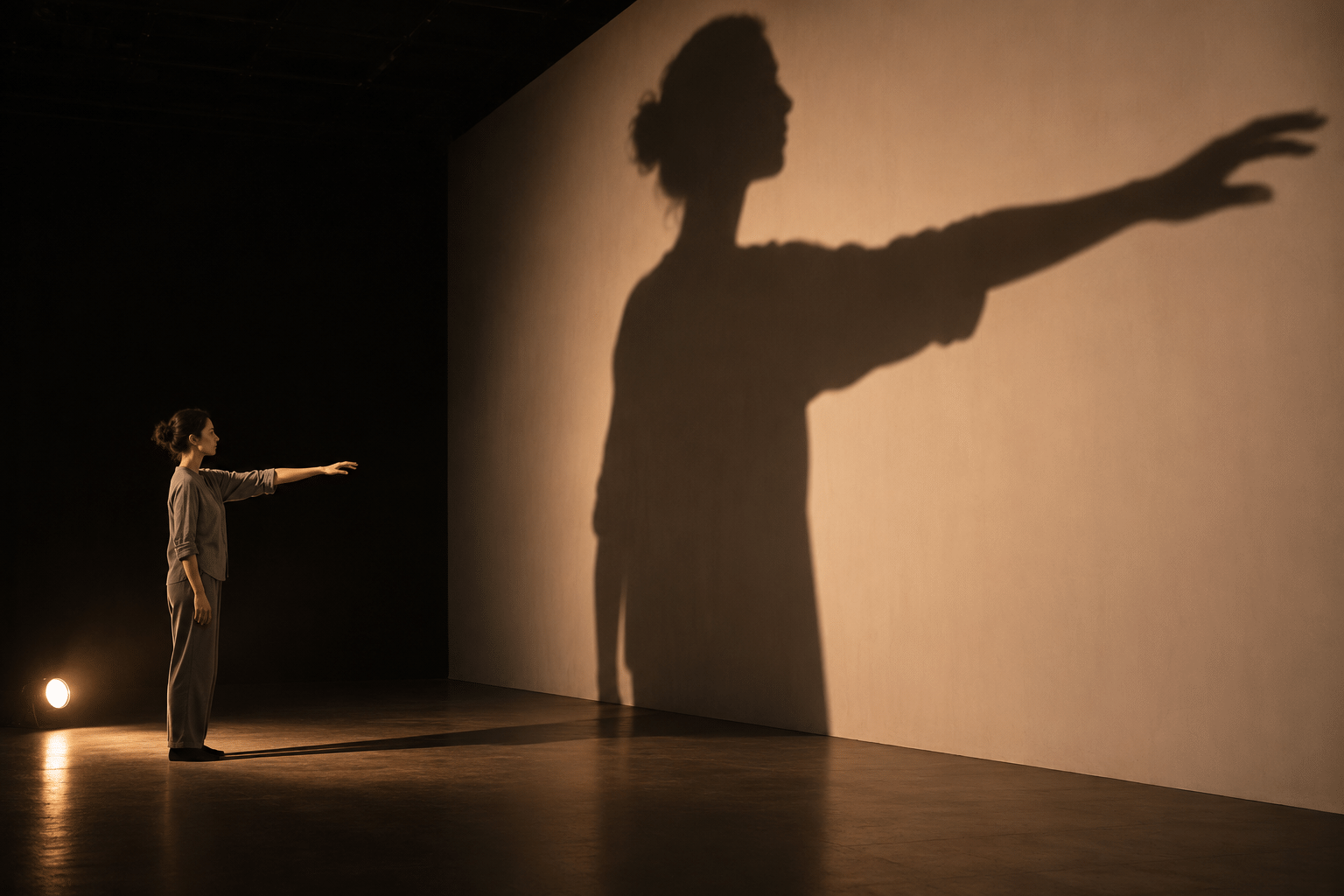
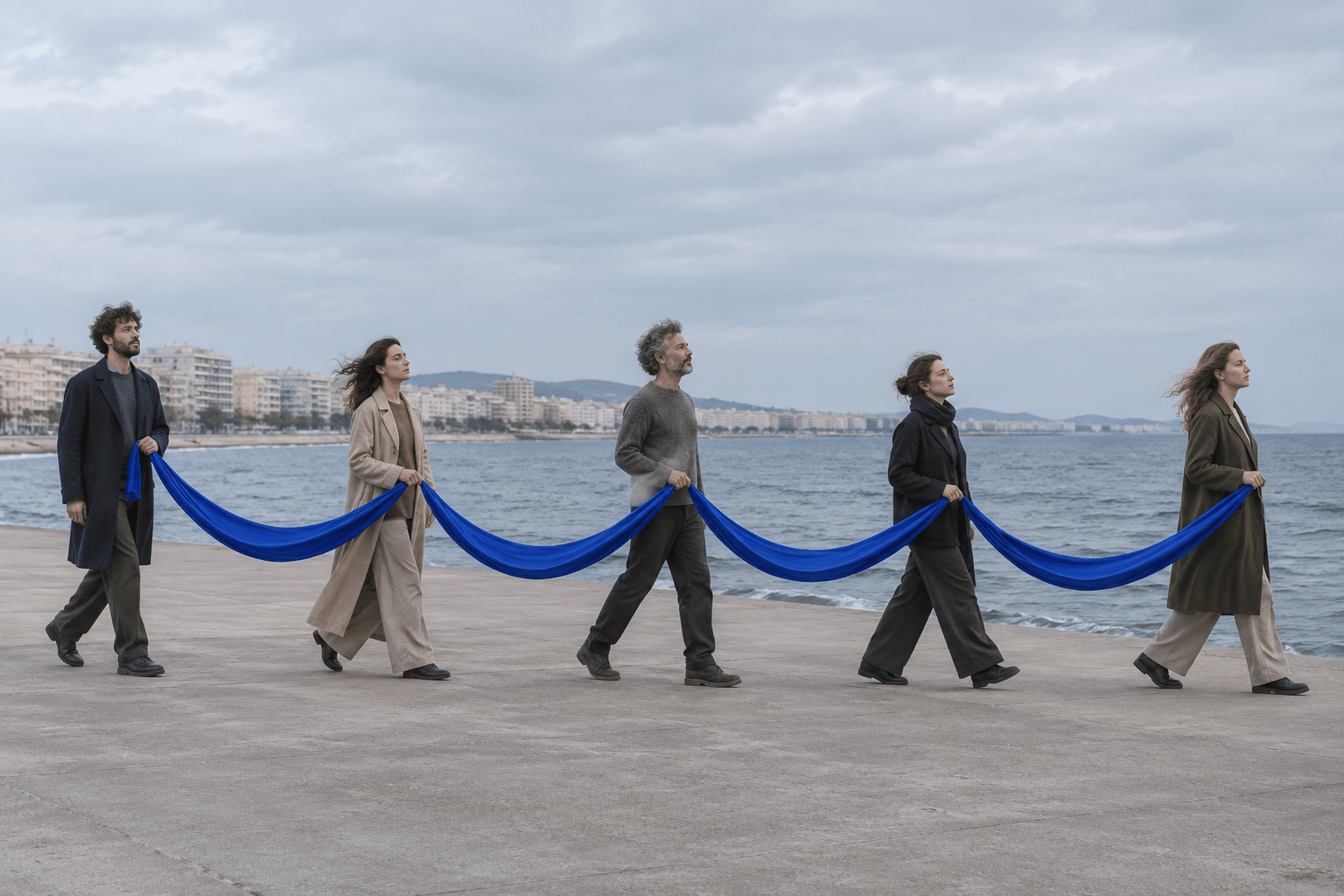
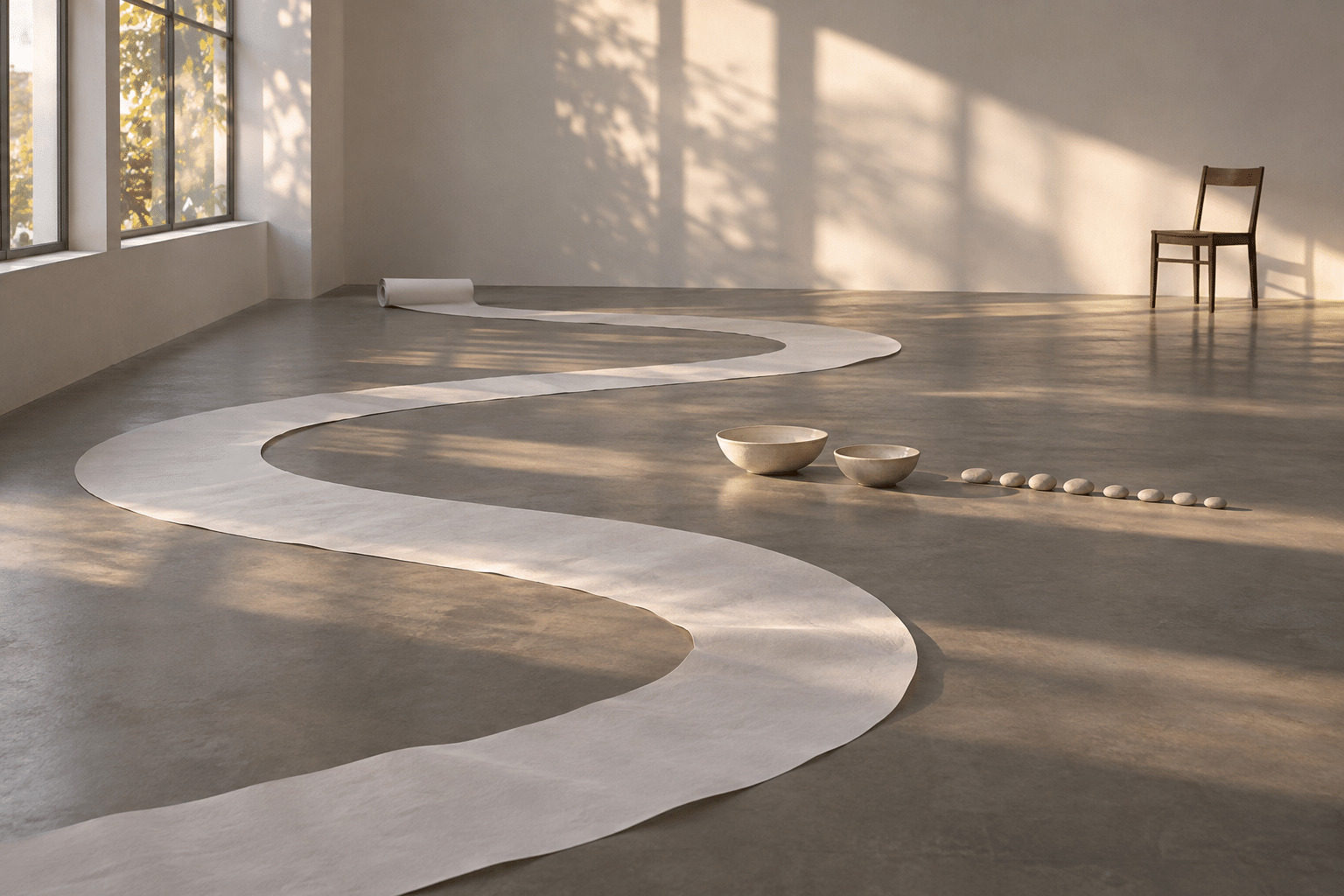
Seven newly generated concept images explore action, repetition, participation, shadow, collective movement and aftermath. They are imagined planning illustrations, not photographs documenting real performances or works by the named historical artists.
Select an image for a closer look. Use the thumbnails, arrow keys or a swipe to compare examples. Zoom in to inspect details, or share the image that inspires you.
Creative toolbox · take this style further
Choose an input and a destination. Search sends your words to the chosen site; Copy & open puts them on your clipboard to paste there.
Create with AI
Turn your chosen input into an image prompt or a new creative direction.
ChatGPT
Copy your input and paste it into a ChatGPT conversation or image request.
Copy & open ChatGPT (new tab)Claude · Anthropic
Develop an image prompt or explore the style in a new Claude conversation.
Copy & open Claude · Anthropic (new tab)Midjourney
Paste your input into the Imagine bar on the Create page.
Copy & open Midjourney (new tab)Adobe Firefly
Copy your input, open Firefly, and paste it into the prompt field.
Copy & open Adobe Firefly (new tab)Leonardo.Ai
Copy your input, open Leonardo, and paste it into the generation field.
Copy & open Leonardo.Ai (new tab)Image search
Find visual references. Short, concrete keywords usually work best.
Lexica
Search AI images and prompts using your selected input.
Search with this input Lexica (new tab)Pexels
Search the photo and video library. Short keywords often work best.
Search with this input Pexels (new tab)Pixabay
Search photos, illustrations and other images.
Search with this input Pixabay (new tab)Unsplash
Search photographs using the style name or your own keywords.
Search with this input Unsplash (new tab)Wikimedia Commons
Search photographs, artworks and historical images. Check each file for its source and reuse terms.
Search with this input Wikimedia Commons (new tab)Art & research
Explore artists, collections and the ideas behind a style.
Wikipedia
Search for background reading. A style may not have its own article.
Search with this input Wikipedia (new tab)WikiArt
Copy your input into WikiArt’s search to explore artists and artworks.
Copy & open WikiArt (new tab)Europeana
Paste your keywords into the search to explore European museum, library and archive collections.
Copy & open Europeana (new tab)Inspiration
Discover portfolios and visual ideas from creative communities.
Instagram hashtags
Search a hashtag made from your input: spaces and punctuation are removed. Instagram may require sign-in.
Search with this input Instagram hashtags (new tab)ArtStation
Paste your input into artwork search for concept art, environments, characters and visual development.
Copy & open ArtStation (new tab)Behance
Paste your input into project search for illustration, design and visual storytelling.
Copy & open Behance (new tab)A closer look
Look for a relationship unfolding through time: a repeated gesture, a changing arrangement, an encounter or a trace left by an action. No single costume, palette or stage design defines performance art.
An artwork can be an action
Performance art uses actions, gestures, bodies and their unfolding in time as artistic material. It may involve one person or many, a precise set of instructions or room for improvisation, a gallery or another setting. The central question is what the action does and how it is experienced, not simply how a performer looks.
A photograph of a dancer, singer or actor is not automatically evidence of performance art. These practices can overlap, but a theatrical appearance alone does not establish the artistic framework. Equally, a quiet action with ordinary objects can be a performance artwork without costumes, dramatic lighting or spectacle.
Instructions and participation: Yoko Ono
MoMA’s account of Yoko Ono’s Cut Piece identifies its first presentation in Kyoto in 1964 and explains its relationship to a written score. Audience members were invited to approach the seated artist and cut small pieces of her clothing, with the artist deciding when to end the performance. The audience’s choices became part of the work rather than a response delivered only afterward.
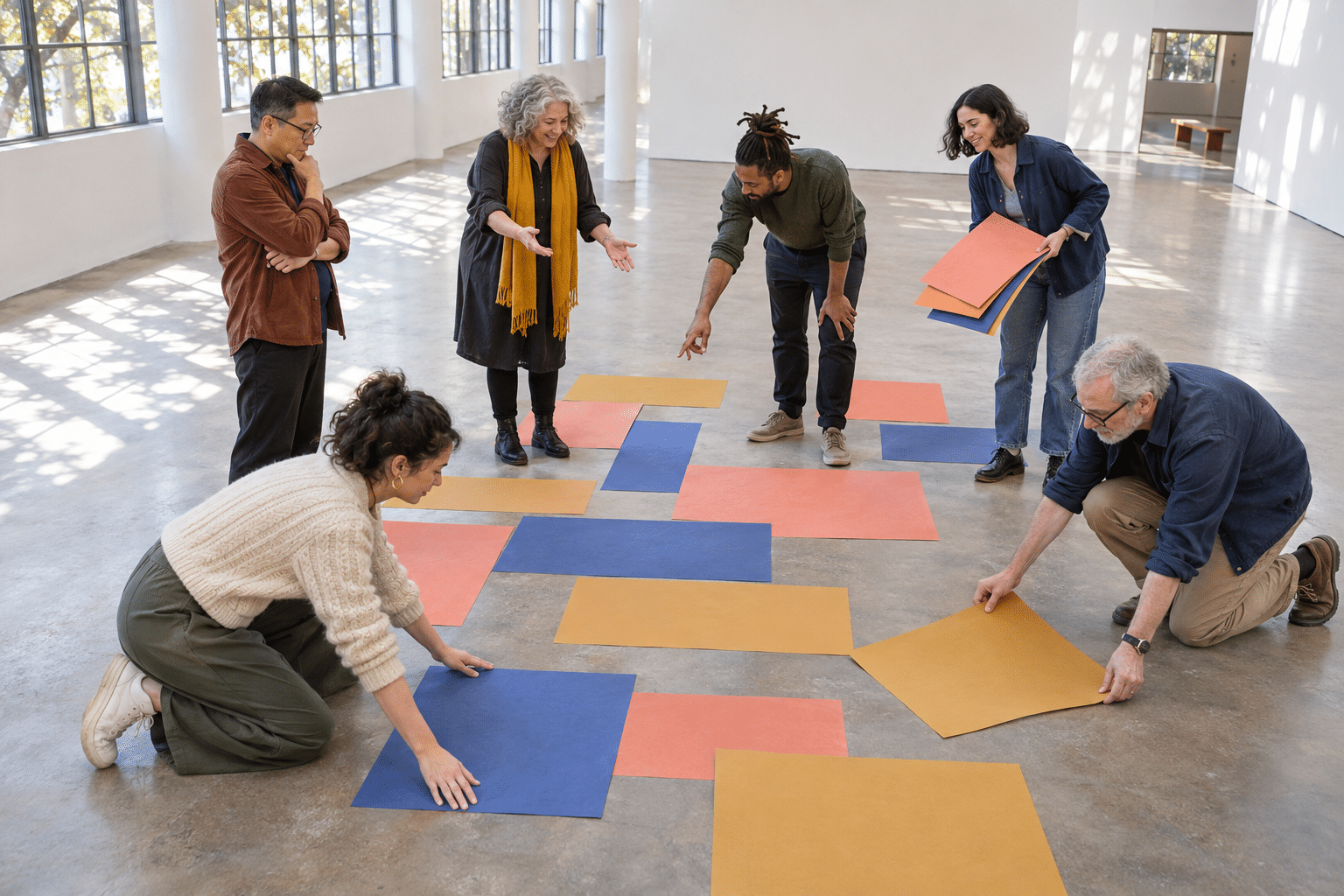
The example makes the relation between instruction, agency and vulnerability concrete. It is a historical work to study in context, not a template that must be copied to make performance art. The new participatory paper arrangement below uses a different, deliberately ordinary activity to explore how individual decisions can change a shared situation.
Duration and attention: Marina Abramović
For The Artist Is Present at MoMA in 2010, Marina Abramović sat silently as visitors took turns sitting opposite her and meeting her gaze. MoMA describes duration and the relation between artist and audience as central to the work. Its visual setup was spare, while the experience depended on time and encounter.
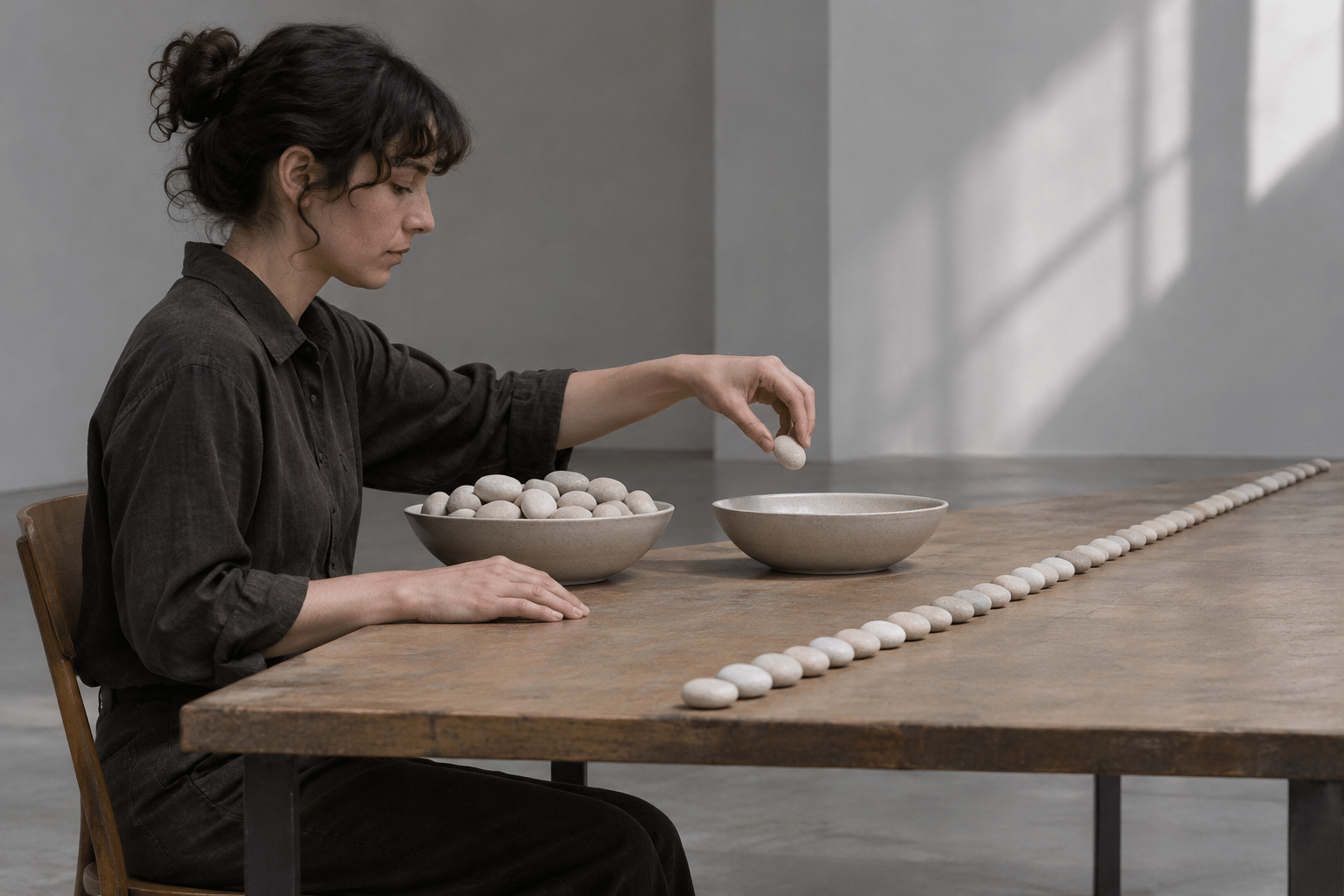
A still photograph can show seating and bodies, but it cannot reproduce the full duration of waiting or being observed. When studying this work, distinguish the live event from a photograph, account or later interpretation. The fictional stone-moving study in this gallery explores repetition; it is not a reconstruction of Abramović’s performance.
Write a score that can actually be understood
A score is a set of instructions or conditions for an action. It can specify materials, participants, a starting point, a stopping condition and what remains open. It need not explain every meaning in advance. A clear rule can generate different experiences when carried out by different people or in different spaces.
An original exercise might ask a participant to move one stone at a time between two bowls, pausing whenever a sound is heard in the room. Another might invite each person to place one coloured sheet in relation to the previous sheet. Decide what a participant can choose, how to decline, and when the action ends. Those decisions are part of the work’s structure, not merely administrative details.
The room and the viewer are active conditions
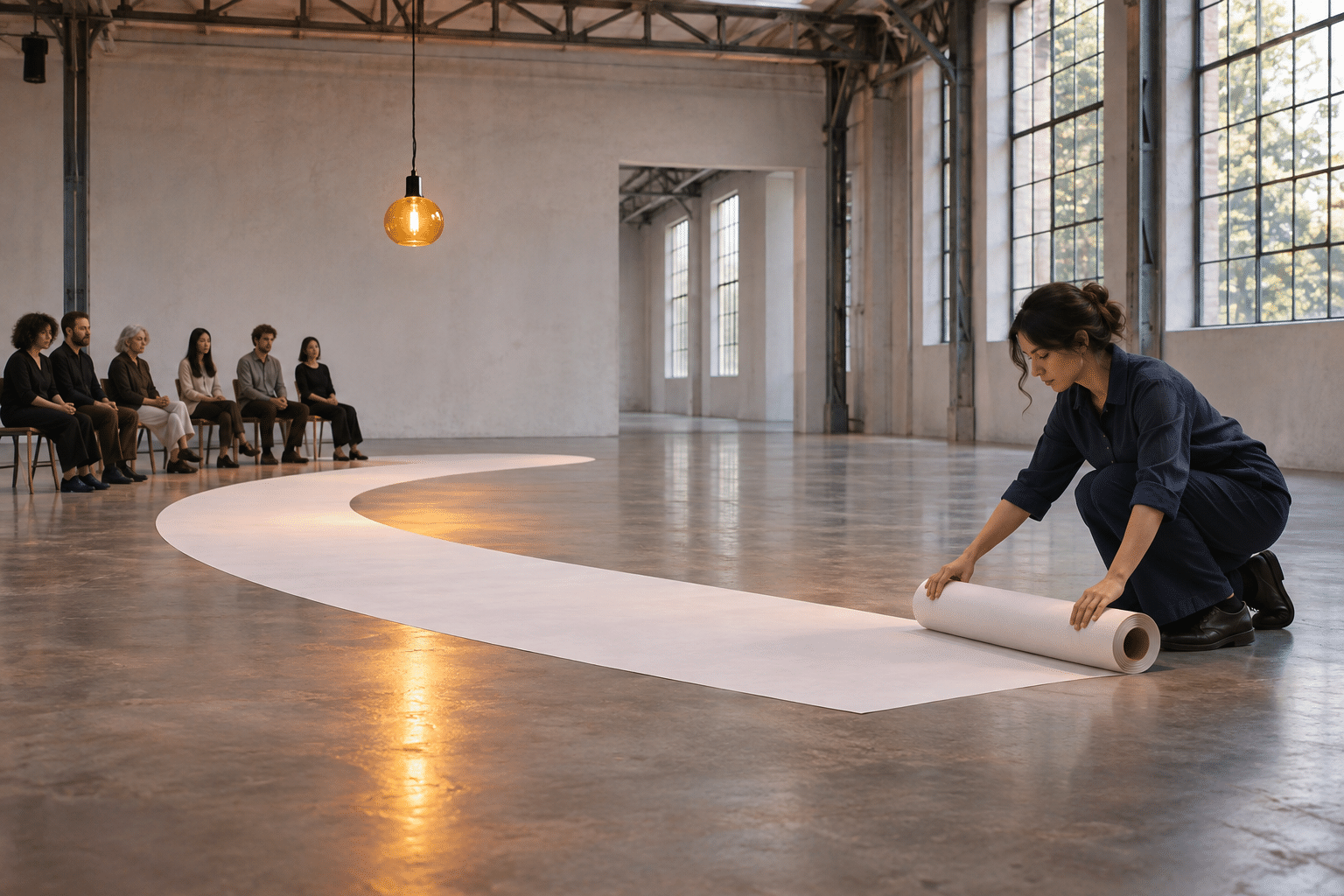
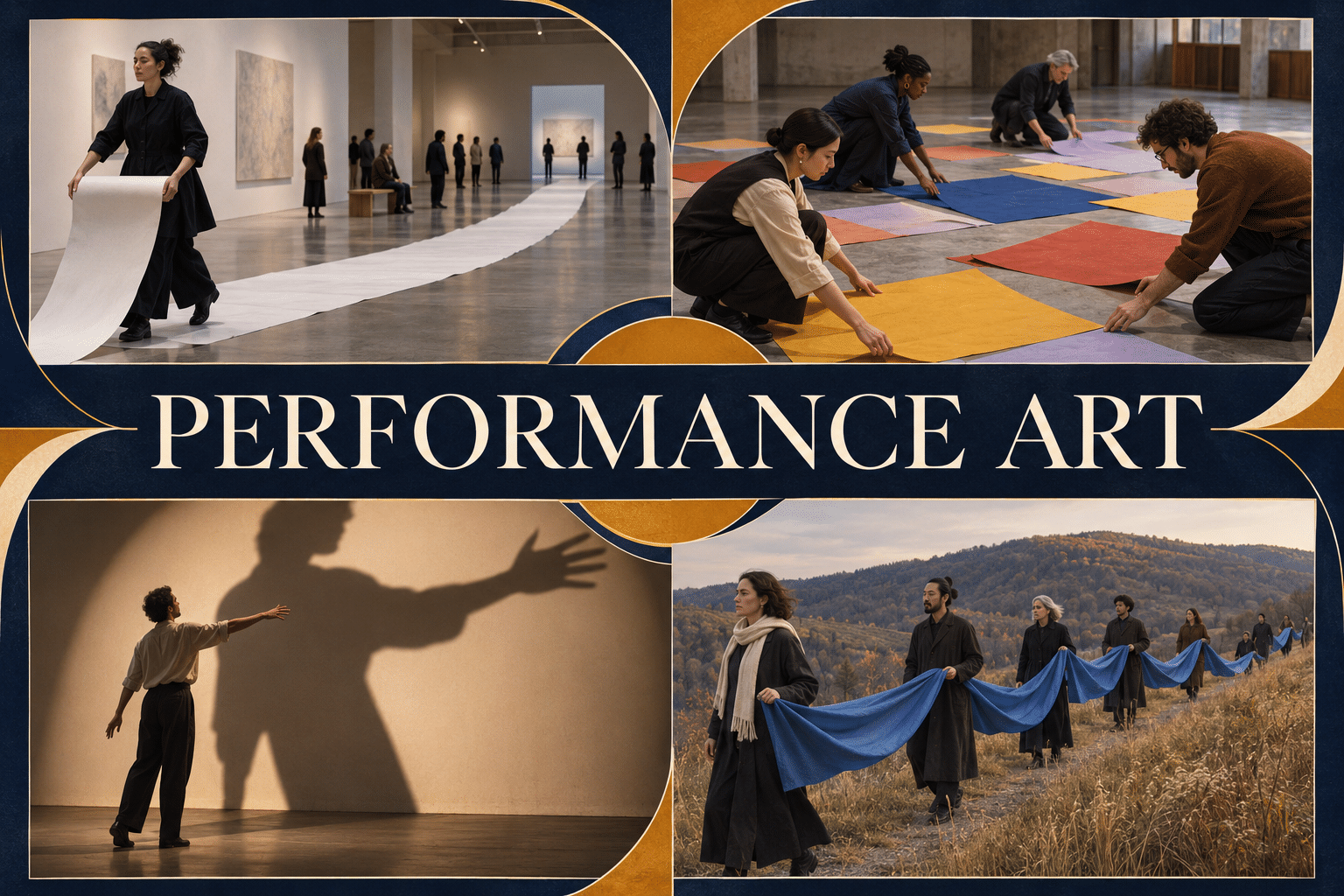
The distance between a performer and an audience, the direction of light, an entrance and a shared floor can shape attention. The new paper-path banner places a simple action across a large quiet room. Its curve connects the performer’s immediate task with spectators at a distance. The material is a shaped paper strip in an imagined scene, not proof of a practical construction method.
The shadow study makes a small bodily gesture visually large. The outdoor cloth study instead links several people through a continuous material and a common pace. These images suggest different questions about scale, coordination and presence. They do not prove that an event happened or that its participants experienced a particular emotion.
Documentation is another layer
Photographs, recordings, written scores, objects and first-person accounts can preserve aspects of performance. Each selects something: a camera frames one viewpoint, a short clip edits duration, and an account interprets what occurred. A performance does not necessarily vanish without any trace, nor is its documentation identical to attending it.
The final gallery image shows a fictional aftermath: paper, bowls, stones and an empty chair. It helps distinguish the objects left behind from the preceding action. Without context, the same arrangement might be read as an installation. A useful record explains the action, date, participants and conditions instead of asking a still image to establish all of them.
How to use AI in the planning stage
AI images can help compare spatial arrangements, visual emphasis, audience distance and possible materials before a performance is developed. They can also produce speculative illustrations for an explanatory article. They cannot supply a real event’s provenance, a performer’s consent or the lived duration of an encounter.
Every new image here is therefore labelled as a concept visualization of an imagined performance. The prompts describe visible situations; the actual performance would require decisions about action, timing, participation and documentation. Review the visuals for coherent bodies and objects, then assess the proposed action separately. An impressive picture can still represent an underdeveloped idea.
Develop beyond the dramatic image
Start with a question: what changes when a gesture repeats, when an audience can intervene, or when an object moves from private to shared use? Choose an action that makes that question perceptible. Avoid adding theatrical props merely because the first sketch looks too plain.
Consider access, voluntary participation, space and a clear ending in proportion to the proposal. A quiet work need not test endurance or expose anyone to harm to be meaningful. Evaluate the relation between idea and action, and be specific about what a viewer can actually observe rather than claiming a universal emotional effect.
Positive review — AOI editorial perspective
Performance art can make time, attention and participation tangible. A simple action may expose relationships that a static object leaves implicit. The concept images here vary the situation through repetition, collaboration, projected scale and shared movement, helping readers compare how a work might unfold rather than treating performance as a costume style.
Negative review — AOI editorial perspective
A dramatic photograph can overshadow a weak action, while vague instructions can leave participants unsure what is being asked of them. Duration by itself does not guarantee depth, and discomfort is not a substitute for an idea. Clarify the question, the participant’s choices and the stopping condition before adding spectacle.
Neutral review — AOI editorial perspective
Performance art encompasses diverse practices and overlaps with other forms without being identical to theatre, dance or installation. The images on this page are planning illustrations, while the linked museum accounts concern documented works. Evaluating an actual performance requires attention to its actions, conditions and duration as well as its visual record.
A small poetic detour
Original words from the AOI studio.
Poetry
A stone is moved. The room stays still.
Another waits beside the bowl.
A strip of paper finds a bend;
the smallest action takes its toll
of measured seconds, not of pain.
A stranger chooses where to stand.
The cloth between us lifts and falls;
we learn its weight from hand to hand.
When all have left, the light remains.
The chair records no single view.
The objects keep their quiet shapes;
the time belonged to me and you.
The prompt workshop
Original creative exercises. These prompts create new illustrations, not documentary evidence.
Start here · A repeated action
Create a concept visualization for an imagined performance: a fully clothed adult moves one small stone between two bowls at a plain table. Show a clear gesture and a line of stones suggesting repetition, with quiet natural light. No text, no real artist likeness; label the result as a fictional planning image.
Richer scene · Shared decisions
Visualize an imagined participatory performance in a spacious gallery. Several adults place coloured paper sheets into an evolving arrangement while others observe. Keep gestures clear and routes open; the action and choices matter more than a finished pattern. No text or logos; not documentary evidence.
Experiment · Before and after
Create a concept image of an empty room after an imagined performance: a curved paper path, two bowls, a line of stones and one chair. Use light and distance to suggest absence. Explain separately what action could have produced the arrangement; do not present the image as a photograph of a real event.
A smile from the studio
Jokes
The performance score said, “Pause here.” The audience gave the comma a standing ovation.