
Graphite and watercolour technique
Pencil can establish structure while watercolour carries light and atmosphere. The interest lies in how a dry line and a fluid wash share the same sheet.
A visual introduction
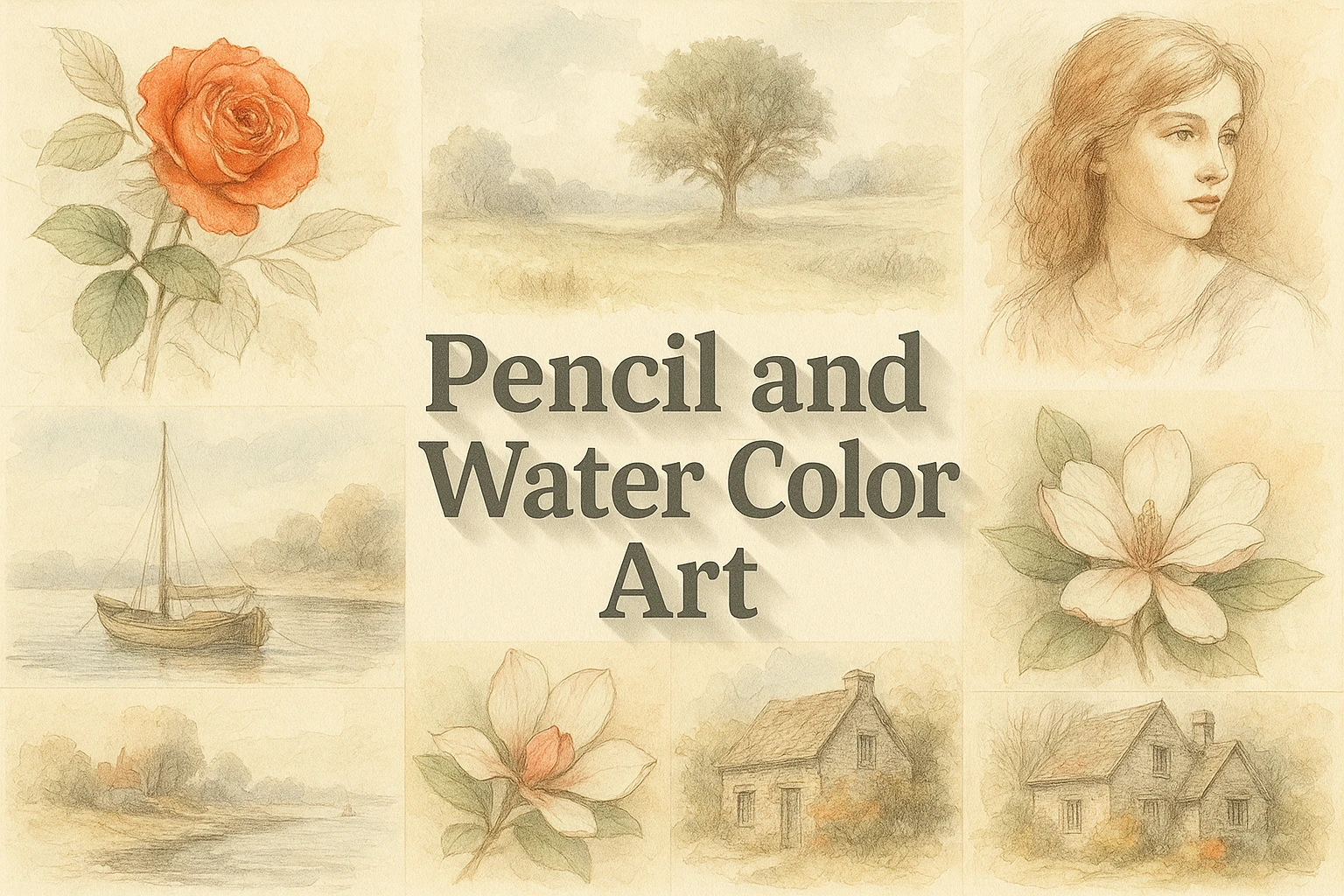
Compare the retained archive studies. The titled collage is modern editorial illustration; its panels are not reproductions of documented works.
Select an image for a closer look. Use the thumbnails, arrow keys or a swipe to compare examples. Zoom in to inspect details, or share the image that inspires you.
Creative toolbox · take this style further
Choose an input and a destination. Search sends your words to the chosen site; Copy & open puts them on your clipboard to paste there.
Create with AI
Turn your chosen input into an image prompt or a new creative direction.
ChatGPT
Copy your input and paste it into a ChatGPT conversation or image request.
Copy & open ChatGPT (new tab)Claude · Anthropic
Develop an image prompt or explore the style in a new Claude conversation.
Copy & open Claude · Anthropic (new tab)Midjourney
Paste your input into the Imagine bar on the Create page.
Copy & open Midjourney (new tab)Adobe Firefly
Copy your input, open Firefly, and paste it into the prompt field.
Copy & open Adobe Firefly (new tab)Leonardo.Ai
Copy your input, open Leonardo, and paste it into the generation field.
Copy & open Leonardo.Ai (new tab)Image search
Find visual references. Short, concrete keywords usually work best.
Lexica
Search AI images and prompts using your selected input.
Search with this input Lexica (new tab)Pexels
Search the photo and video library. Short keywords often work best.
Search with this input Pexels (new tab)Pixabay
Search photos, illustrations and other images.
Search with this input Pixabay (new tab)Unsplash
Search photographs using the style name or your own keywords.
Search with this input Unsplash (new tab)Wikimedia Commons
Search photographs, artworks and historical images. Check each file for its source and reuse terms.
Search with this input Wikimedia Commons (new tab)Art & research
Explore artists, collections and the ideas behind a style.
Wikipedia
Search for background reading. A style may not have its own article.
Search with this input Wikipedia (new tab)WikiArt
Copy your input into WikiArt’s search to explore artists and artworks.
Copy & open WikiArt (new tab)Europeana
Paste your keywords into the search to explore European museum, library and archive collections.
Copy & open Europeana (new tab)Inspiration
Discover portfolios and visual ideas from creative communities.
Instagram hashtags
Search a hashtag made from your input: spaces and punctuation are removed. Instagram may require sign-in.
Search with this input Instagram hashtags (new tab)ArtStation
Paste your input into artwork search for concept art, environments, characters and visual development.
Copy & open ArtStation (new tab)Behance
Paste your input into project search for illustration, design and visual storytelling.
Copy & open Behance (new tab)A closer look
Visible graphite contours, transparent color, reserved paper, soft wet edges and selective crisp accents.
Two kinds of mark
This is a combination of media rather than a unified movement. A pencil line can locate an edge, record a proportion or remain as a visible texture. A transparent wash can cross that structure, soften it or leave it exposed. The Metropolitan Museum’s account of watercolour includes works made over graphite and explains how the white support contributes to luminosity.
A light underdrawing and a heavily worked pencil passage behave differently. Decide whether the drawing is a guide or a visible partner. Test your chosen materials on spare paper before committing to a finished sheet. Water-soluble pencils will behave differently from ordinary graphite.
Keep some of the paper alive
Begin with a simple subject and a few structural lines. Reserve the lightest areas, place a broad pale wash and let it dry before adding a sharper accent. Wet paper encourages diffuse edges; dry passages can hold a clearer boundary. These changes in edge quality can separate a soft tree canopy from a crisp roof corner without outlining every leaf and tile.
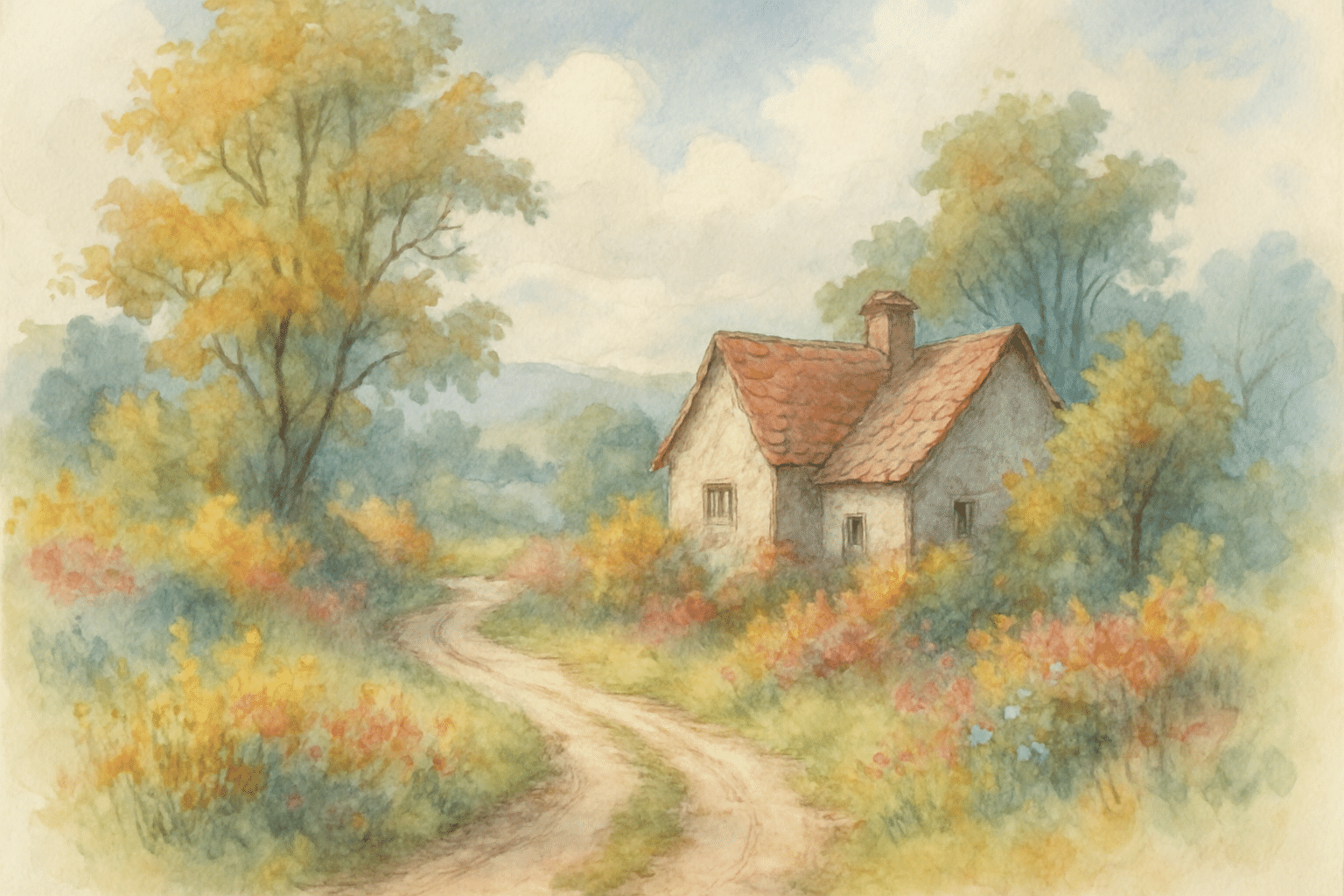
The archive cottage study uses a curving path to lead toward the building, with muted greens and warm roof color. Its softness is useful, but a successful study need not be uniformly pale. Add the darkest marks where they clarify the focal point. If every contour is equally heavy, the wash becomes mere coloring-in; if every line disappears, the pencil has no visible role. Use the pairing deliberately rather than blending both media into an indistinct brown haze.
The prompt workshop
Original creative exercises. These prompts create new illustrations, not documentary evidence.
A line and a wash
Create an original graphite-and-watercolour study of a ceramic cup beside a pear. Keep a few pencil construction lines visible, use transparent yellow-green and blue-grey washes, and reserve white paper for light. No text.
A path toward a cottage
Create an original pencil and watercolour landscape with a small cottage beside a curved path. Keep graphite visible at roof and window edges, soften distant foliage with pale washes, and use one warm roof accent. Textured white paper, no lettering.
Edges as emphasis
Create an original graphite and watercolour botanical study of a single branch. Use crisp pencil detail near one leaf and increasingly loose washes toward the edges. Let some contours remain unfinished; avoid uniform outlines.
Sources and further exploration
The Metropolitan Museum of Art: watercolour materials and techniques