
A researched introduction
Outsider art is a collecting and interpretive category concerned with makers working outside established art-world routes. It is not one visual style, and it cannot be identified by rough drawing alone. The closely related concept Art Brut has a specific history in Jean Dubuffet’s collecting and thinking.
A visual introduction
Open any image to look closer, then browse the examples.
Creative toolbox · take this style further
Choose an input, adjust it, then open a tool. Search links pass your text to the destination. Copy & open copies it for you to paste into the generator; you start generation there.
ChatGPT
Copy your input and paste it into a ChatGPT conversation or image request.
Copy & open ChatGPT (new tab)Claude · Anthropic
Develop an image prompt or explore the style in a new Claude conversation.
Copy & open Claude · Anthropic (new tab)Midjourney
Paste your input into the Imagine bar on the Create page.
Copy & open Midjourney (new tab)Adobe Firefly
Copy your input, open Firefly, and paste it into the prompt field.
Copy & open Adobe Firefly (new tab)Leonardo.Ai
Copy your input, open Leonardo, and paste it into the generation field.
Copy & open Leonardo.Ai (new tab)Lexica
Search AI images and prompts using your selected input.
Search with this input Lexica (new tab)Pexels
Search the photo and video library. Short keywords often work best.
Search with this input Pexels (new tab)Pixabay
Search photos, illustrations and other images.
Search with this input Pixabay (new tab)Unsplash
Search photographs using the style name or your own keywords.
Search with this input Unsplash (new tab)Wikipedia
Search for background reading. A style may not have its own article.
Search with this input Wikipedia (new tab)WikiArt
Copy your input into WikiArt’s search to explore artists and artworks.
Copy & open WikiArt (new tab)Instagram hashtags
Search a hashtag made from your input: spaces and punctuation are removed. Instagram may require sign-in.
Search with this input Instagram hashtags (new tab)A closer look
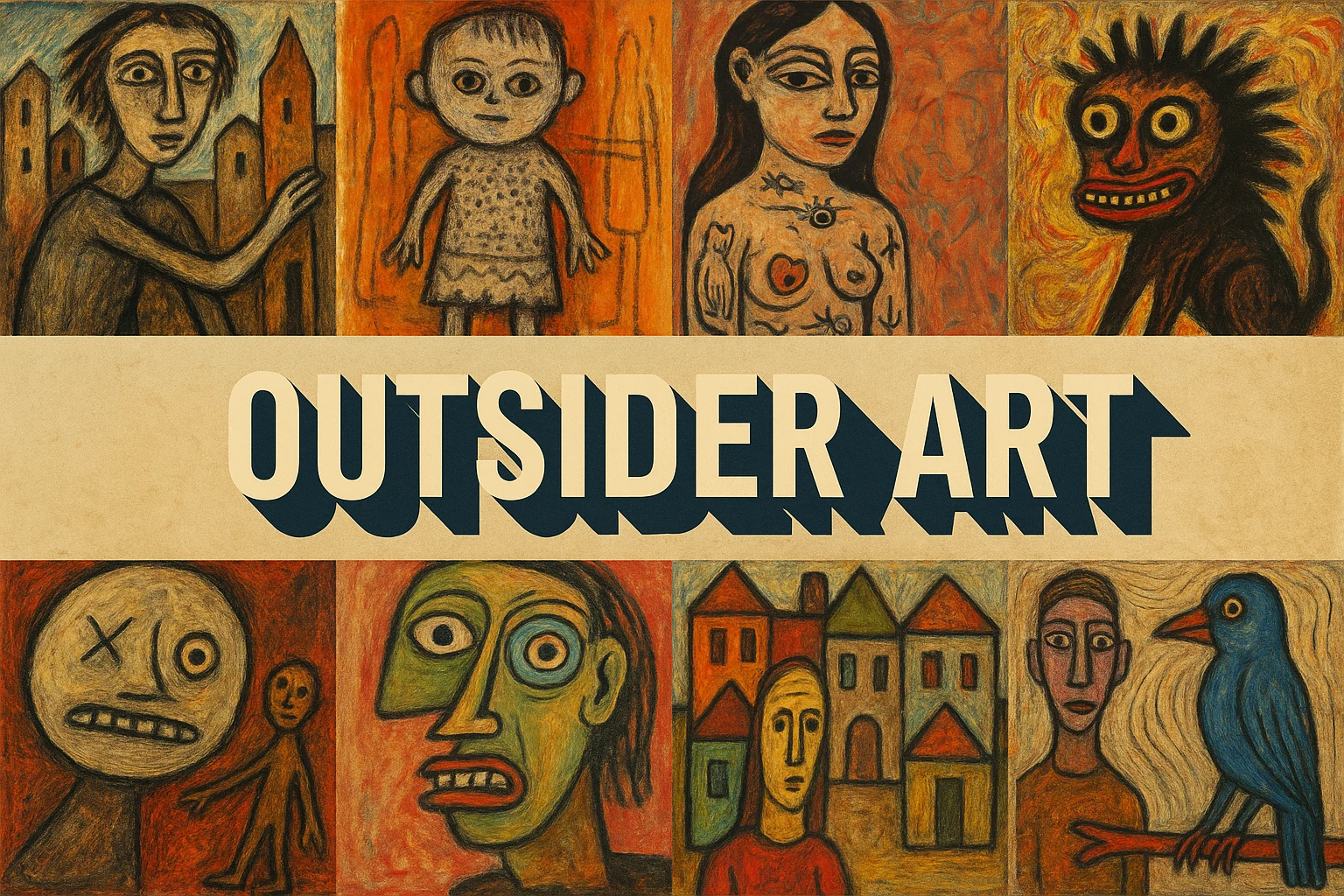
The AOI archive collage groups frontal faces, compressed buildings, a bird and heavily worked surfaces. It can support an exercise in describing line and density. As a synthetic illustration, it cannot demonstrate a maker’s biography, training or relationship to cultural institutions.
Begin with the history of the label
The Collection de l’Art Brut in Lausanne credits Jean Dubuffet with formulating Art Brut and beginning his collection in 1945. Its account explains that he sought work outside prevailing artistic conventions and collected from people in very different social circumstances. That history concerns a collector’s framework as well as the individual makers gathered within it.
The museum’s definition gives social position and distinctive forms of expression a central role. It should be read as a particular account of Art Brut, not as a diagnostic checklist for every object called outsider art. This introduction focuses on that documented connection rather than treating every self-taught artist, folk tradition and unconventional drawing as interchangeable.
Look closely before telling a life story
Describe what is actually present: a figure’s scale relative to a building, a repeated border, a change of material, a dense inscription or an unexpected route through the surface. Those observations are testable. Claims about the maker’s inner life require evidence and may remain unknowable. A crowded page does not establish a mental-health condition.
The collage here uses large eyes and uneven contours, familiar shortcuts in generic outsider-art imagery. Notice how quickly such shortcuts can become a stereotype. Real works require individual attention. A carefully measured structure and a rapidly improvised drawing might both appear within a collection without sharing a process, motivation or life history.
The problem with manufacturing an outsider
An AI model can imitate a rough edge. It cannot acquire a human biography by doing so. Calling a generated image authentic outsider art because it looks untrained confuses appearance with the circumstances that the category often foregrounds. Our illustration is therefore labelled as an AOI interpretation, not attributed to an imagined historical maker.
Avoid prompts that romanticise illness, incarceration or exclusion as aesthetic ingredients. If you want a formal quality, name it directly: uneven charcoal pressure, asymmetrical spacing, a compressed viewpoint, dense repeated marks. That produces a clearer brief while keeping a person’s vulnerability from becoming a decorative adjective.
A better route into the subject
Choose one named maker from a museum collection and read the object record before browsing visually similar pictures. Record the material, dimensions, date or date range, attribution and any uncertainty. Then compare two works by that maker. What changes? What persists? The comparison encourages attention to decisions rather than to a single dramatic biographical explanation.
The important freedom here is the freedom to encounter an individual practice without forcing it into an instantly recognisable look. Let the object complicate the label. A category should help you begin looking; it should not finish the looking on your behalf.
Sources and further exploration
Creative studies to try
Explore these collected prompts as creative interpretations. They are starting points for image-making, not reproductions of historical artworks or evidence about a tradition.
Visual cues: raw sincerity, direct mark-making, deliberate awkwardness
Study 1 — Outsider Art
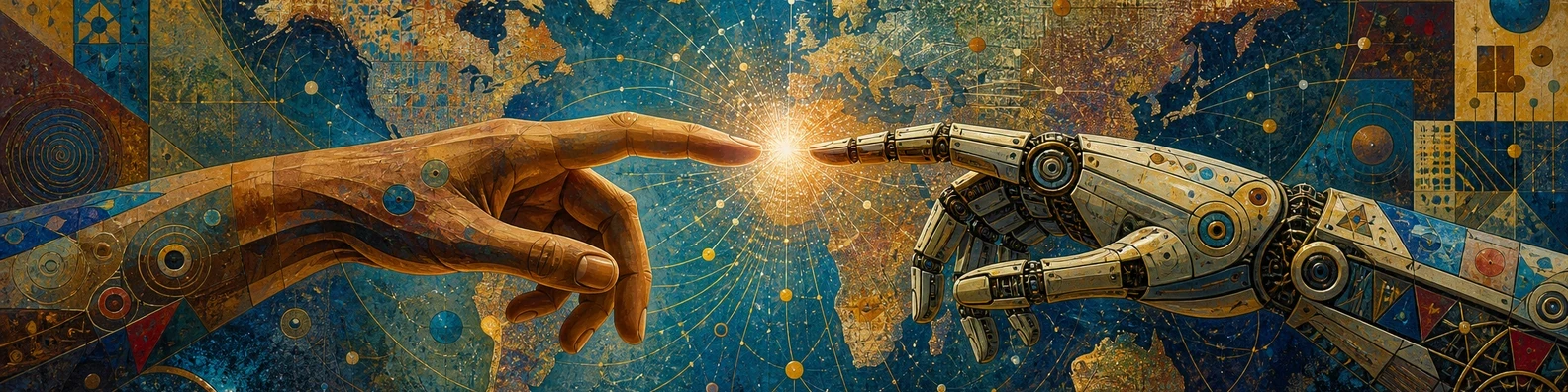
Ultra-wide panoramic banner, a human hand and a sleek robotic hand reaching toward each other, fingertips almost touching, a bright luminous spark of intelligence between them, a subtle world map behind them with global data network lines, symbolizing human-AI collaboration and digital transformation, rendered in Outsider Art style, with refined composition, distinctive materials, elegant lighting, high-detail artistic finish, high quality, high detail, balanced composition, no text, no logo, no watermark, exact aspect ratio 1584:396
Prompt source: 1001 Art Styles. Select the text to copy, then adapt the subject and composition.