
AOI concept · Urban grids, movement and human pauses
Explore Newyorkism as an AOI urban-art concept: architectural grids, transit rhythms and neighbourhood pauses, with original images and clear historical distinctions.
An A⊕I –[-.+] creαt¡ve c⊕ncept, n⊕t αn estαbl¡she∂ h¡st⊕r¡cαl m⊕vement.
A visual introduction
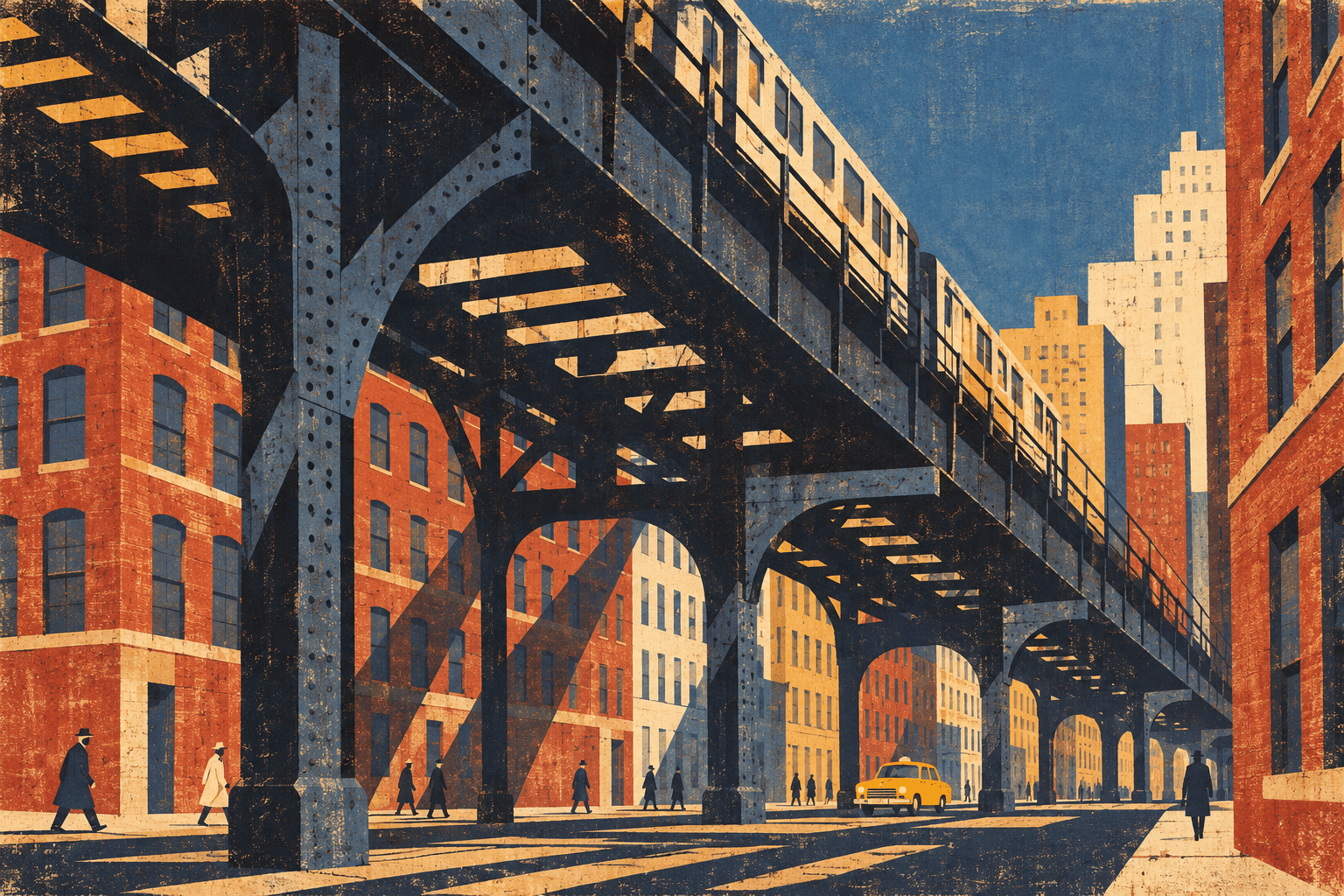
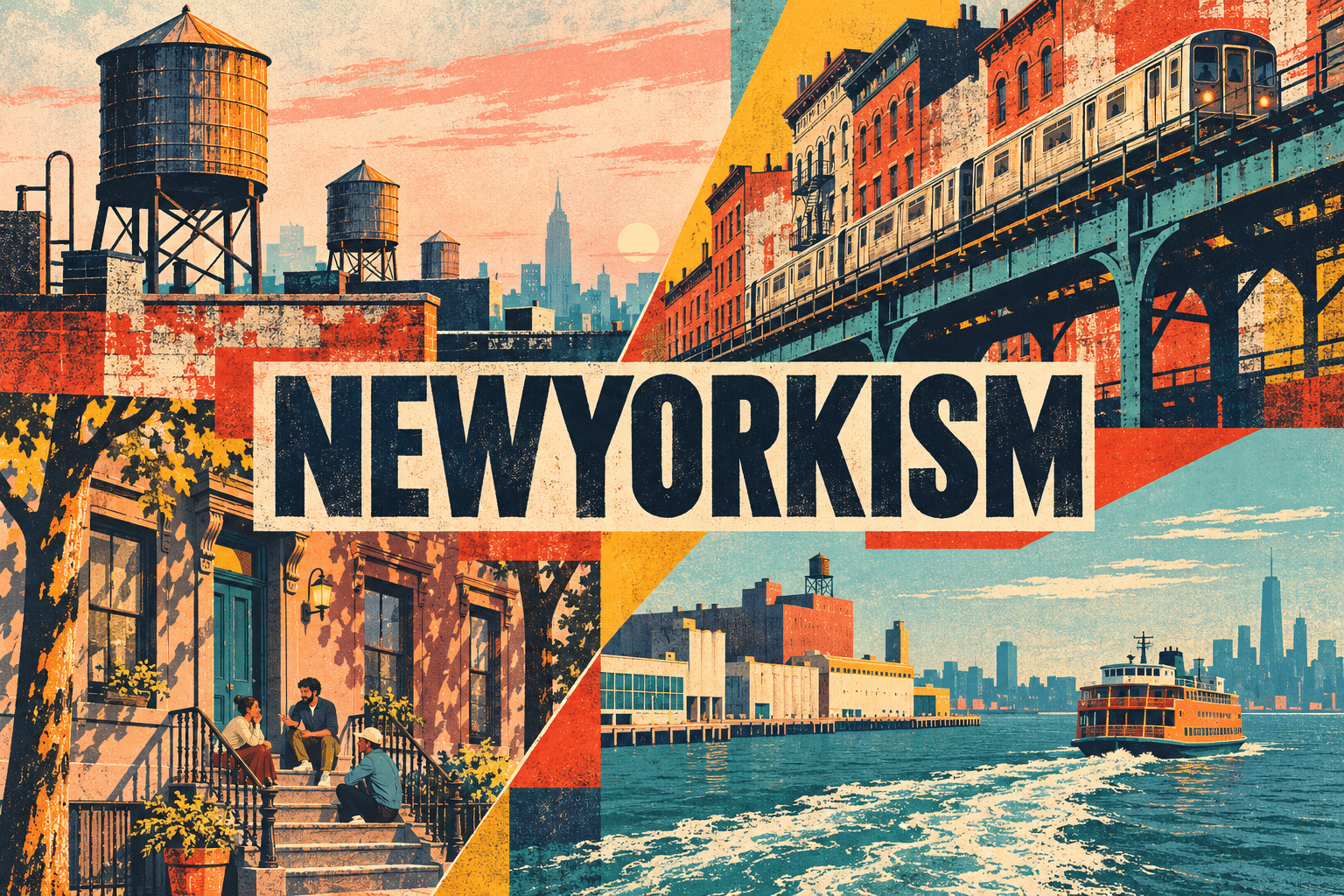
Six new AI-generated assets and one retained cityscape compare structural rhythm at street, rooftop and waterfront scales. The scenes are invented New York-inspired interpretations, not documentary views or historical movement examples.
Select an image for a closer look. Use the thumbnails, arrow keys or a swipe to compare examples. Zoom in to inspect details, or share the image that inspires you.
Creative toolbox · take this style further
Choose an input and a destination. Search sends your words to the chosen site; Copy & open puts them on your clipboard to paste there.
Create with AI
Turn your chosen input into an image prompt or a new creative direction.
ChatGPT
Copy your input and paste it into a ChatGPT conversation or image request.
Copy & open ChatGPT (new tab)Claude · Anthropic
Develop an image prompt or explore the style in a new Claude conversation.
Copy & open Claude · Anthropic (new tab)Midjourney
Paste your input into the Imagine bar on the Create page.
Copy & open Midjourney (new tab)Adobe Firefly
Copy your input, open Firefly, and paste it into the prompt field.
Copy & open Adobe Firefly (new tab)Leonardo.Ai
Copy your input, open Leonardo, and paste it into the generation field.
Copy & open Leonardo.Ai (new tab)Image search
Find visual references. Short, concrete keywords usually work best.
Lexica
Search AI images and prompts using your selected input.
Search with this input Lexica (new tab)Pexels
Search the photo and video library. Short keywords often work best.
Search with this input Pexels (new tab)Pixabay
Search photos, illustrations and other images.
Search with this input Pixabay (new tab)Unsplash
Search photographs using the style name or your own keywords.
Search with this input Unsplash (new tab)Wikimedia Commons
Search photographs, artworks and historical images. Check each file for its source and reuse terms.
Search with this input Wikimedia Commons (new tab)Art & research
Explore artists, collections and the ideas behind a style.
Wikipedia
Search for background reading. A style may not have its own article.
Search with this input Wikipedia (new tab)WikiArt
Copy your input into WikiArt’s search to explore artists and artworks.
Copy & open WikiArt (new tab)Europeana
Paste your keywords into the search to explore European museum, library and archive collections.
Copy & open Europeana (new tab)Inspiration
Discover portfolios and visual ideas from creative communities.
Instagram hashtags
Search a hashtag made from your input: spaces and punctuation are removed. Instagram may require sign-in.
Search with this input Instagram hashtags (new tab)ArtStation
Paste your input into artwork search for concept art, environments, characters and visual development.
Copy & open ArtStation (new tab)Behance
Paste your input into project search for illustration, design and visual storytelling.
Copy & open Behance (new tab)A closer look
Repeated windows and structural bays establish a grid; a railway, shadow or ferry wake interrupts it. Flattened colour planes, worn print-like texture and small human figures connect metropolitan scale with everyday experience.
A creative label with a clear status
On this page, Newyorkism names an AOI interpretation of city rhythm: repeated architectural units interrupted by movement, light and human pauses. It is presented as a creative framework, not an established historical movement. The sources checked do not substantiate the earlier claim that a Pop art branch called Newyorkism was founded in the late 1970s or early 1980s.
This clarification does not claim that AOI invented the word or that nobody has used similar ideas. It defines what the label means in this database. New York provides a reference for density, transit, rooftops, waterfronts and street life; the generated scenes are invented compositions rather than accurate maps or records of particular neighbourhoods.
Keep documented histories distinct
The New York School and Pop art are established terms with their own histories and diverse artists. MoMA maintains separate collection categories for them. Its Pop art selection includes works by Andy Warhol and Roy Lichtenstein; this does not make those artists members of an independently documented movement called Newyorkism.
A city also cannot be represented by one supposedly universal aesthetic. Jacob Lawrence’s Tombstones, dated 1942 by the Whitney, is an opaque-watercolour work showing residents and neighbours outside a Harlem apartment building. Its specific community and life-cycle subject matter offer a richer historical comparison than a generic claim about bright urban colours. Lawrence is cited as a documented reference, not assigned to the AOI concept.
The proposed visual grammar
Begin with a repeating structure: windows, roof levels, stair treads, bridge supports or paving divisions. Give it a clear interval so the eye can recognize an order. Then introduce a competing movement, such as a rising railway diagonal or a curved wake. The tension between repeated units and interruption is the central compositional device.
Flatten selected planes without losing the scene’s readability. Dark steel can become one continuous shape; brick facades can become warm blocks; pedestrians can remain small but distinct. Use a limited palette with one strong accent. Texture should bind these decisions together rather than hide uncertain drawing beneath a layer of artificial wear.
Density needs a place to breathe
A crowded city image does not need equal activity everywhere. Leave an open sky strip, a broad pavement shadow or a stretch of water that lets the dense areas register. The new banner looks beneath an elevated structure, where repeated supports establish scale and a yellow vehicle supplies a small focal accent.
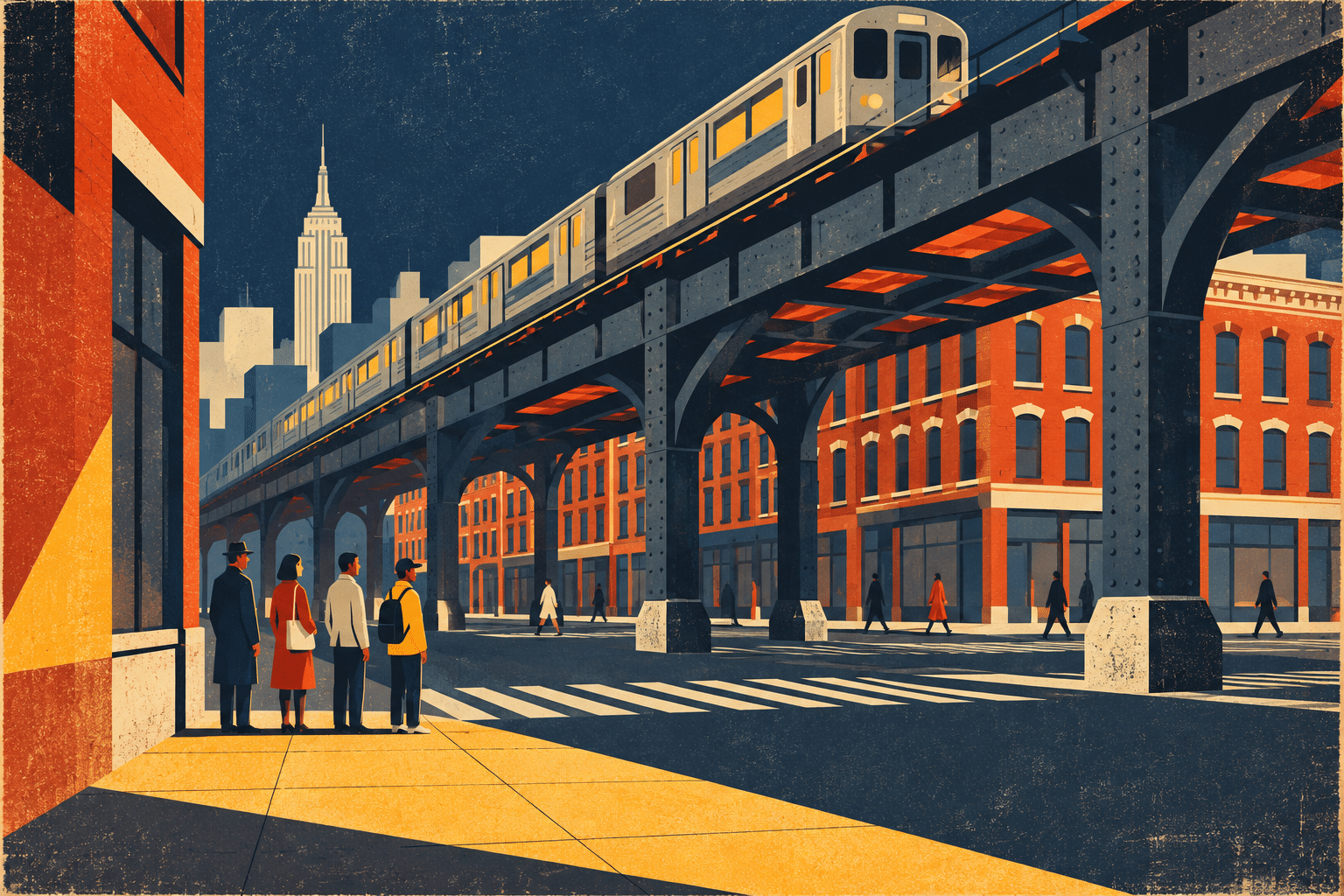
The train example shifts the viewpoint toward the crossing and waiting figures. It uses the same structural vocabulary for a different reading: the city becomes a set of paths and pauses rather than only an architectural spectacle. These are separate compositions, not crops of one image.
Rooftops, stoops and the waterfront
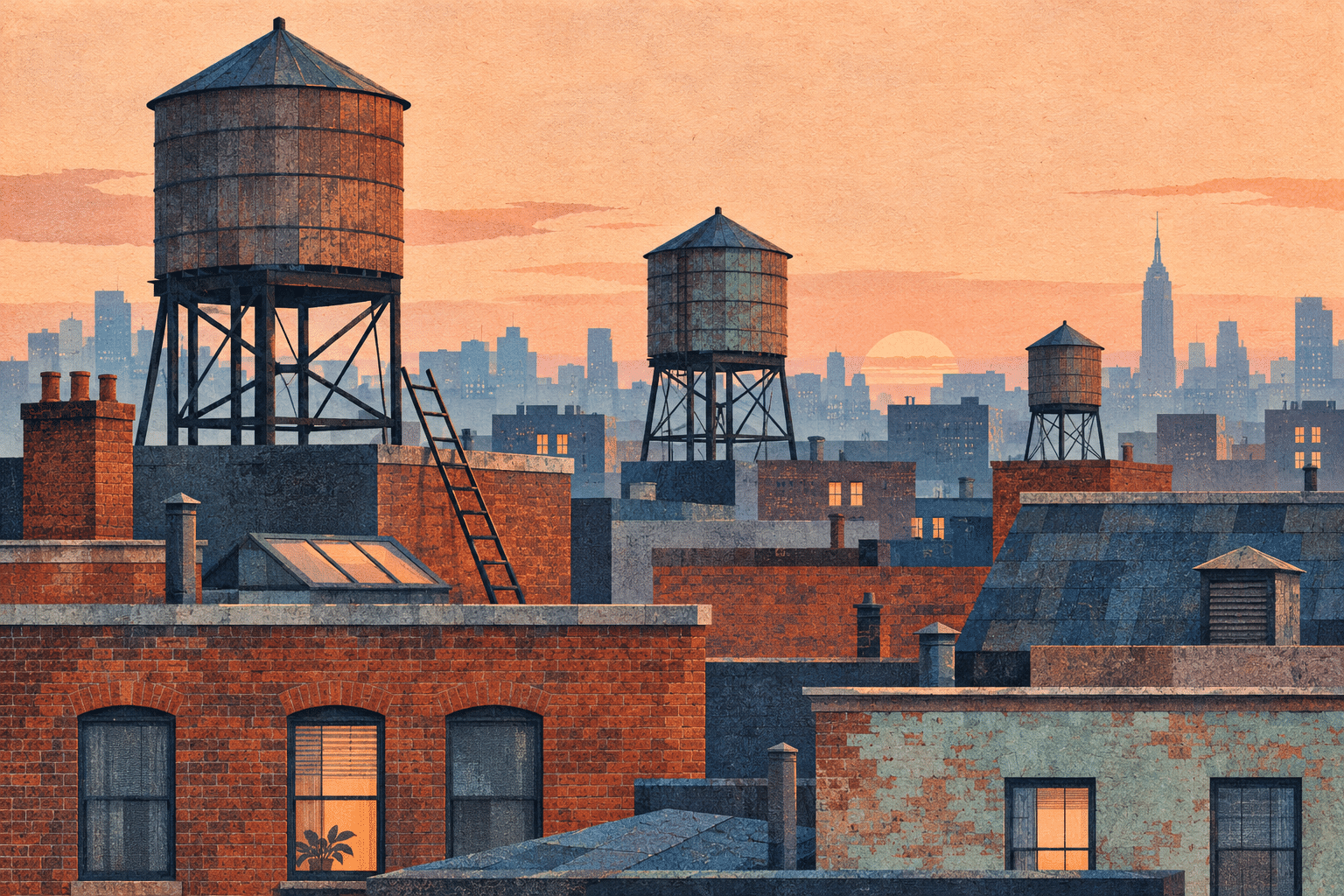
The rooftop study turns water tanks into a rhythm of cylinders above rectangular buildings. A ladder and supporting braces introduce diagonals, while the dawn sky keeps the image from becoming a solid wall of detail. The approach can work with ordinary infrastructure as well as famous landmarks.
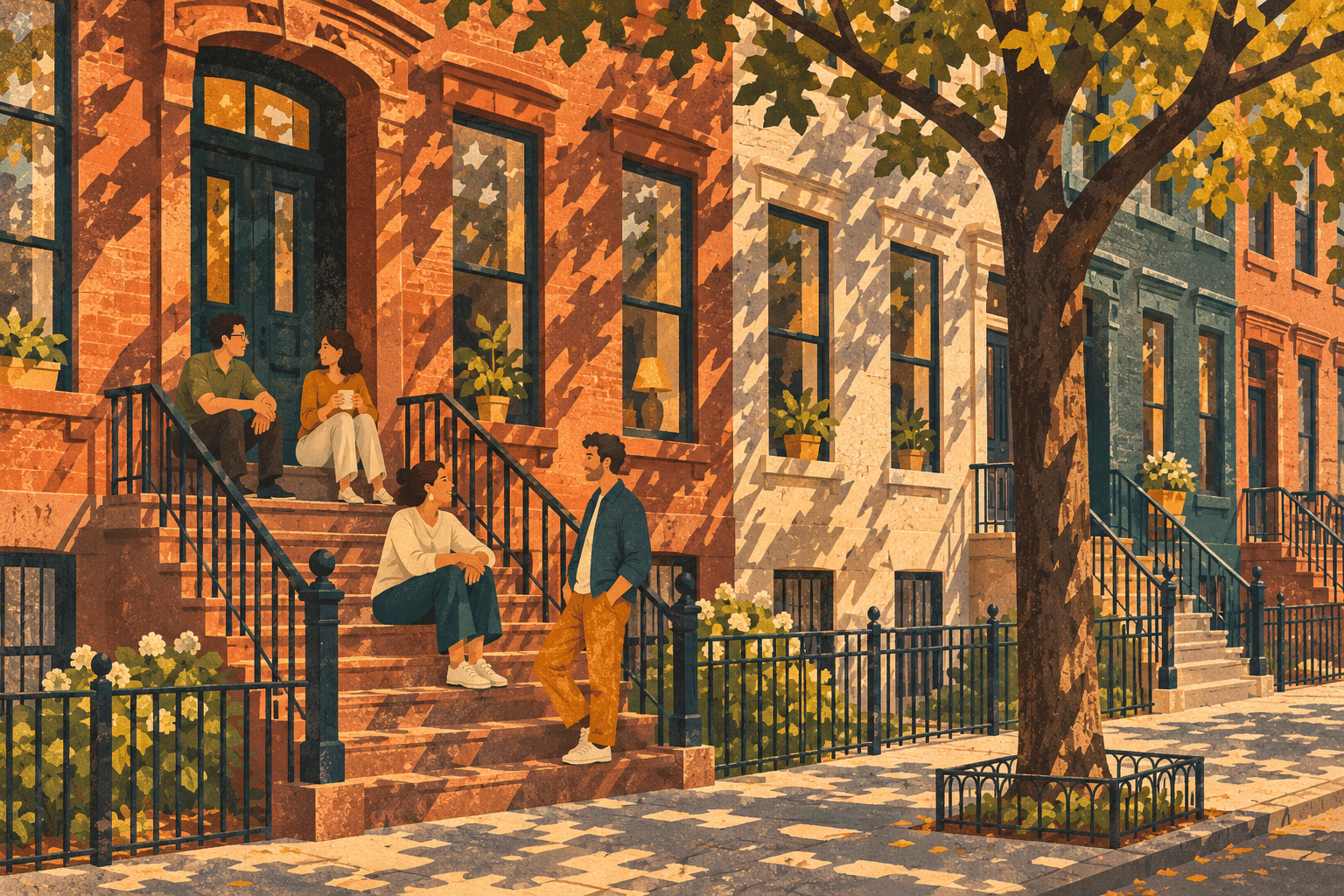
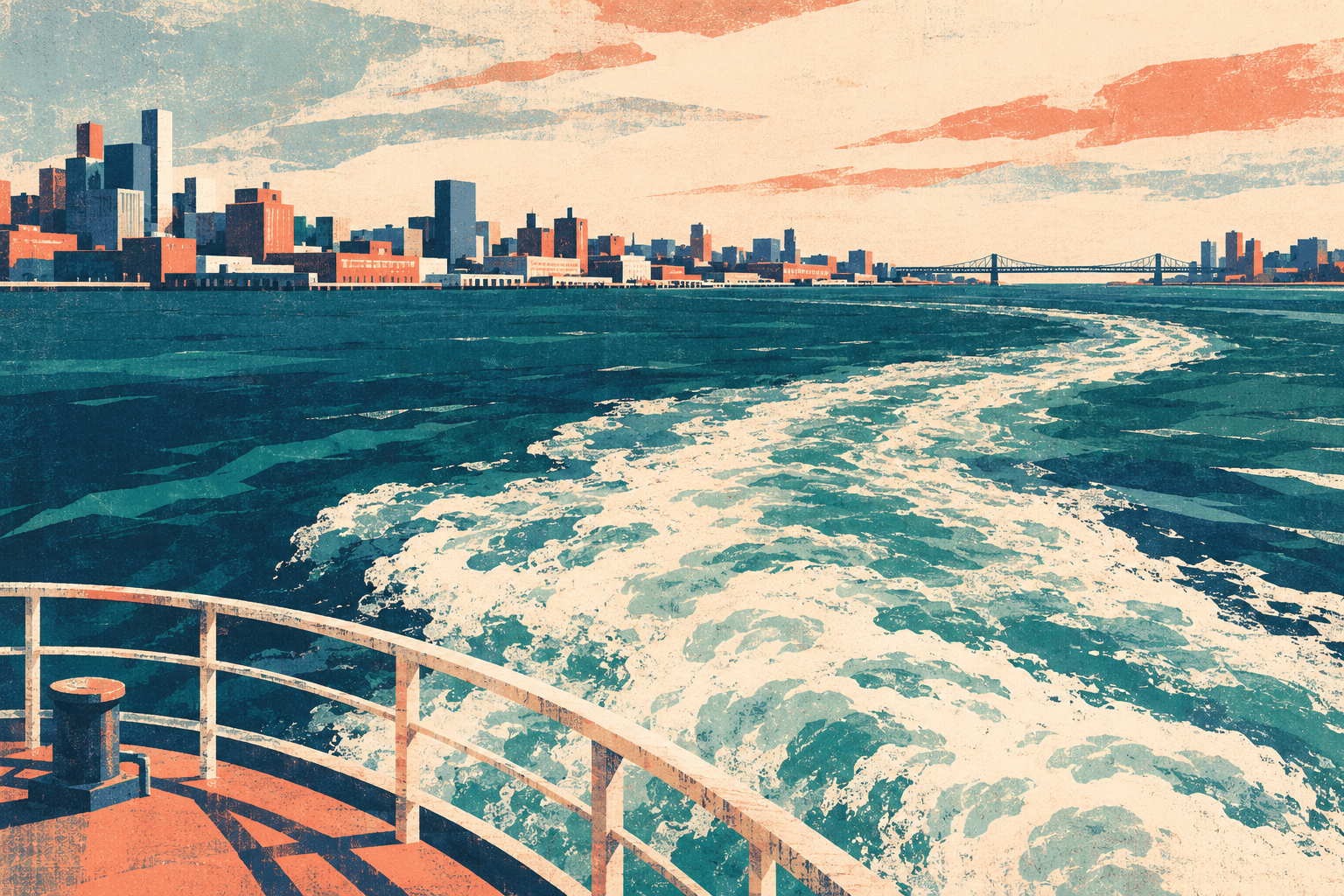
The stoop study moves closer to everyday life. A few people, railings, steps and a tree make a quieter pattern of attention. In the waterfront study, the wake takes over as the principal gesture and the city recedes to a thin band. These changes in distance prevent the concept from becoming an endless sequence of skyline posters.
What the retained image contributes
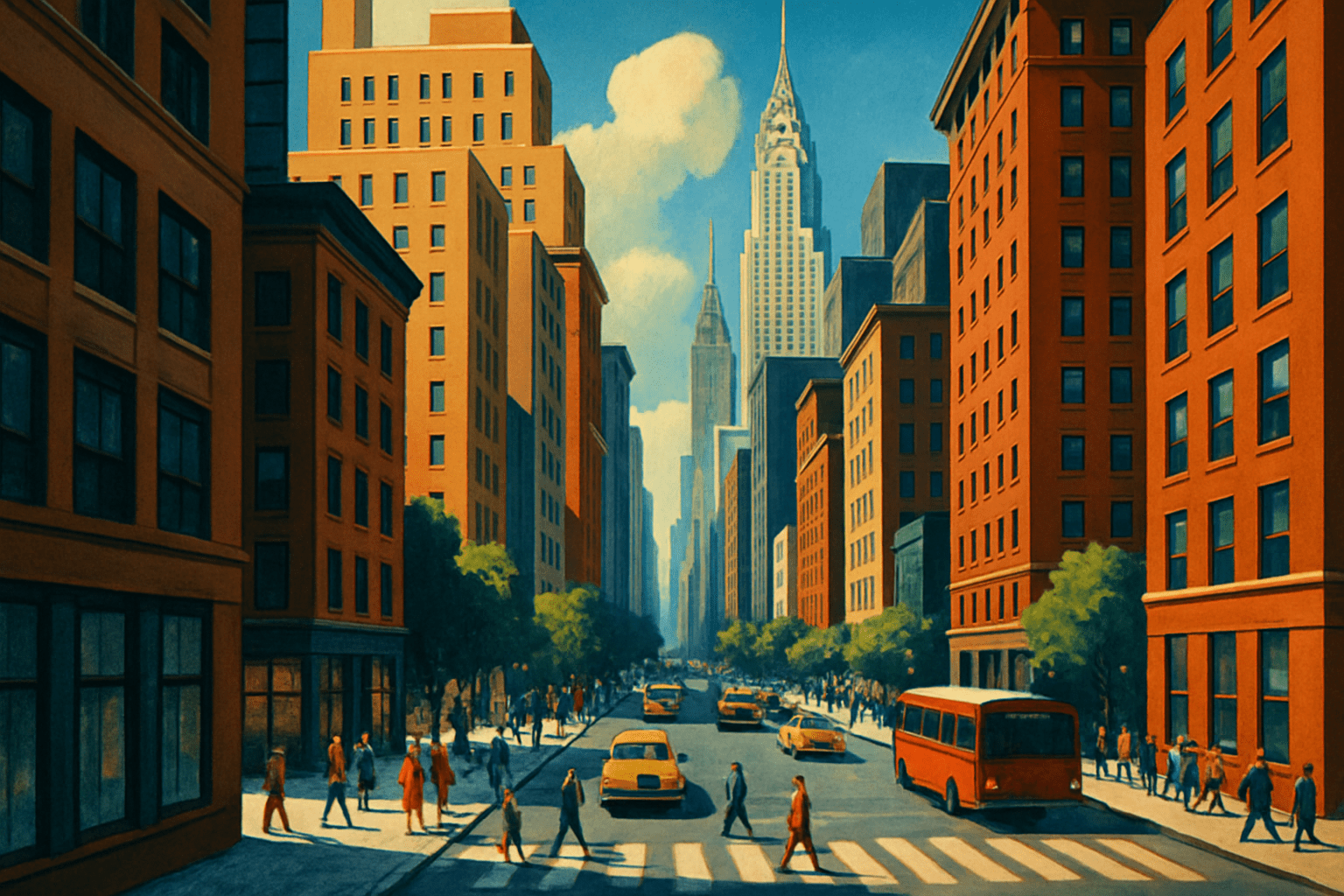
The older AOI cityscape remains as an example of a more painterly, deep-perspective approach. Its warm facades, yellow vehicles and distant tower establish a familiar metropolitan impression. It is retained as an imaginative illustration, with no claim that its arrangement matches a real street.
Compare its converging avenue with the newer flattened graphics. Both can suggest energy, but they organize it differently. This comparison makes the proposed concept more useful: the goal is to notice how repetition, direction and scale operate, rather than to insist that every city picture must share one finish.
A practical workflow
Choose one scale before adding details: rooftop, crossing, stoop or water. Sketch the dominant repeated unit and one interruption. Limit the initial palette to a dark structural colour, a warm building colour, a light ground and one accent. Only then decide where texture and small figures improve the reading.
For AI-assisted work, state the compositional relationship explicitly. “Dense city” is less useful than “three roof tanks above a field of rectangles, with one ladder diagonal and a calm sky.” Review the result for plausible visual structure, legible figures and unnecessary signage. If the image invents geography, keep that status visible in its caption.
Use and limits
The framework suits editorial city illustrations, poster studies, covers and visual essays about movement and place. It can also be an exercise in translating an observed street into a few clear relationships. It is not a replacement for research when a project concerns a real community, building or historical event.
Avoid reducing New York to yellow vehicles and towers alone. Vary the hour, distance and kind of activity; include quietness as well as speed. If a specific cultural setting matters, document it rather than inferring it from a facade or a person’s appearance. The examples here propose compositions, not an authoritative portrait of the whole city.
Positive review — AOI editorial perspective
The strongest feature is the balance between a repeated urban structure and one clear interruption. The roof tanks, train diagonal and ferry wake create different rhythms while sharing a controlled palette and texture. The quieter stoop image gives the set a human scale that a skyline-only sequence would miss.
Negative review — AOI editorial perspective
The approach can become a nostalgic travel-poster formula: distressed texture, orange brick and a few iconic props. When every surface is busy, the rhythm disappears. Simplify one area, change the viewpoint and ask whether the composition has a meaningful focal relationship before adding more city detail.
Neutral review — AOI editorial perspective
Newyorkism is used here as an AOI concept for urban image-making, not a recognized historical school. Its grammar overlaps with graphic city illustration and geometric simplification. Its value lies in the specific exercises and comparisons offered, while documented artists and movements retain their own identities.
A small poetic detour
Original words from the AOI studio.
Poetry
The windows count the morning in,
the railway draws a darker line.
A rooftop tank holds up the sky;
a square of light becomes a sign.
On steps, a conversation stays
while other footsteps cross the street.
The ferry loosens from the shore
and folds the grid beneath its feet.
We leave one patch of water clear,
one quiet space the towers allow:
the city is a thousand times,
and this small drawing holds one now.
The prompt workshop
Original creative exercises. These prompts create new illustrations, not documentary evidence.
Start here · Roof rhythm
Create an original AOI Newyorkism study of three rooftop water tanks above rectangular building masses. Use a limited navy, rust and pale apricot palette, one ladder diagonal and a calm sky. Flatten selected planes and add restrained print-like grain. Invented New York-inspired view, no text.
Richer scene · The human pause
Create an original graphic city painting of a quiet stoop beneath a street tree. Repeating windows and steps establish rhythm; a few people in conversation interrupt it. Prioritize coherent figures and one strong light shape, with warm brick and cool teal. Imagined location, no logos or signage.
Experiment · Let the city recede
Create an original urban graphic composition from a ferry stern. A curved ivory wake dominates dark teal water while the city becomes a narrow band of geometric blocks. Balance density with open space, use subtle layered print texture, and avoid a collage of famous landmarks. No text.
A smile from the studio
Jokes
The city grid asked the diagonal to stay in its lane. The ferry wake declined to comment.