Original AOI concept · Political retrofuturism
An imagined collective future in red geometry, cyan transit lines, magenta windows, and weathered concrete. Monumental public spaces meet ordinary shared life in a luminous, deliberately anachronistic visual world.
An AOI creative concept, not an established historical movement.
A visual introduction
Open any image to look closer, then browse the examples.
Creative toolbox · take this style further
Choose an input, adjust it, then open a tool. Search links pass your text to the destination. Copy & open copies it for you to paste into the generator; you start generation there.
ChatGPT
Copy your input and paste it into a ChatGPT conversation or image request.
Copy & open ChatGPT (new tab)Claude · Anthropic
Develop an image prompt or explore the style in a new Claude conversation.
Copy & open Claude · Anthropic (new tab)Midjourney
Paste your input into the Imagine bar on the Create page.
Copy & open Midjourney (new tab)Adobe Firefly
Copy your input, open Firefly, and paste it into the prompt field.
Copy & open Adobe Firefly (new tab)Leonardo.Ai
Copy your input, open Leonardo, and paste it into the generation field.
Copy & open Leonardo.Ai (new tab)Lexica
Search AI images and prompts using your selected input.
Search with this input Lexica (new tab)Pexels
Search the photo and video library. Short keywords often work best.
Search with this input Pexels (new tab)Pixabay
Search photos, illustrations and other images.
Search with this input Pixabay (new tab)Unsplash
Search photographs using the style name or your own keywords.
Search with this input Unsplash (new tab)Wikipedia
Search for background reading. A style may not have its own article.
Search with this input Wikipedia (new tab)WikiArt
Copy your input into WikiArt’s search to explore artists and artworks.
Copy & open WikiArt (new tab)Instagram hashtags
Search a hashtag made from your input: spaces and punctuation are removed. Instagram may require sign-in.
Search with this input Instagram hashtags (new tab)A closer look
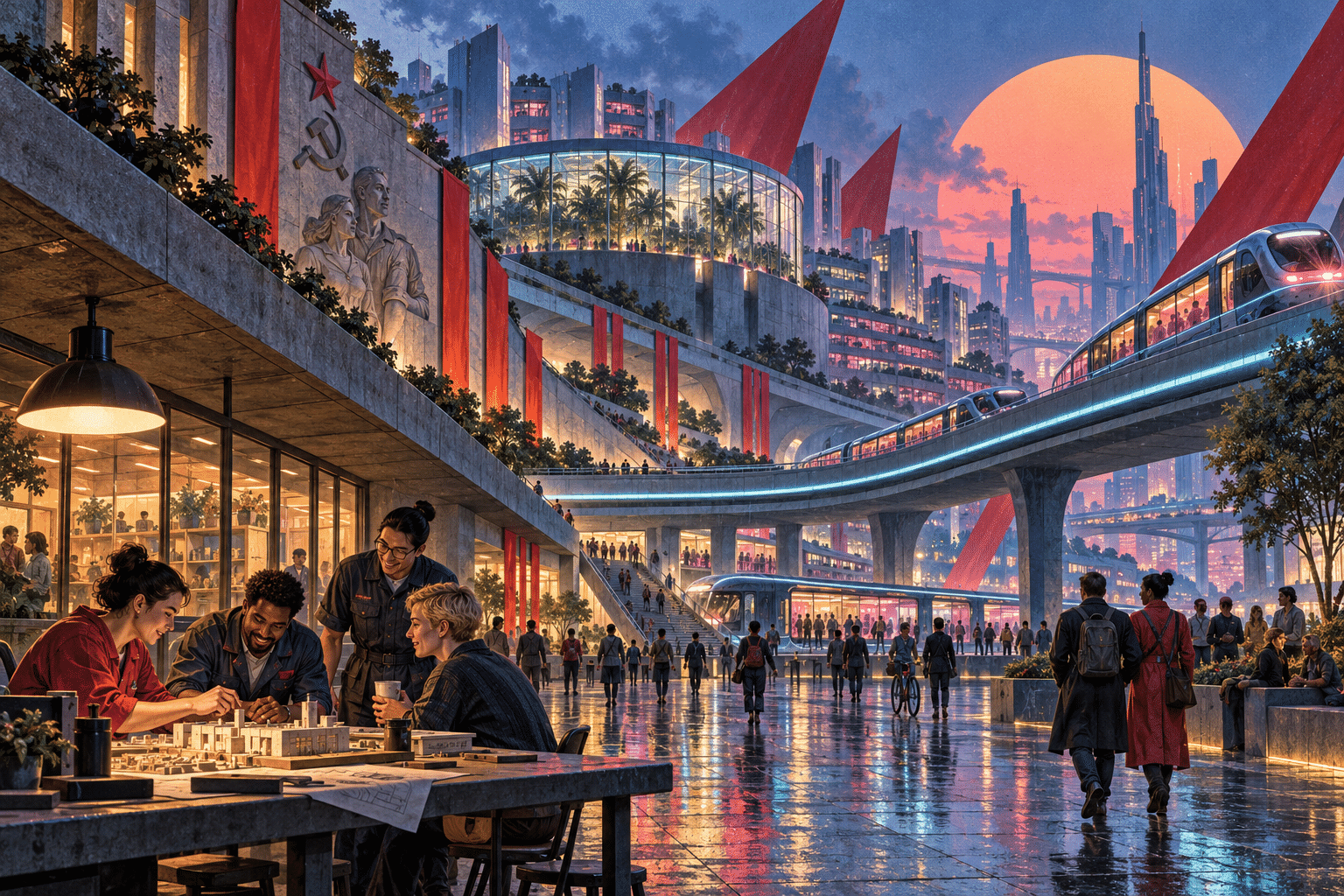
An immense rain-washed communal transit square in an imagined retrofuturist city at blue hour, terraced concrete housing and a circular public greenhouse above a sweeping elevated tram, red diagonal architectural fins crossed by cyan neon routes and warm magenta windows, a small stylized red star and hammer-and-sickle relief integrated into one civic facade, foreground neighbors sharing a worktable under warm light, chrome train noses, analog display shapes, powerful low-angle geometry and a vast apricot artificial sun.
A future after the poster
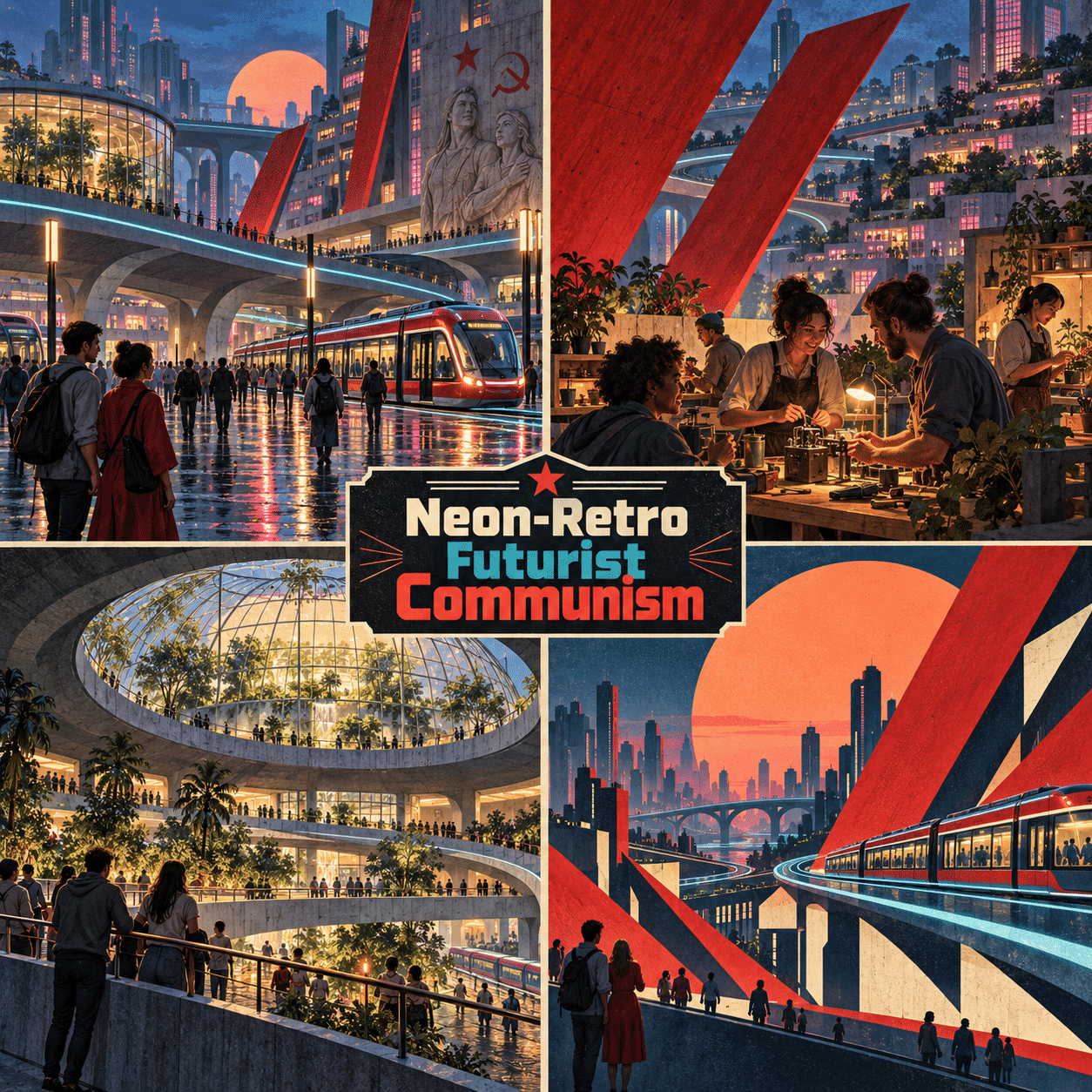
Imagine a future announced in a screen-printed poster and inhabited after the lights come on. A tram glides beneath red diagonal fins; communal greenhouses glow above concrete housing; neighbors repair an appliance at a shared workbench. Neon-Retro Futurist Communism is an original AOI concept that combines collective social space with an intentionally anachronistic technological dream. The title names a fictional art direction, not a newly discovered historical movement.
References without conflation
Its ingredients should remain distinguishable. Constructivist experiments in geometry, graphic design, photography, and architecture are one reference point. Socialist Realism is a different historical category, not another name for angular red posters: MoMA places the Russian avant-garde and the later imposition of Socialist Realism in distinct phases. The neon palette, analog-future interfaces, and speculative city presented here are AOI inventions layered over selected visual references. They should not be attributed to historical artists as if those artists made this hybrid.
Make collective life visible
Give the image a clear social center. A public tram interchange, a shared kitchen, a workshop, or a rooftop garden tells us more than a skyline covered in symbols. Red slabs and forceful diagonals establish the large composition; cyan lines trace movement; magenta windows suggest occupied rooms. Cream highlights and ink-blue shadows keep the palette from turning into an unbroken neon wash. A red star or hammer-and-sickle motif can locate the political vocabulary, but repeating it on every surface weakens both the design and its meaning.
Keep the tension in the picture
The most interesting version lets promise and pressure coexist. Monumental buildings may feel generous from a public courtyard and controlling from an empty ceremonial avenue. Show that tension through scale, repetition, and human activity rather than through an explanatory slogan. People can gather, disagree, mend, rest, and improvise. Giving them distinct actions prevents collective life from collapsing into a uniform crowd. This is visual speculation about an imagined society; attractive lighting is not evidence about the merits or lived reality of any historical regime.
Compose before decorating
For a finished composition, begin with three masses: a dark human foreground, a bright transport crossing, and a quieter monumental silhouette. Keep one strong diagonal and one contrasting circular form. Add print grain to broad surfaces while allowing a few reflections and glass edges to stay crisp. Avoid combining every retro gadget, propaganda emblem, and cyberpunk trope in one frame. A single public greenhouse above an ordinary repair table can carry the entire idea more convincingly than a hundred decorative symbols.
Technique notes
Use red for structural masses and cyan for movement; reserve magenta for occupied interiors.
Let symbols carry context without replacing composition or human activity.
Compare a welcoming courtyard view with a distant ceremonial view of the same building to explore scale and power.
A small poetic detour
Original words from the AOI studio.
Poetry
The tram draws blue across the rain.
Red towers warm their windows again.
Beneath a sun assembled by hand,
we mend what the grand plans never planned.
A thousand futures fill the square;
leave room for one unfinished chair.
The prompt workshop
Original creative exercises. These prompts create new illustrations, not documentary evidence.
The last tram home
Neon-Retro Futurist Communism: a rain-wet communal tram stop beneath one red concrete diagonal, cyan light reflected on paving, three neighbors carrying groceries, warm magenta apartment windows, ink-blue dusk and cream highlights, screenprint grain with cinematic depth, humane scale, no slogans or text.
The commons under an artificial sun
Neon-Retro Futurist Communism: An immense rain-washed communal transit square in an imagined retrofuturist city at blue hour, terraced concrete housing and a circular public greenhouse above a sweeping elevated tram, red diagonal architectural fins crossed by cyan neon routes and warm magenta windows, a small stylized red star and hammer-and-sickle relief integrated into one civic facade, foreground neighbors sharing a worktable under warm light, chrome train noses, analog display shapes, powerful low-angle geometry and a vast apricot artificial sun. Wide cinematic composition, three depth planes, restrained red-cyan-magenta palette, tactile concrete, luminous public interiors, small distinct human actions, optimistic architecture with a hint of institutional vastness, no leaders, no slogans, no gibberish text.
The city as a shared circuit
Neon-Retro Futurist Communism interpreted as a geometric screenprint: red housing slabs, cream circles as communal gardens, cyan transport trajectories and small magenta windows, a shared worktable as the sole figurative anchor, asymmetrical diagonals, generous ink-blue negative space, tactile paper grain, no typography or slogans.
Your next inspiration
Discover another art style
Follow a visual thread to the next subject.

A smile from the studio
Jokes
The five-year plan delivered the future early. The neon sign still says “Opening soon.”
The communal spaceship has no first class. It does have a committee deciding who gets the window seat.
The city abolished private shadows. Everyone now shares the same dramatic lighting.