
Original AOI style proposal
An analyst can carry the harbour in one hand. A passenger has to get across the real one with wet shoes. Neon Retro Future Corporate Technocracy is an AOI proposal for pictures in which a private operator uses a forecast to make a public decision in advance. The company owns the model and the ferry gate. The minute that separates their answer from the arrival of the water is where the story lives.
An A⊕I –[-.+] creαt¡ve c⊕ncept, n⊕t αn estαbl¡she∂ h¡st⊕r¡cαl m⊕vement.
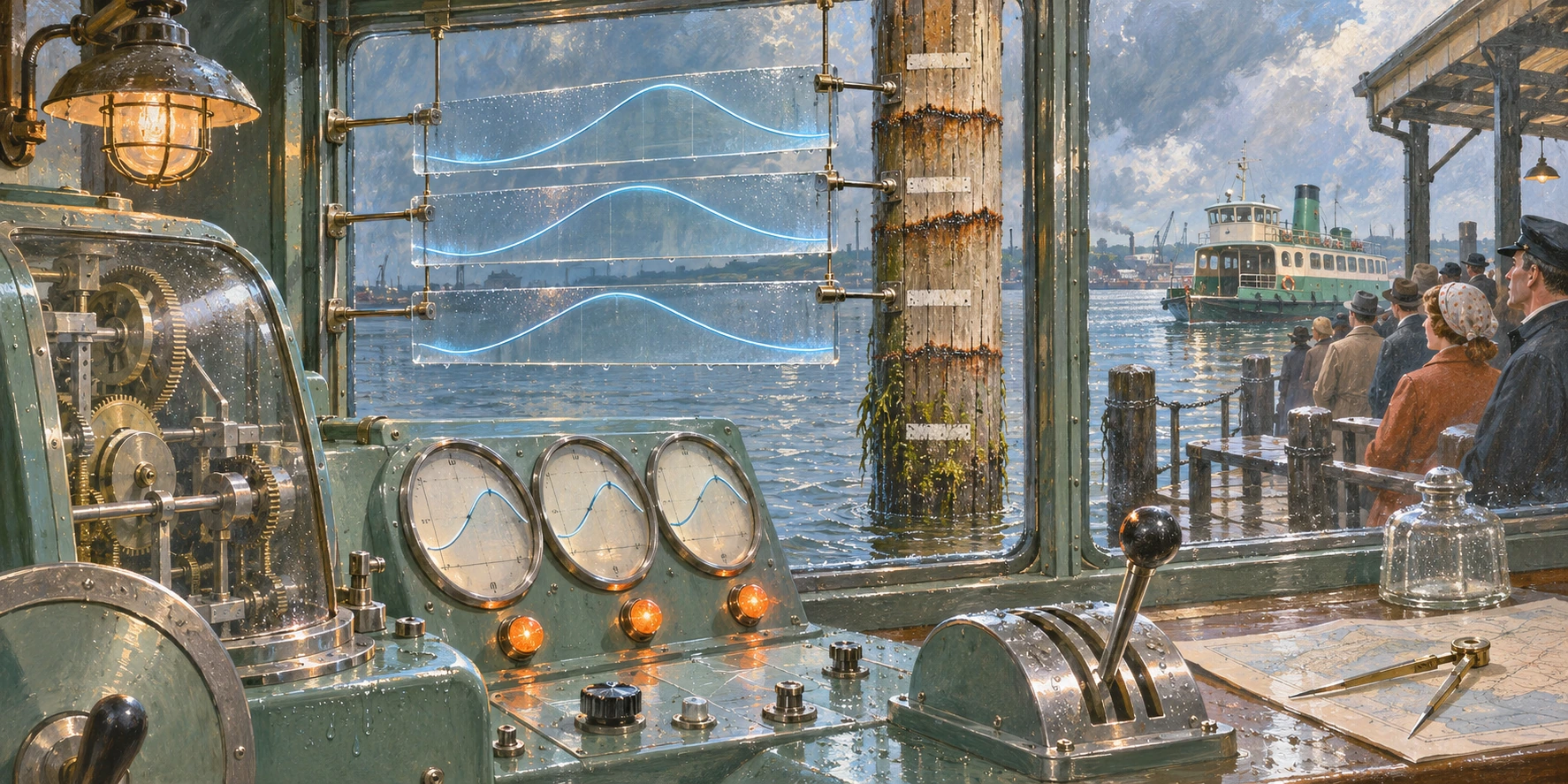
A visual introduction
Whose tide gets painted on the glass? Seven original interpretations explore the question at different scales.
Select an image for a closer look. Use the thumbnails, arrow keys or a swipe to compare examples. Zoom in to inspect details, or share the image that inspires you.
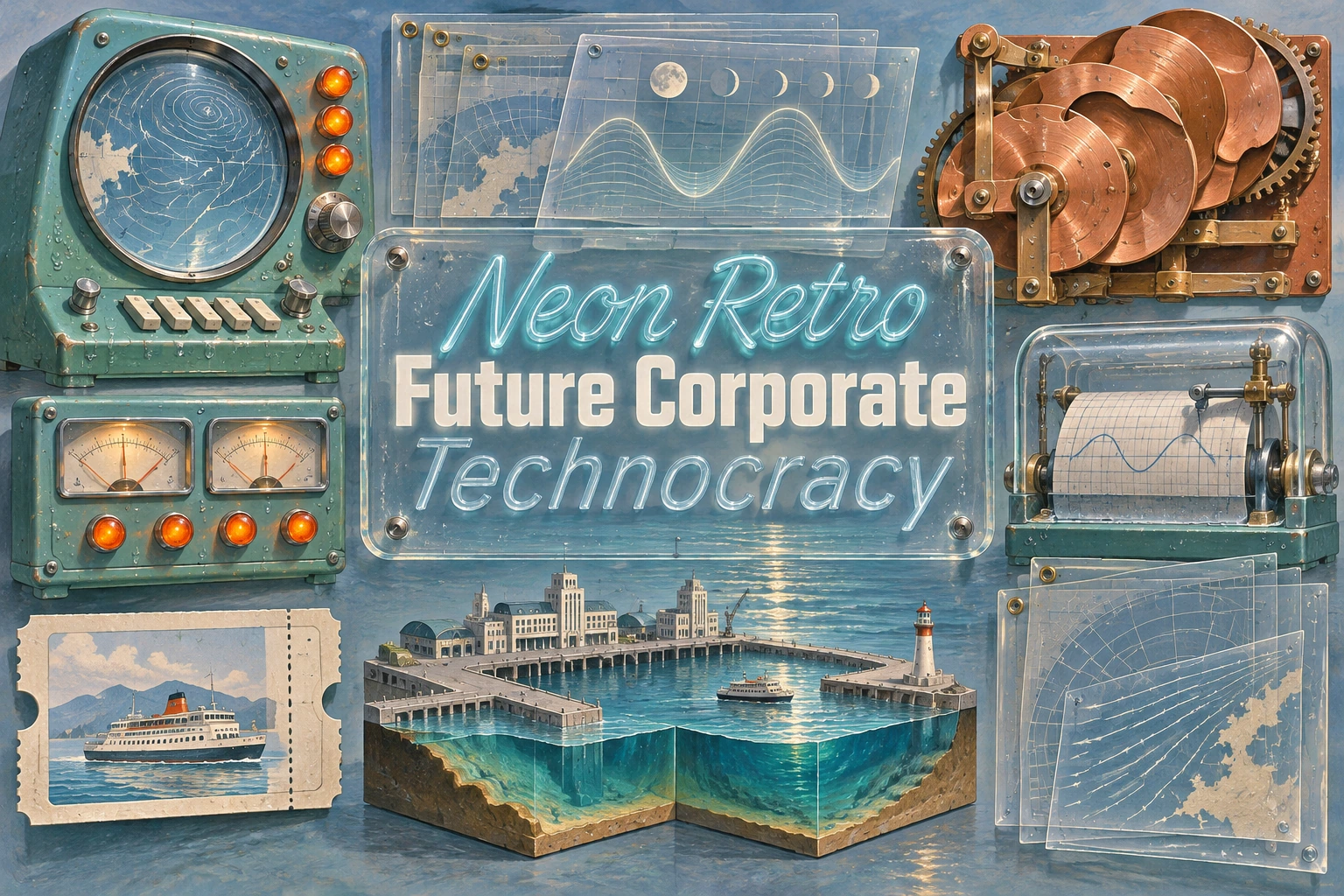
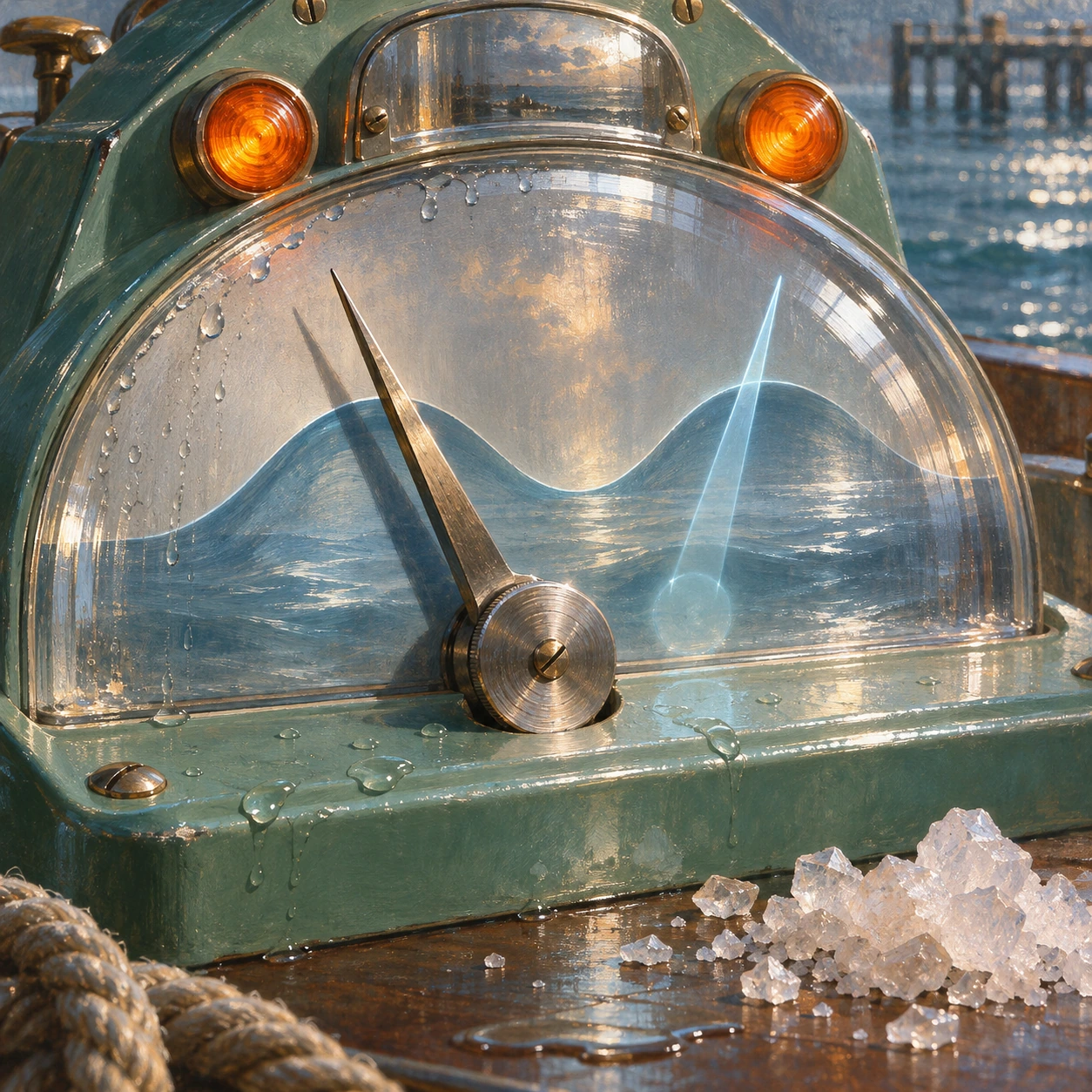
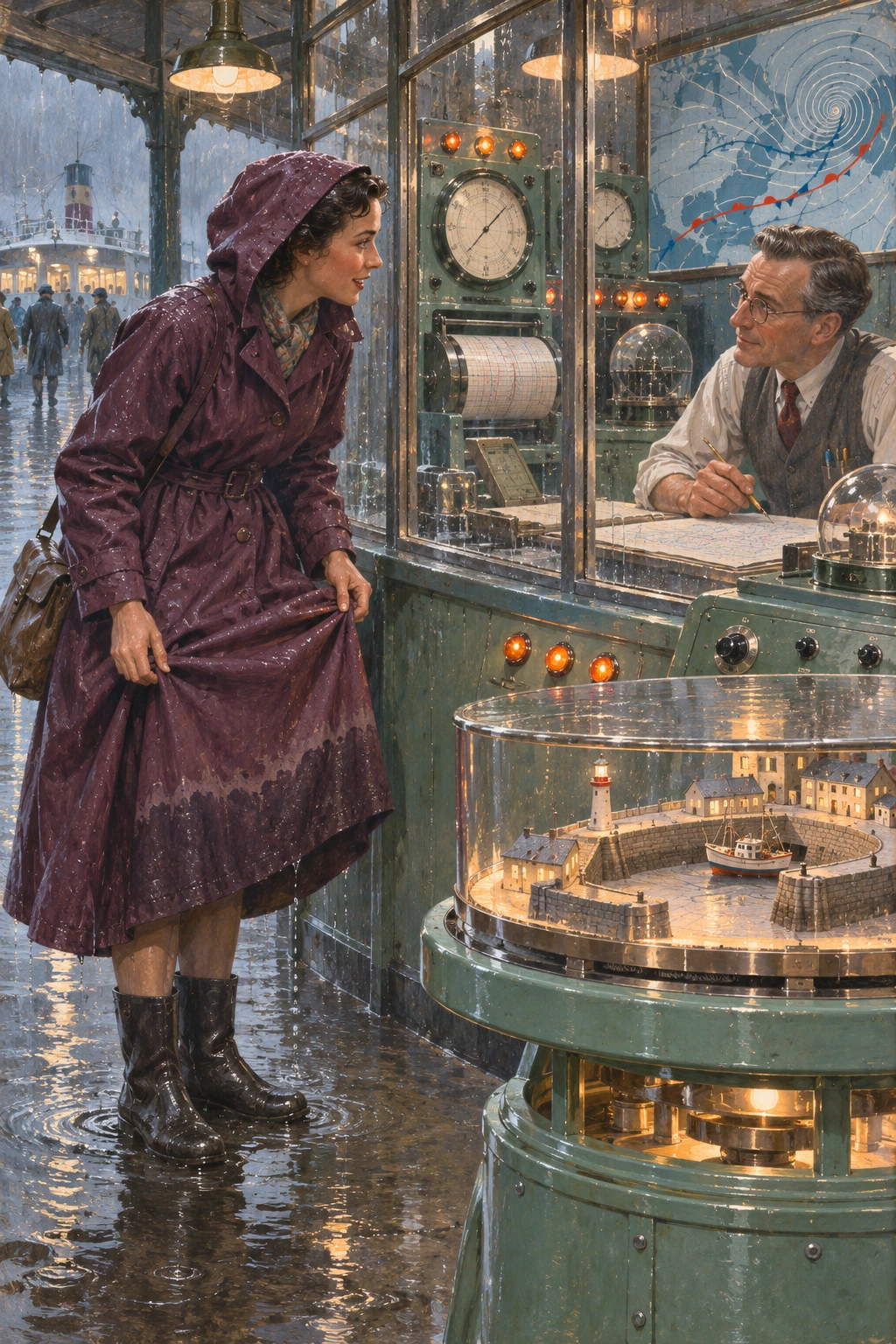
Creative toolbox · take this style further
Choose an input and a destination. Search sends your words to the chosen site; Copy & open puts them on your clipboard to paste there.
Create with AI
Turn your chosen input into an image prompt or a new creative direction.
ChatGPT
Copy your input and paste it into a ChatGPT conversation or image request.
Copy & open ChatGPT (new tab)Claude · Anthropic
Develop an image prompt or explore the style in a new Claude conversation.
Copy & open Claude · Anthropic (new tab)Midjourney
Paste your input into the Imagine bar on the Create page.
Copy & open Midjourney (new tab)Adobe Firefly
Copy your input, open Firefly, and paste it into the prompt field.
Copy & open Adobe Firefly (new tab)Leonardo.Ai
Copy your input, open Leonardo, and paste it into the generation field.
Copy & open Leonardo.Ai (new tab)Image search
Find visual references. Short, concrete keywords usually work best.
Lexica
Search AI images and prompts using your selected input.
Search with this input Lexica (new tab)Pexels
Search the photo and video library. Short keywords often work best.
Search with this input Pexels (new tab)Pixabay
Search photos, illustrations and other images.
Search with this input Pixabay (new tab)Unsplash
Search photographs using the style name or your own keywords.
Search with this input Unsplash (new tab)Wikimedia Commons
Search photographs, artworks and historical images. Check each file for its source and reuse terms.
Search with this input Wikimedia Commons (new tab)Art & research
Explore artists, collections and the ideas behind a style.
Wikipedia
Search for background reading. A style may not have its own article.
Search with this input Wikipedia (new tab)WikiArt
Copy your input into WikiArt’s search to explore artists and artworks.
Copy & open WikiArt (new tab)Europeana
Paste your keywords into the search to explore European museum, library and archive collections.
Copy & open Europeana (new tab)Inspiration
Discover portfolios and visual ideas from creative communities.
Instagram hashtags
Search a hashtag made from your input: spaces and punctuation are removed. Instagram may require sign-in.
Search with this input Instagram hashtags (new tab)ArtStation
Paste your input into artwork search for concept art, environments, characters and visual development.
Copy & open ArtStation (new tab)Behance
Paste your input into project search for illustration, design and visual storytelling.
Copy & open Behance (new tab)A closer look
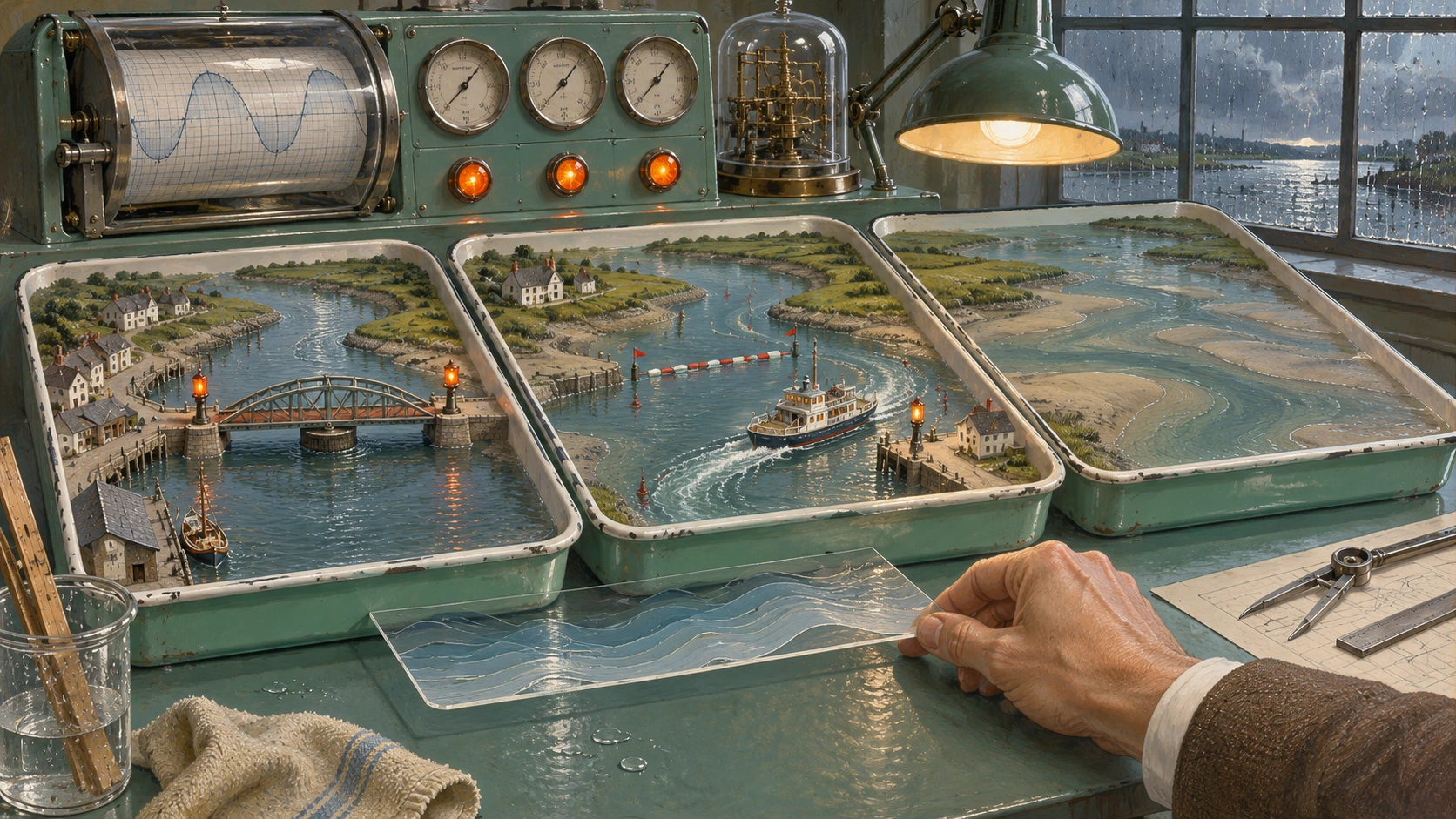
Use at least two surfaces. Give the measured world a material that keeps accidental marks, such as a tide staff, the hem of a raincoat or a stained wall. Give the predicted waterline a different material, perhaps a clear sheet inked with a curve. Overlap the surfaces just enough for a disagreement to show. Keep the model beautifully made. A machine that is visibly useless offers the observer little reason to investigate whose judgment counts.
Whose tide gets painted on the glass?
An analyst can carry the harbour in one hand. A passenger has to get across the real one with wet shoes. Neon Retro Future Corporate Technocracy is an AOI proposal for pictures in which a private operator uses a forecast to make a public decision in advance. The company owns the model and the ferry gate. The minute that separates their answer from the arrival of the water is where the story lives.
Composing the scene
Use at least two surfaces. Give the measured world a material that keeps accidental marks, such as a tide staff, the hem of a raincoat or a stained wall. Give the predicted waterline a different material, perhaps a clear sheet inked with a curve. Overlap the surfaces just enough for a disagreement to show. Keep the model beautifully made. A machine that is visibly useless offers the observer little reason to investigate whose judgment counts.
A reference from the archive
NOAA distinguishes an astronomical tide prediction from an observed water level. Wind and atmospheric pressure can contribute to a difference between the two. Its operational forecast systems bring additional observations and modelling to the question. Those are real distinctions that guided the visual exercise. The fictional operator makes a further decision when it uses one output to assign berths. In the drawing, that decision needs a handle, a person or a gate through which to act.
At the drawing table
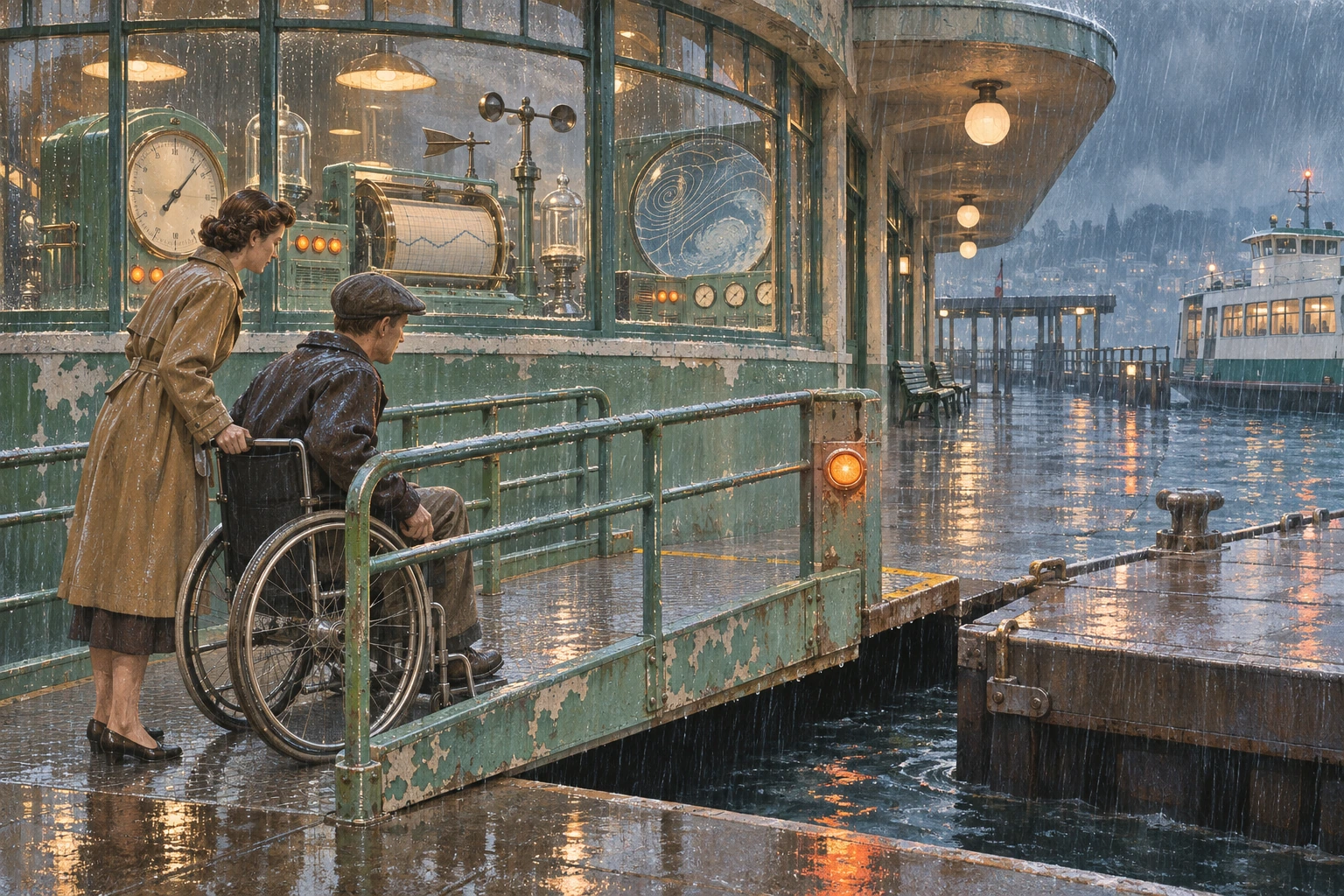
Choose the person who can notice an error before choosing the camera angle. From the control room, a fourth decimal place looks reassuring. At ramp height, a short drop to the pier can decide whether someone can board. The two viewpoints can describe the same moment. A long focal distance through a curved instrument cover brings the gauge and the person closer together without pretending that they know the same things.
Measurement and the right to decide
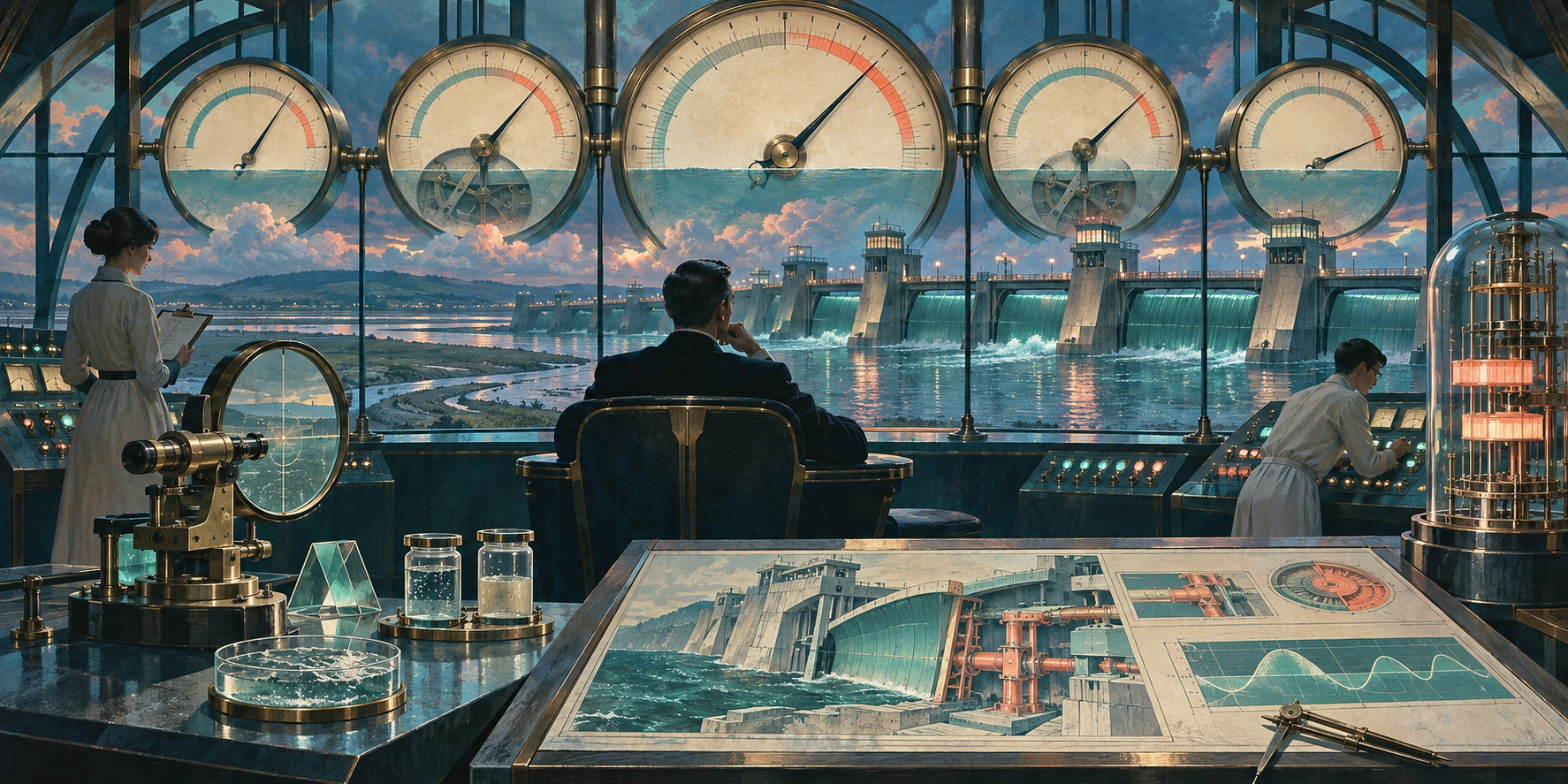
The earlier Corporate Technocracy guide joins a tide gauge to the conditions it samples. The Future variation puts tomorrow’s reading into the room today. Prediction gives staff a reason to act before passengers have evidence of their own. When the painting includes both a convincing model and a credible counter-observation, neither the engineer nor the traveller has to play the fool.
Positive review · AI-authored editorial assessment
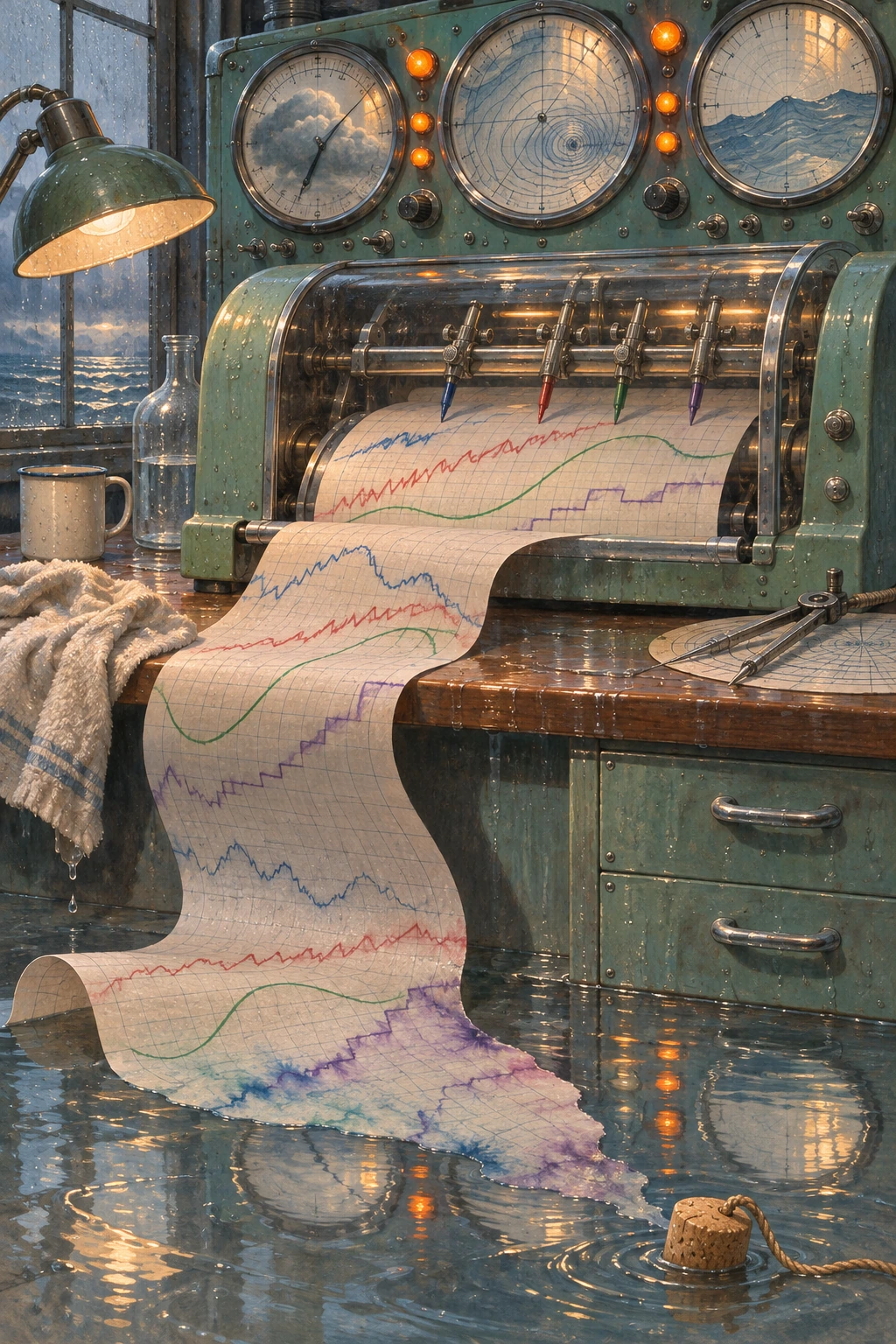
Where the red curve crosses the contact point of a real needle, an abstract disagreement becomes almost tactile. Damp cloth can function as a second instrument. Its owner gets to bring a piece of evidence into a room that usually recognises only its own apparatus.
Negative review · AI-authored editorial assessment
The easiest bad image is a wall of luminous charts that could say anything. Use one prediction with a visible consequence. Avoid building accessibility into the scene solely as a symbol of technology going wrong. Give the traveller space to observe, act and be heard.
Neutral review · AI-authored editorial assessment
This is a visual language for the governance of forecasts. It can illustrate timetables, allocations and decisions about access. It offers no assessment of a real harbour’s safety or the accuracy of a named forecasting system.
A small poetic detour
Original words from the AOI studio.
Poetry
The tide staff wears a line of salt.
The glass wears tomorrow in ink.
Below both, a board knocks twice
where no pencil quite meets the pier.
Someone puts down the chart
and goes to look.
The prompt workshop
Original creative exercises. These prompts create new illustrations, not documentary evidence.
Begin with an object
Draw a salt-streaked harbour gauge and its clear forecast overlay on the same workbench. Offset the two readings by the width of a fingernail. One clipped copper float and an enamel frame in sea green. Leave a little space for someone to put a hand between the layers.
Build a scene
Paint a late ferry departure twice within a single room. At the window a passenger shows the salt line on a raincoat. At the desk a hand slides a predicted tide across a model wharf. Anchor the warm instrument light in damp, green-grey surroundings and keep the people on comparable terms.
Change the conditions
Take away every digit on the central dial. Show what the operator believes using only the positions of a ramp, an indicator and a real reflection in the water. Draw the next minute from the passenger’s seat. Make the consequence of a mistaken prediction visible at that height.
Your next inspiration
Discover another art style
Follow a visual thread to the next subject.
A smile from the studio
Jokes
The forecast office has reserved a dry seat for tomorrow’s tide. The tide has yet to confirm.