
Original AOI style proposal
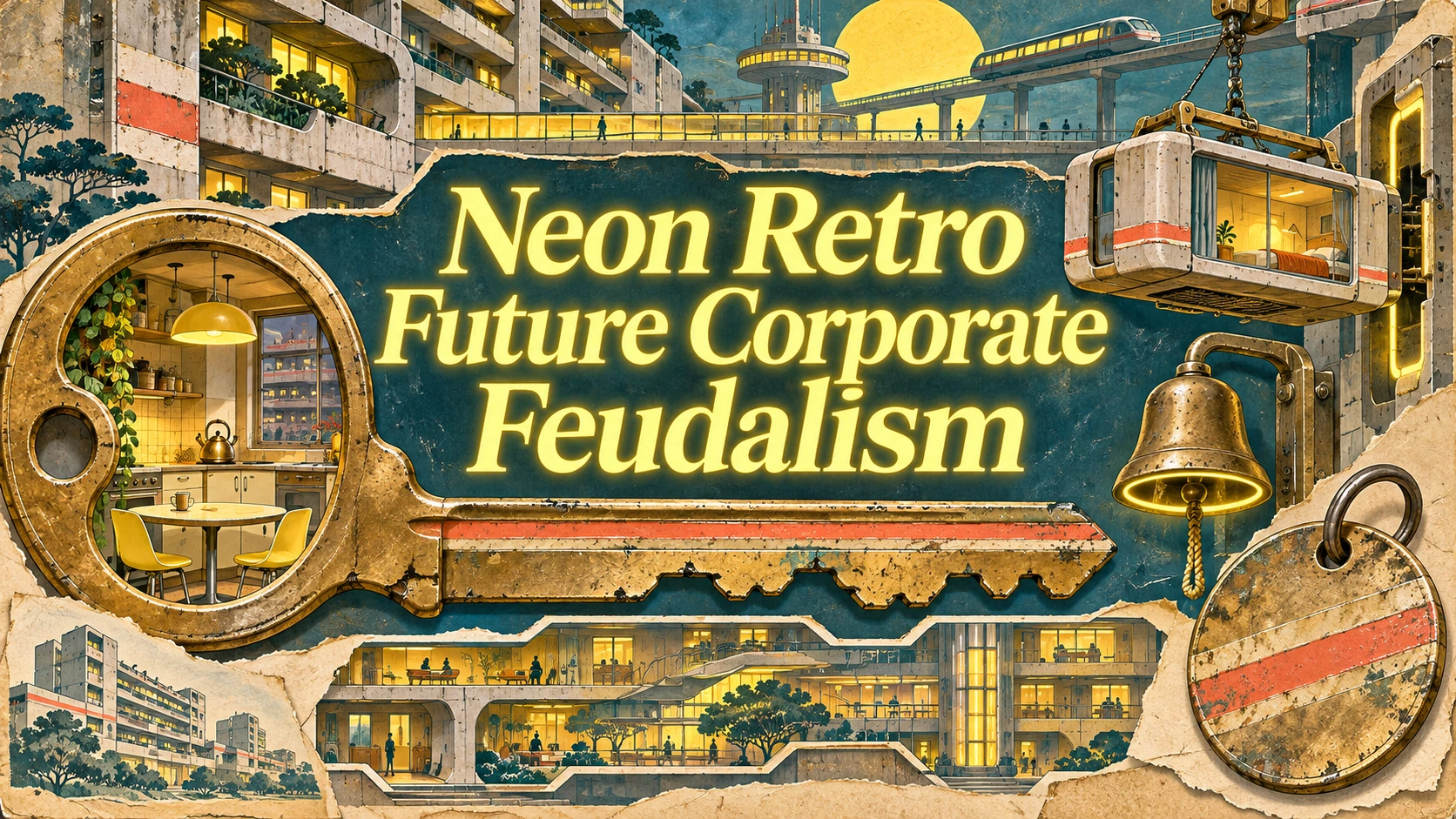
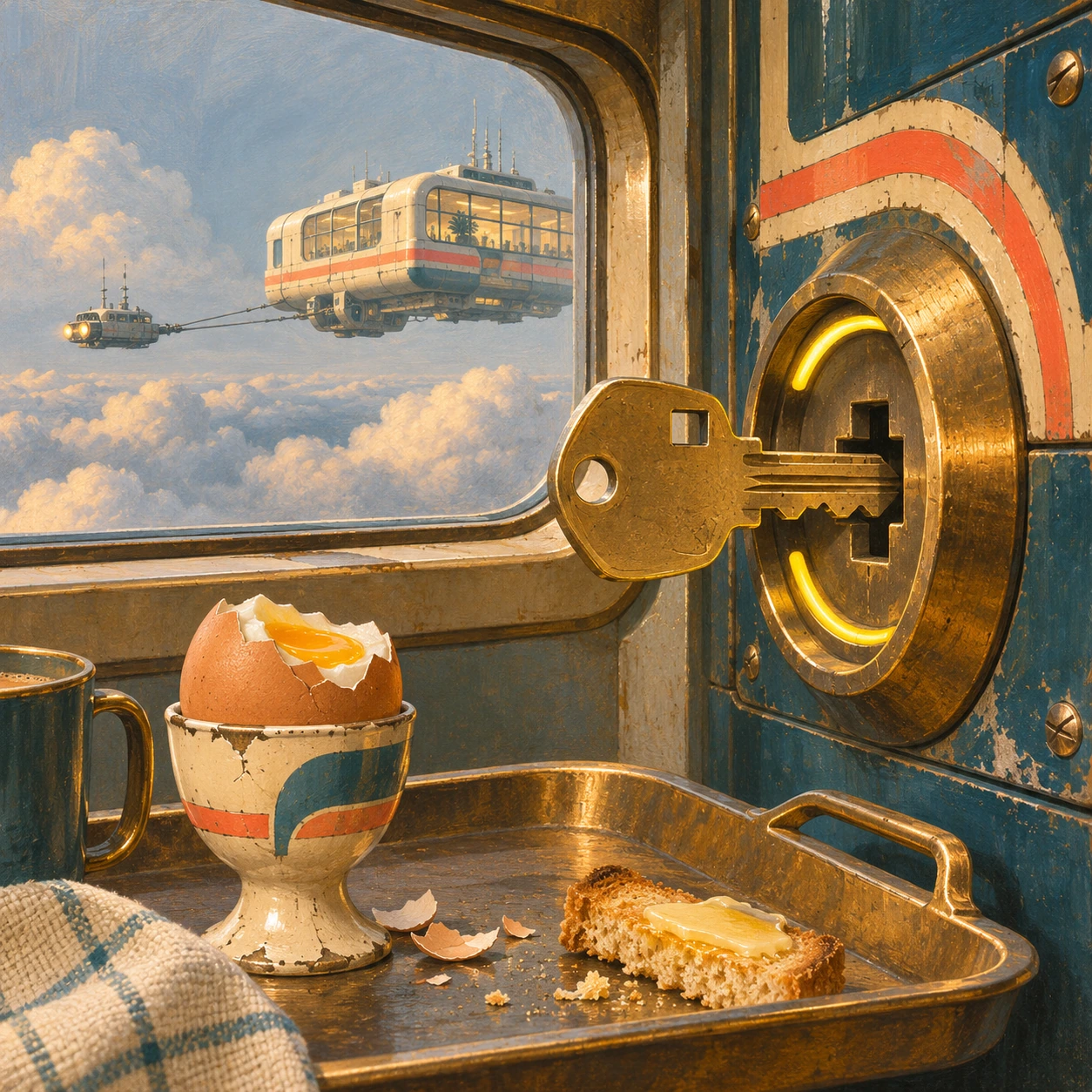
On a kitchen tray, a house key keeps company with an eggcup. One belongs to a family and fits in a pocket. The other end of this key belongs to a business and is big enough to moor a dwelling. Neon Retro Future Corporate Feudalism is an original AOI illustration concept about dependence on a private landlord who also owns the infrastructure. Imagine keeping an apartment after losing the berth where it gets heat, power and a path to school. The drawings begin with that practical difficulty.
An A⊕I –[-.+] creαt¡ve c⊕ncept, n⊕t αn estαbl¡she∂ h¡st⊕r¡cαl m⊕vement.
A visual introduction
What a key can carry Seven original interpretations explore the question at different scales.
Select an image for a closer look. Use the thumbnails, arrow keys or a swipe to compare examples. Zoom in to inspect details, or share the image that inspires you.

Creative toolbox · take this style further
Choose an input and a destination. Search sends your words to the chosen site; Copy & open puts them on your clipboard to paste there.
Create with AI
Turn your chosen input into an image prompt or a new creative direction.
ChatGPT
Copy your input and paste it into a ChatGPT conversation or image request.
Copy & open ChatGPT (new tab)Claude · Anthropic
Develop an image prompt or explore the style in a new Claude conversation.
Copy & open Claude · Anthropic (new tab)Midjourney
Paste your input into the Imagine bar on the Create page.
Copy & open Midjourney (new tab)Adobe Firefly
Copy your input, open Firefly, and paste it into the prompt field.
Copy & open Adobe Firefly (new tab)Leonardo.Ai
Copy your input, open Leonardo, and paste it into the generation field.
Copy & open Leonardo.Ai (new tab)Image search
Find visual references. Short, concrete keywords usually work best.
Lexica
Search AI images and prompts using your selected input.
Search with this input Lexica (new tab)Pexels
Search the photo and video library. Short keywords often work best.
Search with this input Pexels (new tab)Pixabay
Search photos, illustrations and other images.
Search with this input Pixabay (new tab)Unsplash
Search photographs using the style name or your own keywords.
Search with this input Unsplash (new tab)Wikimedia Commons
Search photographs, artworks and historical images. Check each file for its source and reuse terms.
Search with this input Wikimedia Commons (new tab)Art & research
Explore artists, collections and the ideas behind a style.
Wikipedia
Search for background reading. A style may not have its own article.
Search with this input Wikipedia (new tab)WikiArt
Copy your input into WikiArt’s search to explore artists and artworks.
Copy & open WikiArt (new tab)Europeana
Paste your keywords into the search to explore European museum, library and archive collections.
Copy & open Europeana (new tab)Inspiration
Discover portfolios and visual ideas from creative communities.
Instagram hashtags
Search a hashtag made from your input: spaces and punctuation are removed. Instagram may require sign-in.
Search with this input Instagram hashtags (new tab)ArtStation
Paste your input into artwork search for concept art, environments, characters and visual development.
Copy & open ArtStation (new tab)Behance
Paste your input into project search for illustration, design and visual storytelling.
Copy & open Behance (new tab)A closer look
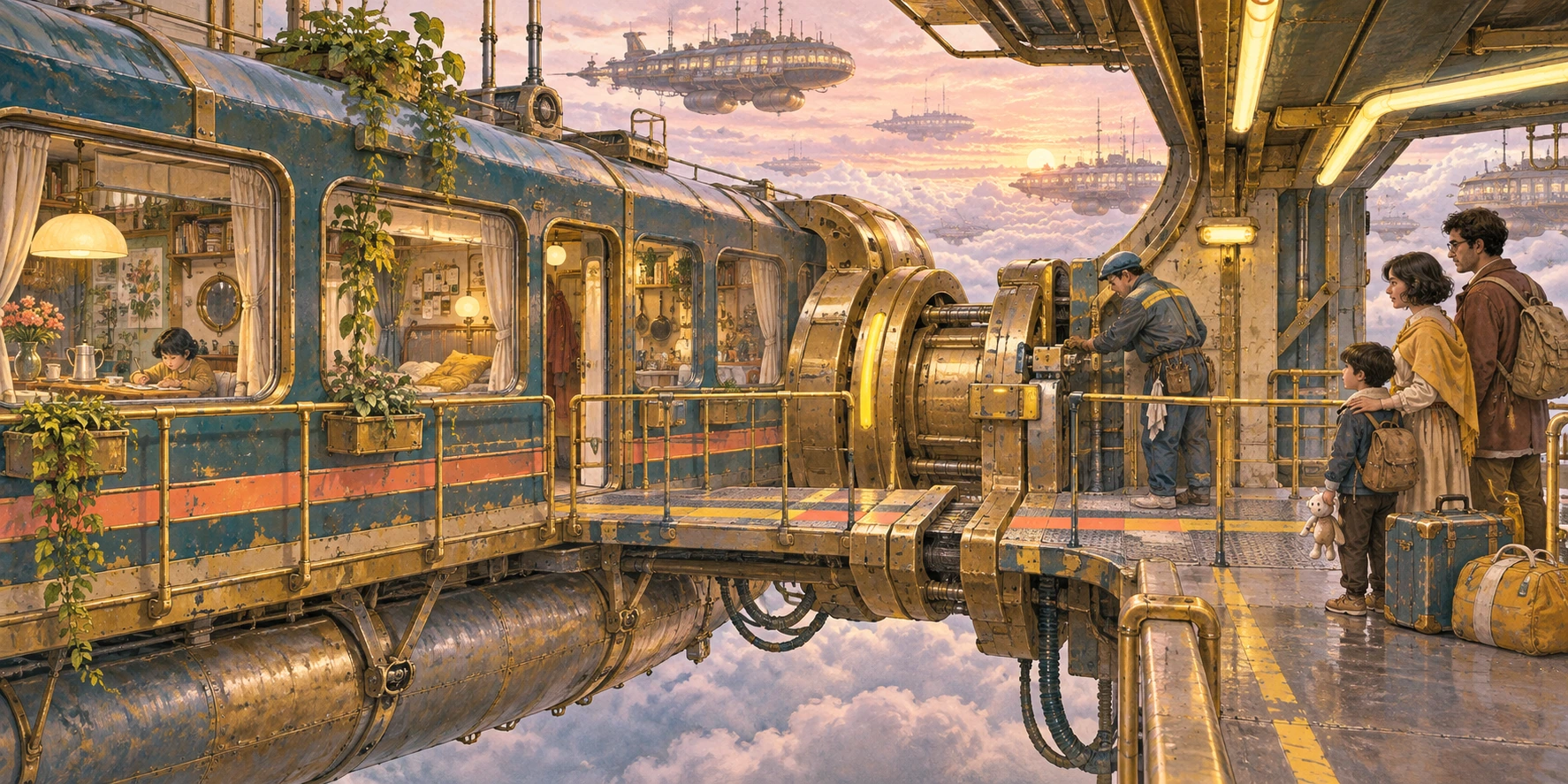
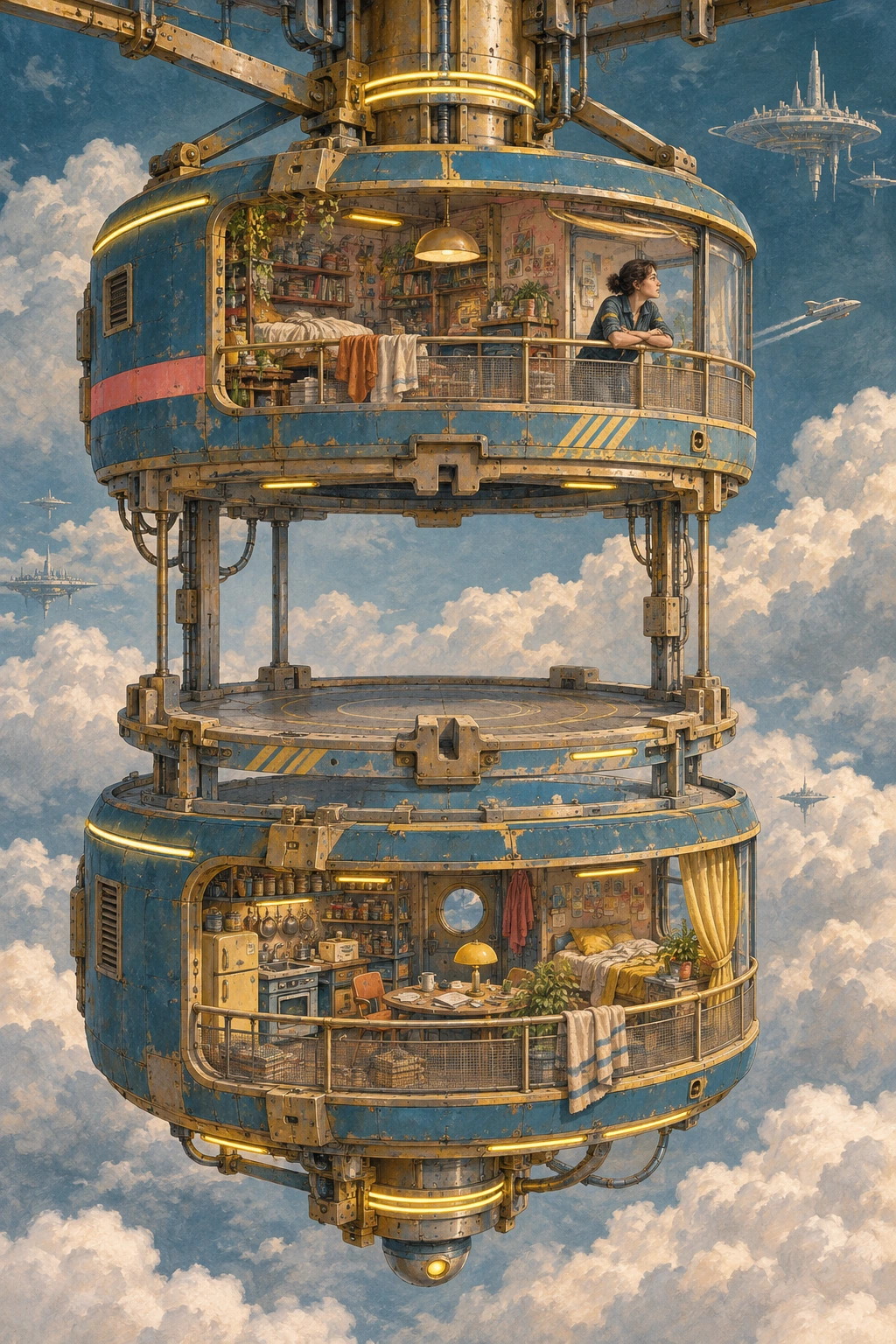
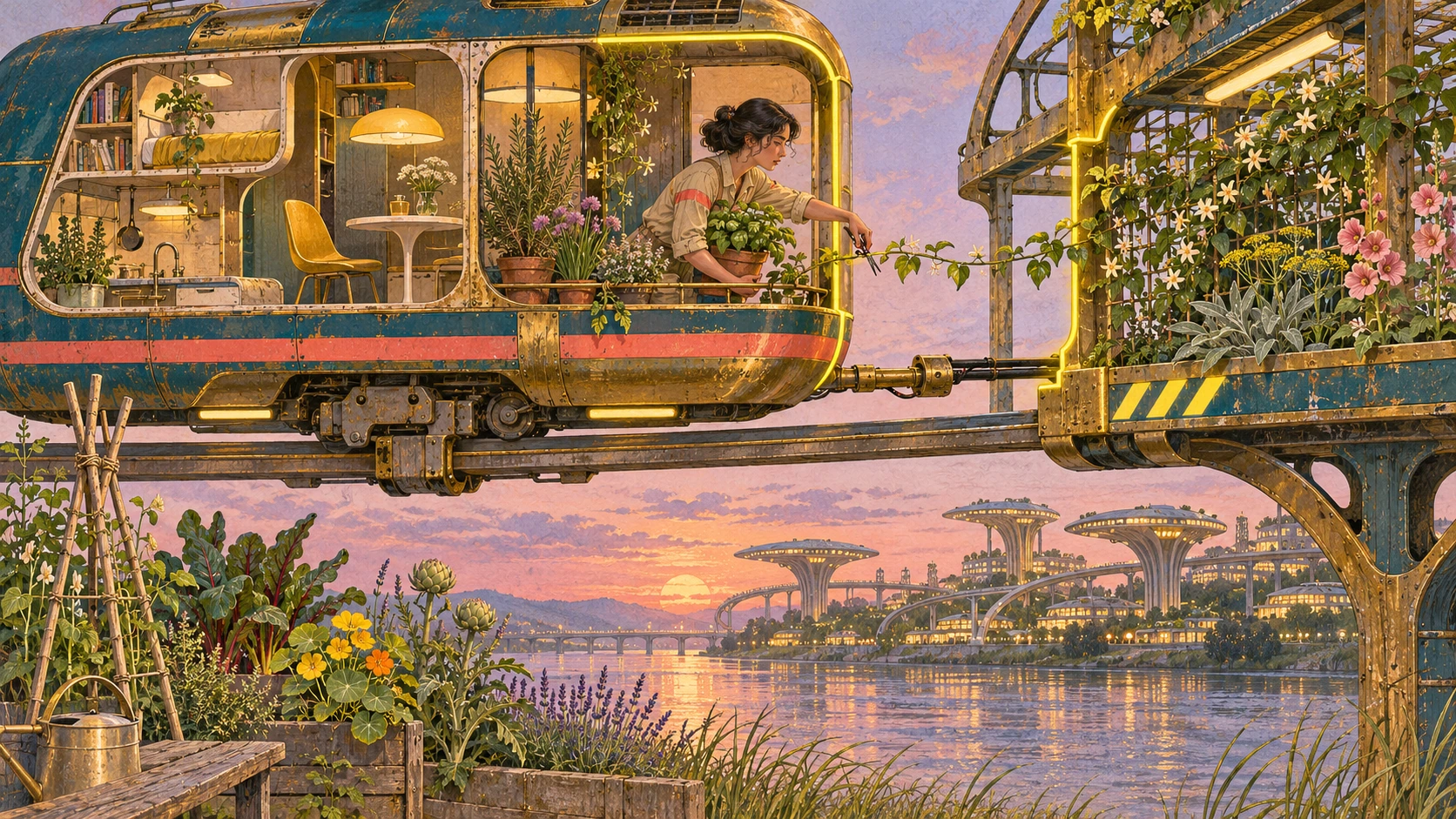
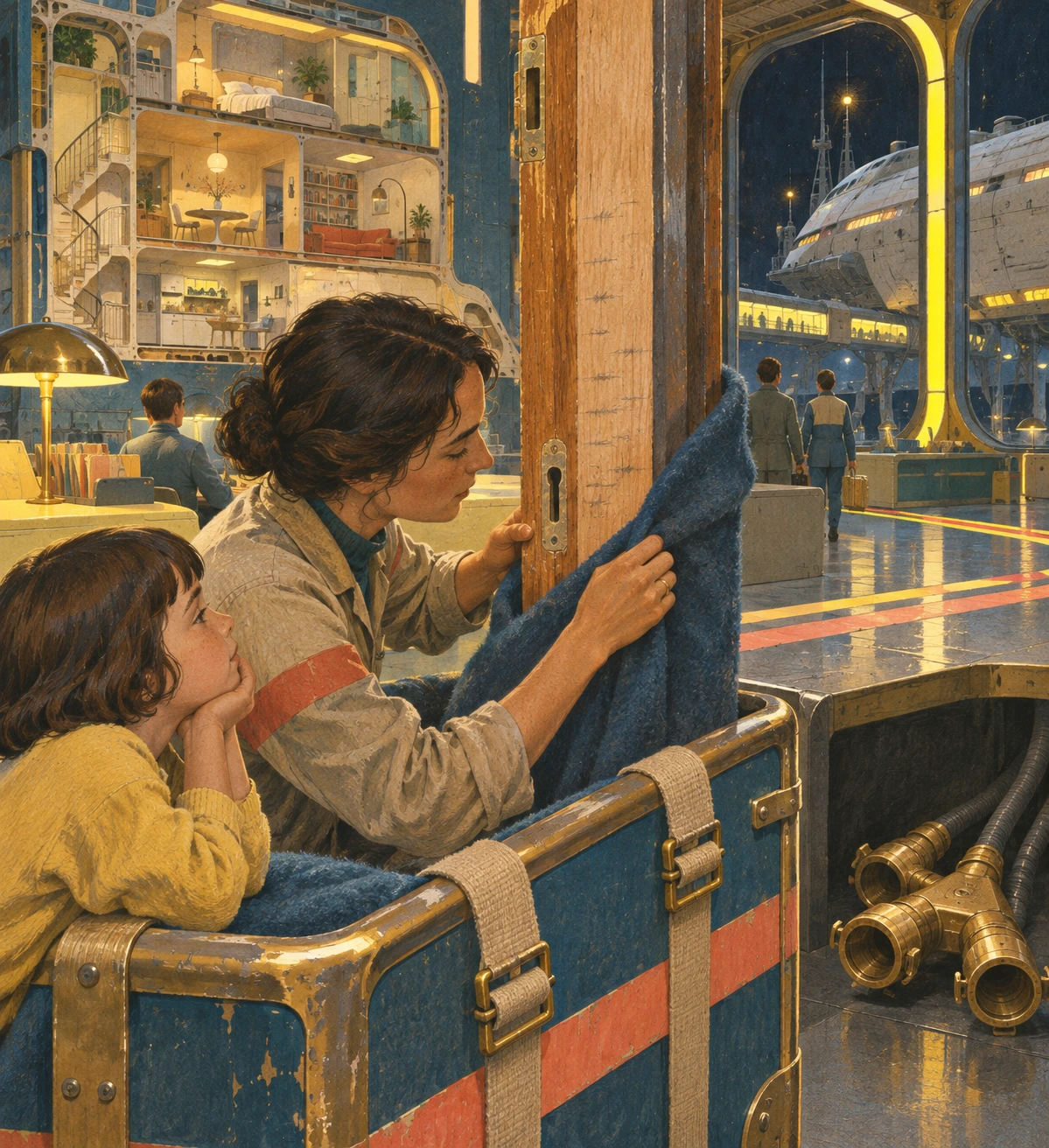
Give the home two edges. On the inside, let objects accumulate through use. A crease in a chair cushion and a mark on a door frame take years to acquire. On the outside, draw a coupling that another household could use tomorrow. Petrol blue makes a good ground for the recess in the metal. A short run of butter-yellow light lets the eye find the joint among a thousand windows. It helps if a viewer can say where a resident might step and where that step would cease to be possible.
What a key can carry
On a kitchen tray, a house key keeps company with an eggcup. One belongs to a family and fits in a pocket. The other end of this key belongs to a business and is big enough to moor a dwelling. Neon Retro Future Corporate Feudalism is an original AOI illustration concept about dependence on a private landlord who also owns the infrastructure. Imagine keeping an apartment after losing the berth where it gets heat, power and a path to school. The drawings begin with that practical difficulty.
Composing the scene
Give the home two edges. On the inside, let objects accumulate through use. A crease in a chair cushion and a mark on a door frame take years to acquire. On the outside, draw a coupling that another household could use tomorrow. Petrol blue makes a good ground for the recess in the metal. A short run of butter-yellow light lets the eye find the joint among a thousand windows. It helps if a viewer can say where a resident might step and where that step would cease to be possible.
A reference from the archive
In the company town of Pullman, housing and employment came under the influence of the same enterprise. The National Park Service documents how different dwellings and rents reflected a hierarchy among employees. A second historical reference, the ILO’s 1961 recommendation on workers’ housing, raises the question of what happens to a worker’s home when employment ends. Those sources give the made-up docking system a social question worth drawing. The airborne estate and its rules belong to this invented world.
At the drawing table
Begin with two paper rectangles for neighbouring rooms. Place the inhabitants’ chairs and tables first. Pull the rectangles apart by the width of a thumb. See whether lunch, an extension cord or a child visiting next door can still cross the space. That narrow interruption is often a stronger subject than a skyline. At the design stage, try the composition before adding a light tube. If the yellow line is doing all the storytelling, the floor plan needs another pass.
What changes when the house moves
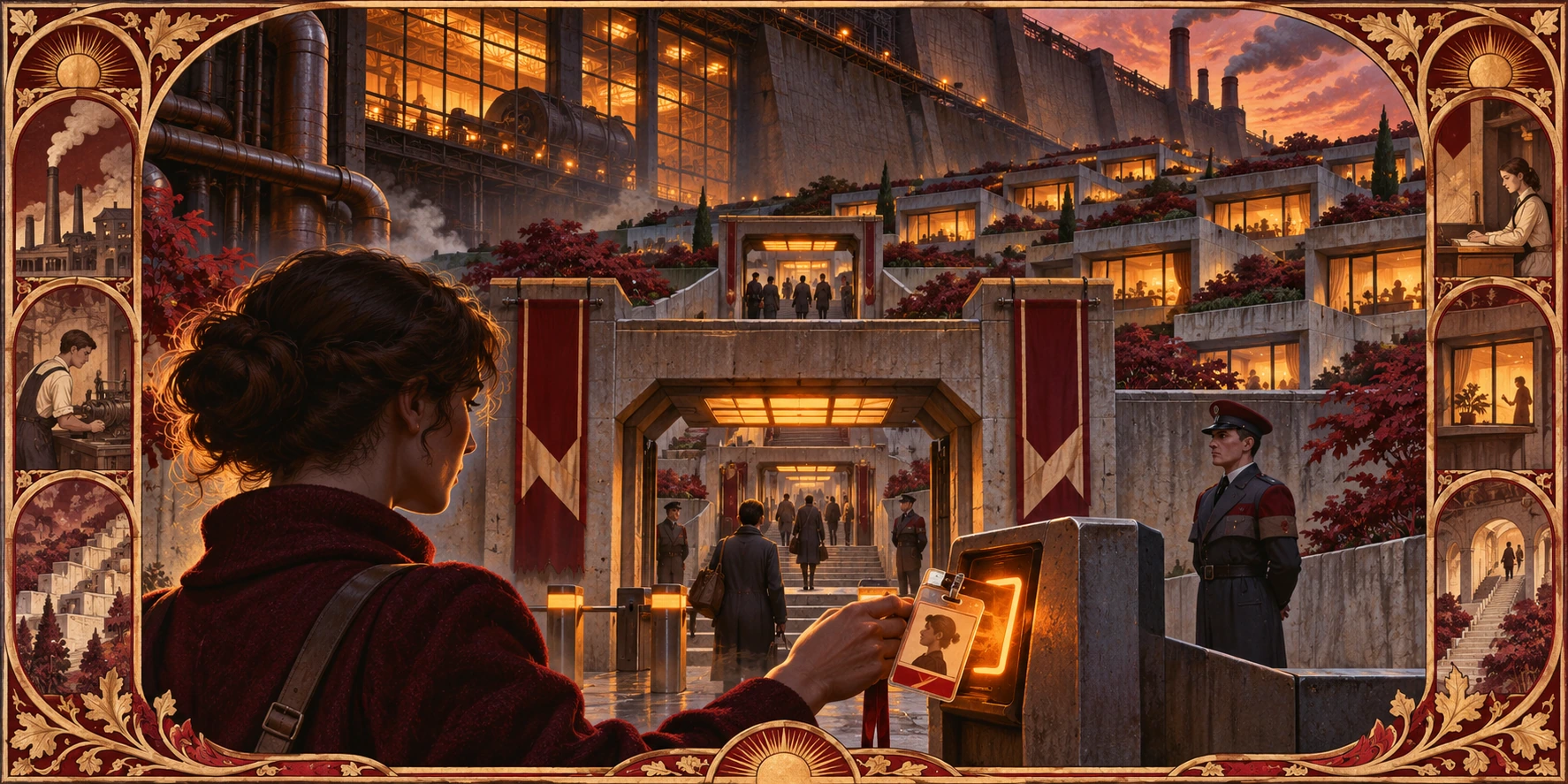
The earlier Corporate Feudalism entry couples a worker’s badge to a house key. Carry that observation forward one step. If the home itself can move while the berth stays under company control, does owning the room give the resident freedom to go anywhere? The cloud and rail settings allow a drawing to ask this without adding an explanatory speech. A botanist at the allotment and a child at the door frame have quite different things at stake in a relocation.
Positive review · AI-authored editorial assessment
The little bowl crossing between rooms makes the premise unusually easy to feel. A docking collar can look ingenious and oppressive in the same image, especially if the person using it has found an ordinary way to feed a neighbour.
Negative review · AI-authored editorial assessment
A fleet of hovering homes can easily become an advert for views. Look for something the household loses in transit, such as the use of a fixed trellis. Without that detail the painting asks viewers to admire engineering while quietly assuming they will supply its social cost.
Neutral review · AI-authored editorial assessment
This visual system suits a storyboard about tenancy, mobility or infrastructure ownership. It communicates the link between two kinds of dependence. Establishing a particular legal right, rent level or historical feudal arrangement would require information outside the frame.
A small poetic detour
Original words from the AOI studio.
Poetry
The rail keeps its teeth.
The bowl travels by hand.
A pencilled inch of growing child
comes loose with the jamb.
Somebody wraps it before the rain.
The inventory has no box for that.
The prompt workshop
Original creative exercises. These prompts create new illustrations, not documentary evidence.
Begin with an object
Paint the kitchen window of a leased cabin. On the sill put a brass key whose cutout repeats the shape of a docking jaw visible beyond the glass. Add one object the tenant has repaired. Morning haze, petrol-blue shadows, one yellow work light, no lettering.
Build a scene
Show an inhabited transfer dock from the shared landing, with one berth vacant and breakfast continuing behind glass in the next two homes. Carry a coral enamel stripe across the docking collars, then break it at the empty space. Let a resident’s herb pots interrupt the symmetry.
Change the conditions
Draw the same mobile apartment on its moving day twice, from the office that assigns berths and from the child’s height beside the door frame. Hold the cabin design and weather constant. Change only the sightline, the distance and which possessions can be seen.
Your next inspiration
Discover another art style
Follow a visual thread to the next subject.
A smile from the studio
Jokes
The brochure calls the apartments fully detached. A resident has suggested adding the day of the week.