
AOI creative concept · not a historical movement
Neon-Chantism is an AOI creative concept for combining luminous colour with visual repetition. “Chant” describes an imagined rhythm within the picture; it does not identify a religious practice or a historical movement. The aim is to make colour and repeated forms work together, without supplying invented founders or treating decorative symbols as cultural evidence.
An AOI creative concept, not an established historical movement.
A visual introduction
Open any image to look closer, then browse the examples.
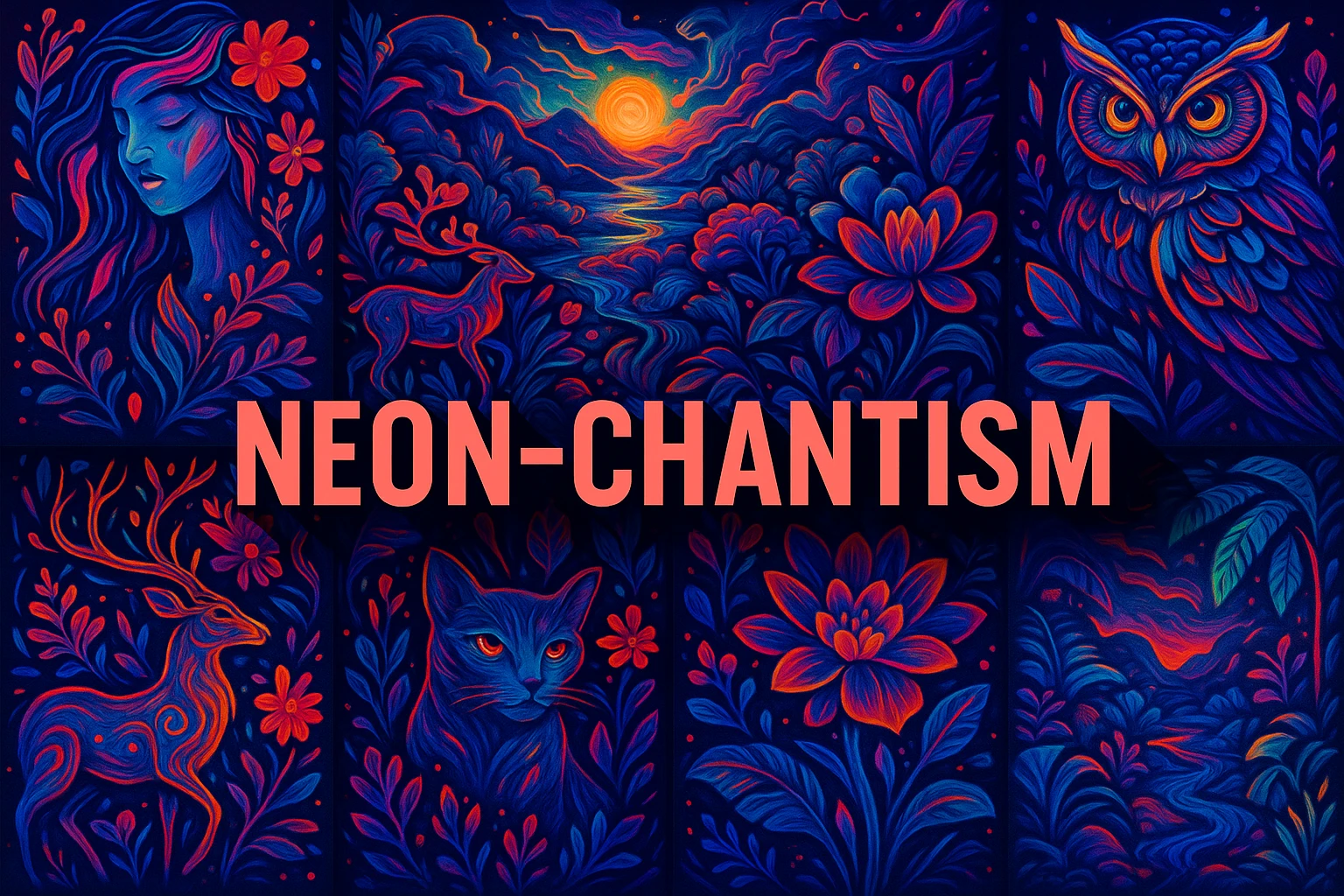
A closer look
The collage places orange-red flowers, eyes and a sun against deep blue foliage and night skies. Curved stems repeat around a face, an owl, a cat and a deer. Small warm accents carry attention between panels, while the dark ground gives the colours room to appear luminous.
Give the eye a phrase it can recognise
A visual refrain might be three repeated leaves, a recurring ring or a sequence of bright points separated by larger areas of darkness. Repetition creates an expectation. Changing one interval or omitting one element can make the pattern feel deliberate rather than mechanically tiled. The useful analogy with a chant is the relation between return and variation, not a claim that a still picture produces sound.
Choose what repeats before choosing how much it glows. If every edge is equally bright, the viewer has little reason to follow one route over another. A dominant rhythm needs quieter passages around it. In the archive collage, the orange sun and eyes stand out partly because much of the surrounding blue remains comparatively subdued.
Neon colour is not the same as a light installation
A screen image can suggest emitted light through contrast and coloured halos. It does not establish what material a depicted object is made from. As a historical comparison, MoMA describes Dan Flavin’s untitled (1969) as two fluorescent tubes arranged at right angles in a corner, with the surrounding space becoming part of the encounter. The material is fluorescent light; calling all luminous art neon would erase that distinction. [1]
Flavin is not assigned to Neon-Chantism, and his work is not reproduced in our collage. The comparison helps separate three things: a bright colour painted on a surface, a simulated glow in an image, and light physically altering a room. Each can be compelling, but they ask different questions of the viewer.
Keep invented ritual visibly invented
The archive image suggests a nocturnal setting through animals, flowers and concentrated warm highlights. Those motifs do not automatically establish spiritual meaning. An owl is a visible bird-shaped figure here; assigning it a universal sacred role would require cultural context that the generated image does not provide.
If you develop an imagined ceremony, invent its objects and describe them as fictional. If you refer to an existing tradition, research the specific community, object and use rather than combining unrelated sacred signs into an exotic atmosphere. Creative freedom becomes more interesting when its choices are intentional. A mysterious mood does not need a counterfeit anthropology department behind it.
Build a study around one controlled change
Make three versions of a simple branch against a dark ground. Keep its shape and background constant. In the first, illuminate every leaf; in the second, illuminate alternate leaves; in the third, leave one unexpected gap in the sequence. Compare how the rhythm changes before introducing additional symbols, creatures or ornament.
For an AI prompt, specify a limited palette, a repeating motif, the position of the brightest accent and a quiet region. Review whether the output actually follows that structure rather than merely producing attractive saturation. Label the result as a synthetic study of the AOI concept. The goal is a picture with a readable pulse, not an electrical bill masquerading as a composition.