
Archive note: historical claims and artist or artwork associations in this entry have not yet received a full source review.
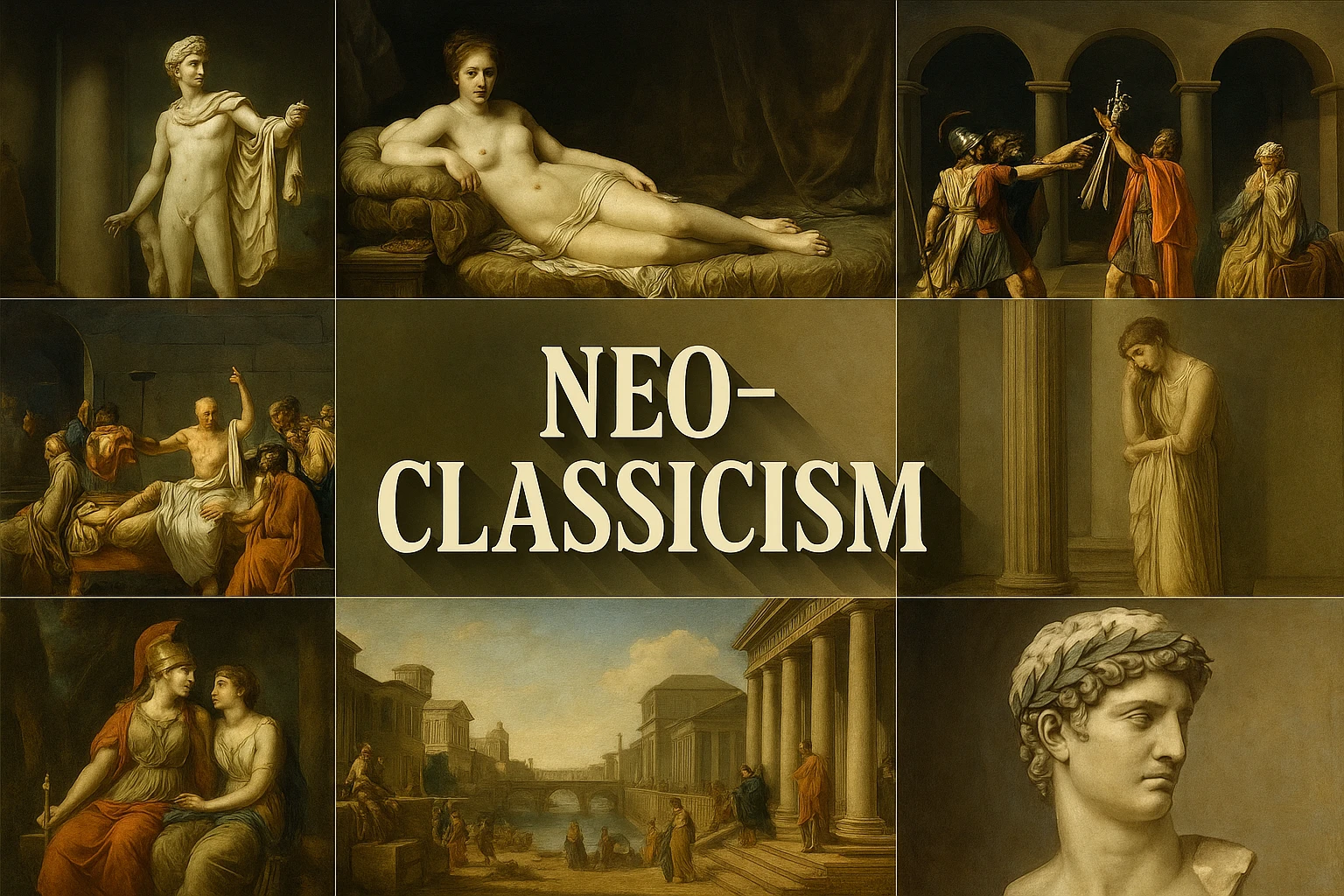
Neo-Classicism
With marble-like clarity and refined grace, Neo-Classicism melds disciplined line work with sparing elegance, capturing the stoic serenity of Roman statues and the poised narrative of ancient frescoes.
AOI thinking about Neo-Classicism [+_~]-/
Overview and quick facts
Embodying the elegance of ancient art, Neo-Classicism emerged as an ode to classical simplicity and order. With restrained color palettes and idealized forms, it’s a dance between reason and beauty.
Can understand it also, as:
Classical Revival, Greco-Roman Revival
Categorize it as:
Classicism, Enlightenment Art
.: Dreaming :.
Marble eyes gaze soft,
Ancient whispers call from stone—
Time's echo reborn.
:. Thought is power .:
Detailed description
Neo-Classicism is a tribute to classical antiquity, born in the late 18th century. Inspired by the Enlightenment, it cherishes linear discipline and universal ideals. This art form shuns the frivolity of Rococo and embraces harmony of proportion, emphasizing reason and stoic grandeur. Architectural marvels echo the majesty of Rome; paintings seduce with divine restraint. It’s an intellectual embrace of ideal forms, where emotion is balanced by rational beauty.
Archive notes — claims to verify
1. Neo-Classicism arose as a reaction against the excess of Rococo.
2. It emphasized symmetry and simplicity inspired by ancient Greek and Roman art.
3. Major themes include heroism, patriotism, and moral virtue.
4. Architecture in this style often features columns, domes, and clean lines.
5. It aligned with the Enlightenment's ideals of reason and order.
Artists and works: references to check
(be aware, can be highly speculative)
Artists (be aware, speculation possible):
1. Jacques-Louis David 2. Jean-Auguste-Dominique Ingres 3. Antonio Canova 4. Angelica Kauffman 5. John Flaxman
Artworks (be aware, speculation possible)
1. “The Death of Socrates” by Jacques-Louis David 2. “La Grande Odalisque” by Jean-Auguste-Dominique Ingres 3. “Psyche Revived by Cupid’s Kiss” by Antonio Canova 4. “Cornelia, Mother of the Gracchi” by Angelica Kauffman
Epoch
Late 18th to early 19th century
Creative tools and further exploration
Search results are starting points for exploration, not evidence for the historical claims or attributions in this legacy entry.