
People and artistic practices in Namibia
Namibians names people, not one visual style. A useful art guide starts with particular makers and media rather than treating a portrait, animal or landscape as a national formula.
A visual introduction
Compare the retained archive studies. The titled collage is modern editorial illustration; its panels are not reproductions of documented works.
Select an image for a closer look. Use the thumbnails, arrow keys or a swipe to compare examples. Zoom in to inspect details, or share the image that inspires you.

Creative toolbox · take this style further
Choose an input and a destination. Search sends your words to the chosen site; Copy & open puts them on your clipboard to paste there.
Create with AI
Turn your chosen input into an image prompt or a new creative direction.
ChatGPT
Copy your input and paste it into a ChatGPT conversation or image request.
Copy & open ChatGPT (new tab)Claude · Anthropic
Develop an image prompt or explore the style in a new Claude conversation.
Copy & open Claude · Anthropic (new tab)Midjourney
Paste your input into the Imagine bar on the Create page.
Copy & open Midjourney (new tab)Adobe Firefly
Copy your input, open Firefly, and paste it into the prompt field.
Copy & open Adobe Firefly (new tab)Leonardo.Ai
Copy your input, open Leonardo, and paste it into the generation field.
Copy & open Leonardo.Ai (new tab)Image search
Find visual references. Short, concrete keywords usually work best.
Lexica
Search AI images and prompts using your selected input.
Search with this input Lexica (new tab)Pexels
Search the photo and video library. Short keywords often work best.
Search with this input Pexels (new tab)Pixabay
Search photos, illustrations and other images.
Search with this input Pixabay (new tab)Unsplash
Search photographs using the style name or your own keywords.
Search with this input Unsplash (new tab)Wikimedia Commons
Search photographs, artworks and historical images. Check each file for its source and reuse terms.
Search with this input Wikimedia Commons (new tab)Art & research
Explore artists, collections and the ideas behind a style.
Wikipedia
Search for background reading. A style may not have its own article.
Search with this input Wikipedia (new tab)WikiArt
Copy your input into WikiArt’s search to explore artists and artworks.
Copy & open WikiArt (new tab)Europeana
Paste your keywords into the search to explore European museum, library and archive collections.
Copy & open Europeana (new tab)Inspiration
Discover portfolios and visual ideas from creative communities.
Instagram hashtags
Search a hashtag made from your input: spaces and punctuation are removed. Instagram may require sign-in.
Search with this input Instagram hashtags (new tab)ArtStation
Paste your input into artwork search for concept art, environments, characters and visual development.
Copy & open ArtStation (new tab)Behance
Paste your input into project search for illustration, design and visual storytelling.
Copy & open Behance (new tab)A closer look
Compare a specific work’s line, material, subject and composition; distinguish a depicted person from the artistic practice used to depict them.
Replace the generalization with a maker
The National Art Gallery of Namibia describes a diverse contemporary art scene and identifies John Muafangejo with linocut printmaking. This gives a concrete point of entry: study the relationship between carved light areas and printed dark masses, then consult a named work for its story and context. It does not make every Namibian artwork a linocut.
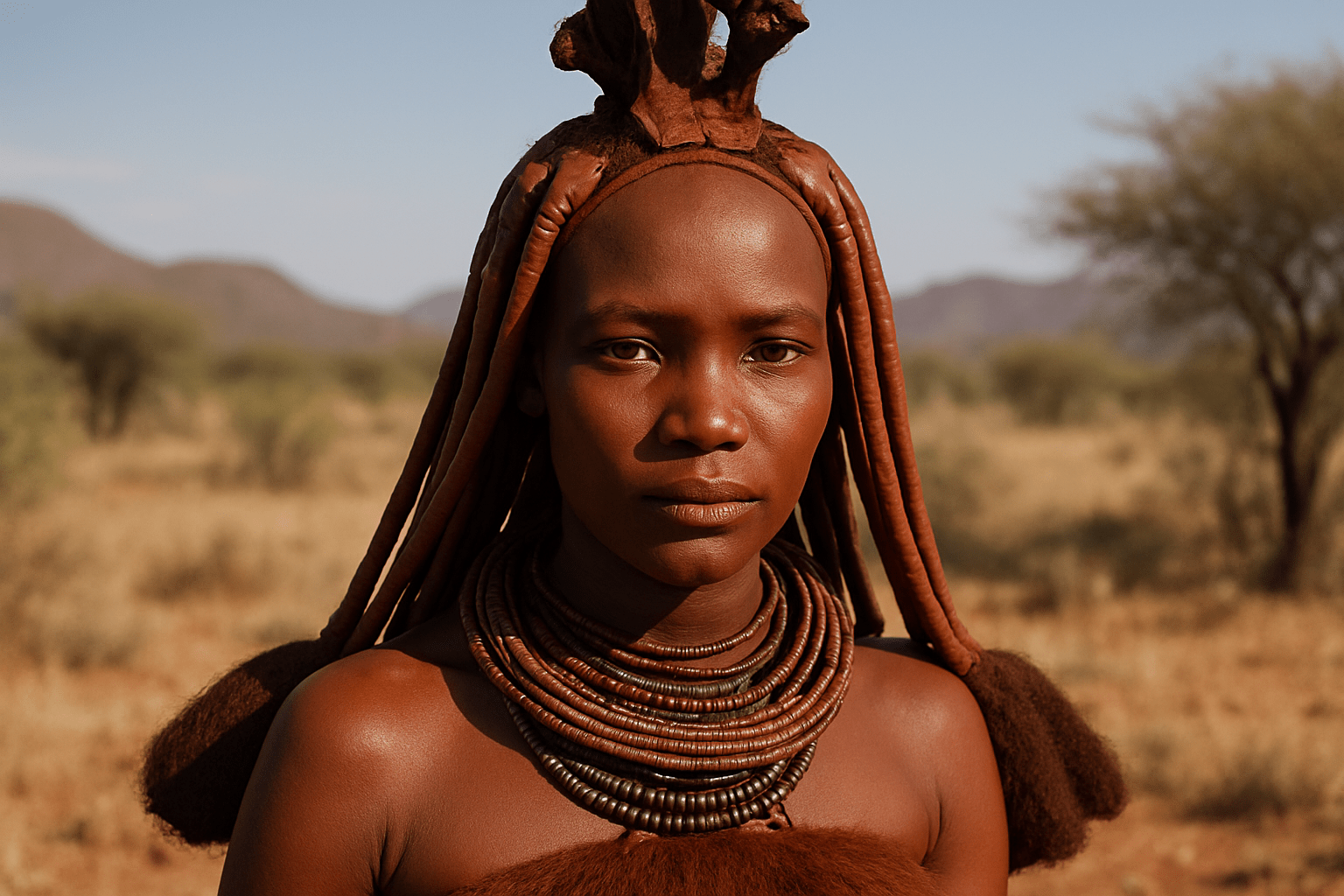
A nationality or community is not a paint effect. Likewise, clothing, a hairstyle or an animal in an image cannot establish the maker’s identity. The retained AOI portrait and collage are imaginative archive illustrations. They should not be used as ethnographic documentation or as a representative sample of all Namibian people and art.
Let the medium carry the exercise
For a contemporary print-inspired study, choose an ordinary scene you can describe precisely: neighbors at a table, a bus stop or a small workshop. Reduce it to black and white, checking that hands, tools and faces remain distinct. A few repeated cut-like marks can describe texture without covering every surface.
Make the story visible through relationships between figures and objects, rather than adding generic costume or wildlife as a shortcut to place. If you depict a documented person or community, use suitable references and identify the context. If the scene is invented, say so. This approach makes the exercise useful for narrative composition while leaving cultural attribution where it belongs: with evidence about a specific maker, work and setting.
The prompt workshop
Original creative exercises. These prompts create new illustrations, not documentary evidence.
A shared table
Create an original black-and-white relief-print-inspired illustration of three neighbors sharing a meal at a simple table. Use clear silhouettes, varied cut-like marks and a strong central arrangement. Invented scene, no ethnic costume shorthand, logos or lettering.
Work and tools
Create an original monochrome print-style image of an adult repairing a bicycle in a small workshop. Make the hands, wheel and tools readable through clean light-dark separation. Use texture sparingly; no text or documentary claims.
Two ways to tell a scene
Create two original black-and-white studies of a community garden, one using broad silhouettes and one using finer cut-like lines. Keep the same invented arrangement of people and plants. No lettering or claimed cultural authenticity.
Sources and further exploration
National Art Gallery of Namibia: artists and the contemporary scene