
A descriptive category used with care
Simplified space can be deliberate and expressive. Naive style is useful as a visual description, but an image alone cannot establish an artist’s training, intelligence or intentions.
A visual introduction
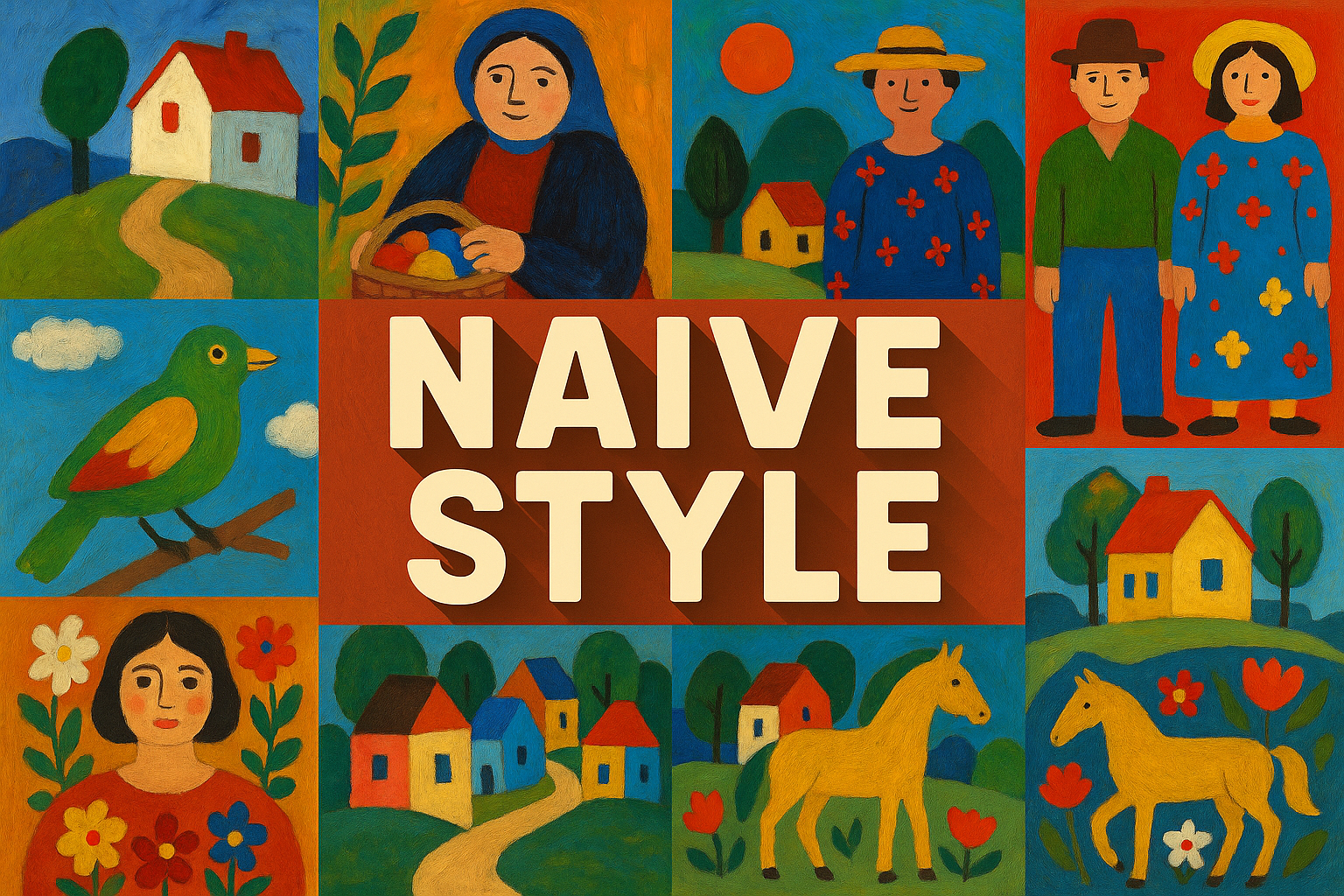
Compare the retained archive studies. The titled collage is modern editorial illustration; its panels are not reproductions of documented works.
Select an image for a closer look. Use the thumbnails, arrow keys or a swipe to compare examples. Zoom in to inspect details, or share the image that inspires you.
Creative toolbox · take this style further
Choose an input and a destination. Search sends your words to the chosen site; Copy & open puts them on your clipboard to paste there.
Create with AI
Turn your chosen input into an image prompt or a new creative direction.
ChatGPT
Copy your input and paste it into a ChatGPT conversation or image request.
Copy & open ChatGPT (new tab)Claude · Anthropic
Develop an image prompt or explore the style in a new Claude conversation.
Copy & open Claude · Anthropic (new tab)Midjourney
Paste your input into the Imagine bar on the Create page.
Copy & open Midjourney (new tab)Adobe Firefly
Copy your input, open Firefly, and paste it into the prompt field.
Copy & open Adobe Firefly (new tab)Leonardo.Ai
Copy your input, open Leonardo, and paste it into the generation field.
Copy & open Leonardo.Ai (new tab)Image search
Find visual references. Short, concrete keywords usually work best.
Lexica
Search AI images and prompts using your selected input.
Search with this input Lexica (new tab)Pexels
Search the photo and video library. Short keywords often work best.
Search with this input Pexels (new tab)Pixabay
Search photos, illustrations and other images.
Search with this input Pixabay (new tab)Unsplash
Search photographs using the style name or your own keywords.
Search with this input Unsplash (new tab)Wikimedia Commons
Search photographs, artworks and historical images. Check each file for its source and reuse terms.
Search with this input Wikimedia Commons (new tab)Art & research
Explore artists, collections and the ideas behind a style.
Wikipedia
Search for background reading. A style may not have its own article.
Search with this input Wikipedia (new tab)WikiArt
Copy your input into WikiArt’s search to explore artists and artworks.
Copy & open WikiArt (new tab)Europeana
Paste your keywords into the search to explore European museum, library and archive collections.
Copy & open Europeana (new tab)Inspiration
Discover portfolios and visual ideas from creative communities.
Instagram hashtags
Search a hashtag made from your input: spaces and punctuation are removed. Instagram may require sign-in.
Search with this input Instagram hashtags (new tab)ArtStation
Paste your input into artwork search for concept art, environments, characters and visual development.
Copy & open ArtStation (new tab)Behance
Paste your input into project search for illustration, design and visual storytelling.
Copy & open Behance (new tab)A closer look
Clear contours, flattened depth, repeated motifs, direct color and scale chosen for emphasis rather than optical accuracy.
Simplicity is not lack of thought
The label naive is often associated with self-taught art, but formal appearance and an artist’s biography are different kinds of evidence. MoMA identifies Henri Rousseau as self-taught and discusses the strange meeting of an interior figure and imagined jungle in The Dream, 1910. His carefully organized picture is a better reference than the assumption that an unconventional perspective is merely a mistake.
A contemporary artist can deliberately flatten space or simplify a face. That choice does not make the work equivalent to every self-taught tradition. Describe what the image does: perhaps houses stack upward instead of receding, or flowers grow larger because they matter to the story.
Build a readable world
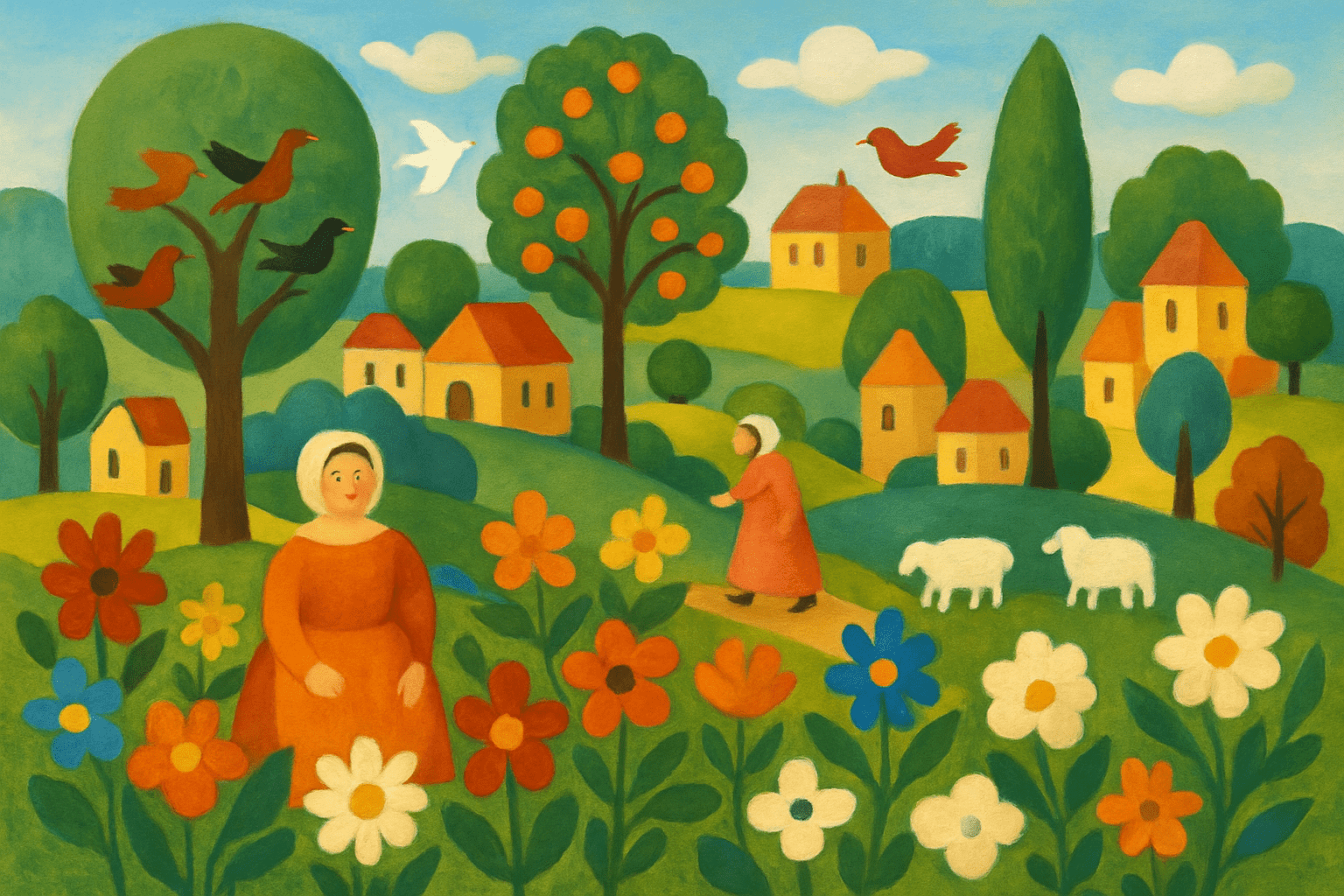
Choose a small set of shapes and repeat them with variation. A round tree, a triangular roof and an oval face can establish a consistent visual vocabulary. Separate nearby forms by color and contour so that the scene remains legible even when conventional perspective is relaxed.
In the archive village, bright flowers and people share attention with trees and houses. The composition works through patterned intervals rather than a single realistic viewpoint. For an original exercise, decide where the viewer should linger and enlarge or brighten that area. Avoid making every object equally busy. A quiet patch of sky or grass gives the repeated motifs room to breathe. The result can be warm, strange or unsettling; cheerfulness is not a requirement of simplified representation.
The prompt workshop
Original creative exercises. These prompts create new illustrations, not documentary evidence.
A village told in shapes
Create an original painting of a small village garden with rounded trees, simple houses and two people carrying flowers. Use flattened depth, clear contours and direct blocks of color. Vary repeated motifs and leave a quiet sky; no text.
Scale for meaning
Create an original flattened narrative painting of a child-sized adult gardener beside an enormous flowering plant and a small distant house. Make the unusual scale intentional, with consistent simple shapes and careful spacing. No lettering.
A quiet strange room
Create an original painting of a simple room containing a chair, a sleeping cat and a garden growing through an open window. Use clear contours, shallow space and a restrained palette. Quietly dreamlike, no text.