
Historical movement · Mexican muralism
Muralismo Mexicano turns the wall into a public argument. Monumental figures, connected episodes and architectural scale give work, history and collective life a place that viewers can enter together.
A visual introduction
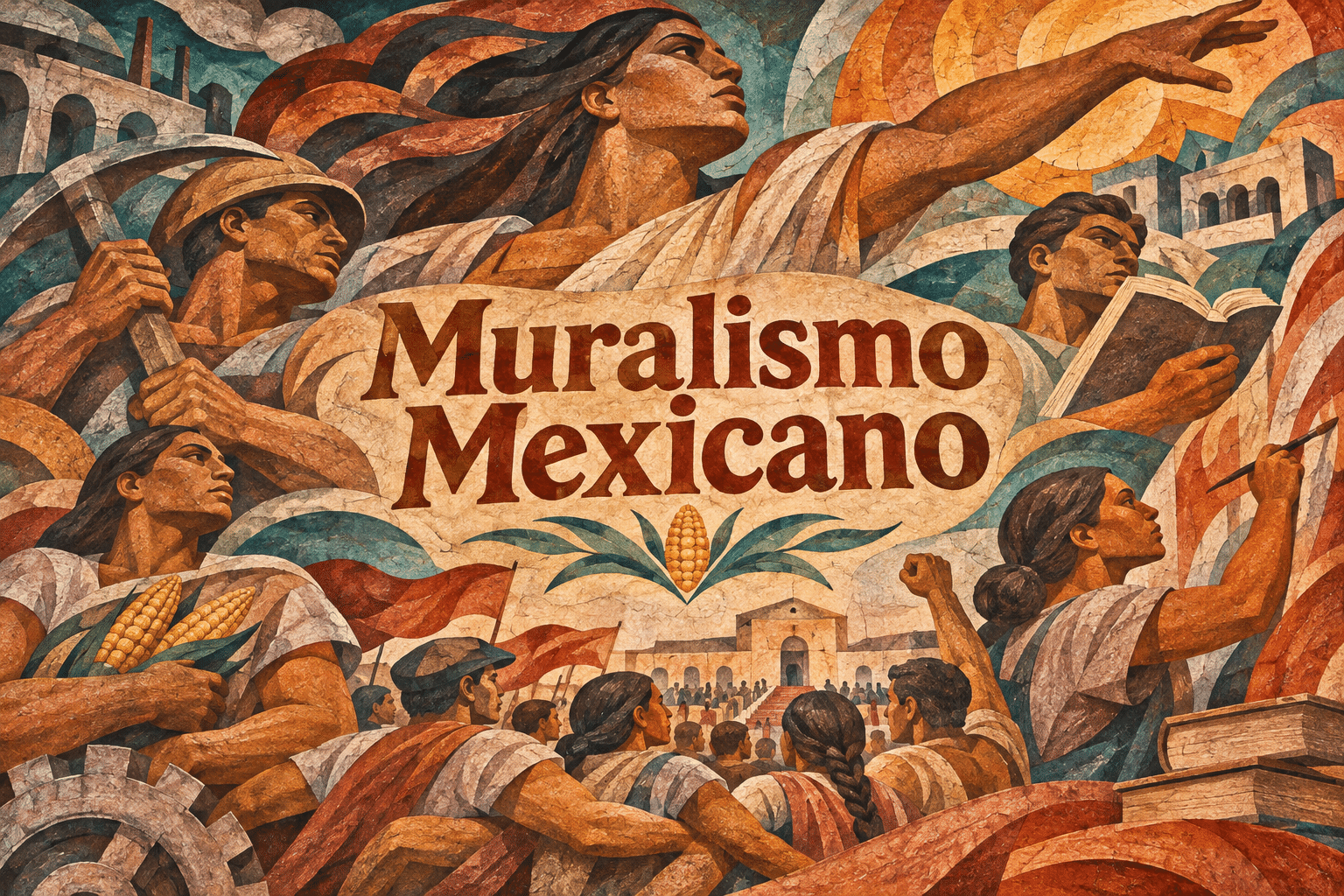
Seven original AI-generated interpretations: a dedicated banner, a centrally titled artistic collage and five standalone studies.
Select an image for a closer look. Use the thumbnails, arrow keys or a swipe to compare examples. Zoom in to inspect details, or share the image that inspires you.
Creative toolbox · take this style further
Choose an input and a destination. Search sends your words to the chosen site; Copy & open puts them on your clipboard to paste there.
Create with AI
Turn your chosen input into an image prompt or a new creative direction.
ChatGPT
Copy your input and paste it into a ChatGPT conversation or image request.
Copy & open ChatGPT (new tab)Claude · Anthropic
Develop an image prompt or explore the style in a new Claude conversation.
Copy & open Claude · Anthropic (new tab)Midjourney
Paste your input into the Imagine bar on the Create page.
Copy & open Midjourney (new tab)Adobe Firefly
Copy your input, open Firefly, and paste it into the prompt field.
Copy & open Adobe Firefly (new tab)Leonardo.Ai
Copy your input, open Leonardo, and paste it into the generation field.
Copy & open Leonardo.Ai (new tab)Image search
Find visual references. Short, concrete keywords usually work best.
Lexica
Search AI images and prompts using your selected input.
Search with this input Lexica (new tab)Pexels
Search the photo and video library. Short keywords often work best.
Search with this input Pexels (new tab)Pixabay
Search photos, illustrations and other images.
Search with this input Pixabay (new tab)Unsplash
Search photographs using the style name or your own keywords.
Search with this input Unsplash (new tab)Wikimedia Commons
Search photographs, artworks and historical images. Check each file for its source and reuse terms.
Search with this input Wikimedia Commons (new tab)Art & research
Explore artists, collections and the ideas behind a style.
Wikipedia
Search for background reading. A style may not have its own article.
Search with this input Wikipedia (new tab)WikiArt
Copy your input into WikiArt’s search to explore artists and artworks.
Copy & open WikiArt (new tab)Europeana
Paste your keywords into the search to explore European museum, library and archive collections.
Copy & open Europeana (new tab)Inspiration
Discover portfolios and visual ideas from creative communities.
Instagram hashtags
Search a hashtag made from your input: spaces and punctuation are removed. Instagram may require sign-in.
Search with this input Instagram hashtags (new tab)ArtStation
Paste your input into artwork search for concept art, environments, characters and visual development.
Copy & open ArtStation (new tab)Behance
Paste your input into project search for illustration, design and visual storytelling.
Copy & open Behance (new tab)A closer look
Build broad interlocking masses and a clear rhythm of gestures. Relate figures to the wall, viewing distance and surrounding architecture; let a few repeated colors and directional lines connect the narrative.
A movement with a public address
Mexican muralism belongs to the cultural transformation following the Mexican Revolution, rather than describing every mural made in Mexico. The Whitney Museum places its emergence in the new public relationship of art after 1920 and identifies José Clemente Orozco, Diego Rivera and David Alfaro Siqueiros as leading figures. Its account emphasizes social justice, national life and the movement's substantial influence on artists in the United States. [1]
Treat those concerns as part of the work, not background decoration. A large painted worker does not automatically make an image muralist: ask what the image says about labor, education, land, power and the people who are allowed to occupy public space. The movement contains different artistic voices and political positions, not one universal Mexican appearance.
Read the wall before the details
AOI's practical starting point is a three-distance test. From far away, the mural needs a few legible masses. At walking distance, gestures and repeated shapes should connect episodes. Close up, faces, tools and material handling can reward attention. If every face demands equal contrast, the wall becomes a queue of portraits rather than a continuous composition.
Design around an actual architectural situation, even for an imagined digital study. A doorway interrupts the field; a stair changes the viewer's eye level; a corner can join two accounts of the same event. A long horizontal panel can carry a procession, while an upright wall can build pressure through stacked figures. These are workshop decisions, not rules shared by every historical mural.
A documented example: Detroit Industry
The Detroit Institute of Arts records Rivera's Detroit Industry Murals as frescoes dated 1932–1933. Its collection account discusses the dual qualities of humanity, nature and technology, including industrial power and the symbolism of life and death. This is a useful counterweight to treating machinery as either an uncomplicated hero or a simple enemy. [2]
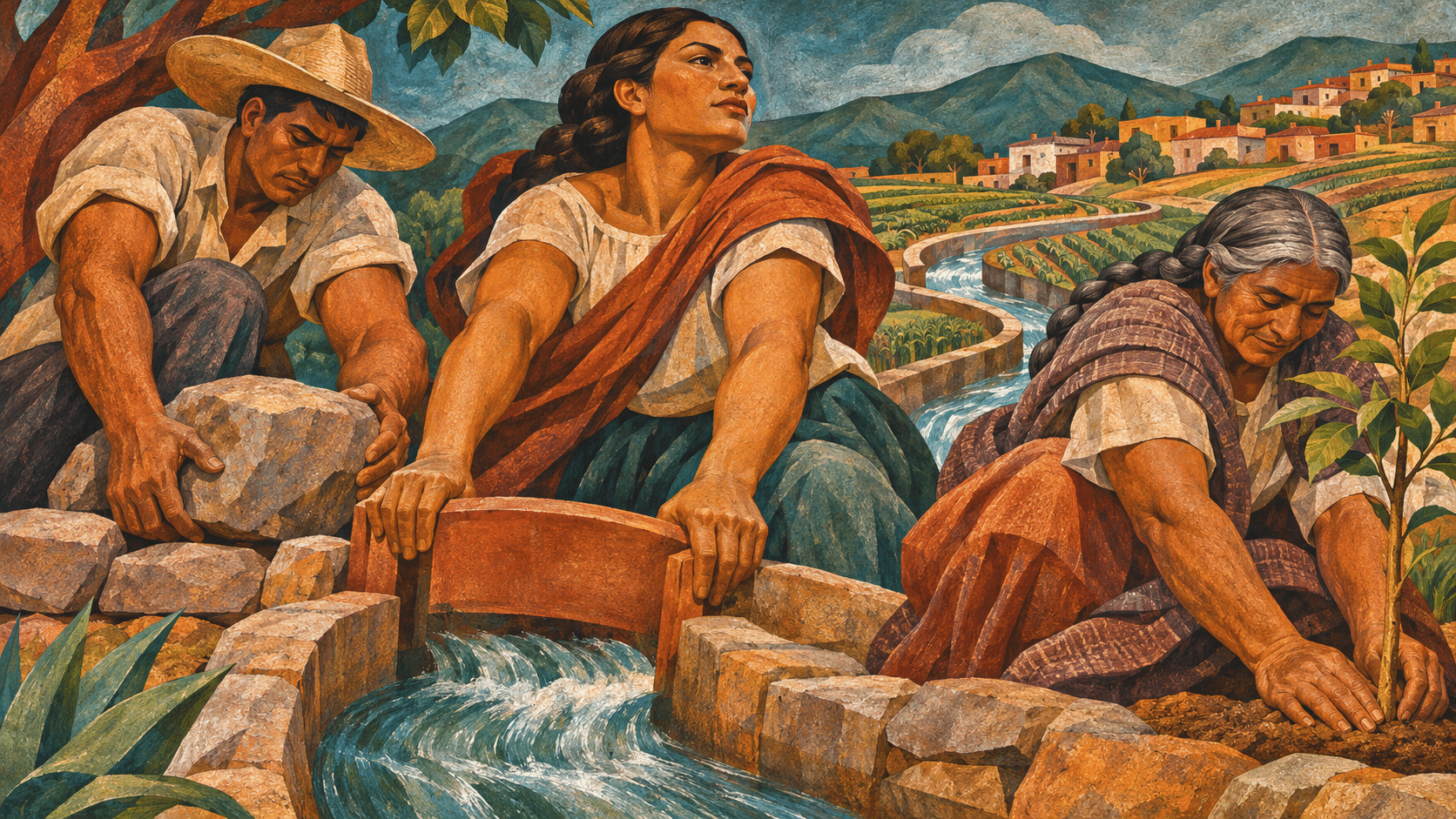
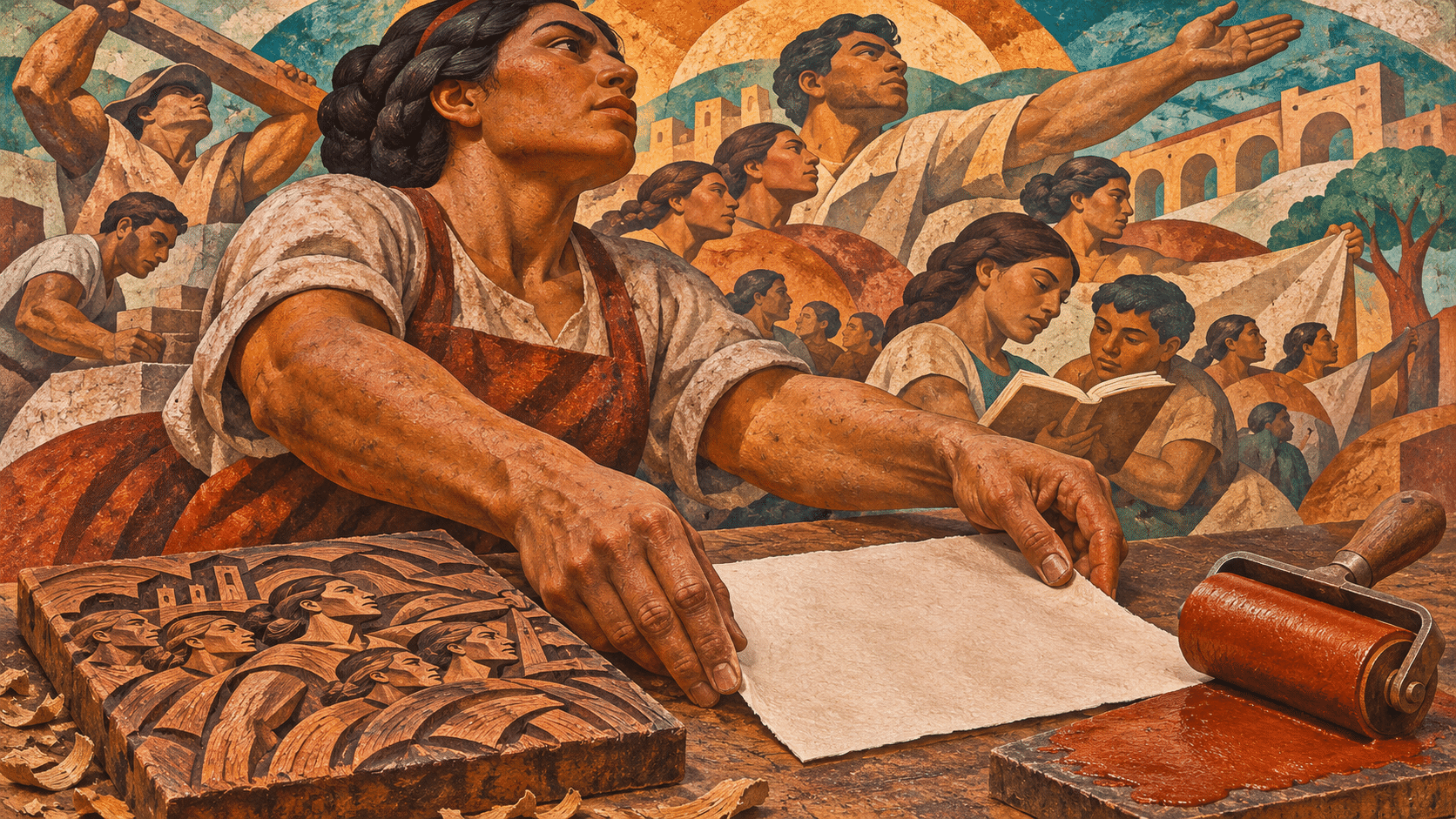
For a new study, show how a tool changes relationships between people. A water channel joins upstream and downstream lives; a printing block connects a maker with an audience. Keep the activity physically readable. Hands should hold the object, bodies should carry weight, and the architecture should provide a believable stage even when scale is deliberately exaggerated.
Surface, color and material
Fresco is an important reference here, but the name of a movement should not be reduced to a texture preset. The DIA's medium record describes a real wall-painting material; the illustrations on this page are generated interpretations. Their mineral-looking surfaces do not prove the use of wet plaster or physical pigments. [2]
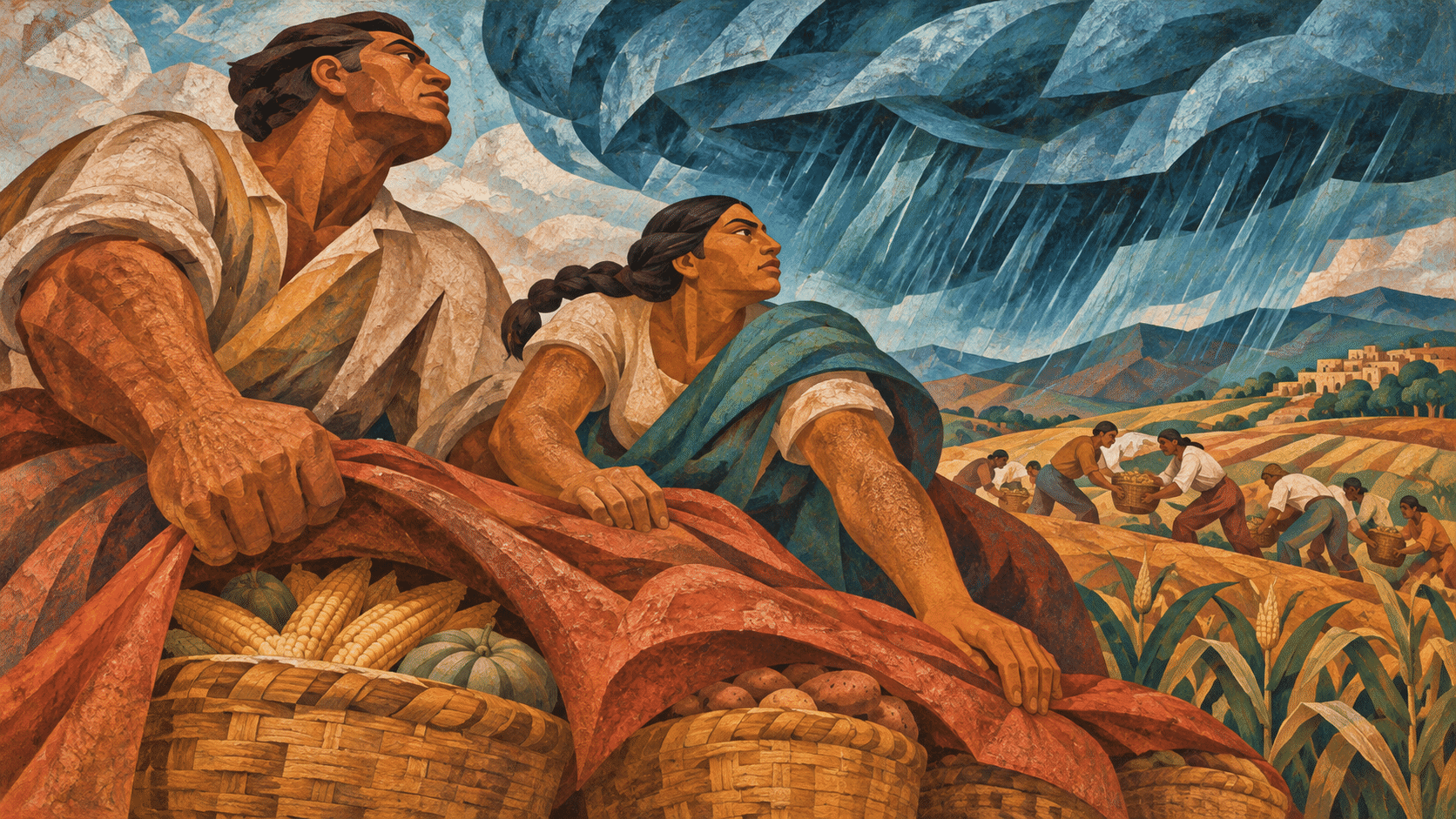
In the accompanying studies, terracotta and ochre make a warm figure family, while teal water or storm shapes establish a cool counter-rhythm. The colors recur across people and landscape so that the image reads as one field. A quieter passage around a face or hand can be more powerful than an extra band of ornament.
Agency, history and interpretation
An ethical visual study gives people purposeful actions and individual attention. Avoid a decorative inventory of supposedly national symbols. Do not substitute anonymous heroism for specific historical knowledge, and do not present a new generated scene as a surviving revolutionary mural.
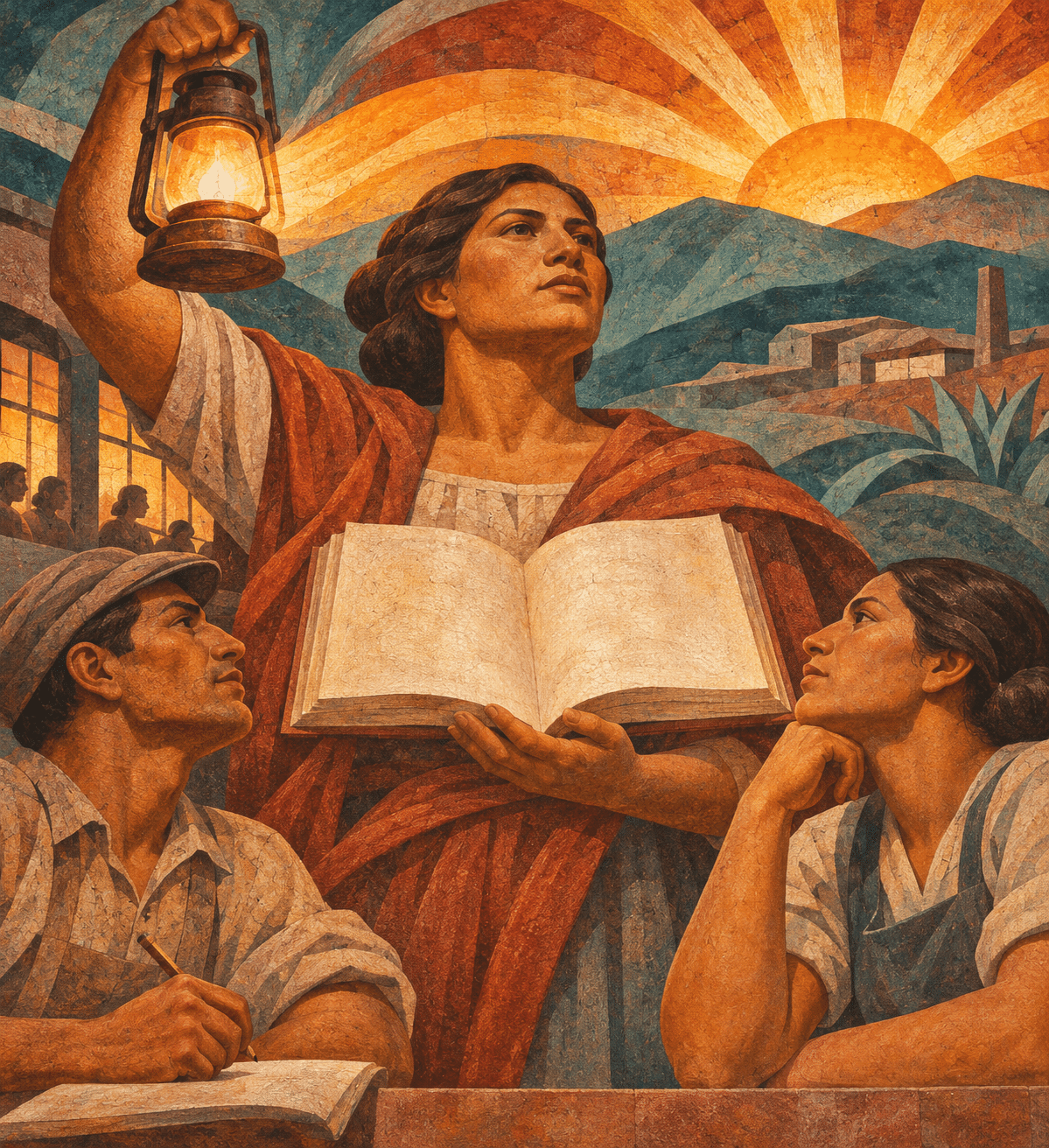
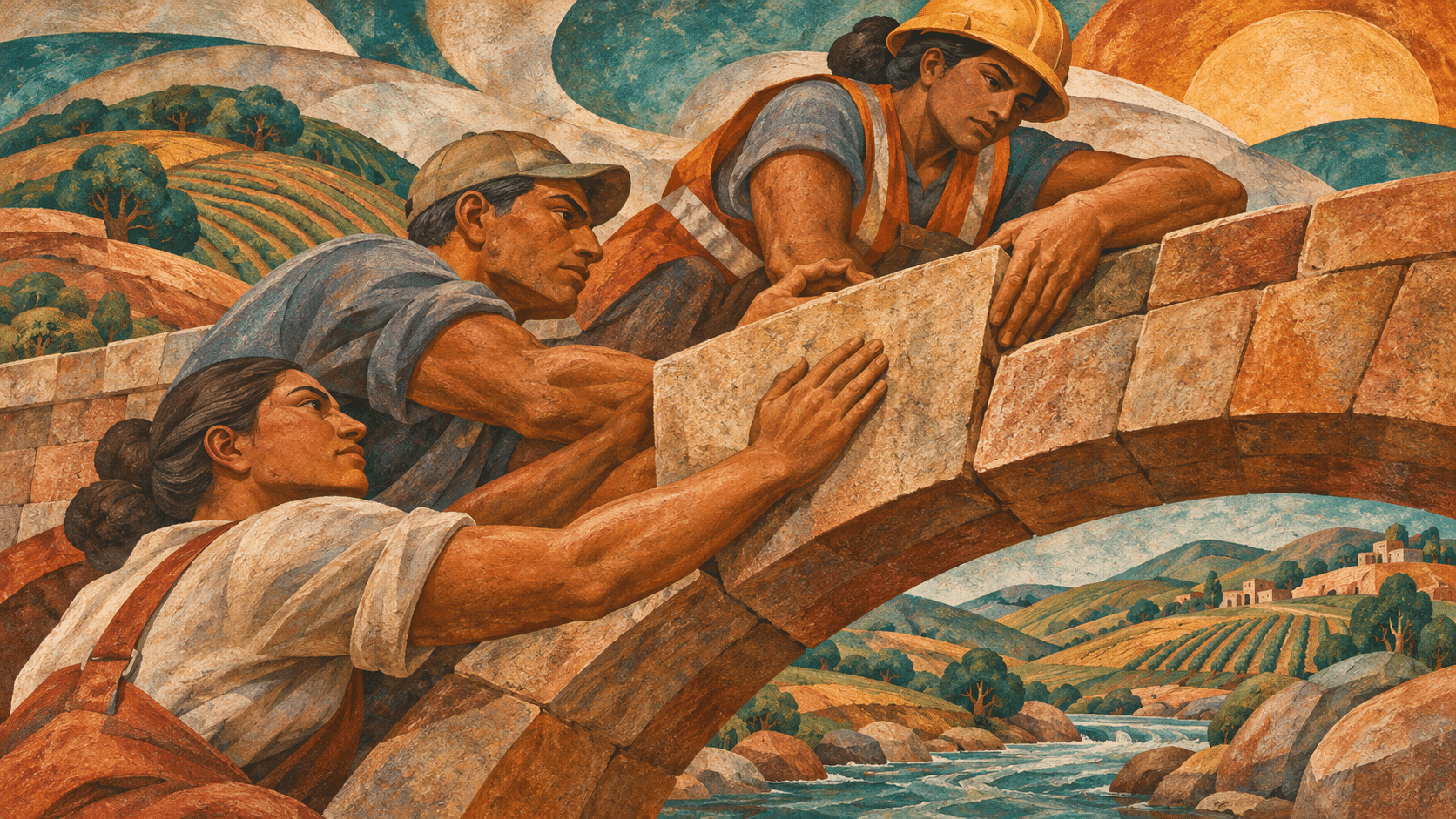
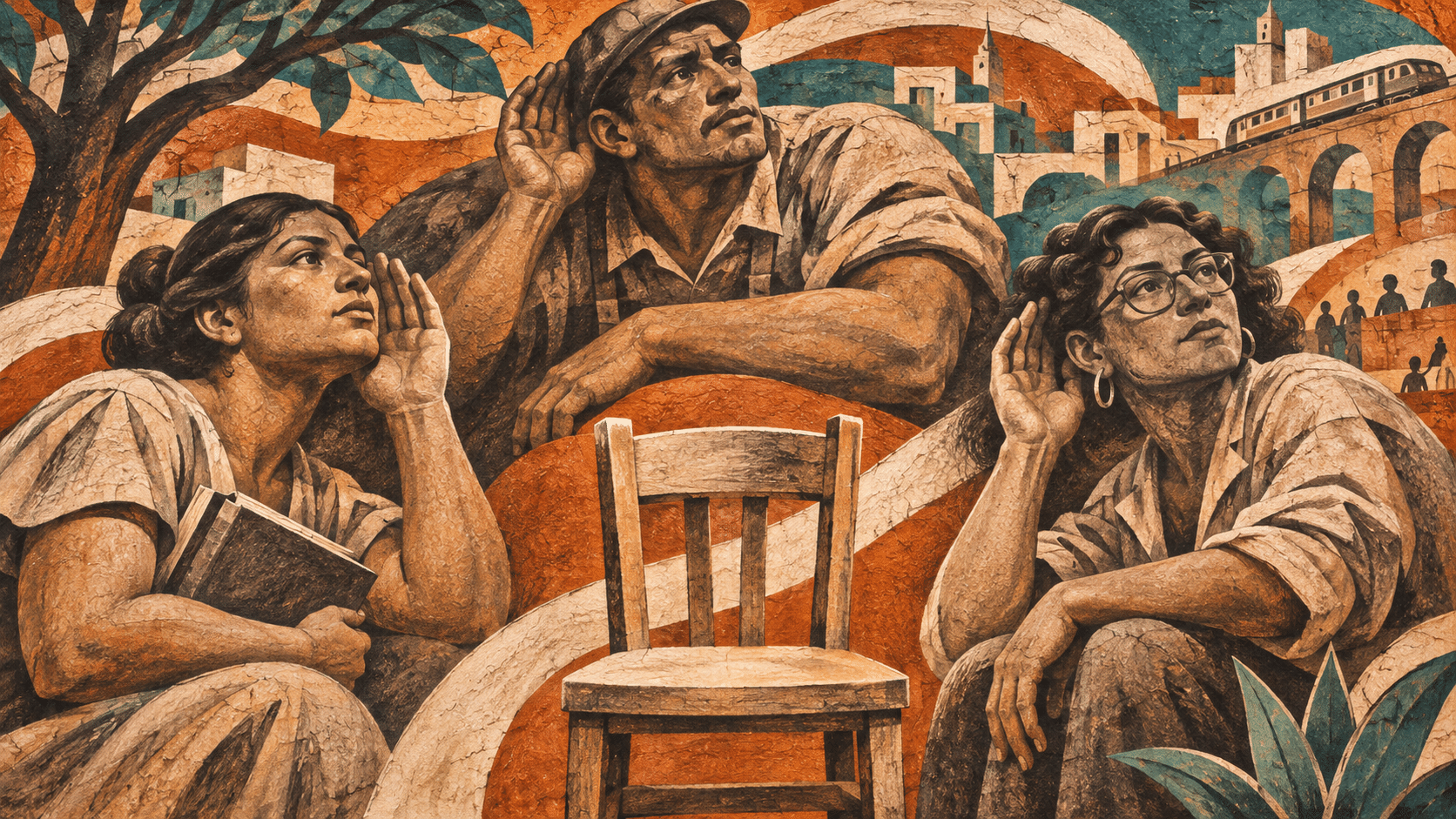
The seven images here are contemporary AOI exercises, not historical reconstructions. Water repair, learning, bridge building and printmaking make different kinds of collective action visible. The listening scene changes the emphasis: the empty chair reserves space for a person or account that the image does not yet contain.
Use the approach without flattening it
This visual language can support public-history interpretation, editorial illustration and proposals for community art. For an actual commissioned wall, the people who use the place should help define the subject and its meaning. A spectacular image cannot stand in for that conversation.
Start with one event, three main value groups and a route through the composition. Test the picture small, then examine the focal hands and faces at full size. Remove symbols that do no narrative work. Finally ask whether the image invites a viewer to think, or merely tells them what to admire.
Positive editorial perspective
AOI editorial perspective (AI-authored). Monumental scale can make ordinary work publicly visible. A shared gesture gives a large composition an intelligible human center, while connected episodes reward a viewer who moves along the wall.
Negative editorial perspective
AOI editorial perspective (AI-authored). A superficial imitation turns history into heroic poses and decorative stereotypes. Too many symbols flatten the argument. Give figures distinct agency, research the setting and let quieter intervals interrupt the rhetoric.
Neutral editorial perspective
AOI editorial perspective (AI-authored). Mexican muralism is a historically situated movement with varied practitioners. These digital studies explore public narrative and compositional scale; they do not reproduce its materials, political circumstances or community processes.
Pocket-sized facts
Mexican muralism emerged in the post-revolutionary cultural transformation of the early twentieth century. [1]
Rivera's Detroit Industry Murals are dated 1932–1933 and recorded as frescoes by the DIA. [2]
The illustrations here are original AI-generated interpretations, not reproductions of historical murals.
A small poetic detour
Original words from the AOI studio.
Poetry
A wall remembers more than weather.
It holds the elbow, lifted stone,
the water guided back to gardens,
the book no reader owns alone.
A hand becomes a road through color;
a shoulder bears the afternoon.
Beyond the painted edge, a neighbor
will bring a different story soon.
Leave room beside the bright procession.
Leave one chair open in the square.
The wall can speak across a city;
it must also learn to hear.
The prompt workshop
Original creative exercises. These prompts create new illustrations, not documentary evidence.
One shared task
Create an original mural-inspired scene of three neighbors repairing a water channel. Use broad interlocking shapes, readable working hands and a river line connecting figures to distant fields. Warm earth colors against cool water, no text. Contemporary interpretation, not a historical reconstruction.
Make the activity legible before adding symbols.
The wall as a sequence
Create an exceptional standalone original artwork. Vary aspect ratio to fit the stated composition. The repaired bridge: landscape composition, three contemporary workers assembling a broad arch whose stones merge with cultivated hills, diagonal shared effort. Original contemporary interpretation of Mexican muralism: monumental painted figures with coherent anatomy, broad interlocking rhythmic forms, public narrative and collective agency, mineral fresco-like texture, terracotta ochre and teal. No reproduction of historical artworks, no generic cultural stereotypes. No text, lettering, logo, watermark or signature.
Let the arch and hills repeat one curve at different scales.
A public pause
Create an exceptional standalone original artwork. Vary aspect ratio to fit the stated composition. The city listens: monochrome charcoal-like mural on warm plaster, three diverse adult city neighbors in listening poses around one empty chair, bold black rhythm and white interval. Original contemporary interpretation of Mexican muralism: monumental painted figures with coherent anatomy, broad interlocking rhythmic forms, public narrative and collective agency, mineral fresco-like texture, terracotta ochre and teal. No reproduction of historical artworks, no generic cultural stereotypes. No text, lettering, logo, watermark or signature.
Try black and ivory first; reserve empty space for the absent voice.
People & works to explore
References discussed in this article. Consult the sources below for context.
Artists and practitioners
Diego Rivera
José Clemente Orozco
David Alfaro Siqueiros
Paintings and other works
Diego Rivera — Detroit Industry Murals (1932–1933)
A smile from the studio
Jokes
The mural committee asked for a small revision: could the bridge move slightly left, the river become more optimistic, and the entire history of collective labor fit above the light switch? The painter considered the wall. “Yes,” she said, “but the light switch will need a supporting role.”