
Artistic medium and technique
Discover mosaic through tesserae, directional rows, stone, ceramic and reflective glass, with historical context, varied artworks and practical design prompts.
A visual introduction
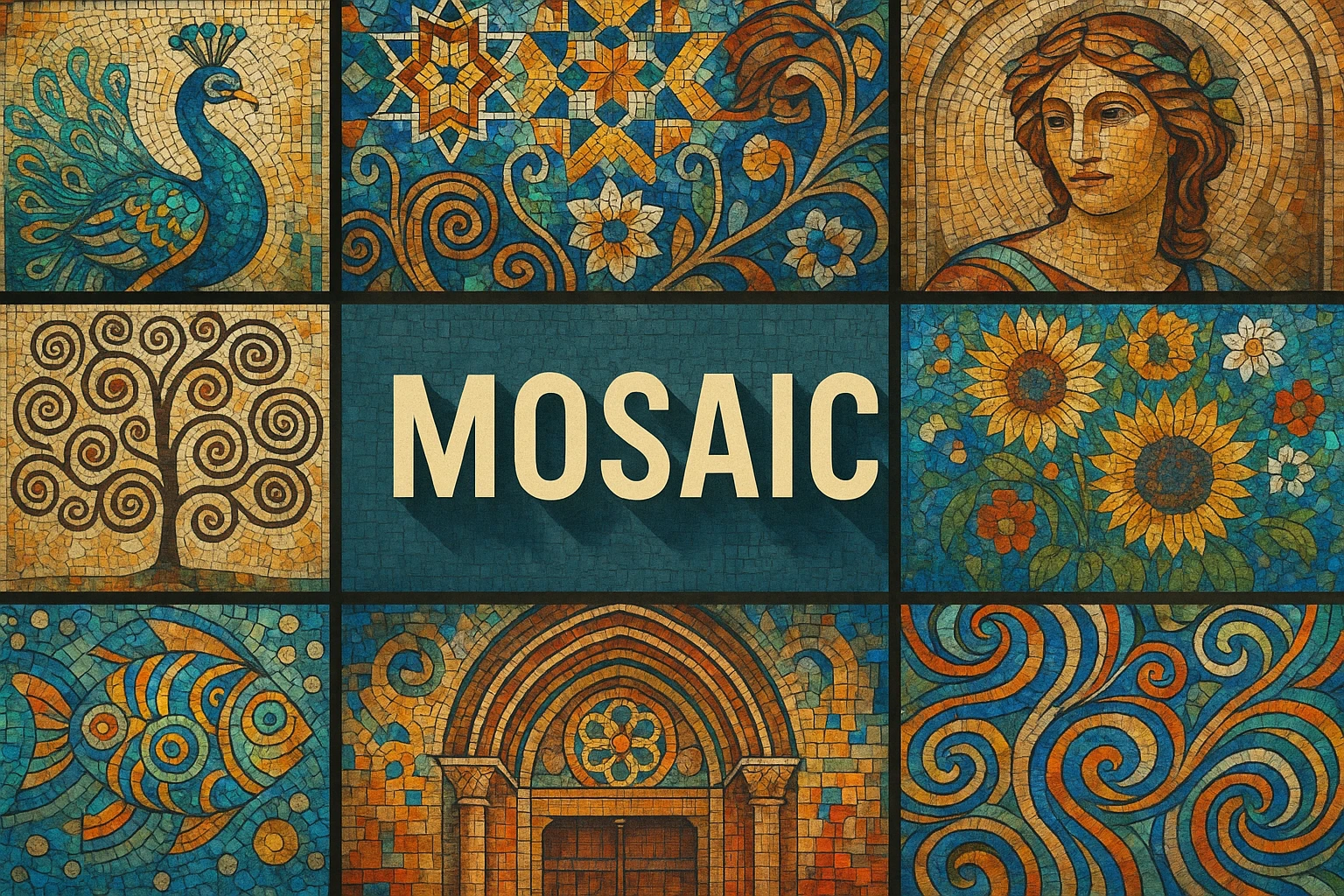
Six new AI-generated artworks join the reviewed existing MOSAIC collage: one dedicated banner and five standalone studies explore stone, reflective glass, ceramic fragments, borders and botanical forms. These are concept illustrations, not documented historical or fabricated works. Previous material remains archived.
Select an image for a closer look. Use the thumbnails, arrow keys or a swipe to compare examples. Zoom in to inspect details, or share the image that inspires you.
Creative toolbox · take this style further
Choose an input and a destination. Search sends your words to the chosen site; Copy & open puts them on your clipboard to paste there.
Create with AI
Turn your chosen input into an image prompt or a new creative direction.
ChatGPT
Copy your input and paste it into a ChatGPT conversation or image request.
Copy & open ChatGPT (new tab)Claude · Anthropic
Develop an image prompt or explore the style in a new Claude conversation.
Copy & open Claude · Anthropic (new tab)Midjourney
Paste your input into the Imagine bar on the Create page.
Copy & open Midjourney (new tab)Adobe Firefly
Copy your input, open Firefly, and paste it into the prompt field.
Copy & open Adobe Firefly (new tab)Leonardo.Ai
Copy your input, open Leonardo, and paste it into the generation field.
Copy & open Leonardo.Ai (new tab)Image search
Find visual references. Short, concrete keywords usually work best.
Lexica
Search AI images and prompts using your selected input.
Search with this input Lexica (new tab)Pexels
Search the photo and video library. Short keywords often work best.
Search with this input Pexels (new tab)Pixabay
Search photos, illustrations and other images.
Search with this input Pixabay (new tab)Unsplash
Search photographs using the style name or your own keywords.
Search with this input Unsplash (new tab)Wikimedia Commons
Search photographs, artworks and historical images. Check each file for its source and reuse terms.
Search with this input Wikimedia Commons (new tab)Art & research
Explore artists, collections and the ideas behind a style.
Wikipedia
Search for background reading. A style may not have its own article.
Search with this input Wikipedia (new tab)WikiArt
Copy your input into WikiArt’s search to explore artists and artworks.
Copy & open WikiArt (new tab)Europeana
Paste your keywords into the search to explore European museum, library and archive collections.
Copy & open Europeana (new tab)Inspiration
Discover portfolios and visual ideas from creative communities.
Instagram hashtags
Search a hashtag made from your input: spaces and punctuation are removed. Instagram may require sign-in.
Search with this input Instagram hashtags (new tab)ArtStation
Paste your input into artwork search for concept art, environments, characters and visual development.
Copy & open ArtStation (new tab)Behance
Paste your input into project search for illustration, design and visual storytelling.
Copy & open Behance (new tab)A closer look
Tesserae form both the subject and a visible pattern of joints; their arrangement can follow contours, establish rhythm or make light and texture part of the composition.
Look at the pieces and the whole
Mosaic builds an image or pattern from separate pieces, often called tesserae, set into a larger surface. Getty’s account of its Syrian peacock fragment explains the use of cut stone and notes ceramic and glass as other possible materials. The component does not define one universal historical style: mosaics belong to many periods and settings, with different visual priorities.
The Metropolitan Museum’s record of fifty Byzantine tesserae identifies glass with gold and silver leaf. Getty’s peacock fragment uses stone to describe a bird and its surroundings. These examples show why mosaic cannot be reduced to a filter that divides a photograph into identical squares. The choices of piece, joint, row and surface participate in making the image.
Direction can describe form
Follow the rows around a contour. They may turn with a body, reinforce a border or create a different rhythm in the background. In Getty's peacock fragment, the arrangement of stones helps articulate the bird and surrounding design. The joints participate in drawing rather than merely separating colors.
For an original exercise, draw a simple leaf or vessel and decide how rows of pieces will move around it. Compare a contour-following arrangement with a rigid grid. Neither is automatically better, but they produce different spatial and rhythmic effects.
Choose scale before adding detail
Small pieces permit finer transitions, while larger pieces can make the material rhythm more apparent. Determine the intended viewing distance. An eye or a narrow stem needs enough material resolution to remain readable, but excessive detail can weaken the larger pattern.
Treat the gaps as part of the design. Their width and color affect contrast between neighboring pieces. A dark joint can sharpen a light shape; a closely matched joint can make it read as a more continuous field. Keep the spacing intentional rather than uniformly perfect by default.
Material changes the light
Stone, ceramic and glass do not reflect light in the same way. A glass surface can create small highlights that change with the viewer's position; a matte stone field can emphasize color and arrangement. Specify the intended material when designing or prompting an interpretation.
An original digital mosaic study should remain clear about its medium. It may propose a material arrangement without being a fabricated mosaic. When discussing an actual historical object, retain its documented place, date and materials instead of assigning a generic “ancient” identity.
Keep historical places and materials specific
Getty dates its Mosaic Fragment with Peacock Facing Left to the fifth or sixth century and identifies Syria as its place of creation. The bird is outlined and surrounded by vines; the museum relates the fragment to a larger church-floor composition. This is a particular surviving object, not a template for every ancient mosaic. Follow its current collection record for provenance and documented context.
For the Great Umayyad Mosque in Damascus, the French Ministry of Culture’s archaeological resource describes coloured glass tesserae and metal leaf enclosed between glass layers. It also identifies mother-of-pearl pieces used for selected details. Its account of gold backgrounds and silver mixed into water motifs demonstrates how material could help articulate a subject as well as supply colour. These observations concern that monument and should not be generalized to every mosaic tradition.
The surface begins before the visible pieces
The same Damascus resource describes a preparatory drawing and a setting bed of mortar. Underpainting helped guide the placement of colours, and the orientation of gold tesserae could enhance reflection toward a viewer. This is useful historical evidence that the finished image depended on preparation and placement, not simply on choosing attractive pieces.
For a contemporary design study, begin by deciding whether the proposed work is a wall panel, a floor pattern or a small object. That decision changes viewing angle, scale and the relationship of the image to its surroundings. The illustrations here explore visual arrangements only. They do not specify a substrate, adhesive or construction method for an actual installation.
Six new studies, six visual problems
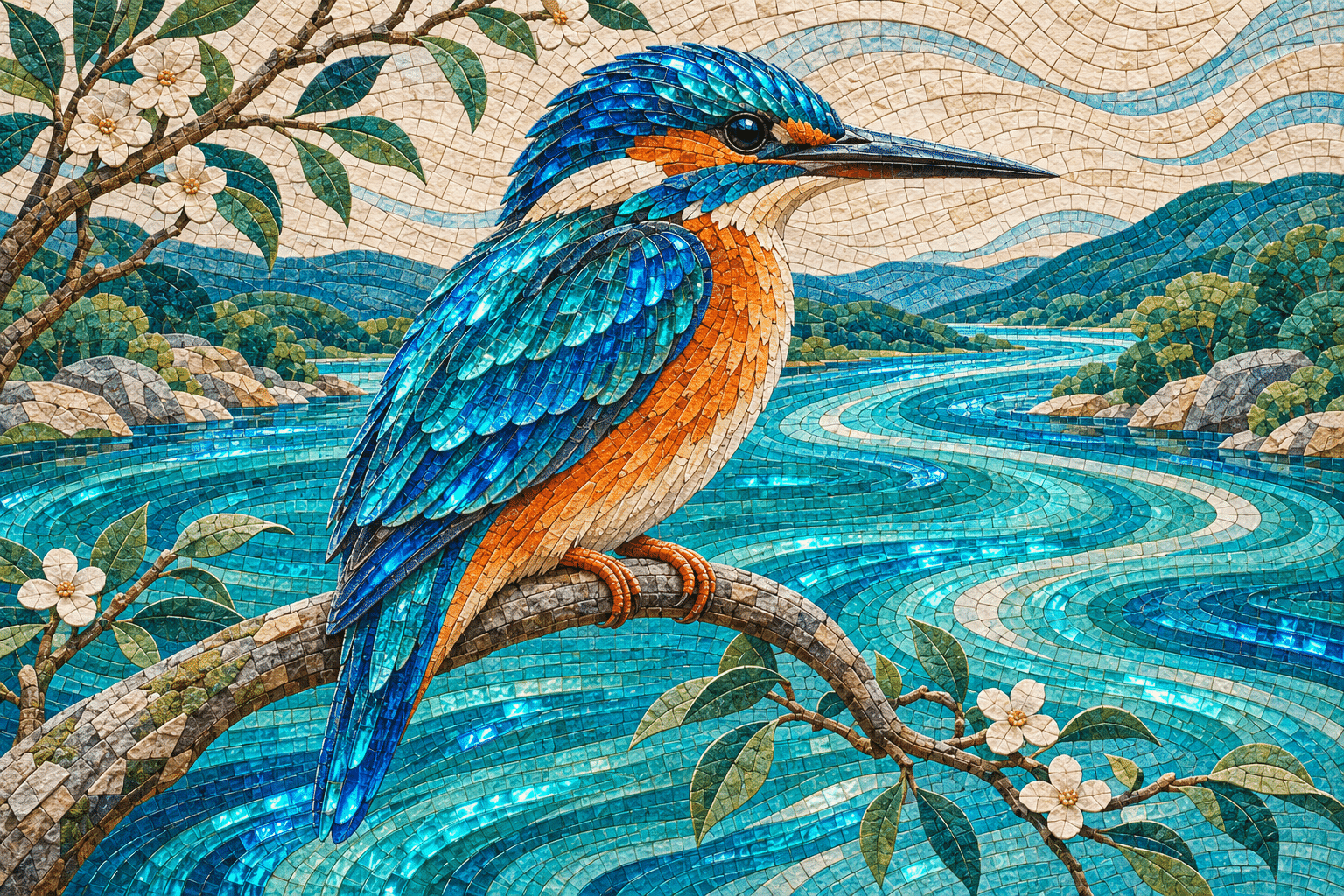
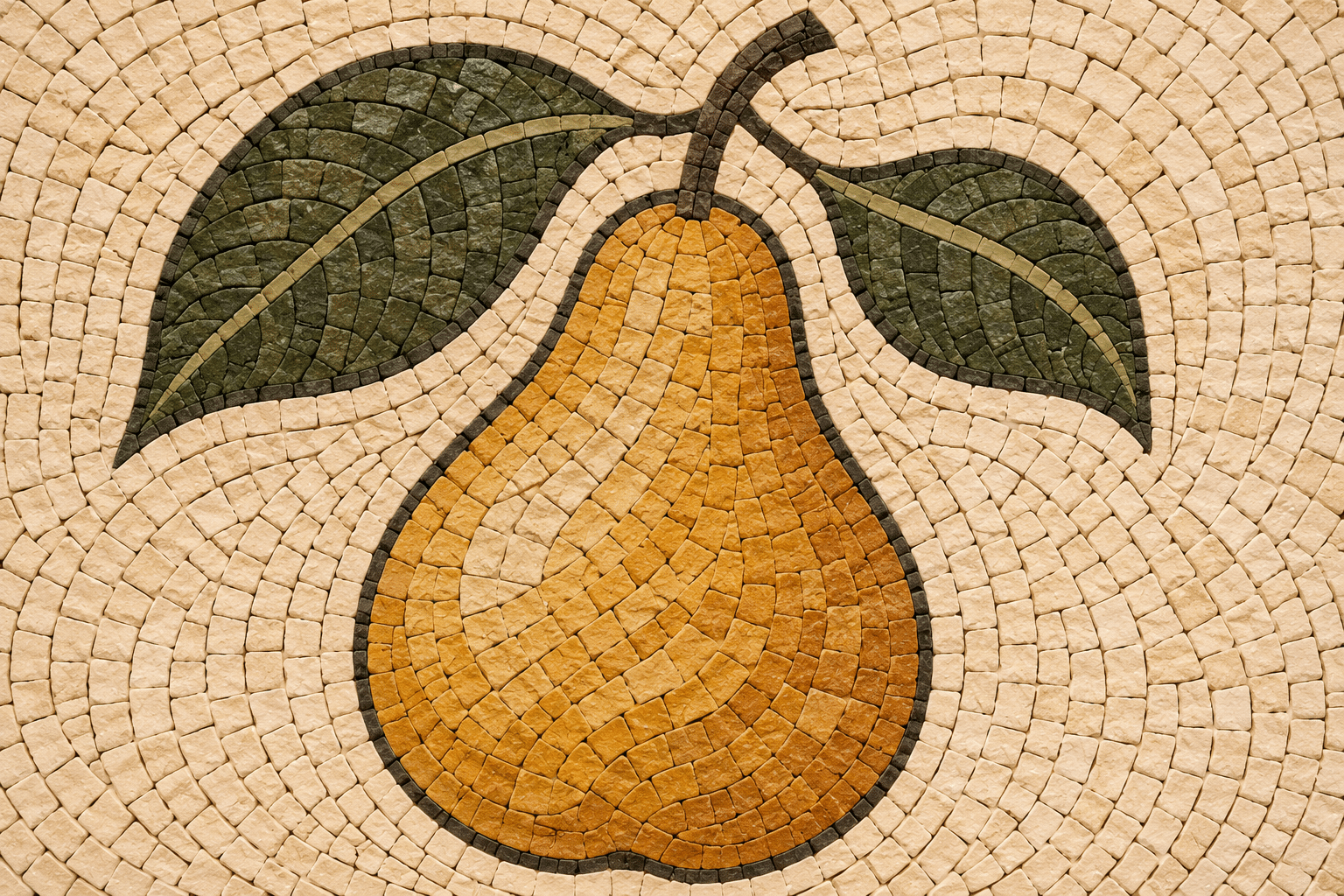
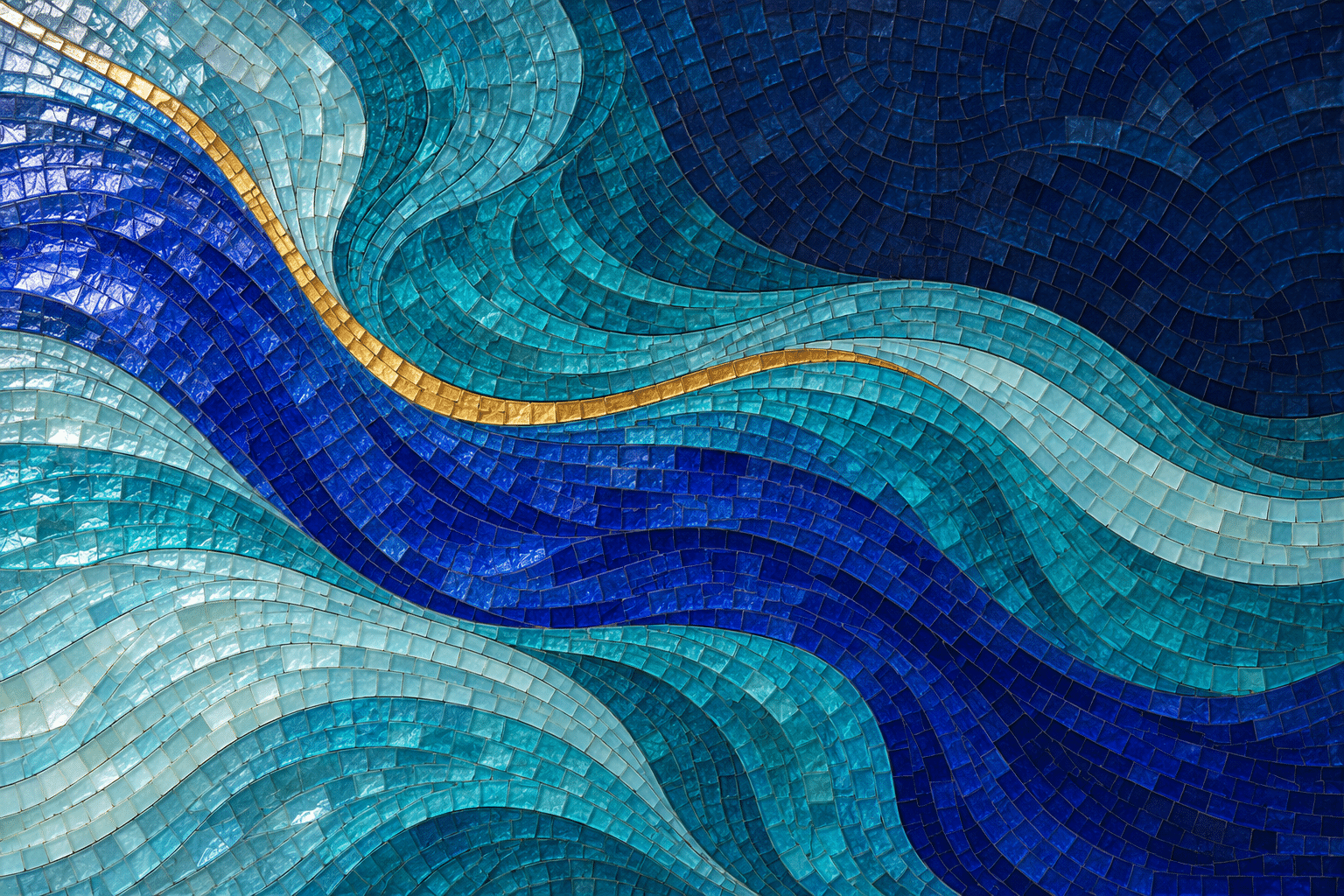
The kingfisher banner combines reflective blue pieces with quieter stone-like areas and a river whose rows turn through the scene. The pear study removes that complexity: a limited palette and clearly outlined silhouette make the direction of the tesserae easy to follow. The abstract river panel then concentrates on curved bands and reflected light without a figurative focal point.
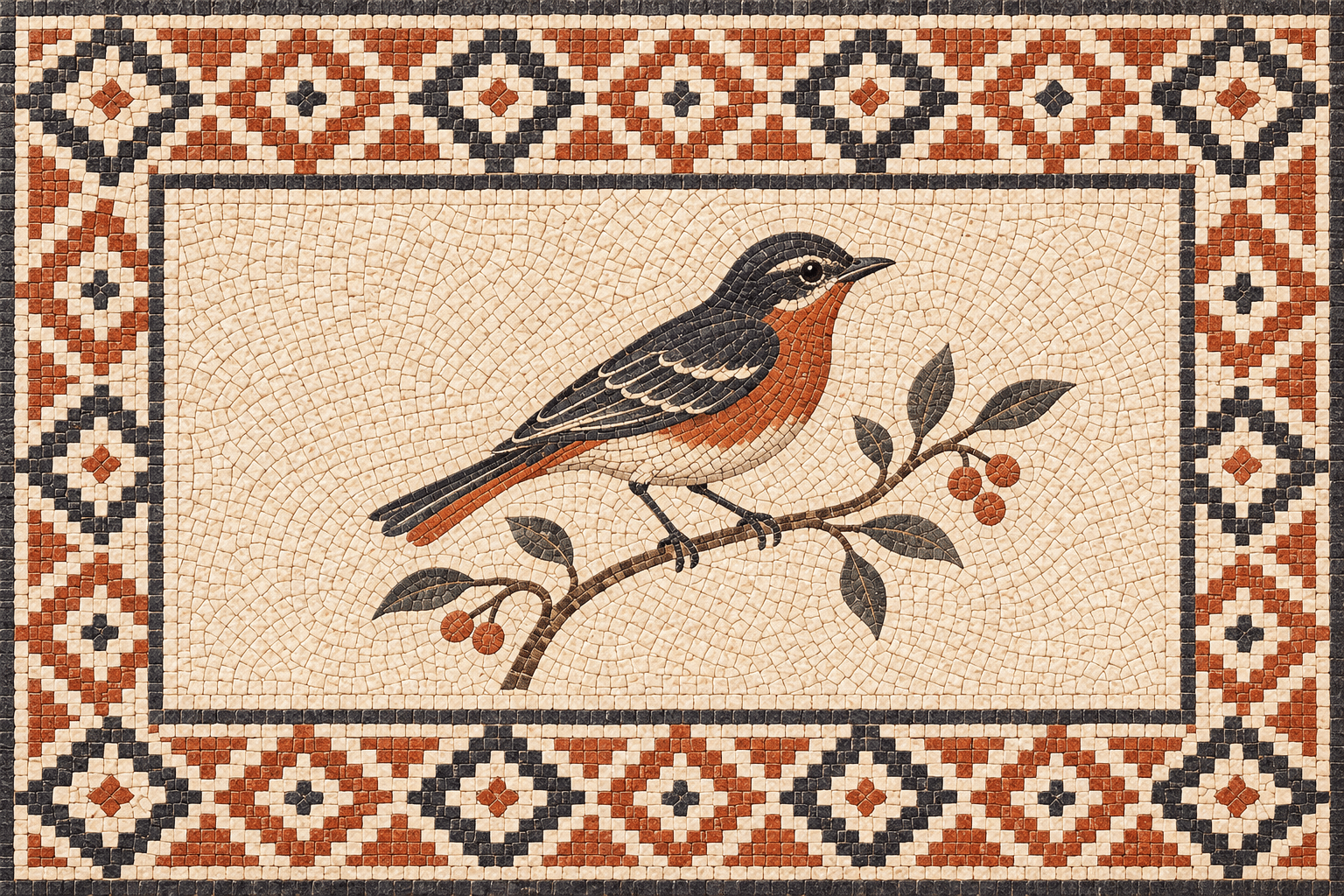
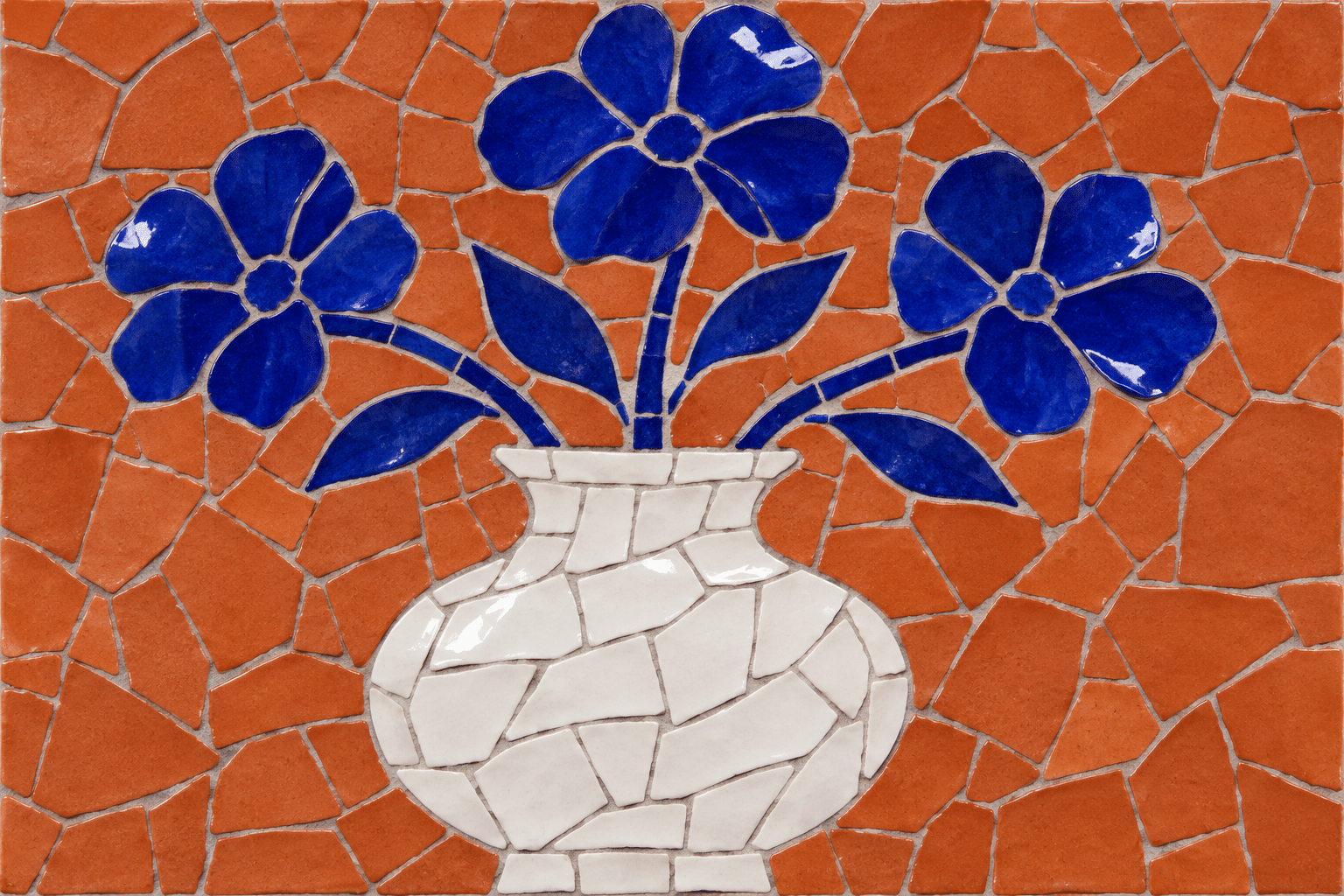
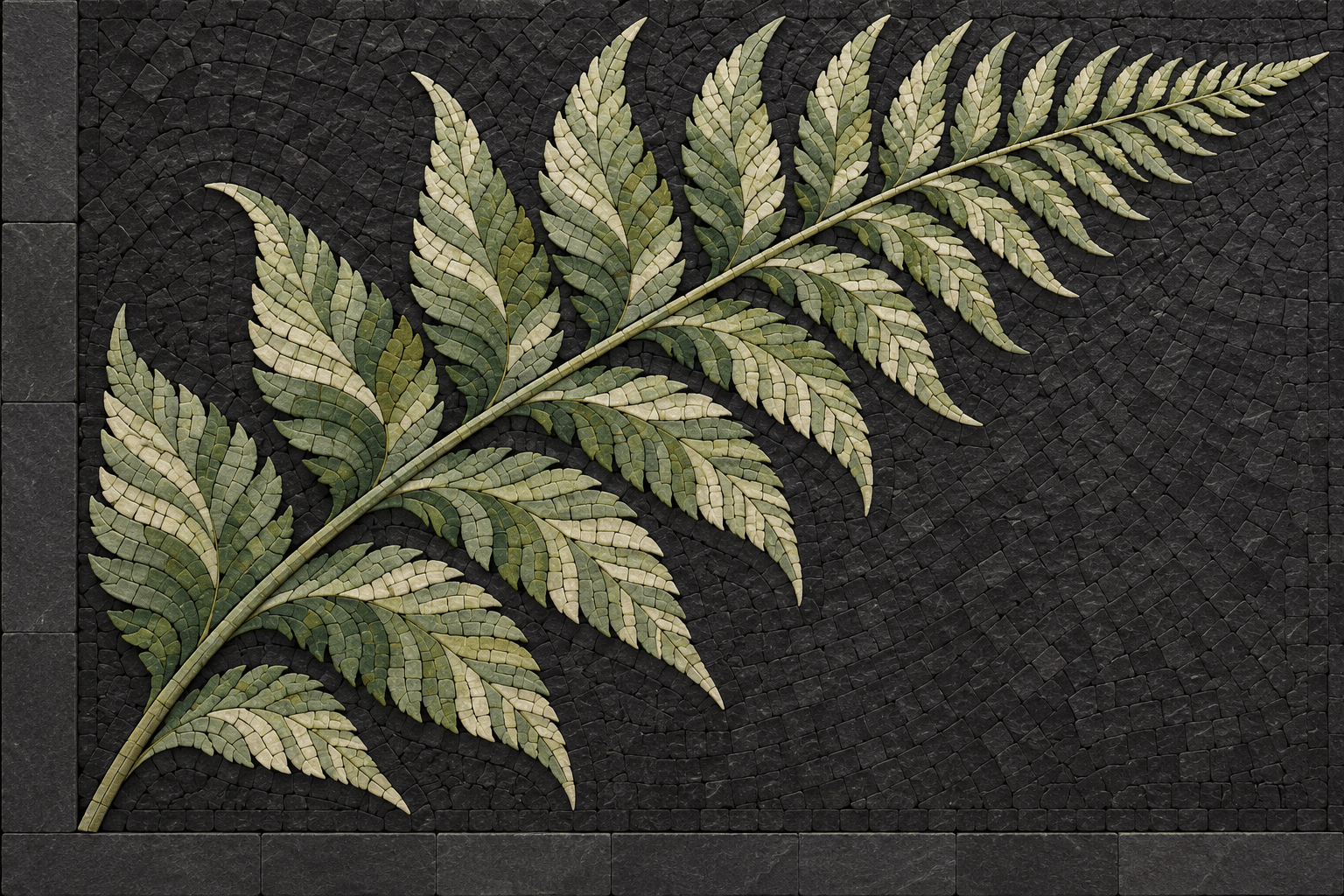
The songbird floor concept gives a central image a geometric border. The ceramic vase uses much larger, irregular fragments and visible pale joints; its rhythm differs from the small pieces of the stone studies. The fern panel tests how narrow stems and repeated leaflets can remain readable against a broad dark field. All six are AI-generated interpretations, not photographs of fabricated mosaics or reproductions of the historical objects discussed here.
From sketch to a coherent pattern
Start with the largest silhouette and the intended viewing distance. Reduce the palette before deciding how many small transitions are needed. Mark the important contours, then choose a direction for the rows in each major region. Let changes of direction explain the form or establish a contrasting background rhythm.
Make a simple paper arrangement or digital mock-up before treating the pattern as resolved. Compare the whole image with a close view of the joints. A design can be compelling from a distance yet become an arbitrary texture close up, or be fascinating in detail while losing its main shape. The two scales should contribute to the same visual intention.
Prompt for the arrangement, then inspect the result
An effective AI prompt names a subject, material, piece size, row direction, joint treatment and lighting condition. A small stone pear on cream with contour-following rows asks a different question from a wall of reflective glass. Keep the description focused enough to judge whether the result answers it.
Inspect whether apparent tesserae remain separate, whether joints pass coherently around shapes and whether tiny details dissolve into painted marks. Generated images may invent cuts or reflections that would be difficult to fabricate. A convincing concept is useful for discussion, but it does not certify craftsmanship, material performance or historical authenticity.
Use and interpretation
Mosaic can join image and architecture, make a durable-looking graphic field or turn a simple motif into a tactile pattern. In a digital illustration, the contrast between the whole and its parts can also carry an idea of assembly, repetition or difference. Those meanings come from the particular work; no material has one compulsory symbolic meaning.
Keep a clear distinction between the retained editorial collage, the new concept studies and the linked museum objects. The collage combines varied modern interpretations under the title MOSAIC. Its peacock, portrait and architectural motifs are not a documented archaeological ensemble. The older collected illustration remains archived rather than being presented with an incomplete source credit.
Positive review — AOI editorial perspective
Mosaic makes the relation between a whole image and its individual parts unusually tangible. Directional rows can describe a curve, while material changes alter the light. The new pear, river, ceramic vase and fern studies show that this medium offers more than a uniform tiled texture: scale and arrangement can change the entire character of a subject.
Negative review — AOI editorial perspective
A mosaic interpretation can become a detailed surface laid over an otherwise generic image. Uniform piece sizes, arbitrary joints or excessive sparkle may conceal weak composition. Generated renderings can also promise an implausible physical construction. Strengthen the large silhouette, give the rows a purpose and keep material claims within what the image actually demonstrates.
Neutral review — AOI editorial perspective
Mosaic is a medium and family of techniques, not one period or visual style. Its suitability depends on the relationship between subject, material, surface and viewing distance. The gallery supplies original AI-generated design studies; the historical sources document specific objects and practices and should be read independently of those invented images.
A small poetic detour
Original words from the AOI studio.
Poetry
A river turns one stone at a time.
The little blue keeps to its place;
beside it, green begins a leaf,
and ochre gives the pear its face.
The joints are lines the pieces share.
The dark makes room for pale to shine.
A bird appears across the gaps,
its wing a hundred turns of line.
Come closer: every edge is there.
Step back: the separate colours sing.
The whole is neither one nor many,
but what their patient meetings bring.
The prompt workshop
Original creative exercises. These prompts create new illustrations, not documentary evidence.
Contours in stone
Original stone-mosaic concept of a pear and two leaves, tesserae rows following the contours, restrained cream, green and ochre palette, deliberate joint spacing, clear composition at a distance.
Light in glass
Original contemporary glass-mosaic wall panel with a flowing abstract river motif, varied blue pieces and restrained reflective highlights, directional rows and coherent physical joints, no historic attribution.
Pattern and focal image
Original mosaic floor concept with one small bird in a central field and a surrounding geometric border, controlled contrast, clear transitions in piece size, plausible stone materials, no copied archaeological design.
A smile from the studio
Jokes
One tessera asked for a promotion. The mosaicist moved it to the highlight. It said the new position had excellent visibility but very little room for expansion.
Sources and further exploration
Getty — Mosaic Fragment with Peacock Facing Left: fifth–sixth-century Syrian object and provenance
Getty Education — close looking at the peacock’s cut-stone arrangement
The Met — fifty Byzantine tesserae: glass, gold and silver leaf
French Ministry of Culture — making tesserae for the Great Umayyad Mosque in Damascus
French Ministry of Culture — setting beds, underpainting and reflective placement in Damascus