
Kinetic sculpture · Suspended and standing mobiles
Explore mobile sculpture through balance, moving joints, materials and shadow, with Calder references and original paper, brass and glass artwork concepts.
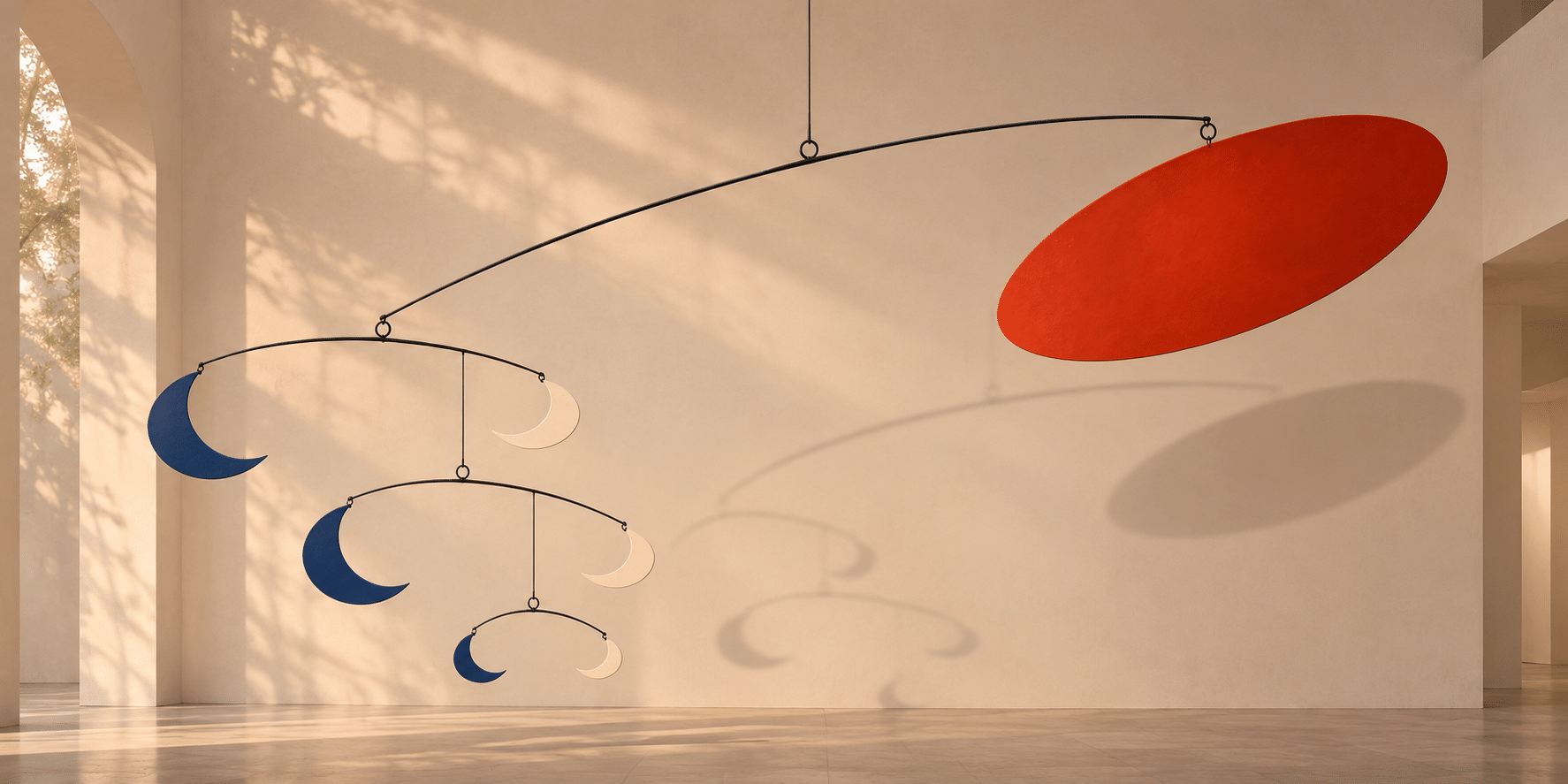
A visual introduction
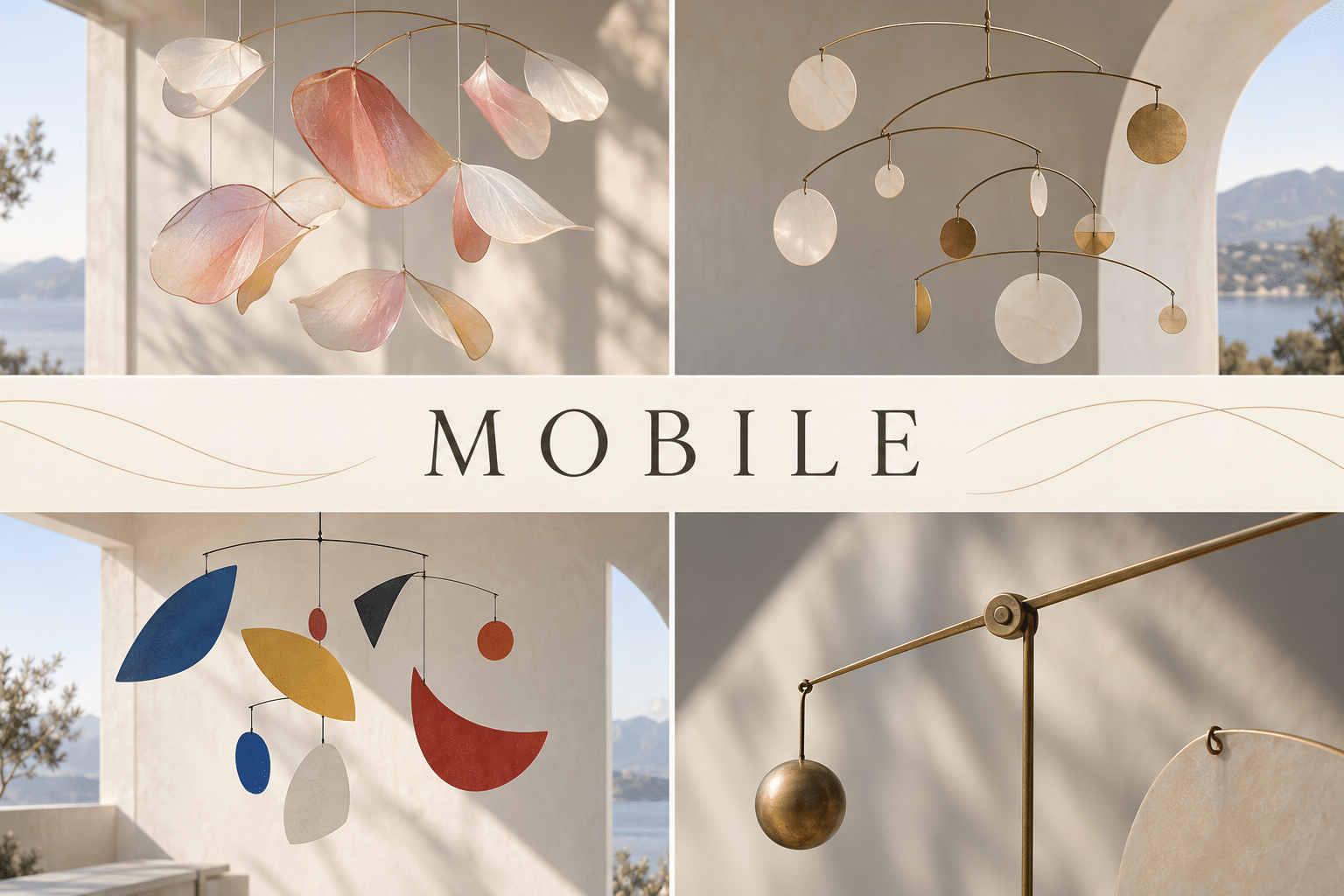
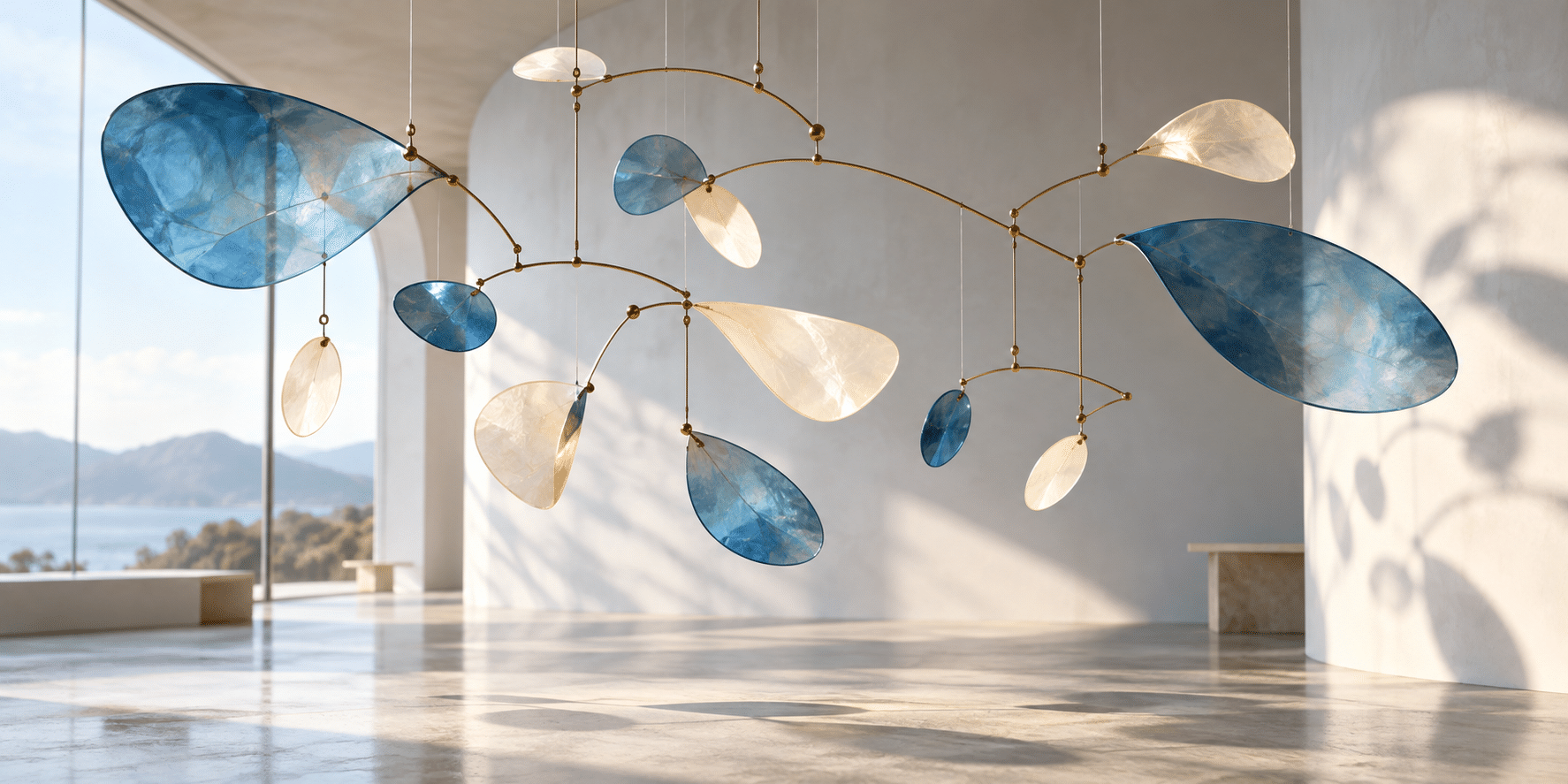
Explore six AOI images, including a new banner and three new material studies. Each is an AI-generated visual concept. Historical works are linked in the reading section. Physical balance and movement require testing in a constructed object.
Select an image for a closer look. Use the thumbnails, arrow keys or a swipe to compare examples. Zoom in to inspect details, or share the image that inspires you.

Creative toolbox · take this style further
Choose an input and a destination. Search sends your words to the chosen site; Copy & open puts them on your clipboard to paste there.
Create with AI
Turn your chosen input into an image prompt or a new creative direction.
ChatGPT
Copy your input and paste it into a ChatGPT conversation or image request.
Copy & open ChatGPT (new tab)Claude · Anthropic
Develop an image prompt or explore the style in a new Claude conversation.
Copy & open Claude · Anthropic (new tab)Midjourney
Paste your input into the Imagine bar on the Create page.
Copy & open Midjourney (new tab)Adobe Firefly
Copy your input, open Firefly, and paste it into the prompt field.
Copy & open Adobe Firefly (new tab)Leonardo.Ai
Copy your input, open Leonardo, and paste it into the generation field.
Copy & open Leonardo.Ai (new tab)Image search
Find visual references. Short, concrete keywords usually work best.
Lexica
Search AI images and prompts using your selected input.
Search with this input Lexica (new tab)Pexels
Search the photo and video library. Short keywords often work best.
Search with this input Pexels (new tab)Pixabay
Search photos, illustrations and other images.
Search with this input Pixabay (new tab)Unsplash
Search photographs using the style name or your own keywords.
Search with this input Unsplash (new tab)Wikimedia Commons
Search photographs, artworks and historical images. Check each file for its source and reuse terms.
Search with this input Wikimedia Commons (new tab)Art & research
Explore artists, collections and the ideas behind a style.
Wikipedia
Search for background reading. A style may not have its own article.
Search with this input Wikipedia (new tab)WikiArt
Copy your input into WikiArt’s search to explore artists and artworks.
Copy & open WikiArt (new tab)Europeana
Paste your keywords into the search to explore European museum, library and archive collections.
Copy & open Europeana (new tab)Inspiration
Discover portfolios and visual ideas from creative communities.
Instagram hashtags
Search a hashtag made from your input: spaces and punctuation are removed. Instagram may require sign-in.
Search with this input Instagram hashtags (new tab)ArtStation
Paste your input into artwork search for concept art, environments, characters and visual development.
Copy & open ArtStation (new tab)Behance
Paste your input into project search for illustration, design and visual storytelling.
Copy & open Behance (new tab)A closer look
Slender arms carry unequal shapes around visible pivots. Open intervals allow parts to turn at different depths. Curved rods draw through space, plates alternate between face and edge, and shadows extend the composition onto the room.
A sculpture with more than one composition
A mobile is a kinetic sculpture whose parts can move relative to one another. Its composition unfolds through time. One plate turns edge-on, another moves forward, and a gap opens where two shapes overlapped. The work includes the objects, the spaces between them and the changing relationships produced by motion.
Suspended mobiles hang from an overhead support. Standing mobiles carry moving elements on a base or upright structure. Some respond to air currents, while others use motors or manual actuation. The broader field of kinetic art also includes many other mechanisms. A mobile gives particular attention to articulated parts and their balance.
From abstract painting into moving space
Alexander Calder developed his abstract mobiles in the early 1930s. The Calder Foundation traces an important turning point to his October 1930 visit to Piet Mondrian’s studio. Marcel Duchamp supplied the name mobile in 1931. Calder’s early experiments included mechanisms driven by cranks and motors, followed by works sensitive to air currents. The Foundation also records Jean Arp’s term stabile for Calder’s stationary abstract sculptures.
Bruno Munari’s Useless Machines provide a related investigation. Luca Zaffarano’s study describes suspended arrangements of coloured forms and modest materials, including balsa, cardboard and glass, as well as the dialogue between moving elements and their projected shadows. Their deliberately non-utilitarian movement makes observation itself the activity. Compare the artists’ individual decisions about material, space and rhythm when looking at these works.
Four historical works worth looking at
Calder’s Mobile, about 1934, in the Peggy Guggenheim Collection combines glass, china, painted metal wire and thread. Its materials broaden the familiar association between mobiles and brightly painted metal plates. In the same collection, Arc of Petals, 1941, uses painted and unpainted aluminum with metal wire. Compare the intervals between its elements and the way a long descending arrangement occupies a volume of air.
The Detroit Institute of Arts describes its Mobile, about 1946, as a construction in metal, wire and wood with a supported central form and successively smaller booms. It offers a useful example of a mobile carried by a standing structure. At a much larger scale, Calder’s Untitled, 1976, in the National Gallery of Art moves on the East Building’s interior air currents. Paul Matisse translated the design into a lightweight construction. The museum records its installation in November 1977. Together these works show how support, material and setting shape the experience.
Read the balance from the bottom upward
Follow one small shape to its connecting thread, then to the arm carrying it. Continue upward until you reach the main support. This reveals a hierarchy of loads. Unequal forms can balance at unequal distances from a pivot. For a simple horizontal arm, compare each weight multiplied by its horizontal distance from the pivot, including the arm’s own weight and any lower assembly.
The National Gallery describes Calder developing the East Building model from the lowest arm upward, balancing each section before adding it to the next. This is a useful starting method for a small study. In an image, the support path should remain readable. In a made object, the actual mass, stiffness and joint friction determine whether the proposed movement works.
Give every part room to move
A successful view needs more than a pleasing outline. Consider the swept space around each rotating element. Two plates that appear comfortably separated in a photograph may collide when an arm turns. Different heights, short lower branches and deliberate gaps can make independent movement easier to read.
Watch how a broad sail becomes a narrow line as it turns. Open shapes can frame the background, while a solid plate can briefly hide a neighbouring form. A quiet wall helps the eye follow these events. Light from the side adds a second changing composition of shadows, and transparent material introduces transmitted colour. A slight change in viewpoint can reorganize the whole work.
What the new artwork studies explore
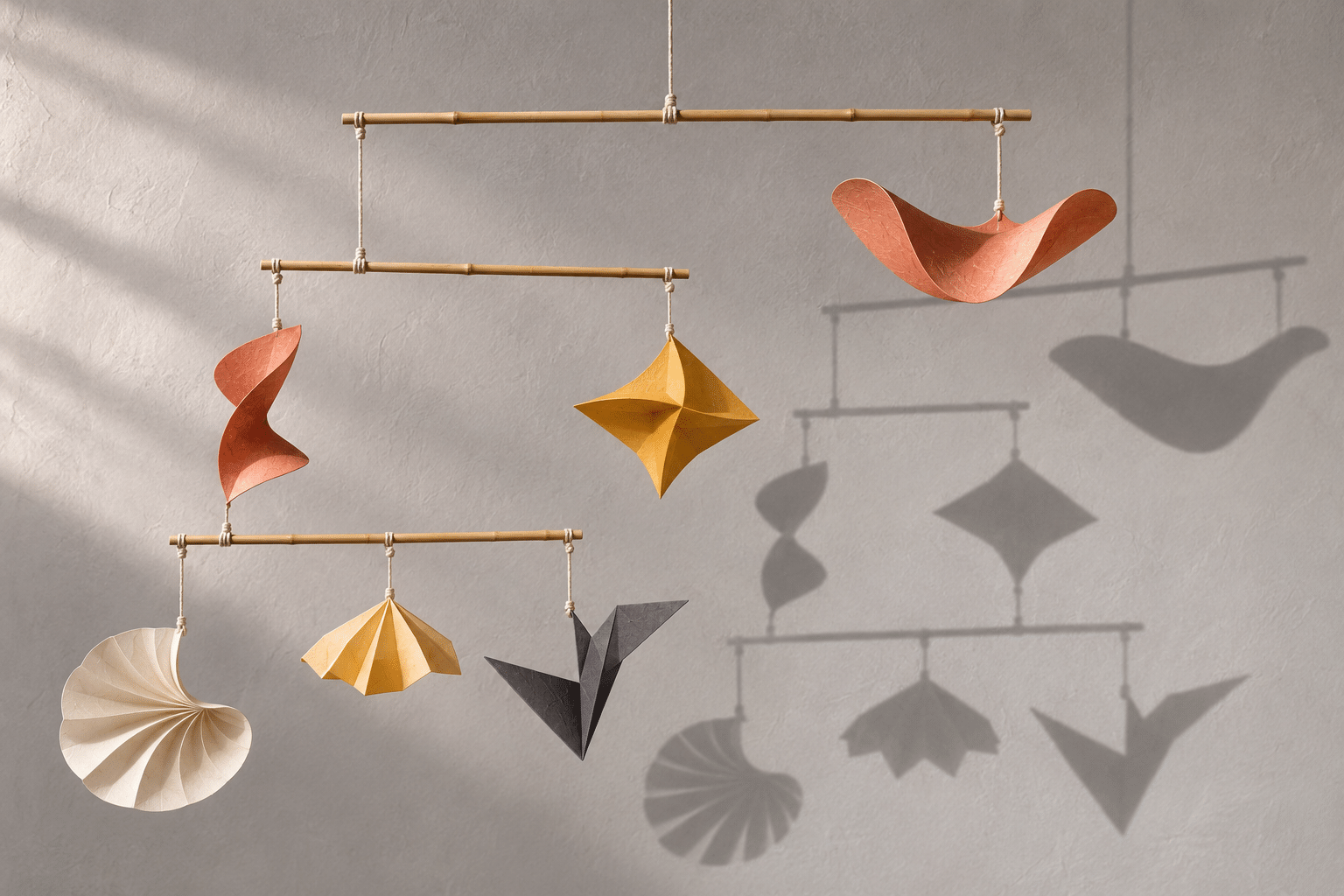
The red sail banner pairs one broad oval with a descending group of blue and ivory crescents. Its large areas of empty space make the branches legible at a small viewing size. The paper study brings folded surfaces and shadows into the foreground. Its lower tier is pictured connecting through a coral form, a detail that would need structural reconsideration during fabrication.
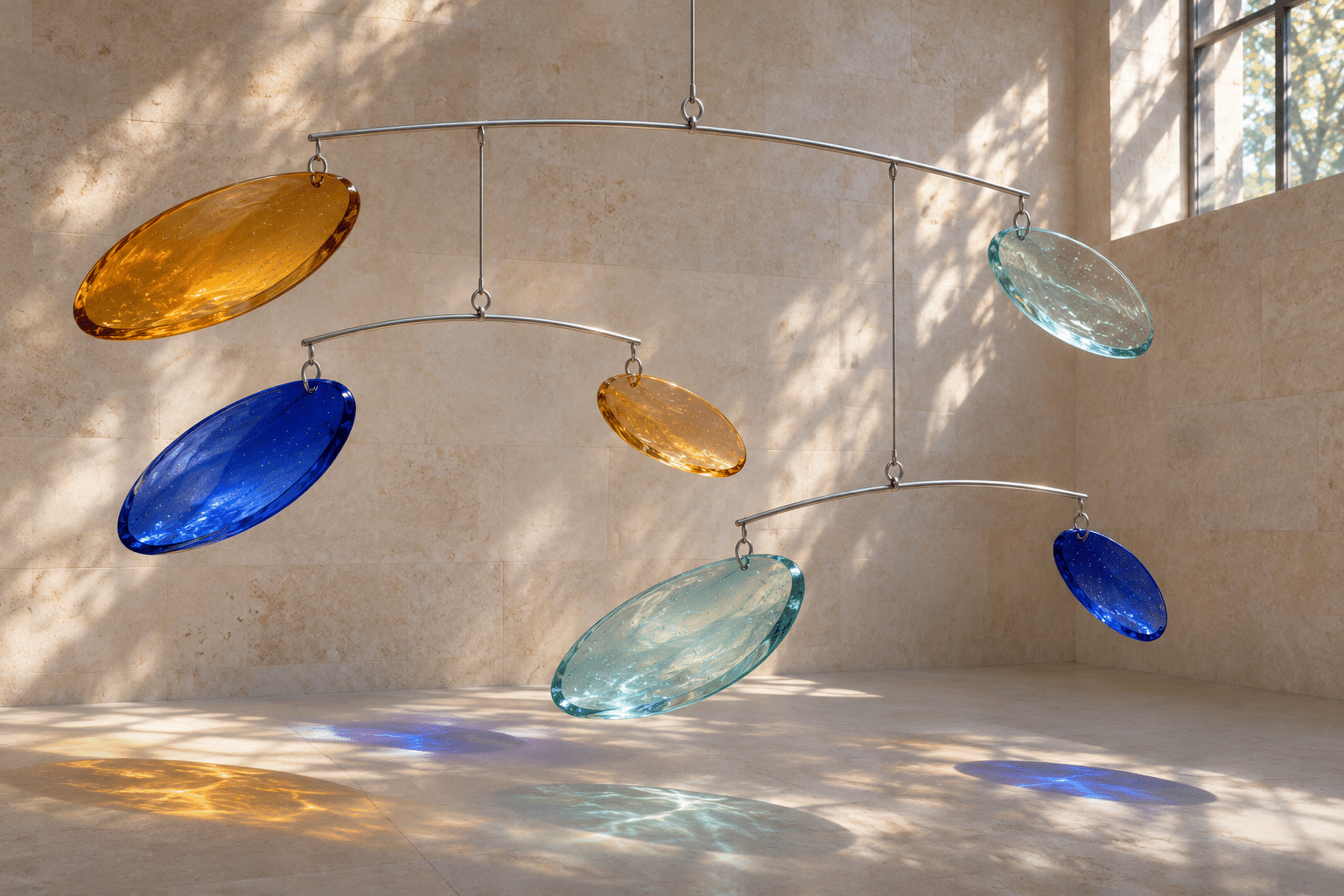
The tabletop study places moving brass parts on an arched support and dark stone base, making the joint sequence easy to inspect at an intimate scale. The glass study explores thickness, transparency and coloured light with six oval elements. The earlier blue-and-ivory leaf image adds a more distributed suspension arrangement. These are original AOI illustrations, and their mechanical behaviour has not been physically tested.
Build a visual study with a clear question
Begin with a small number of elements and choose one relationship to explore. Try one broad shape against several smaller ones, three different depths against a plain background, or translucent pieces that transform sunlight. Keep the supports visible and let the material influence the design. Paper can fold, thin sheet metal can form a crisp silhouette, and pierced plates can make light part of their appearance.
Draw the same imagined mobile from the front, from below and after a quarter turn. Compare the gaps and potential collisions. For a physical small-scale experiment, start with lightweight materials and test each subassembly before joining it to the next. For a digital illustration, inspect every attachment and explain what remains conceptual. Use the prompt workshop to explore these decisions with deliberately different materials.
A small poetic detour
Original words from the AOI studio.
Poetry
One red shape waits at the end of a wire.
Below it, six pale moons are learning the room.
A door opens somewhere beyond the gallery
and the smallest crescent turns.
The wall receives a softer version.
An edge becomes a surface,
a surface gives the light away,
and the arrangement takes another breath.
Each joint keeps a little freedom.
Each weight asks something of the next.
For a moment the air holds everything
in a sentence still being written.
The prompt workshop
Original creative exercises. These prompts create new illustrations, not documentary evidence.
Begin with paper and shadow
Original mobile sculpture concept with six folded paper forms in coral, cream, saffron and charcoal, suspended on three bamboo arms. Show continuous threads and clear pivots, leave open gaps between forms, and use strong side light to cast a second composition on a plaster wall. Full assembly in view, precise paper texture, calm background, no writing.
Explore a standing mobile
Original tabletop mobile concept with a brass arch seated in a low dark stone base. Two articulated balance beams carry a small bronze weight and two pierced brass ovals. Show every ring joint and support connection clearly, with off-centre balance, generous space and soft raking light against a dark green background. Refined material study, no lettering.
Experiment with transmitted colour
Original suspended mobile concept with six transparent glass sails in amber, cobalt and pale aqua on three slender metal arms. One main suspension, visible pivots, staggered depths and sufficient gaps for rotation. Side light passes through the glass and colours the limestone floor. Show edge thickness and subtle bubbles, entire assembly framed, no labels.
Your next inspiration
Discover another art style
Follow a visual thread to the next subject.

People & works to explore
References discussed in this article. Consult the sources below for context.
Artists and practitioners
Alexander Calder
Bruno Munari
Paintings and other works
Alexander Calder, Mobile, ca. 1934, Peggy Guggenheim Collection
Alexander Calder, Arc of Petals, 1941, Peggy Guggenheim Collection
Alexander Calder, Mobile, ca. 1946, Detroit Institute of Arts
Alexander Calder, Untitled, 1976, National Gallery of Art
Bruno Munari, Useless Machines, series
A smile from the studio
Jokes
The mobile asked the gallery to give it some space.
Its smallest disc said it was carrying the balance of the conversation.
Sources and further exploration
Calder Foundation — 1930–1936 timeline · Mondrian visit, naming and early motor-driven works
Peggy Guggenheim Collection — Mobile, ca. 1934 · glass, china, wire and thread
Peggy Guggenheim Collection — Arc of Petals, 1941 · aluminum and metal wire
Detroit Institute of Arts — Mobile, ca. 1946 · supported form and successive booms
National Gallery of Art — Untitled, 1976 · model, fabrication, balance and installation