
Artistic approach and historical context
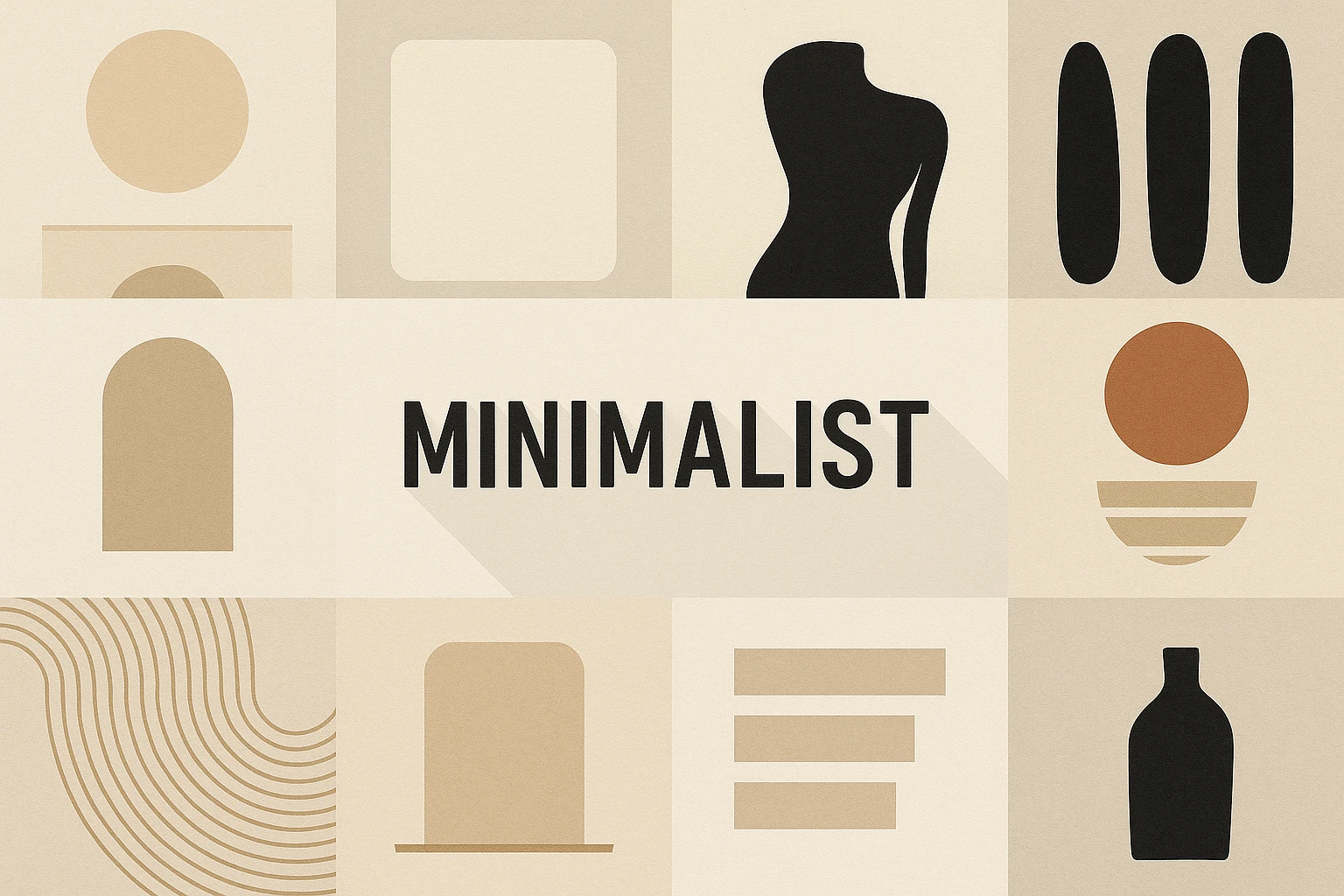
Minimalist art concentrates attention through a reduced set of forms, materials or operations. Historical Minimalism and the broader adjective “minimalist” are related but not interchangeable: a sparse image is not automatically part of the historical tendency.
A visual introduction
Select an image for a closer look. Use the thumbnails, arrow keys or a swipe to compare examples. Zoom in to inspect details, or share the image that inspires you.
Creative toolbox · take this style further
Choose an input and a destination. Search sends your words to the chosen site; Copy & open puts them on your clipboard to paste there.
Create with AI
Turn your chosen input into an image prompt or a new creative direction.
ChatGPT
Copy your input and paste it into a ChatGPT conversation or image request.
Copy & open ChatGPT (new tab)Claude · Anthropic
Develop an image prompt or explore the style in a new Claude conversation.
Copy & open Claude · Anthropic (new tab)Midjourney
Paste your input into the Imagine bar on the Create page.
Copy & open Midjourney (new tab)Adobe Firefly
Copy your input, open Firefly, and paste it into the prompt field.
Copy & open Adobe Firefly (new tab)Leonardo.Ai
Copy your input, open Leonardo, and paste it into the generation field.
Copy & open Leonardo.Ai (new tab)Image search
Find visual references. Short, concrete keywords usually work best.
Lexica
Search AI images and prompts using your selected input.
Search with this input Lexica (new tab)Pexels
Search the photo and video library. Short keywords often work best.
Search with this input Pexels (new tab)Pixabay
Search photos, illustrations and other images.
Search with this input Pixabay (new tab)Unsplash
Search photographs using the style name or your own keywords.
Search with this input Unsplash (new tab)Wikimedia Commons
Search photographs, artworks and historical images. Check each file for its source and reuse terms.
Search with this input Wikimedia Commons (new tab)Art & research
Explore artists, collections and the ideas behind a style.
Wikipedia
Search for background reading. A style may not have its own article.
Search with this input Wikipedia (new tab)WikiArt
Copy your input into WikiArt’s search to explore artists and artworks.
Copy & open WikiArt (new tab)Europeana
Paste your keywords into the search to explore European museum, library and archive collections.
Copy & open Europeana (new tab)Inspiration
Discover portfolios and visual ideas from creative communities.
Instagram hashtags
Search a hashtag made from your input: spaces and punctuation are removed. Instagram may require sign-in.
Search with this input Instagram hashtags (new tab)ArtStation
Paste your input into artwork search for concept art, environments, characters and visual development.
Copy & open ArtStation (new tab)Behance
Paste your input into project search for illustration, design and visual storytelling.
Copy & open Behance (new tab)A closer look
Scale, interval, repetition, surface and the viewer’s position become especially noticeable when there are few competing elements.
Reduction makes decisions visible
The Guggenheim describes Minimalism through an extreme economy of means and geometric abstraction, while noting that it was not a self-proclaimed movement. Its examples include works in varied materials and formats. Minimalism is therefore more specific than an empty white background.
In a new composition, identify the relationship that deserves attention. It might be the gap between two forms, a repeated unit's rhythm or the difference between a solid surface and reflected light. Remove elements only when doing so strengthens that relationship.
Scale changes the encounter
A small square on a page, a large panel on a wall and an object occupying a room produce different experiences. The viewer's body and distance matter. A photograph can show the form while hiding much of its actual scale and spatial effect.
For a digital study, make the intended format explicit. A composition designed for a small icon needs a different balance from one intended for a large print. Test both the full image and its thumbnail rather than assuming that reduction guarantees legibility.
Repetition needs an interval
Repeated units can produce calm, pressure or instability depending on spacing and alignment. Establish a rule, then decide whether to keep it exact or introduce a meaningful variation. Random irregularity is not automatically expressive.
Use a limited number of variables. If size, color, angle and spacing all change at once, it becomes difficult to understand which relationship is central. A single altered interval may carry more force when the rest of the arrangement is consistent.
Material is not an afterthought
Metal, paint, light, paper and a digital gradient have different properties. In a rendering, specify whether a surface absorbs, reflects or transmits light. Generic glossy shading can obscure a composition whose interest depends on a flat plane or a precise edge.
Judge the result by the clarity and consequence of its decisions, not by how few objects it contains. A successful minimal study rewards looking at what remains. It need not claim spiritual purity, universal calm or membership in a historical movement.
A small poetic detour
Original words from the AOI studio.
Poetry
Lines in quiet grace,
Whispering the void within,
Presence in absence.
The prompt workshop
Original creative exercises. These prompts create new illustrations, not documentary evidence.
Two intervals
Original minimalist composition of three matte rectangular forms with deliberately unequal gaps, precise edges and a restrained neutral palette.
Material contrast
Original study of one brushed-metal plane beside one matte painted plane, simple geometry and physically distinct responses to soft light.
One exception
Original geometric composition with a regular series of narrow vertical units and one carefully placed change in spacing, no decorative texture.