
Historical art movement
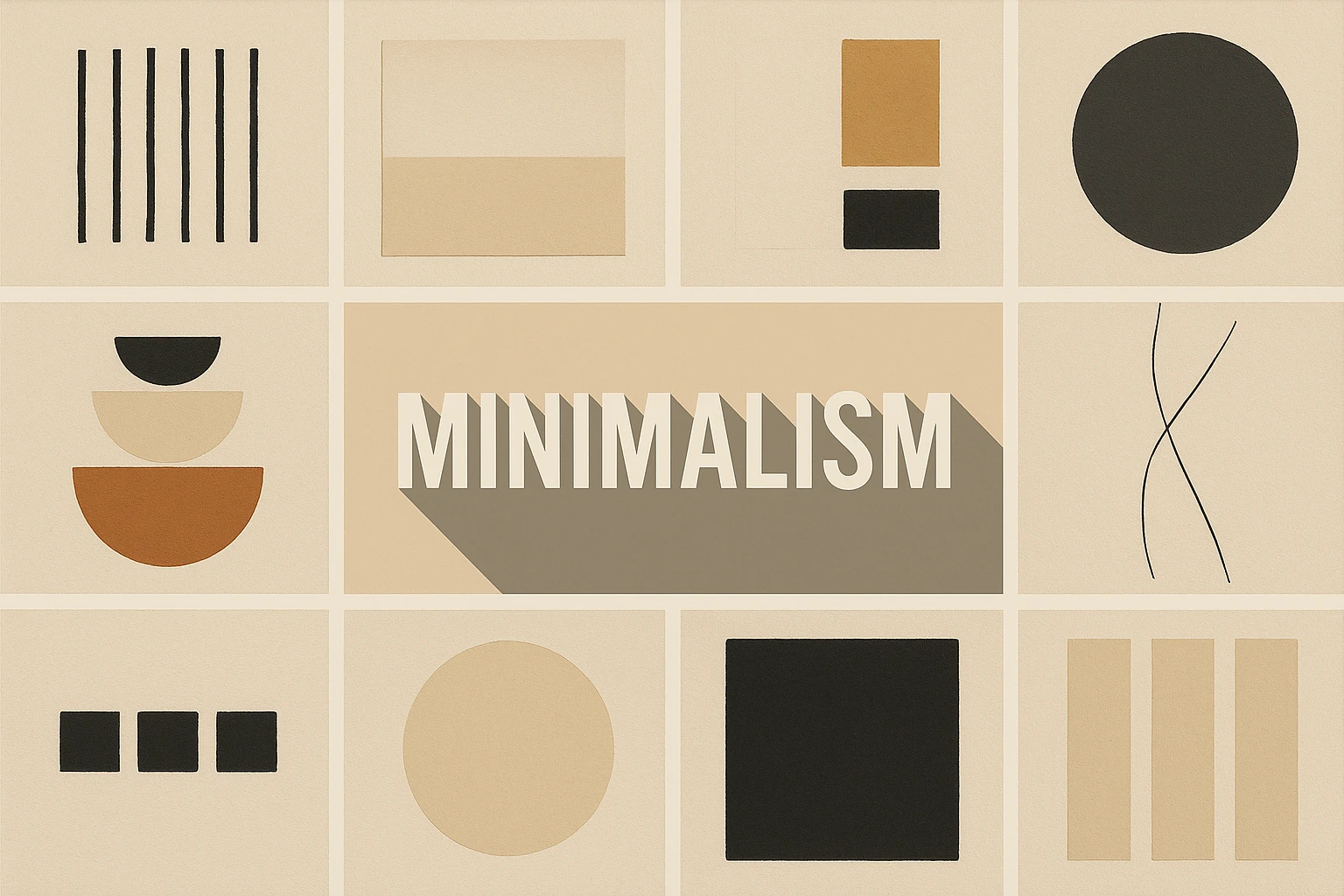
Minimalism asks close attention to form, material, repetition and the viewer’s encounter with an object or space.
A closer look
For an original study, choose one repeated unit and vary only spacing, scale or orientation.
Understanding the subject
Minimalism in art history is more specific than a preference for tidy rooms or sparse photographs. Associated works often emphasize simple forms, repetition, materials and spatial relationships. The viewer’s movement and position can be important to how a work is experienced. Individual artists differed in their methods and arguments, so a cube or a limited palette alone does not establish historical affiliation.
AOI looking and making workshop
For an original study, choose one repeated unit and vary only spacing, scale or orientation. Notice how the floor and light affect the relationship between units. A small change becomes significant when the rest of the system is stable. Avoid adding a dramatic symbolic explanation merely to fill the apparent simplicity. In a generated installation proposal, check repeated dimensions and cast shadows for consistency. The exercise is to make a few relationships perceptible, not to assume that removing detail automatically produces clarity or seriousness.
The prompt workshop
Original creative exercises. These prompts create new illustrations, not documentary evidence.
Repeated units
Create an original installation proposal of five matte rectangular blocks on a pale floor, equal dimensions and carefully varied spacing. Use neutral daylight so the spatial relationships remain clear.
Color and interval
Create a restrained abstract composition of repeated blue vertical bars separated by unequal cream intervals. Let rhythm arise from spacing rather than texture or expressive brushwork.
A viewer’s path
Design an original sparse room with three low geometric forms arranged to change their overlap as a viewer moves. Show a plausible perspective and consistent shadows, without gallery branding.
Your next inspiration
Discover another art style
Follow a visual thread to the next subject.

Creative studies to try
Explore these collected prompts as creative interpretations. They are starting points for image-making, not reproductions of historical artworks or evidence about a tradition.
Visual cues: reduction, quiet space, clean symbolic shape

Study 1 — Minimalism
Ultra-wide panoramic banner, a human hand and a sleek robotic hand reaching toward each other, fingertips almost touching, a bright luminous spark of intelligence between them, a subtle world map behind them with global data network lines, symbolizing human-AI collaboration and digital transformation, rendered in Minimalism style, with restrained forms, clean space, precise contours, calm visual rhythm, high quality, high detail, balanced composition, no text, no logo, no watermark, exact aspect ratio 1584:396
Prompt source: 1001 Art Styles. Select the text to copy, then adapt the subject and composition.