
AOI Highlight · Original marine-fantasy framework
Mermaidism imagines a world where the boundary between body, object and sea stays fluid. A tail becomes a current; a shell edge becomes an arch; reflected light seems to finish a form that water has partly concealed. This AOI flagship develops that idea into a usable visual language, with six original illustrations, four motif studies and practical prompts. It is a contemporary creative framework informed by marine observation and mermaid imagery, not a claimed historical art movement.
A visual introduction
Six original AI-generated illustrations: the featured tidal scene, a centrally titled concept collage, and four studies spanning architecture, figure, deep-water abstraction and object design.
Select an image for a closer look. Use the arrow keys or gallery controls to compare the illustrations.
Creative toolbox · take this style further
Choose an input and a destination. Search sends your words to the chosen site; Copy & open puts them on your clipboard to paste there.
Create with AI
Turn your chosen input into an image prompt or a new creative direction.
ChatGPT
Copy your input and paste it into a ChatGPT conversation or image request.
Copy & open ChatGPT (new tab)Claude · Anthropic
Develop an image prompt or explore the style in a new Claude conversation.
Copy & open Claude · Anthropic (new tab)Midjourney
Paste your input into the Imagine bar on the Create page.
Copy & open Midjourney (new tab)Adobe Firefly
Copy your input, open Firefly, and paste it into the prompt field.
Copy & open Adobe Firefly (new tab)Leonardo.Ai
Copy your input, open Leonardo, and paste it into the generation field.
Copy & open Leonardo.Ai (new tab)Image search
Find visual references. Short, concrete keywords usually work best.
Lexica
Search AI images and prompts using your selected input.
Search with this input Lexica (new tab)Pexels
Search the photo and video library. Short keywords often work best.
Search with this input Pexels (new tab)Pixabay
Search photos, illustrations and other images.
Search with this input Pixabay (new tab)Unsplash
Search photographs using the style name or your own keywords.
Search with this input Unsplash (new tab)Wikimedia Commons
Search photographs, artworks and historical images. Check each file for its source and reuse terms.
Search with this input Wikimedia Commons (new tab)Art & research
Explore artists, collections and the ideas behind a style.
Wikipedia
Search for background reading. A style may not have its own article.
Search with this input Wikipedia (new tab)WikiArt
Copy your input into WikiArt’s search to explore artists and artworks.
Copy & open WikiArt (new tab)Europeana
Paste your keywords into the search to explore European museum, library and archive collections.
Copy & open Europeana (new tab)Inspiration
Discover portfolios and visual ideas from creative communities.
Instagram hashtags
Search a hashtag made from your input: spaces and punctuation are removed. Instagram may require sign-in.
Search with this input Instagram hashtags (new tab)ArtStation
Paste your input into artwork search for concept art, environments, characters and visual development.
Copy & open ArtStation (new tab)Behance
Paste your input into project search for illustration, design and visual storytelling.
Copy & open Behance (new tab)A closer look
Sweeping current curves, deliberate waterlines, pearlescent edges against matte surfaces, selective luminous details and generous intervals of open water. Mermaid figures are one possible subject; architecture, vessels and near-abstraction can carry the same visual logic.
A world drawn from the waterline
Mermaidism begins with a relationship rather than a costume. Something solid meets something moving, and each changes how we see the other. A seated figure may continue below the surface as a long curve. An opening in a vessel may reappear as a distorted reflection. A colonnade may resemble the ribs of a shell while leaving broad channels for water to pass through. The eye follows these connections before it examines the ornament.
The mermaid is a compelling emblem for this approach because her form belongs to two imagined worlds. Yet a successful Mermaidism composition does not require a mermaid. Its strongest signature is continuity across a threshold: above and below, hard and flowing, familiar and invented. The motif studies test that signature at the scale of a coastline, a body, an architectural space and a small object.
AOI uses Mermaidism here as a studio framework. No historical school, founder or claim to first-ever use of the name is asserted. The gallery is newly generated imaginative artwork. Its merfolk, buildings and designed objects are inventions, while the sources below provide specific connections to real art and marine environments.
A real painting, a different purpose
The Royal Academy of Arts identifies John William Waterhouse’s A Mermaid as a 1900 oil painting. Its collection commentary draws attention to the solitary figure and her shell of pearls, and suggests a possible connection with Tennyson’s poem. This gives Mermaidism a concrete art reference: a sea figure can carry solitude, longing and material detail rather than functioning only as decorative fantasy.
Waterhouse is a reference discussed here, not a member or founder of Mermaidism. The new illustrations do not reproduce his composition. They explore another question: what happens when the whole picture, including architecture and empty water, shares the figure’s flowing logic? Other water-being traditions deserve their own named sources and contexts; they should not be blended into an invented universal mermaid mythology.
Five rules for a recognizable Mermaidism image
1. Establish a tidal spine. Begin with one sweeping S, arch or folded ribbon. Let two or three elements answer it: a tail, a channel, a reflection or a vaulted rib. They need not touch, but their directions should feel related. Avoid giving every small detail its own competing swirl.
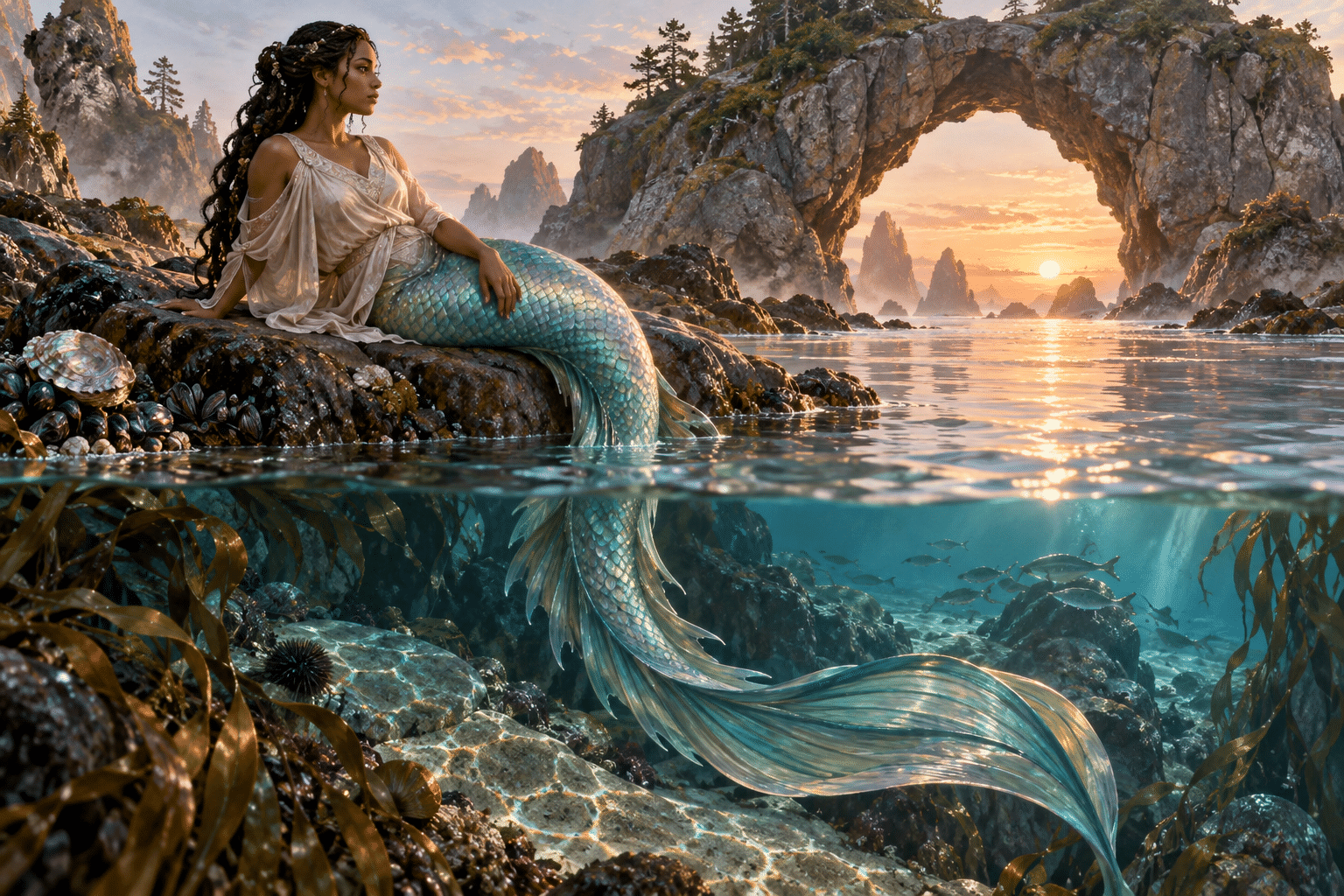
2. Make a threshold visible. A waterline, shadow edge or opening separates two conditions. Change clarity, color or scale across that boundary. In the banner, the warm shore above the surface contrasts with the cooler submerged tail. The transition carries the image’s idea without an explanatory label.
3. Give pearl a dark companion. A nacre-like rim feels luminous beside rough stone, matte clay or deep water. Reserve the brightest surface changes for a chosen focal passage. If every shell, scale and rock shines equally, the picture loses its hierarchy.
4. Let the environment answer the subject. Hair, fabric, fins and nearby ribbons should suggest compatible movement. The current need not be a scientific simulation, but an arbitrary tangle makes the body feel pasted into the scene. Preserve a readable face or primary silhouette.
5. Leave water unfilled. An open blue-green interval conveys distance and gives intricate surfaces room to breathe. It is an active shape in the composition. Treat it with the same care as the most detailed scale or shell edge.
Marine observation that improves the fantasy
NOAA explains that light diminishes with depth: the sunlit upper ocean gives way to a much darker environment. Use that distinction as a design constraint. A shallow scene can support warm surface reflections, shafts of light and visible plant forms; a deep-water scene calls for a different lighting plan. Combining bright surface sunlight with an abyssal setting should be an intentional fantasy choice, not an unnoticed contradiction.
NOAA defines bioluminescence as light produced by living organisms through chemical processes. It is not simply the blue color of water, a shiny shell or reflected moonlight. In the midnight study, sparse luminous points borrow the visual idea of living light. They do not identify actual species or establish that imaginary merfolk could glow.
Monterey Bay Aquarium’s giant-kelp material offers another useful reference: long blades, supporting structures and the layered space of a kelp forest. Study the spacing and direction of those forms rather than adding a generic tropical plant to every underwater image. The kelp mantle is a shallow-water fantasy; the midnight study deliberately leaves kelp out.
Observe first, transform second. A shoreline walk, aquarium sketch or properly credited photograph can suggest a convincing shape or lighting relationship. Do not imply that an invented palace, glowing tail or hybrid organism is a discovery from marine biology.
The flagship gallery: six views of one language
The threshold garden — the featured banner uses a split view at the water surface. An adult mermaid rests beside a coastal arch while her turquoise tail extends through the cooler foreground. Pearl-toned clothing, textured rocks and a distant warm sky balance the detailed scales. The illustration is an invented scene, not a real location.
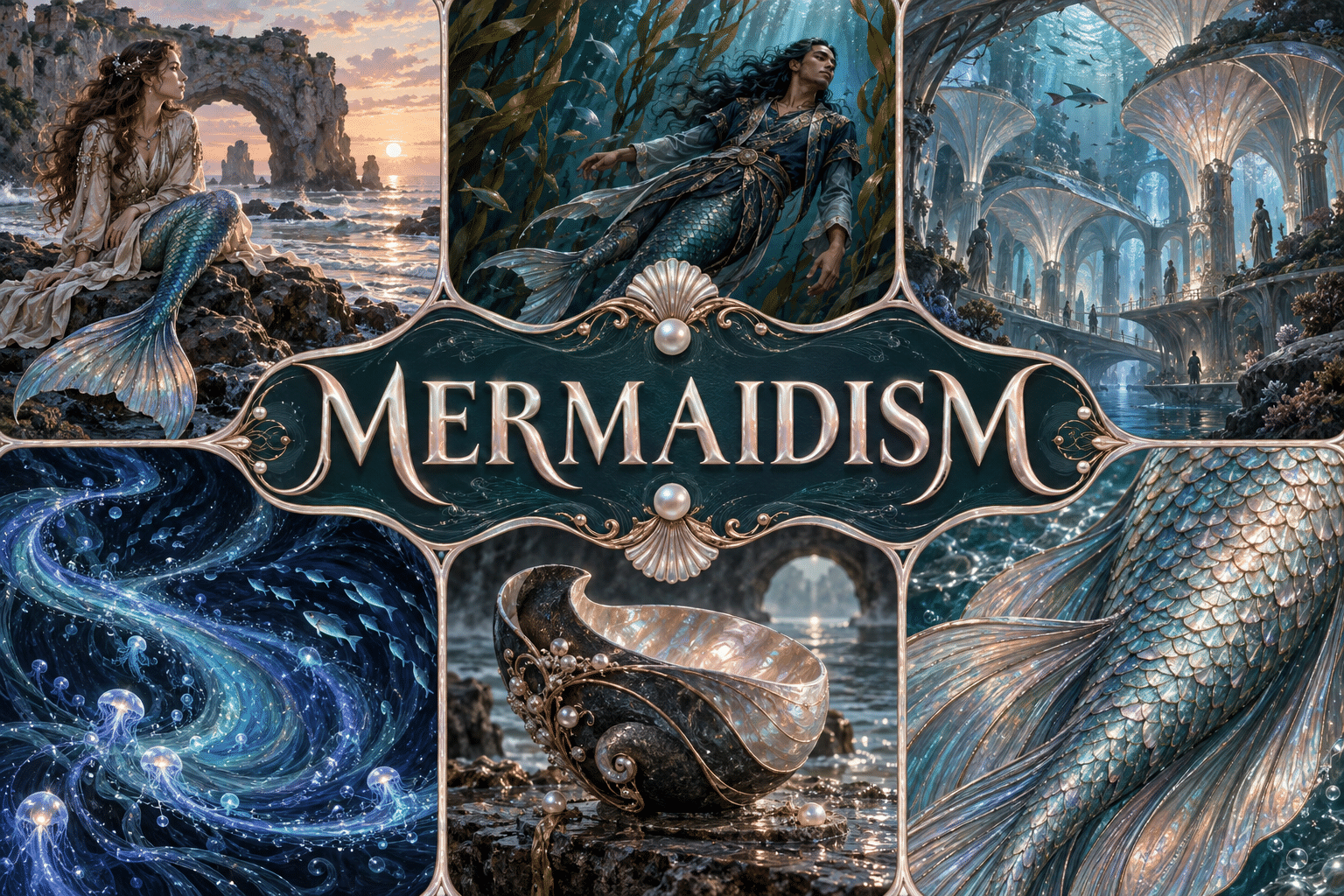
A vocabulary of tides — the centrally titled collage gathers six related possibilities around the complete Mermaidism name. Portrait, architecture, luminous current, vessel and surface detail share a palette while changing scale. Use it as a visual map, then inspect the individual studies for more deliberate choices.
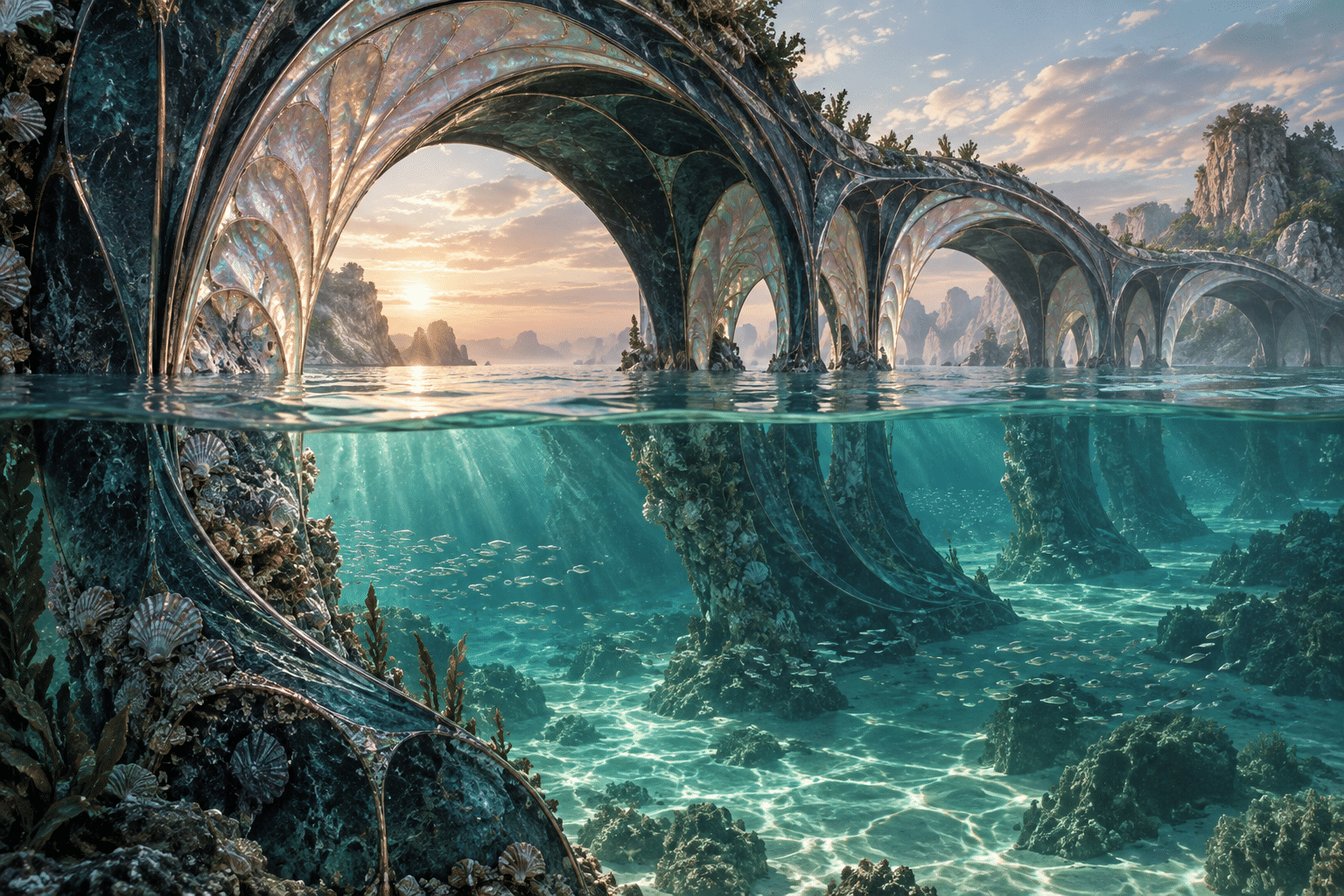
01 · The tide-built arcade translates the current into architecture. Shell-like vaults and darker structural masses create a route through water. The test is whether the empty channel feels as designed as the arches; architectural fantasy becomes stronger when it offers clear spaces instead of endless ornament.
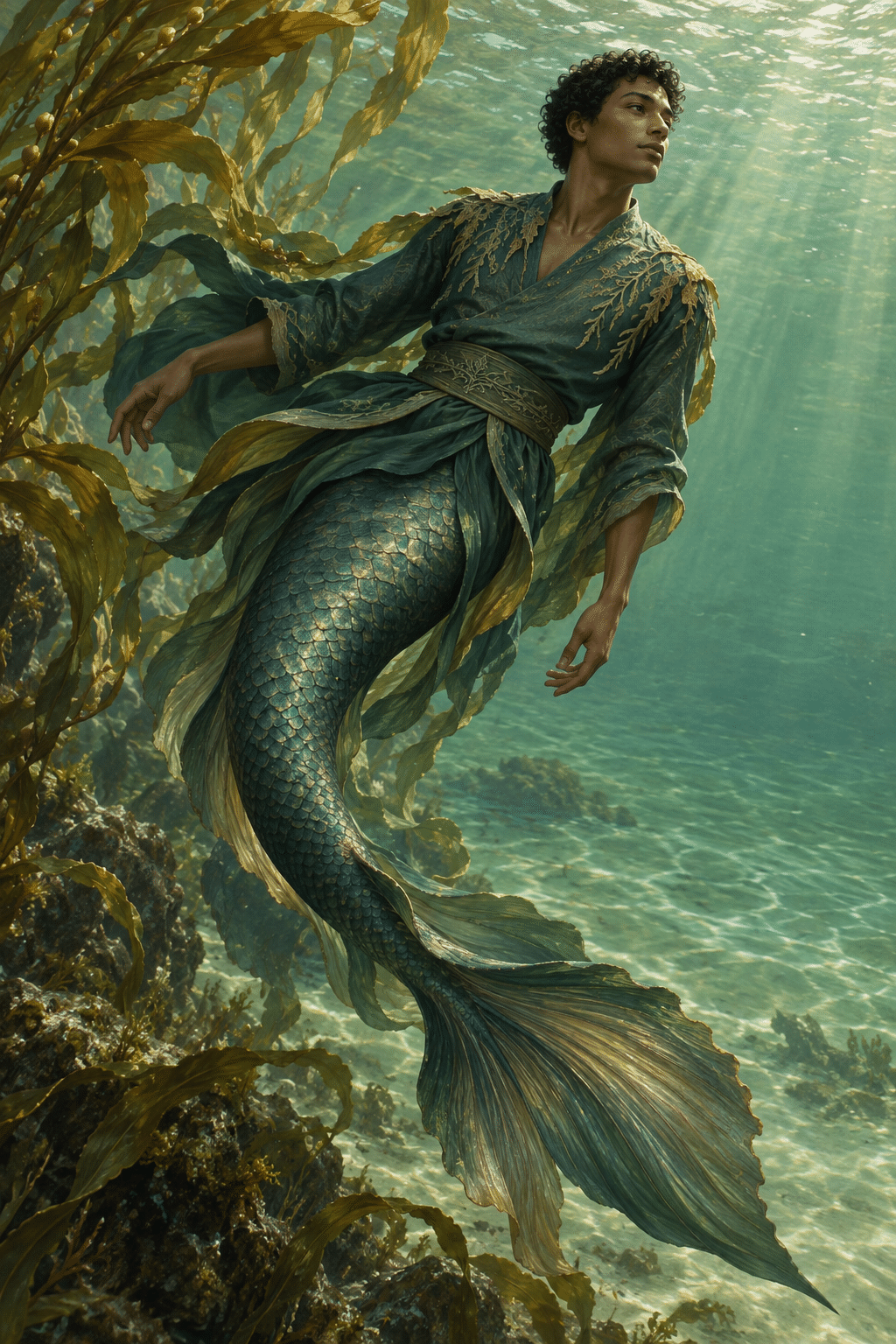
02 · The kelp mantle studies costume and movement. A clothed adult merperson and surrounding ribbon forms follow a shared direction. Keep the anatomy legible and distinguish the figure from the plants. The relationship is compositional, not a claim about a real aquatic species.
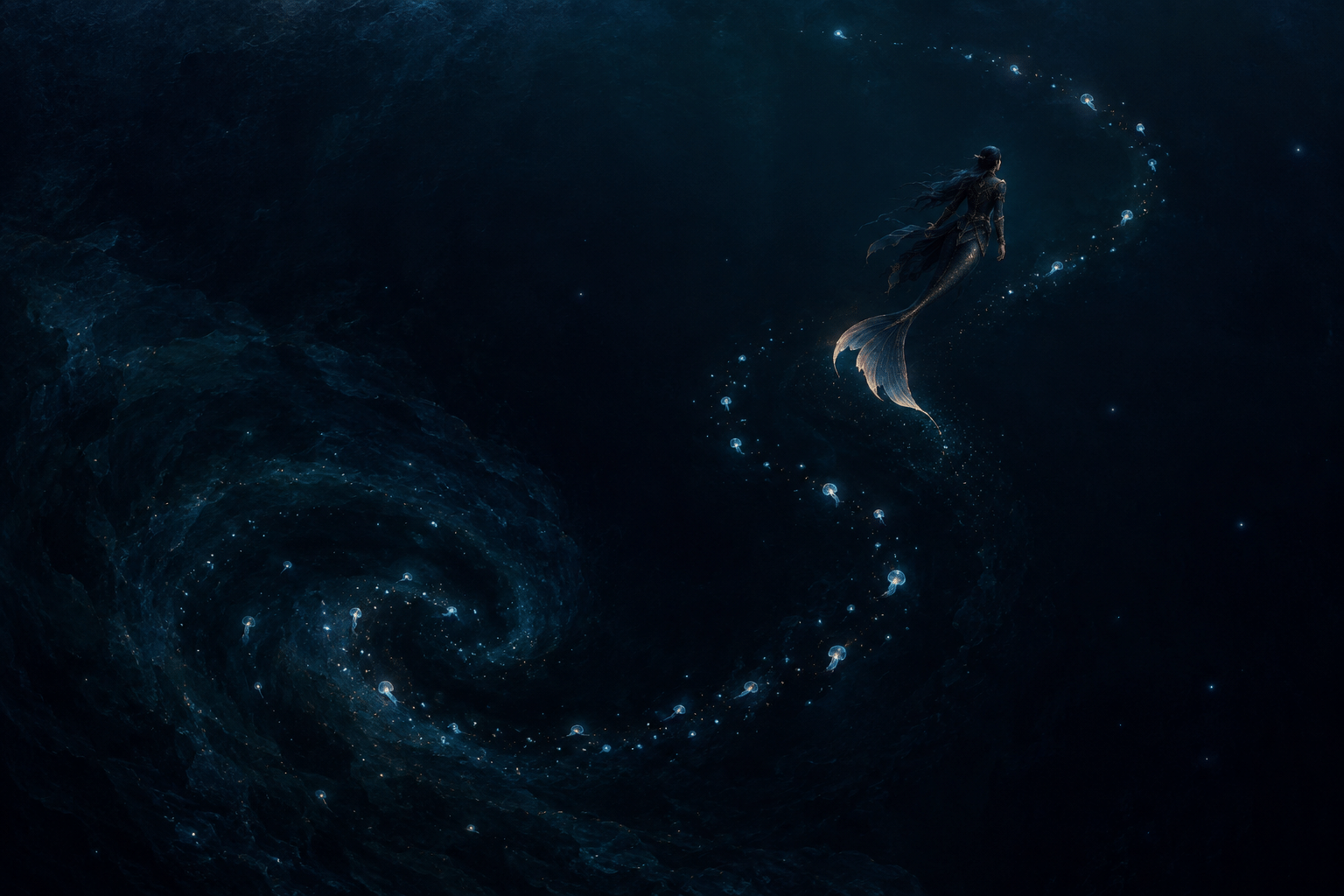
03 · The midnight current reduces the vocabulary to a small merfolk silhouette, a broken luminous trail and deep indigo space. It tests how little detail the concept needs. Darkness should remain substantial rather than becoming a background for indiscriminate neon.
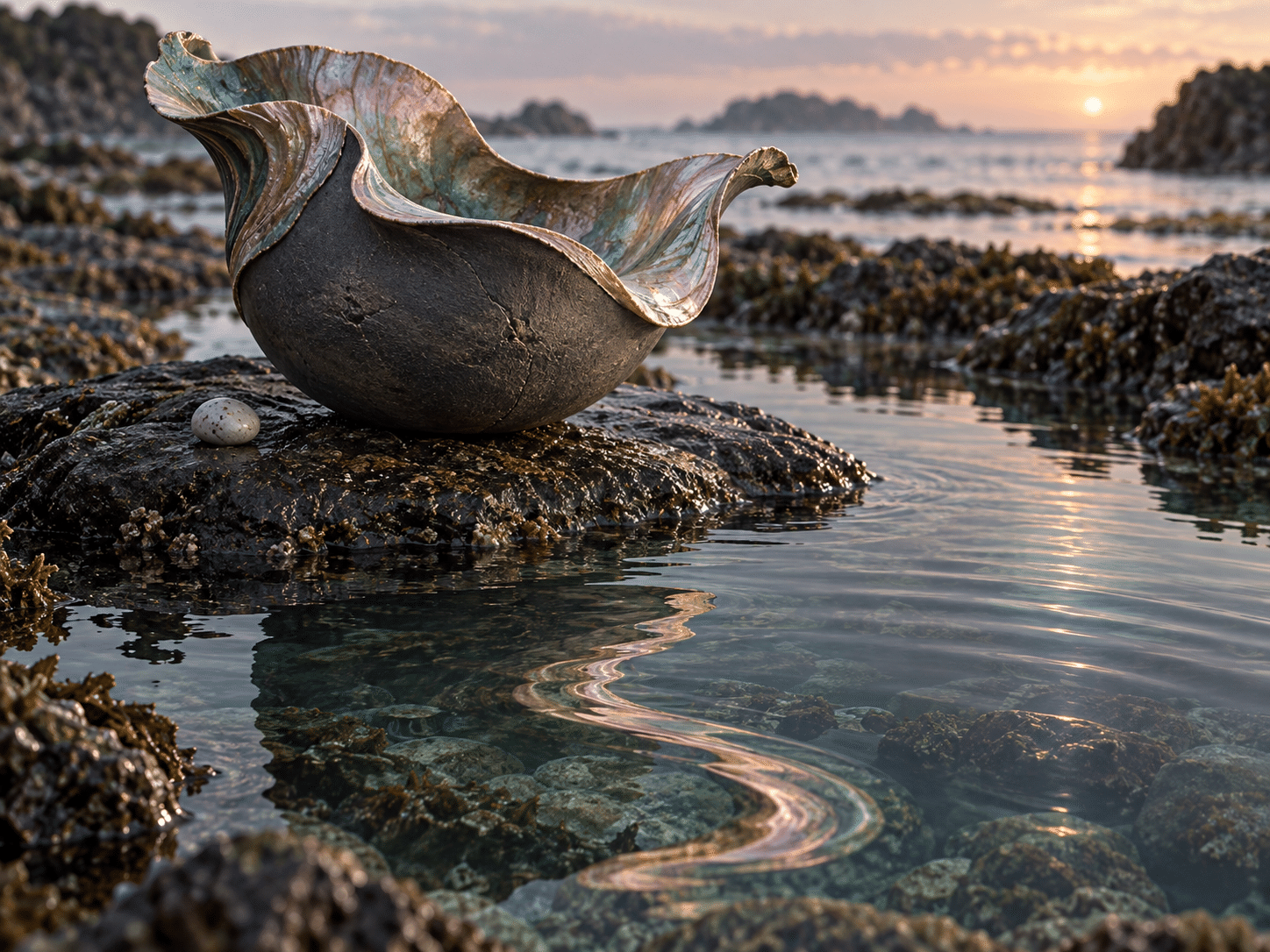
04 · Vessel for a borrowed tide removes the figure altogether. A matte ceramic body, a shell-like rim and a curved reflection carry the style. The object is imaginary: this is a design study, not a photograph of a product available to buy.
Build your own study in five decisions
Choose a subject and a scale. Begin with a single figure, one vessel or three arches rather than an entire underwater civilization. Select one dominant curve, then make a quick monochrome sketch. The subject and the open-water interval should remain readable when the image is small.
Decide where the light comes from. Separate reflected surface light, transmitted daylight and imagined bioluminescence in your description. Choose a dark foundation, one middle color and a restrained pearl or warm accent. Add texture only after the composition works.
Define materials by their differences. Ask for matte fired clay against a lustrous rim, coarse rock against fine scales, or translucent water against opaque fabric. The word iridescent alone often produces uniform rainbow gloss. A small area of changing color is more convincing when adjacent surfaces stay quiet.
Review the result for a continuous body, plausible hands, a clear tail connection, purposeful reflections and uncluttered boundaries. For the architecture and vessel studies, check that openings remain openings and that important edges do not dissolve into decoration. A beautiful image still needs a coherent structure.
Save the prompt with the image and vary one decision at a time. Compare a warm shallow version with a restrained deep-water version, or keep the light fixed while changing stone to ceramic. Mermaidism can support illustration, imaginary costume design, environmental concept art and editorial covers without reducing them all to the same sparkling portrait.
Pocket-sized facts
AOI presents Mermaidism as an original creative framework rather than a documented historical movement.
Waterhouse’s A Mermaid (1900) is a specific historical reference, not an example of membership in Mermaidism.
Bioluminescence, reflection and pearlescent appearance are different visual ideas; the gallery uses them selectively.
All six images are AI-generated imaginative illustrations.
Technique notes
Sketch the dominant curve and quiet water shape before adding surface detail.
Keep daylight, reflection and imagined bioluminescence distinct in the lighting brief.
Use marine references for specific forms and conditions; name the source and label imaginative departures.
Check figures, fins, reflections and architectural openings at full size before approving an image.
A small poetic detour
Original words from the AOI studio.
Poetry
The shore unfastens into blue,
A silver seam lets morning through.
The stone remembers being sand;
The tide forgets the shape of land.
Between a shell and open sea,
A borrowed curve makes room for me.
No map can hold that water still;
The light goes wandering where it will.
The prompt workshop
Original creative exercises. These prompts create new illustrations, not documentary evidence.
Start here · One curve, two worlds
An original Mermaidism illustration of an adult mermaid in an opaque pearl-toned tunic resting beside a coastal arch. Show a clear waterline: warm dawn air above, cool turquoise water below. Her single long fish tail follows one sweeping S that continues into a reflected channel. Matte dark rocks balance a few pearlescent edges; preserve open water and a readable silhouette. Invented place and figure, no text, no franchise characters, no uniform glitter.
01 · The tide-built arcade
Original Mermaidism fine-art illustration for the AOI flagship article. A coherent visual language: one sweeping tidal S-curve links solid form and surrounding water; matte deep-teal or indigo masses edged with restrained nacre-like rose-gold and pearl highlights; a readable quiet water interval; finely observed marine-inspired texture rather than generic glitter. Rich layered painterly detail, superb composition, gallery-quality contemporary imaginative art, not an imitation of any named artist or franchise. Merfolk are fictional adults, with elegant opaque clothing and anatomically coherent single fish tails. No logos, no watermark. Landscape architectural motif study, no people. An invented partially submerged arcade made from matte blue-black stone and delicate shell-like vaulted ribs; the structures curve in one sweeping S through clear shallow turquoise water. Half of one arch rises above a visible waterline into quiet dawn air while its underwater continuation softens and shifts. Broken sunlight catches pearl-pink edges; broad deep-green water separates the vaults. No literal palace, no treasure, no mermaid statue, no text. Let the water shape the structure, exquisite material detail, calm grand scale.
02 · The kelp mantle
Original Mermaidism fine-art illustration for the AOI flagship article. A coherent visual language: one sweeping tidal S-curve links solid form and surrounding water; matte deep-teal or indigo masses edged with restrained nacre-like rose-gold and pearl highlights; a readable quiet water interval; finely observed marine-inspired texture rather than generic glitter. Rich layered painterly detail, superb composition, gallery-quality contemporary imaginative art, not an imitation of any named artist or franchise. Merfolk are fictional adults, with elegant opaque clothing and anatomically coherent single fish tails. No logos, no watermark. Portrait-oriented 2:3 fine-art movement and costume study. One dignified adult merperson with short dark curly hair, warm brown skin, an opaque beautifully tailored sea-green tunic and a single long fish tail, drifting diagonally in sunlit green shallow water. Golden olive kelp-inspired blades form a loose mantle-like frame around but do not fuse with the body. Tunic folds, one graceful hand and tail fin all answer the same current. Face clearly readable, no bubbles obscuring it. Restrained nacre on a few scales, mostly matte textures, one large empty green-water interval, no text or crowns.
03 · The midnight current
Original Mermaidism fine-art illustration for the AOI flagship article. A coherent visual language: one sweeping tidal S-curve links solid form and surrounding water; matte deep-teal or indigo masses edged with restrained nacre-like rose-gold and pearl highlights; a readable quiet water interval; finely observed marine-inspired texture rather than generic glitter. Rich layered painterly detail, superb composition, gallery-quality contemporary imaginative art, not an imitation of any named artist or franchise. Merfolk are fictional adults, with elegant opaque clothing and anatomically coherent single fish tails. No logos, no watermark. Landscape nocturnal deep-water motif, a vast velvet indigo water field with no sunlight, no surface rays, no kelp and no coral reef. A small distant fictional adult merperson in opaque dark clothing moves in an elegant S silhouette through sparse cyan bioluminescence-inspired points. One soft pearl edge describes a single tail fin; a broken trail of tiny luminous shapes continues the body curve across the dark composition. Luminous points form a delicate discontinuous spiral, never a solid neon tube. Deep quiet, incredible negative space and restrained atmospheric painterly detail, no text.
04 · Vessel for a borrowed tide
Original Mermaidism fine-art illustration for the AOI flagship article. A coherent visual language: one sweeping tidal S-curve links solid form and surrounding water; matte deep-teal or indigo masses edged with restrained nacre-like rose-gold and pearl highlights; a readable quiet water interval; finely observed marine-inspired texture rather than generic glitter. Rich layered painterly detail, superb composition, gallery-quality contemporary imaginative art, not an imitation of any named artist or franchise. Merfolk are fictional adults, with elegant opaque clothing and anatomically coherent single fish tails. No logos, no watermark. Landscape intimate fine-art still life with no people or mermaids. One extraordinary invented asymmetrical ceramic vessel on a dark smooth rock in a shallow tidal pool. Matte charcoal clay body, a folded shell-like rim with delicate mother-of-pearl rose and green edges. A long reflected ribbon from the opening becomes a graceful S in clear water, subtly broken by ripples. One small pale pebble for scale, no decorative clutter, soft side-lit dawn, tactile fired clay, restrained iridescence not metallic rainbow chrome. Museum-quality object portrait, no text.
Collage · A vocabulary of tides
Original Mermaidism fine-art illustration for the AOI flagship article. A coherent visual language: one sweeping tidal S-curve links solid form and surrounding water; matte deep-teal or indigo masses edged with restrained nacre-like rose-gold and pearl highlights; a readable quiet water interval; finely observed marine-inspired texture rather than generic glitter. Rich layered painterly detail, superb composition, gallery-quality contemporary imaginative art, not an imitation of any named artist or franchise. Merfolk are fictional adults, with elegant opaque clothing and anatomically coherent single fish tails. No logos, no watermark. Landscape 3:2 editorial style collage, six beautifully coordinated panels: an adult mermaid at a dawn tidal arch; a fully clothed adult merperson drifting among kelp-like ribbons; submerged shell-like architectural vaults; an abstract indigo bioluminescent current; a pearl-and-dark-clay sculptural vessel; close-up pearlescent tail textures. Clear panel divisions made of delicate nacre borders. At the EXACT CENTER place the complete exact word "MERMAIDISM" in large flawlessly legible elegant sculpted pearl lettering, M E R M A I D I S M. A dark teal quiet central cartouche gives superb title contrast; never split or misspell the word. Fine art anthology cover, restrained rose-gold highlights, exquisite varied compositions not repeated faces. No other text.
Your next inspiration
Discover another art style
Follow a visual thread to the next subject.
People & works to explore
References discussed in this article. Consult the sources below for context.
Artists and practitioners
John William Waterhouse — historical reference for mermaid imagery, not a Mermaidism practitioner.
Paintings and other works
A Mermaid (1900), John William Waterhouse, Royal Academy of Arts — discussed as a contextual reference.
A smile from the studio
Jokes
My Mermaidism portrait needed more depth. The model sent it to the bottom of the ocean.
The shell asked for a minimalist redesign. It wanted less shelf-awareness.
I painted a perfectly calm sea. The reflections immediately asked for a wave review.