
Artist and technique · researched guide
M-City is the documented artist name of Mariusz Waras, whose practice includes large urban compositions built with stencils. This page replaces the unsupported treatment of “mcity1984” as an art movement. That wording survives in our legacy URL and archive illustration; the cited museum records identify the artist as M-City, not mcity1984.
A visual introduction
Open any image to look closer, then browse the examples.
A closer look
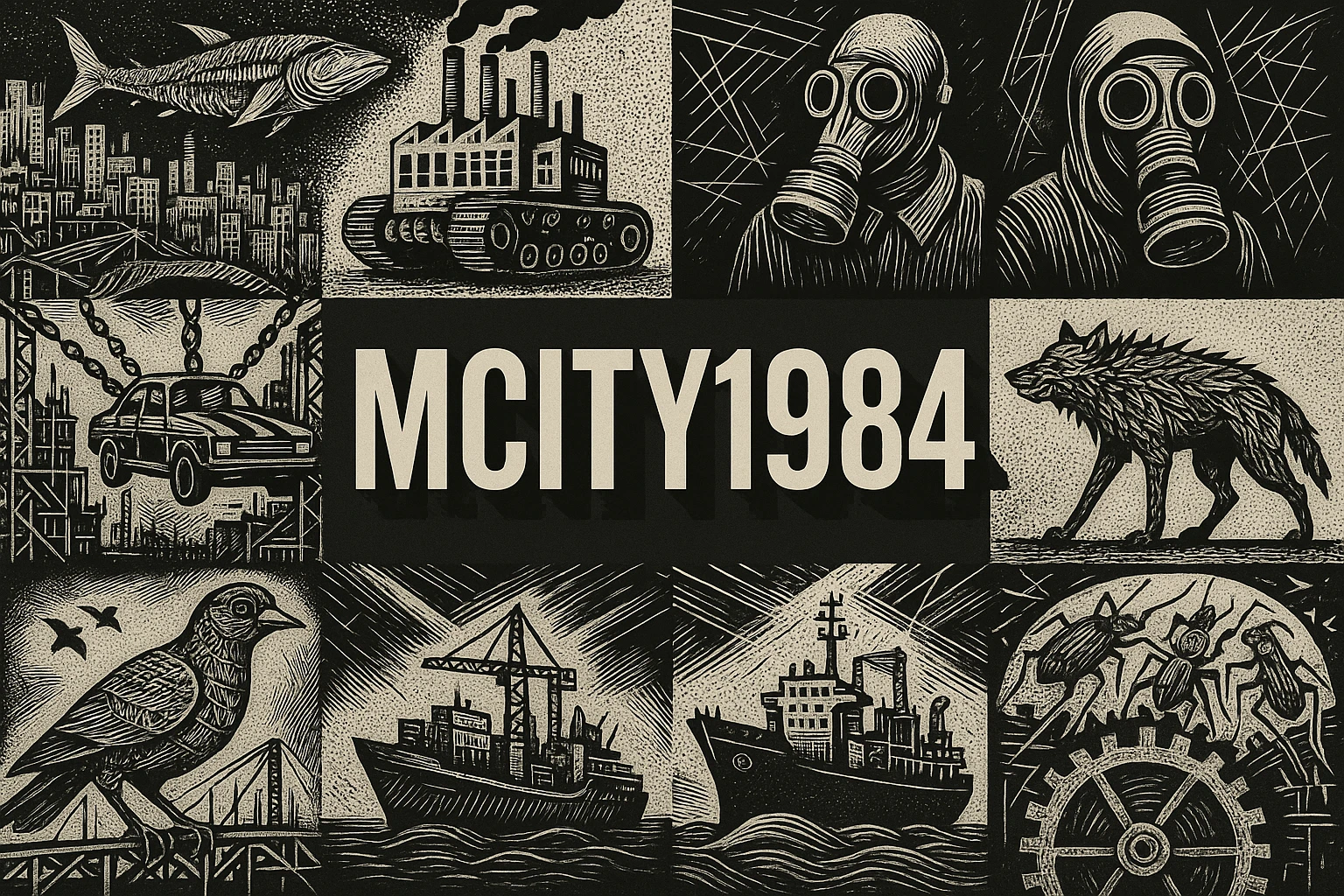
Our black-and-cream archive collage contains ships, factories, gas masks, a suspended car and invented animals. Scratched lines and strong silhouettes give it an industrial atmosphere. It is an AI illustration, not a collection of works by Waras or evidence that each motif belongs to his practice.
From a small module to a large wall
Völklinger Hütte describes Waras’s modular stencil system and the use of parallel projection in expandable cityscapes. Small repeatable components can therefore contribute to a much larger structure. This gives us a more precise way to discuss the work than calling every industrial image dystopian: consider how units connect, how their scale changes, and how the overall composition remains readable. [1]
A useful visual exercise is to choose one repeated element in a documented reproduction and follow where it reappears. Is it rotated, resized or placed beside a different neighbour? Then step back from the details and describe the largest silhouette. The relationship between those two levels is part of the viewing experience; a dense surface alone does not explain it.
An artist has a history; a label is not a biography
Urban Nation identifies Mariusz Waras as a Polish artist raised among Gdynia’s factories, chimneys and cranes. Its account describes his graphic-art training in Gdańsk and the assembly of carefully cut stencils into imagined urban landscapes. It also records his work in the museum’s opening exhibition in 2017. These are attributable details, unlike the unverified alias preserved in our old catalogue title. [2]
The industrial setting matters because it locates an artistic interest in experience and practice. It should not become a universal explanation for every image. Look for the particular decisions in a particular work, and use the linked institutional records to establish the title, date and material before interpreting its theme.
One documented work: Dooms Day III
The Völklinger Hütte record lists Dooms Day III as a 2022 work in acrylic on canvas, measuring 2 by 3.8 metres. Its account describes a hostile ship moving through a city and connects the artist’s statement with the invasion of Ukraine. This specific context matters: the work’s threatening imagery should not be reduced to an attractive industrial backdrop. [1]
Consult the museum’s reproduction when studying that work. The boats in the AOI collage are invented images and are not substitutes for it. The distinction is especially necessary here because ships and machinery can make an unrelated picture look superficially consistent with the discussion. Similar subject matter is not provenance.
Use the technique as a question, not an attribution
To explore modular composition yourself, cut three simple shapes from scrap paper: a rectangle, a stepped roof and a narrow chimney. Arrange them into several structures using the same components. Change the spacing before adding detail. This reveals how repetition can produce a coherent environment without making every building identical.
For a digital or AI study, describe an original industrial scene through modular silhouettes, restrained colour and a clear scale relationship. Keep your own subject and purpose explicit. Credit a research reference when appropriate, but do not sign the result with an artist’s name or imply his participation. The rewarding lesson here is how a composition grows from parts; the artist’s identity is not a texture setting.
People & works to explore
References discussed in this article. Consult the sources below for context.
Artists and practitioners
Mariusz Waras, known as M-City — documented artist; no verified association with the alias mcity1984
Paintings and other works
Dooms Day III (2022), acrylic on canvas — linked museum example, not reproduced in the collage