
Artistic tendency
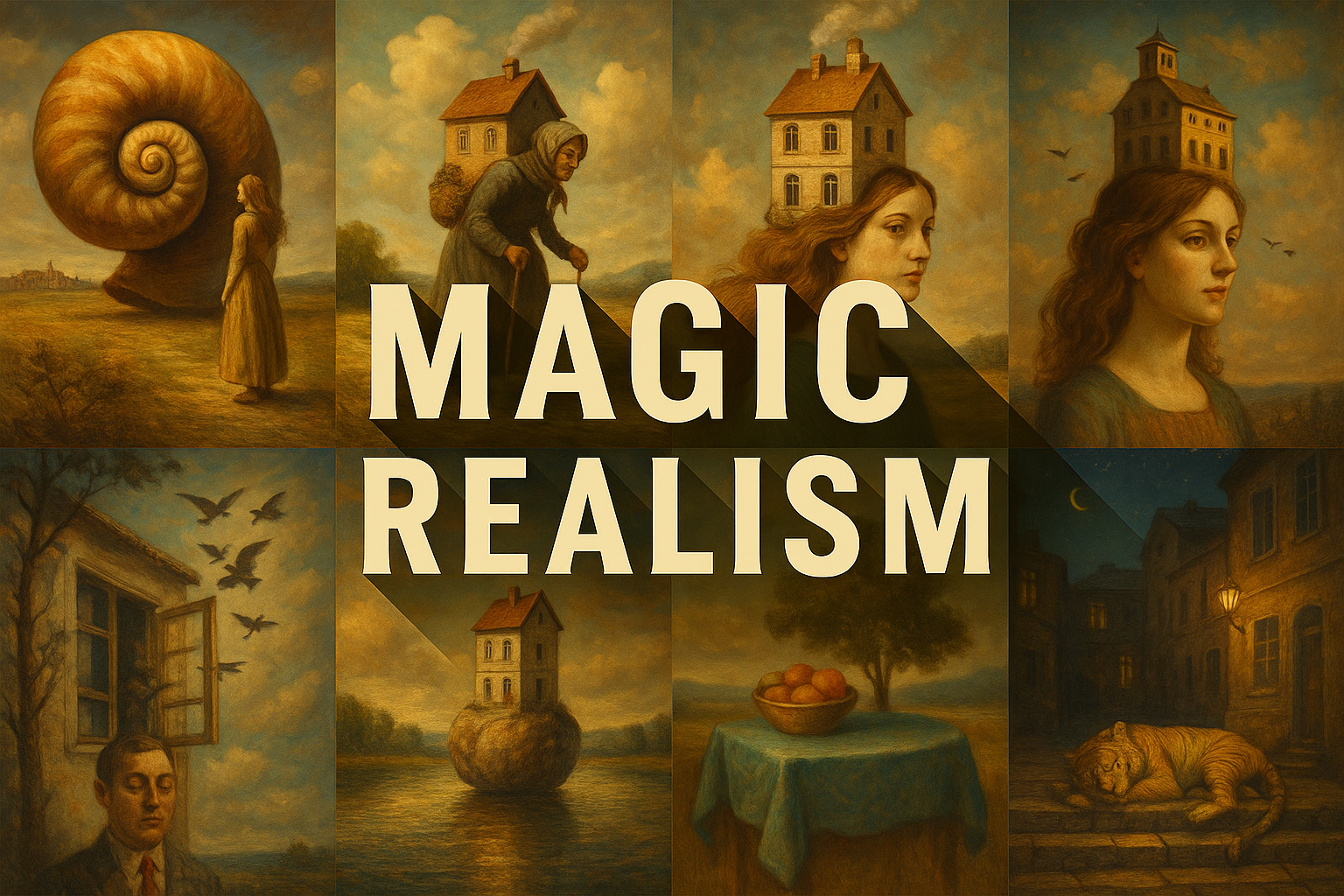
Magic realism in painting can describe images that use precise, convincing representation to make an improbable or unsettling situation feel present. Its art-historical uses should be distinguished from the related but separate history of magical realism in literature.
A visual introduction
Select an image for a closer look. Use the thumbnails, arrow keys or a swipe to compare examples. Zoom in to inspect details, or share the image that inspires you.


Creative toolbox · take this style further
Choose an input and a destination. Search sends your words to the chosen site; Copy & open puts them on your clipboard to paste there.
Create with AI
Turn your chosen input into an image prompt or a new creative direction.
ChatGPT
Copy your input and paste it into a ChatGPT conversation or image request.
Copy & open ChatGPT (new tab)Claude · Anthropic
Develop an image prompt or explore the style in a new Claude conversation.
Copy & open Claude · Anthropic (new tab)Midjourney
Paste your input into the Imagine bar on the Create page.
Copy & open Midjourney (new tab)Adobe Firefly
Copy your input, open Firefly, and paste it into the prompt field.
Copy & open Adobe Firefly (new tab)Leonardo.Ai
Copy your input, open Leonardo, and paste it into the generation field.
Copy & open Leonardo.Ai (new tab)Image search
Find visual references. Short, concrete keywords usually work best.
Lexica
Search AI images and prompts using your selected input.
Search with this input Lexica (new tab)Pexels
Search the photo and video library. Short keywords often work best.
Search with this input Pexels (new tab)Pixabay
Search photos, illustrations and other images.
Search with this input Pixabay (new tab)Unsplash
Search photographs using the style name or your own keywords.
Search with this input Unsplash (new tab)Wikimedia Commons
Search photographs, artworks and historical images. Check each file for its source and reuse terms.
Search with this input Wikimedia Commons (new tab)Art & research
Explore artists, collections and the ideas behind a style.
Wikipedia
Search for background reading. A style may not have its own article.
Search with this input Wikipedia (new tab)WikiArt
Copy your input into WikiArt’s search to explore artists and artworks.
Copy & open WikiArt (new tab)Europeana
Paste your keywords into the search to explore European museum, library and archive collections.
Copy & open Europeana (new tab)Inspiration
Discover portfolios and visual ideas from creative communities.
Instagram hashtags
Search a hashtag made from your input: spaces and punctuation are removed. Instagram may require sign-in.
Search with this input Instagram hashtags (new tab)ArtStation
Paste your input into artwork search for concept art, environments, characters and visual development.
Copy & open ArtStation (new tab)Behance
Paste your input into project search for illustration, design and visual storytelling.
Copy & open Behance (new tab)A closer look
Ordinary surfaces and stable space can support a carefully chosen anomaly; the tension often depends on restraint rather than a large collection of spectacular effects.
A useful historical point of reference
MoMA's 1943 exhibition Realists and Magic Realists brought together sharply represented images ranging from observed subjects to imagined situations. Its contemporary account explicitly described a tendency rather than a coordinated movement with one shared program.
That historical use is a useful anchor, not a definition of every work later given the label. Examine the individual picture and the context in which the term is used. Do not assume that painting, fiction and film share an identical chronology or method.
Build a credible ordinary world
The improbable element becomes more effective when the surrounding space feels considered. Establish a table's perspective, a room's light or an object's contact with the ground. Consistent shadows and surface behavior help the viewer accept the setting long enough to notice what is unusual.
Choose one main anomaly. A familiar room containing a subtly impossible reflection may hold attention better than a room filled with unrelated floating objects. The ordinary parts need enough specificity to resist becoming a generic dream background.
Control the degree of explanation
An image can remain unsettling without revealing why the event has happened. Avoid adding symbols that explain every detail. The viewer's uncertainty can be part of the experience, provided the composition itself remains legible.
Compare two versions of the same scene: one in which the anomaly dominates and one in which it is discovered gradually. Notice how the balance changes from spectacle to quiet unease. Neither is automatically better; the choice should match the intended encounter.
Keep neighboring terms useful
Magic realism can overlap with Surrealist concerns, but not every fantastic image belongs to the same historical tendency. Use a specific source when discussing an artist's classification rather than assigning a label from appearance alone.
For a contemporary interpretation, describe the actual visual mechanism: exact rendering, ordinary setting, one impossible relationship and restrained staging. A generated example illustrates those decisions; it is not a newly discovered historical work or evidence that a named artist used a particular process.
The prompt workshop
Original creative exercises. These prompts create new illustrations, not documentary evidence.
One impossible reflection
Original precisely painted quiet kitchen in which one small mirror reflects an empty garden instead of the room, consistent daylight and otherwise ordinary objects.
A delayed discovery
Original restrained painting of a neatly set table with one cup casting the shadow of a branch, credible materials and subtle visual emphasis.
Stillness and distance
Original magic-realist scene of a modest waiting room with a doorway opening onto a remote shoreline, exact spatial construction and no additional fantasy effects.
Sources and further exploration
MoMA — the original 1943 Realists and Magic Realists exhibition account