
Alpine façade-painting tradition
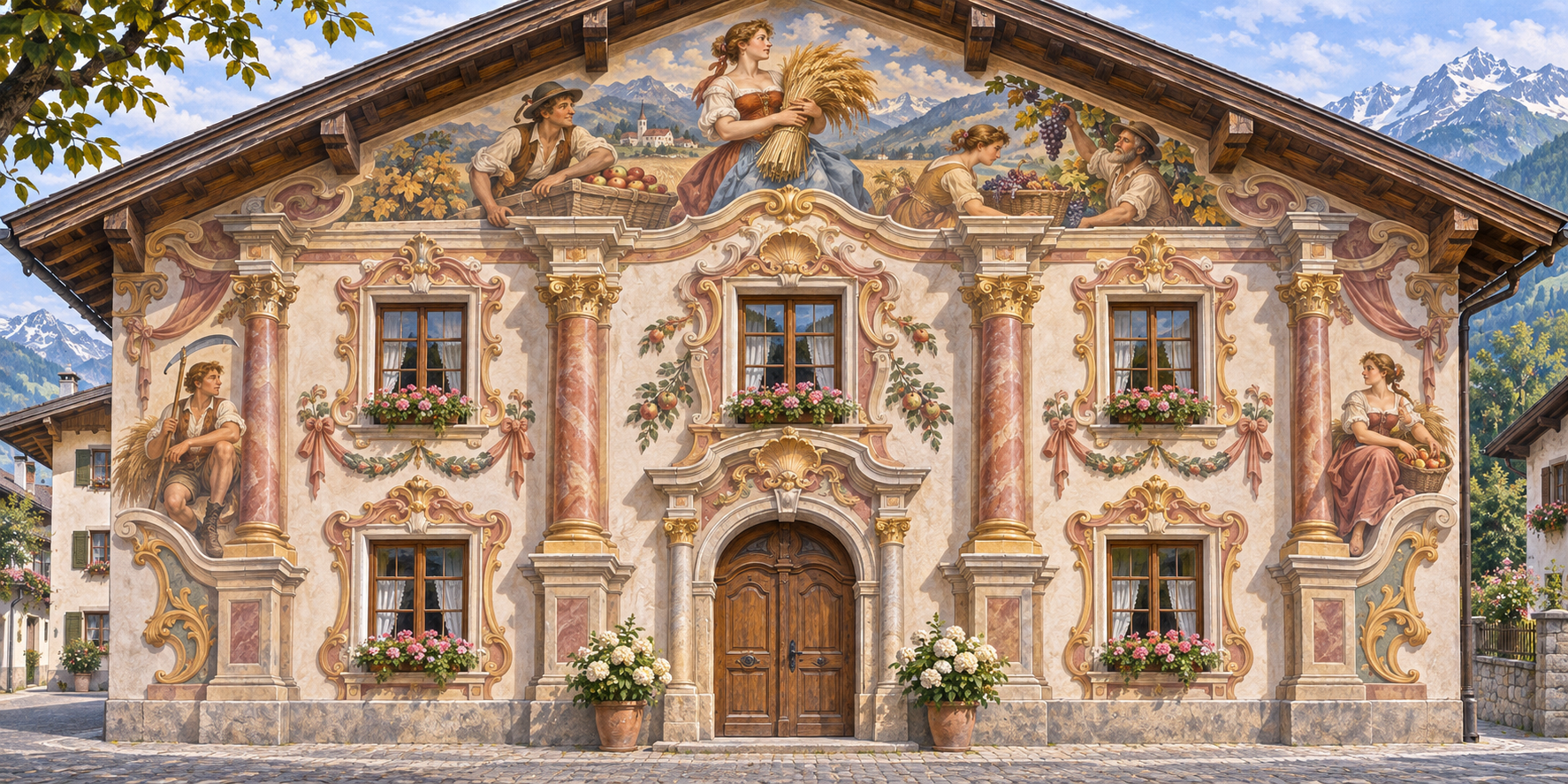
Lüftlmalerei transforms building façades through painted architectural illusion, ornamental framing and narrative scenes designed around real windows, doors and gables.
A visual introduction
Select an image for a closer look. Use the thumbnails, arrow keys or a swipe to compare examples. Zoom in to inspect details, or share the image that inspires you.
Creative toolbox · take this style further
Choose an input and a destination. Search sends your words to the chosen site; Copy & open puts them on your clipboard to paste there.
Create with AI
Turn your chosen input into an image prompt or a new creative direction.
ChatGPT
Copy your input and paste it into a ChatGPT conversation or image request.
Copy & open ChatGPT (new tab)Claude · Anthropic
Develop an image prompt or explore the style in a new Claude conversation.
Copy & open Claude · Anthropic (new tab)Midjourney
Paste your input into the Imagine bar on the Create page.
Copy & open Midjourney (new tab)Adobe Firefly
Copy your input, open Firefly, and paste it into the prompt field.
Copy & open Adobe Firefly (new tab)Leonardo.Ai
Copy your input, open Leonardo, and paste it into the generation field.
Copy & open Leonardo.Ai (new tab)Image search
Find visual references. Short, concrete keywords usually work best.
Lexica
Search AI images and prompts using your selected input.
Search with this input Lexica (new tab)Pexels
Search the photo and video library. Short keywords often work best.
Search with this input Pexels (new tab)Pixabay
Search photos, illustrations and other images.
Search with this input Pixabay (new tab)Unsplash
Search photographs using the style name or your own keywords.
Search with this input Unsplash (new tab)Wikimedia Commons
Search photographs, artworks and historical images. Check each file for its source and reuse terms.
Search with this input Wikimedia Commons (new tab)Art & research
Explore artists, collections and the ideas behind a style.
Wikipedia
Search for background reading. A style may not have its own article.
Search with this input Wikipedia (new tab)WikiArt
Copy your input into WikiArt’s search to explore artists and artworks.
Copy & open WikiArt (new tab)Europeana
Paste your keywords into the search to explore European museum, library and archive collections.
Copy & open Europeana (new tab)Inspiration
Discover portfolios and visual ideas from creative communities.
Instagram hashtags
Search a hashtag made from your input: spaces and punctuation are removed. Instagram may require sign-in.
Search with this input Instagram hashtags (new tab)ArtStation
Paste your input into artwork search for concept art, environments, characters and visual development.
Copy & open ArtStation (new tab)Behance
Paste your input into project search for illustration, design and visual storytelling.
Copy & open Behance (new tab)A closer look
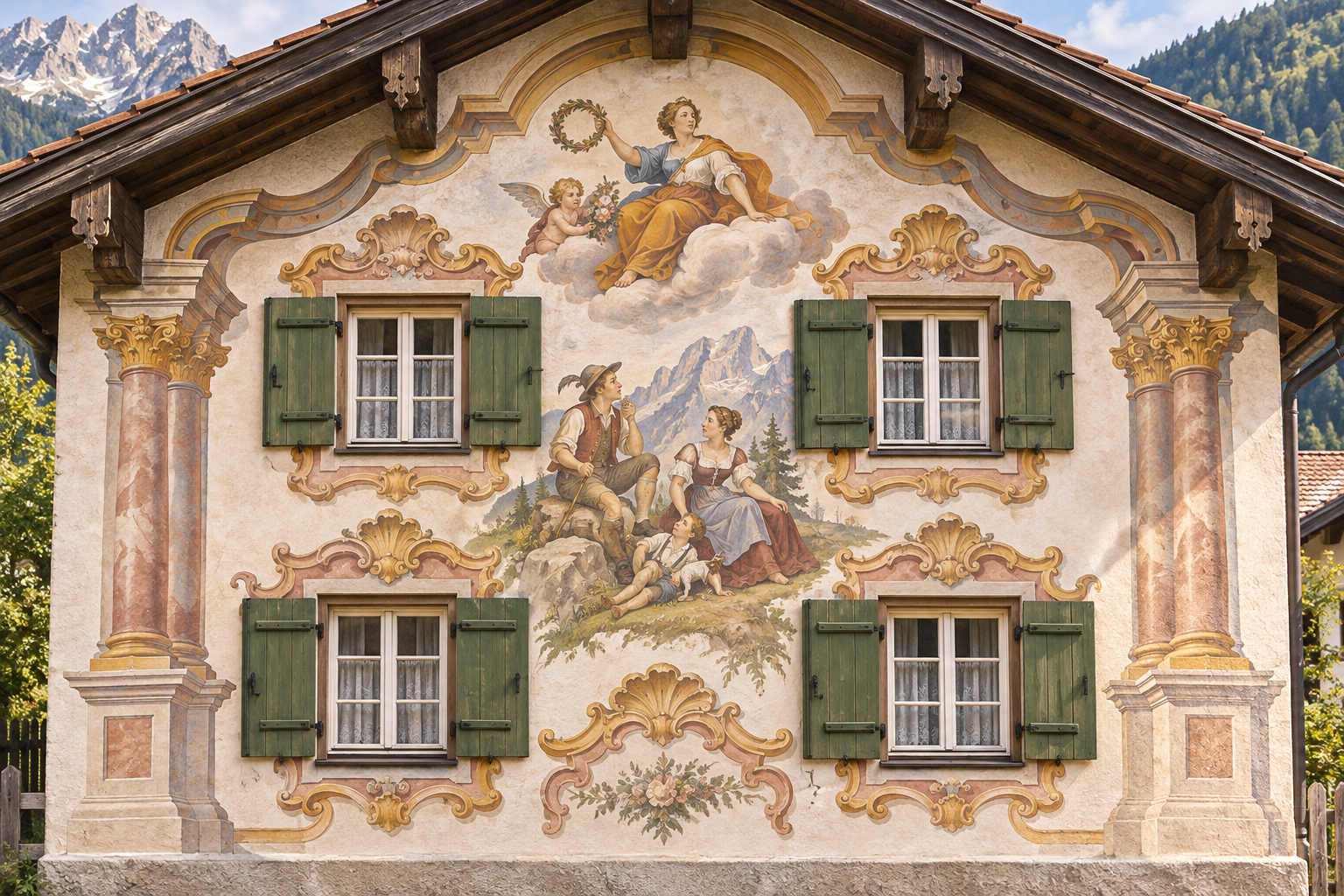
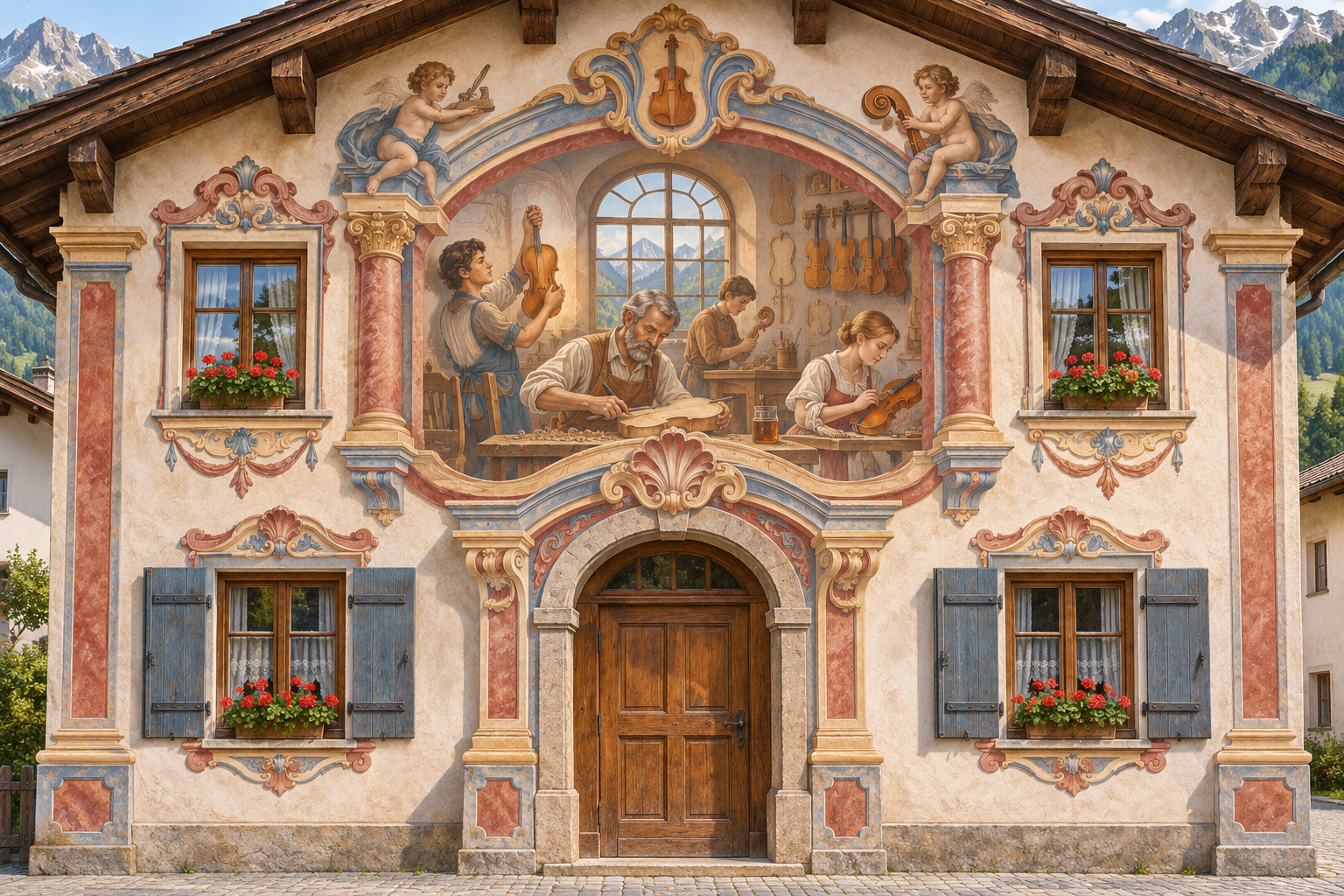
Painted columns and cornices, shaded architectural illusion, ornamental window frames, narrative figure groups, pale plaster grounds and compositions integrated with actual façade geometry.
A building becomes the picture
Lüftlmalerei is associated especially with the decorated façades of Upper Bavarian Alpine towns such as Oberammergau and Mittenwald. The Oberammergau Museum identifies Franz Seraph Zwinck as a central practitioner whose painted buildings remain important to the region's streetscapes.
The conservation magazine Monumente distinguishes Zwinck's integrated illusionistic architecture from Franz Karner's more separately arranged façade scenes. This is a reminder that the tradition has different compositional approaches. The same account treats the origin of the name Lüftlmalerei as uncertain, so a neat etymological story should not be presented as settled fact.
Compose around the real openings
Start with the actual building: door, windows, roof pitch, corners and the viewpoint from the street. Painted architecture should respond to those facts. A cornice that appears to continue a real ledge can create a convincing illusion; an invented column that ignores a window opening will expose the contradiction.
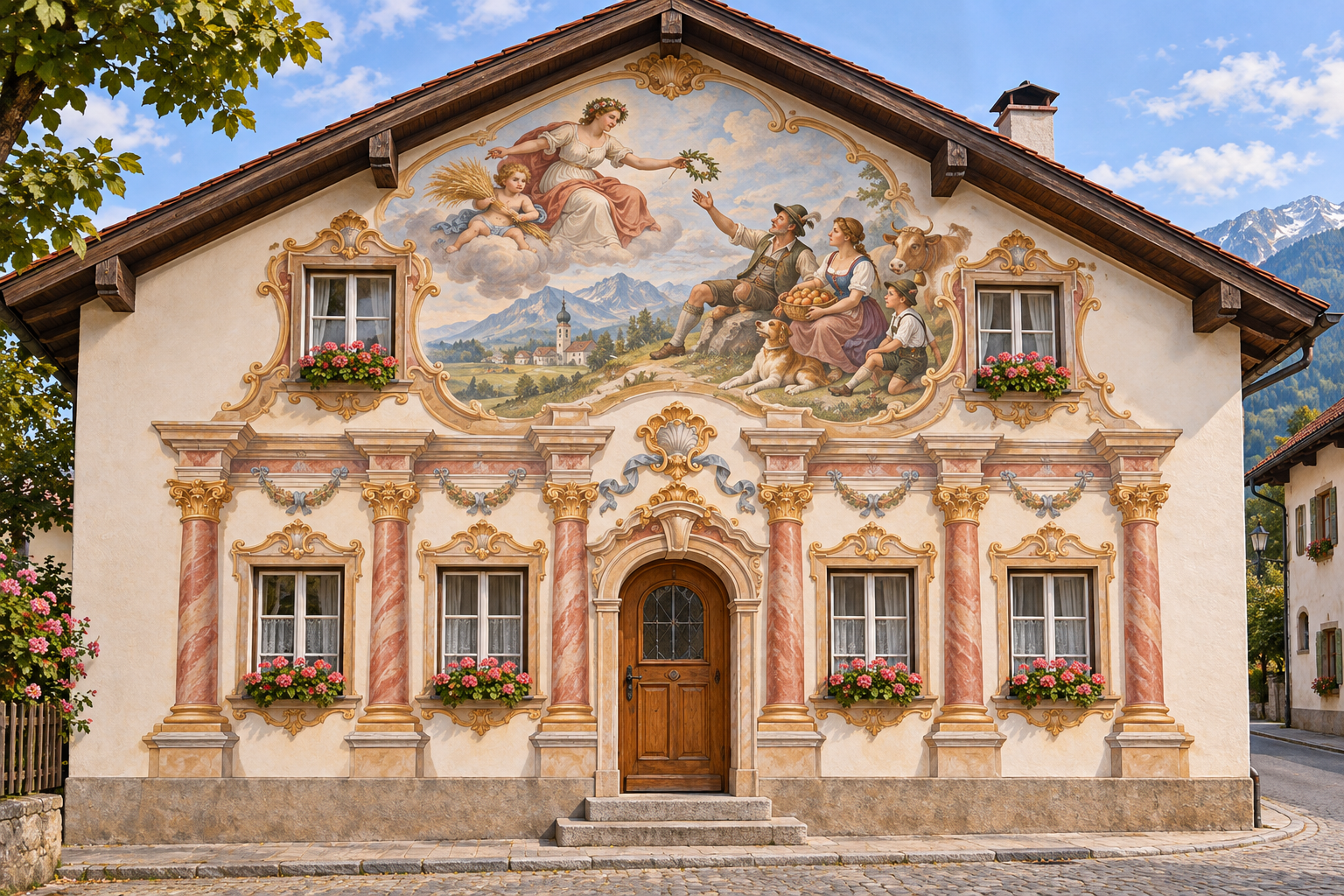
Decide whether the façade will act as one continuous stage or as several framed scenes. A gable can hold the main narrative, while quieter ornament connects the windows below. Reserve plain plaster so the building can breathe. Covering every available surface with figures usually weakens both the painting and the architecture.
Illusion, ornament and narrative
Use a consistent painted light direction. Highlights and shadows can make shallow painted frames seem to project from the wall, but the illusion depends on their relationship to the actual façade. Restrained ochres, cool grays and muted reds can support the structure without competing with every narrative detail.
Religious scenes are an important part of the documented tradition, alongside other decorative and narrative material. A contemporary interpretation can explore an original secular scene, but it should say so. Do not invent a saint's attributes or label a newly generated building as a surviving historic monument.
An architectural art, not a wallpaper effect
The useful unit is the whole façade seen from a plausible viewing position. A close study of one window frame can explain ornament; a wider street view reveals whether the design works on a building. Both are more informative than a flat ornamental texture detached from doors and windows.
For AI imagery, specify stable masonry, coherent openings and painted depth distinct from real sculptural relief. Historic examples include fresco work, but the label alone does not prove the materials or execution method of every façade. This article concerns visual understanding and original design studies, not a conservation recipe.
Positive editorial perspective
AOI editorial perspective (AI-authored). Lüftlmalerei can unite everyday architecture and storytelling. The most persuasive façades use real openings as compositional partners, making the building feel both inhabited and imaginatively expanded.
Negative editorial perspective
AOI editorial perspective (AI-authored). Detached ornament or inconsistent perspective can reduce the tradition to themed decoration. Begin with the actual façade and remove painted elements that compete with its openings, scale or light.
Neutral editorial perspective
AOI editorial perspective (AI-authored). This is a regional façade-painting tradition with varied artists, subjects and techniques. Digital interpretations can study its architectural integration, but they do not document a real historic building or establish its material construction.
A small poetic detour
Original words from the AOI studio.
Poetry
The window opens into air;
Its painted columns stay just there.
A cornice casts a borrowed shade,
A little depth the brush has made.
The gable holds a story high,
Between the shutters and the sky.
Below, the door admits the day;
The figures have no need to stray.
A wall can keep the weather out
And let a painted world look out.
I pass; the house keeps watch all night,
Its borrowed columns holding light.
The prompt workshop
Original creative exercises. These prompts create new illustrations, not documentary evidence.
Integrate a painted window frame
Original Lüftlmalerei-inspired façade study of a small Alpine house, real shuttered windows surrounded by painted architectural frames, coherent illusionistic shadows, pale plaster and restrained ochre, clear distinction between paint and physical relief, no text.
Start from credible window and door geometry.
Compose the entire façade
An invented Upper Bavarian house with an original contemporary façade painting, one narrative scene in the gable, painted columns linking the lower windows, generous plain plaster, consistent street-level perspective, no claim to depict a real monument.
Keep the composition subordinate to the building's structure.
Make a secular narrative stage
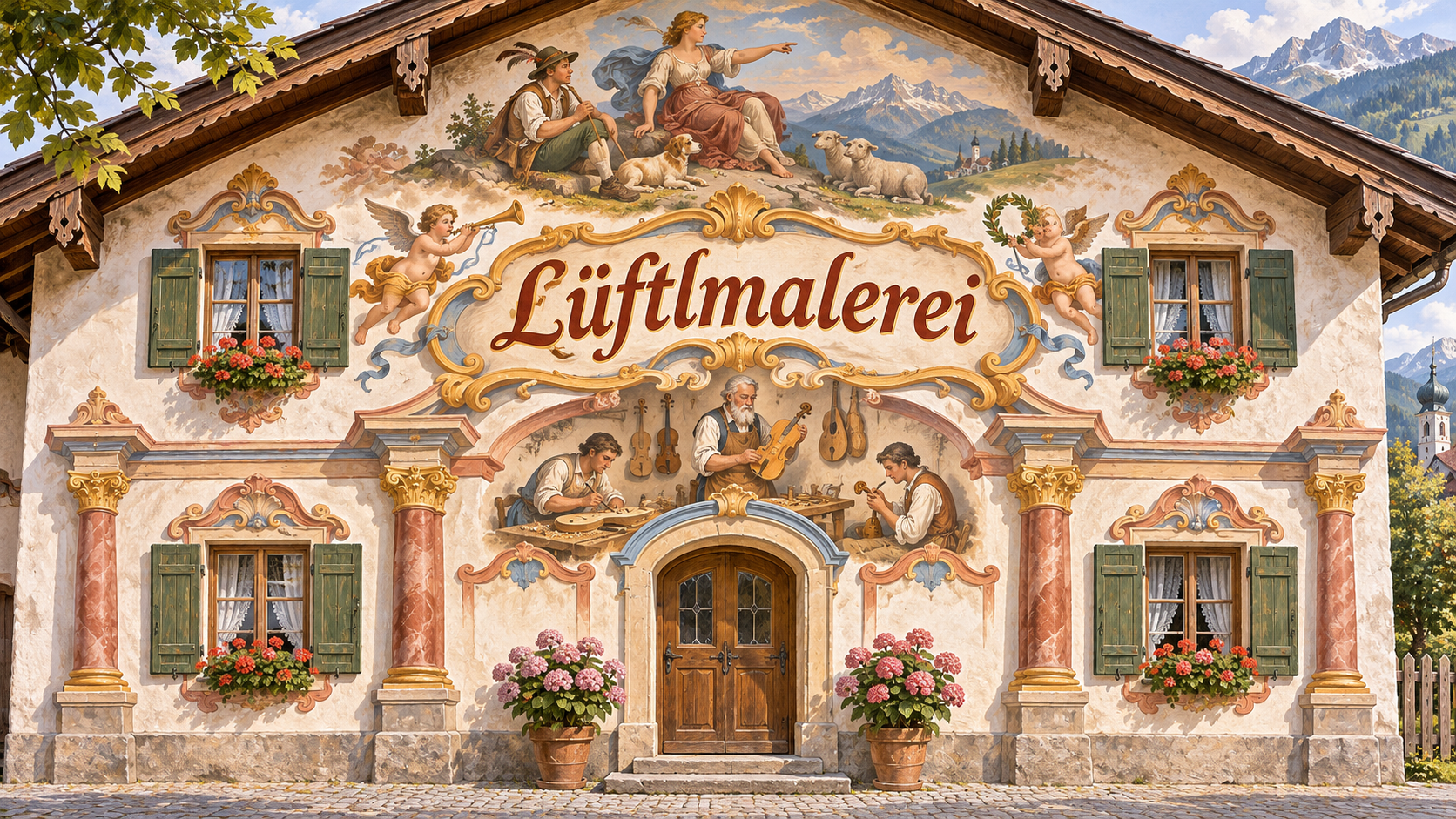
Original architectural illustration of a modest Alpine façade with a painted scene of instrument makers at work above the entrance, integrated ornamental frames, muted red and blue accents, believable real openings and painted shadows, no lettering.
Identify this as an invented secular design, not a recovered historical painting.
A smile from the studio
Jokes
The homeowner ordered two columns, a balcony and a grand staircase. The painter delivered all three without reducing the floor space. The building inspector was impressed until someone tried to put a flowerpot on the balcony. The painter now includes the phrase 'excellent views, limited load capacity' in every proposal.