
Literary-derived visual approach
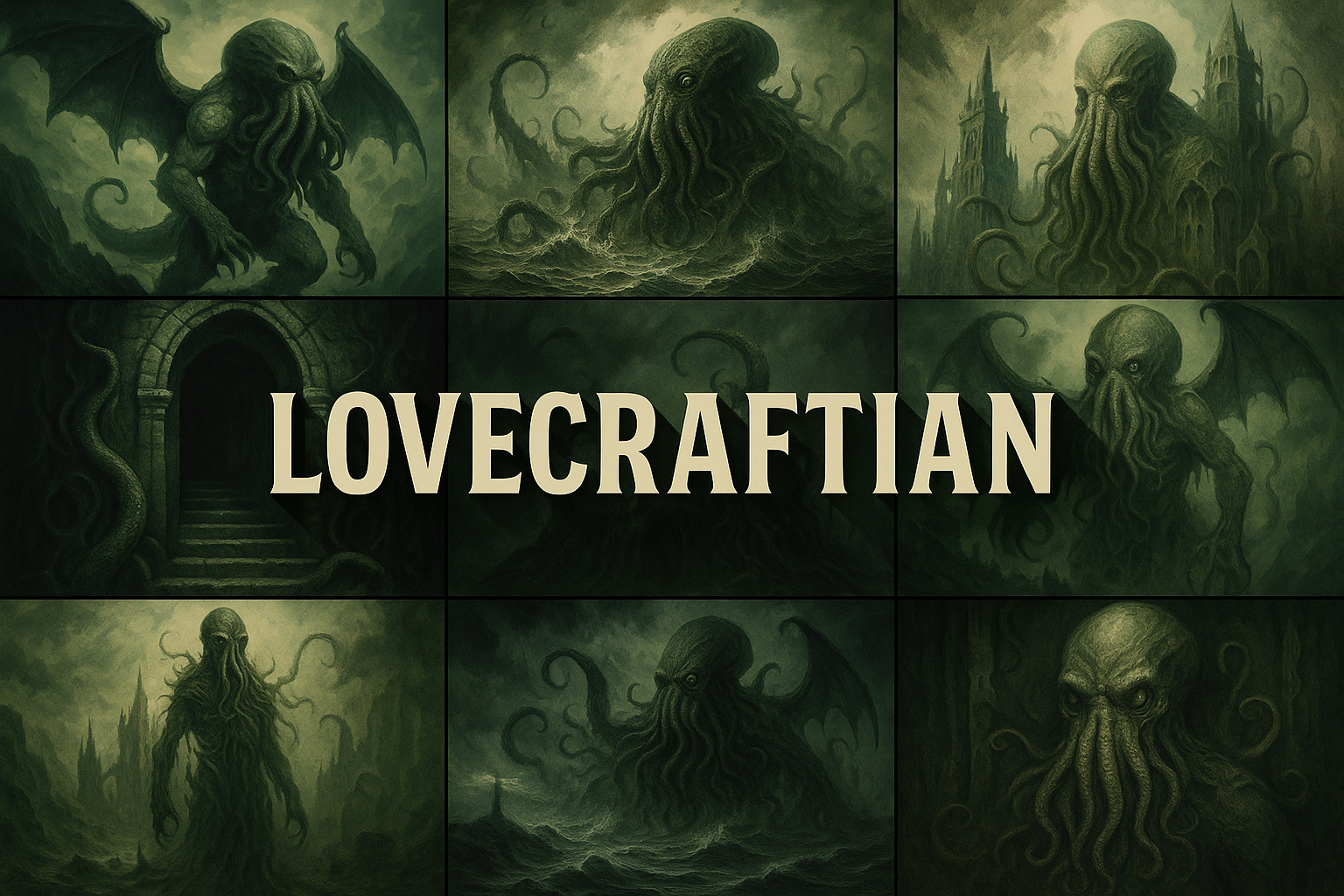
Lovecraftian imagery draws on the cosmic unease associated with H. P. Lovecraft’s fiction. Its strongest visual principle is a disturbance of human certainty and scale; tentacles and ancient-looking buildings are optional motifs, not the definition.
A visual introduction
Select an image for a closer look. Use the thumbnails, arrow keys or a swipe to compare examples. Zoom in to inspect details, or share the image that inspires you.

Creative toolbox · take this style further
Choose an input and a destination. Search sends your words to the chosen site; Copy & open puts them on your clipboard to paste there.
Create with AI
Turn your chosen input into an image prompt or a new creative direction.
ChatGPT
Copy your input and paste it into a ChatGPT conversation or image request.
Copy & open ChatGPT (new tab)Claude · Anthropic
Develop an image prompt or explore the style in a new Claude conversation.
Copy & open Claude · Anthropic (new tab)Midjourney
Paste your input into the Imagine bar on the Create page.
Copy & open Midjourney (new tab)Adobe Firefly
Copy your input, open Firefly, and paste it into the prompt field.
Copy & open Adobe Firefly (new tab)Leonardo.Ai
Copy your input, open Leonardo, and paste it into the generation field.
Copy & open Leonardo.Ai (new tab)Image search
Find visual references. Short, concrete keywords usually work best.
Lexica
Search AI images and prompts using your selected input.
Search with this input Lexica (new tab)Pexels
Search the photo and video library. Short keywords often work best.
Search with this input Pexels (new tab)Pixabay
Search photos, illustrations and other images.
Search with this input Pixabay (new tab)Unsplash
Search photographs using the style name or your own keywords.
Search with this input Unsplash (new tab)Wikimedia Commons
Search photographs, artworks and historical images. Check each file for its source and reuse terms.
Search with this input Wikimedia Commons (new tab)Art & research
Explore artists, collections and the ideas behind a style.
Wikipedia
Search for background reading. A style may not have its own article.
Search with this input Wikipedia (new tab)WikiArt
Copy your input into WikiArt’s search to explore artists and artworks.
Copy & open WikiArt (new tab)Europeana
Paste your keywords into the search to explore European museum, library and archive collections.
Copy & open Europeana (new tab)Inspiration
Discover portfolios and visual ideas from creative communities.
Instagram hashtags
Search a hashtag made from your input: spaces and punctuation are removed. Instagram may require sign-in.
Search with this input Instagram hashtags (new tab)ArtStation
Paste your input into artwork search for concept art, environments, characters and visual development.
Copy & open ArtStation (new tab)Behance
Paste your input into project search for illustration, design and visual storytelling.
Copy & open Behance (new tab)A closer look
Partial visibility, disproportionate scale and a conflict between familiar cues and unexplained forms can create dread while leaving the central mystery unresolved.
Atmosphere precedes the creature
Lovecraft's essay Supernatural Horror in Literature emphasizes atmosphere and contact with forces beyond ordinary understanding. Read it as an author's argument about fiction, not as scientific evidence for its broad claims about psychology or human history.
For a visual interpretation, ask what the scene makes uncertain. A landscape may contain a form whose scale cannot be reconciled with nearby objects. A familiar interior may reveal a depth that should not fit inside the building. The image needs a precise disturbance rather than a catalogue of horror accessories.
Preserve some reliable information
Uncertainty is more effective when part of the scene remains understandable. A small boat, a doorway or a human figure can establish a scale that the larger form unsettles. If every element is equally impossible, the viewer has little basis for recognizing the disruption.
Keep the main spatial relationships coherent enough to follow. Use fog, darkness or cropping to withhold selected information, rather than hiding unresolved construction everywhere. The unseen part should feel consequential.
Resist explaining everything
A fully illuminated creature portrait can turn mystery into a design specimen. Decide how much the viewer needs to see. A contour, an effect on the environment or an interrupted pattern may communicate more than an elaborate face.
Compare a version with the threatening form visible and one where only its influence appears. Which creates the more sustained uncertainty? This is an artistic choice, not a rule that horror must always remain obscure.
Build an original contemporary response
Use the literary reference critically rather than importing every assumption of the source material. The unfamiliar need not be represented through stereotypes of real peoples or cultures. An invented spatial or ecological relationship can carry the unease on its own.
The prompts below propose original scenes, not historical illustrations or evidence of supernatural events. Judge them by scale, restraint and the relationship between known and unknown, rather than by how many tentacles or invented occult symbols they contain.
The prompt workshop
Original creative exercises. These prompts create new illustrations, not documentary evidence.
Uncertain scale
Original cosmic-horror seascape with a small research boat beside a partially visible submerged form of unresolved scale, restrained light and no copied creature.
Impossible depth
Original quiet interior with one doorway revealing a spatial depth that cannot fit the building, stable foreground geometry and minimal visual explanation.
Only the influence
Original remote landscape where vegetation and shadows bend around an unseen presence, coherent ordinary details and one disturbing relationship.
Sources and further exploration
H. P. Lovecraft — primary essay on atmosphere and the weird tale