
Words and images · Narrative, poetry and interpretation
Explore literary painting through story, poetry and visual interpretation, with documented examples, original narrative artworks and practical painting prompts.
A visual introduction
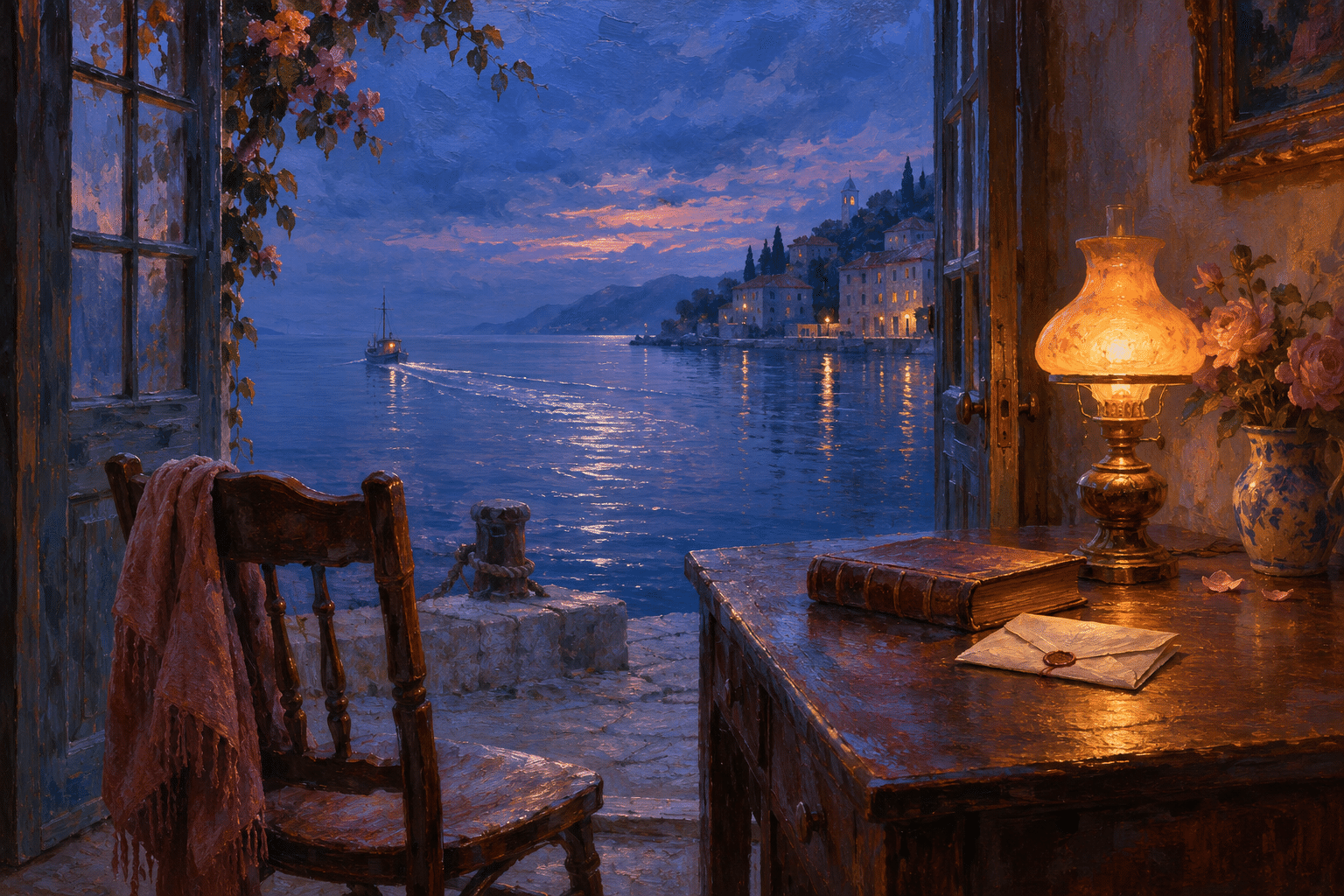
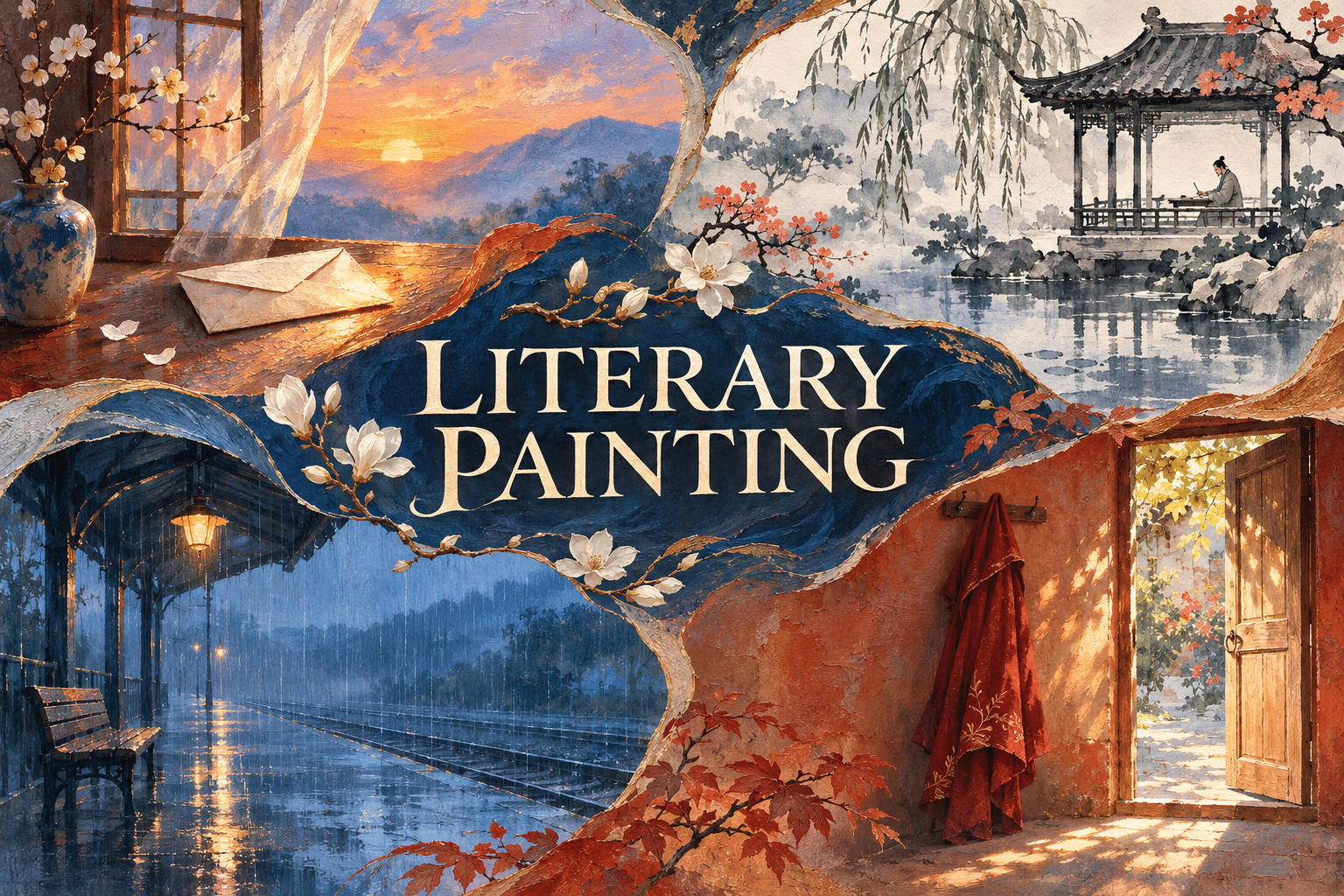
A new harbour banner and titled collage introduce four original narrative studies, alongside a retained reader illustration. All are AI-generated interpretations, not historical paintings, physical media demonstrations or named artists’ works.
Select an image for a closer look. Use the thumbnails, arrow keys or a swipe to compare examples. Zoom in to inspect details, or share the image that inspires you.
Creative toolbox · take this style further
Choose an input and a destination. Search sends your words to the chosen site; Copy & open puts them on your clipboard to paste there.
Create with AI
Turn your chosen input into an image prompt or a new creative direction.
ChatGPT
Copy your input and paste it into a ChatGPT conversation or image request.
Copy & open ChatGPT (new tab)Claude · Anthropic
Develop an image prompt or explore the style in a new Claude conversation.
Copy & open Claude · Anthropic (new tab)Midjourney
Paste your input into the Imagine bar on the Create page.
Copy & open Midjourney (new tab)Adobe Firefly
Copy your input, open Firefly, and paste it into the prompt field.
Copy & open Adobe Firefly (new tab)Leonardo.Ai
Copy your input, open Leonardo, and paste it into the generation field.
Copy & open Leonardo.Ai (new tab)Image search
Find visual references. Short, concrete keywords usually work best.
Lexica
Search AI images and prompts using your selected input.
Search with this input Lexica (new tab)Pexels
Search the photo and video library. Short keywords often work best.
Search with this input Pexels (new tab)Pixabay
Search photos, illustrations and other images.
Search with this input Pixabay (new tab)Unsplash
Search photographs using the style name or your own keywords.
Search with this input Unsplash (new tab)Wikimedia Commons
Search photographs, artworks and historical images. Check each file for its source and reuse terms.
Search with this input Wikimedia Commons (new tab)Art & research
Explore artists, collections and the ideas behind a style.
Wikipedia
Search for background reading. A style may not have its own article.
Search with this input Wikipedia (new tab)WikiArt
Copy your input into WikiArt’s search to explore artists and artworks.
Copy & open WikiArt (new tab)Europeana
Paste your keywords into the search to explore European museum, library and archive collections.
Copy & open Europeana (new tab)Inspiration
Discover portfolios and visual ideas from creative communities.
Instagram hashtags
Search a hashtag made from your input: spaces and punctuation are removed. Instagram may require sign-in.
Search with this input Instagram hashtags (new tab)ArtStation
Paste your input into artwork search for concept art, environments, characters and visual development.
Copy & open ArtStation (new tab)Behance
Paste your input into project search for illustration, design and visual storytelling.
Copy & open Behance (new tab)A closer look
A story can emerge from a gesture, an absent person, a recurring object or a contrast in light. The painting chooses a viewpoint and a moment; its relationship to a named text should be stated rather than guessed.
What makes a painting literary?
Literary painting is a broad relationship between images and written language, not a single movement with a founding date or a uniform appearance. A painter may interpret a scene from a play, give visual form to a poem, combine image and inscription, or build a new picture around an original sentence. The relationship can be direct, allusive or deliberately unresolved.
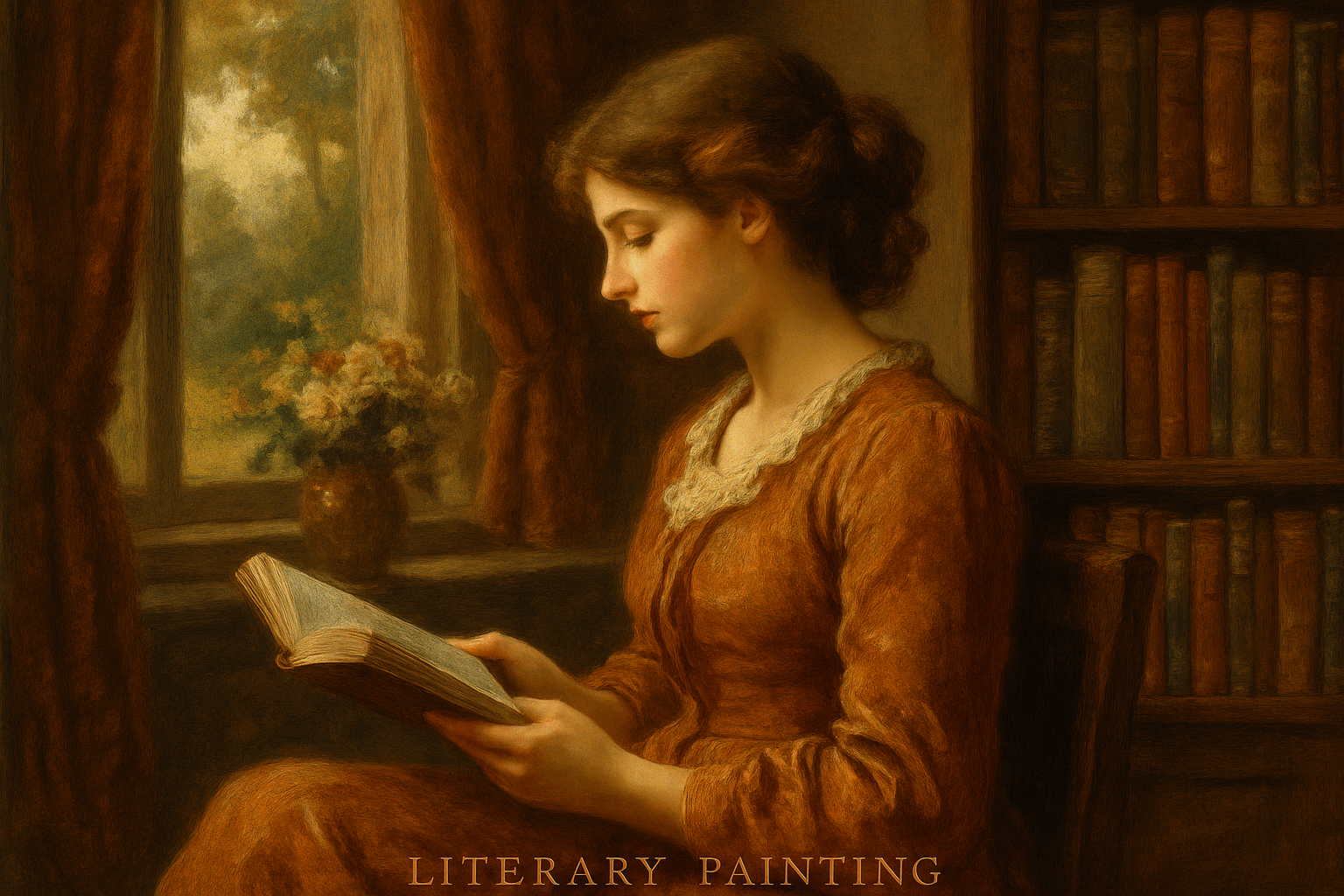
A painted book is not sufficient evidence of a particular literary source. A reader at a window may invite thoughts about imagination and private experience, but identifying the novel requires documentation. Distinguish an illustration of a named work from a picture about reading, and both from a painting that merely feels poetic.
Do not collapse distinct traditions
A picture based on a story is one kind of literary art. In Chinese literati traditions, poetry, calligraphy and painting can also form an integrated work. The Met’s Vision and Verse exhibition explores how artists illustrated poems, evoked them indirectly or composed their own inscriptions. These practices should not be flattened into one timeless “literary style.”
One documented relationship
The Met identifies Gao Jian’s 1698 Discourse on Poetry as a handscroll made to accompany Song Luo’s treatise. The work brings together painting, calligraphy and poetry, and its garden scene suggests an idealized portrait rather than literal reportage. The retained AOI picture instead shows a reader beside books; it is a contemporary conceptual illustration and has no documented relation to Gao’s scroll.
A scene from a play becomes a painted world
A contrasting example is John Everett Millais’s Ophelia, an oil painting in Tate’s collection. Tate’s published collection account identifies its subject with Shakespeare’s Hamlet and explains that the landscape was studied beside the Hogsmill River in Surrey. The source is a particular dramatic character and episode, rather than a general atmosphere of melancholy.
As a viewing exercise, consider what changes when language becomes a fixed image. A painter must choose a viewpoint, distribute attention across a surface and decide which details remain visible together. The literary source can guide interpretation, while the painted handling of space, colour and duration creates another experience. The generated works below are not copies of Millais’s painting.
Turn a passage into a picture
Pick one short text and list what it states and what it leaves open. Paint a detail the words do not describe, such as the light after the scene, rather than illustrating every noun. If the text is under copyright, avoid reproducing it without permission. Use a short original passage for the prompts here.
Separate three kinds of information before painting: what the passage explicitly states, what it implies, and what you invent. Choose one narrative pressure rather than packing every event into a scene. A closed envelope can delay revelation; a chair pulled back can suggest a recent presence. These are possibilities for this composition, not universal symbols with fixed meanings.
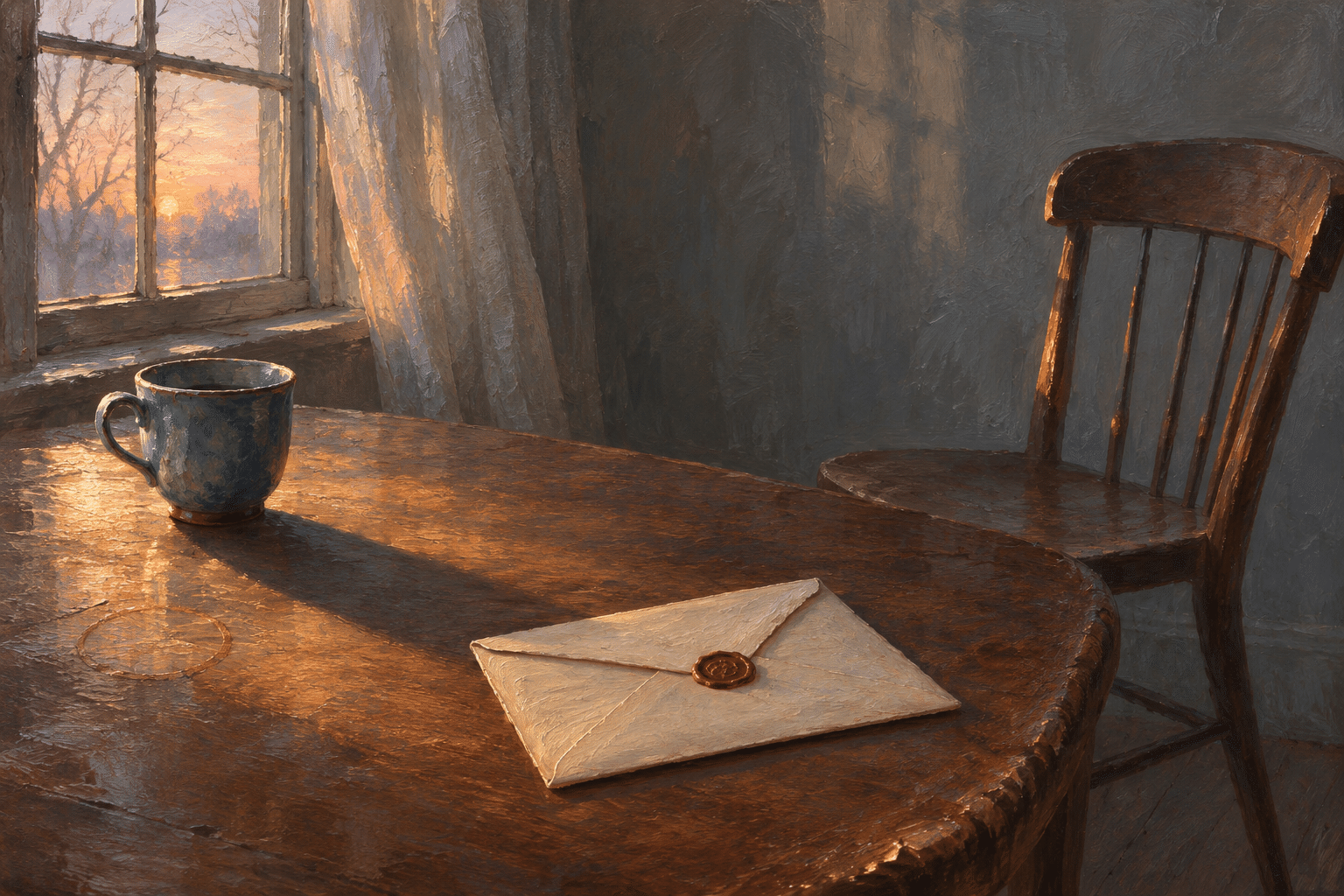
For a practical study, use the original sentence “The letter waited until morning.” The new still life makes waiting visible through a sealed envelope and dawn light. The empty chair leaves the recipient outside the frame. Changing that light to harsh midday would change the emotional reading even if the objects stayed in place.
Narrative time and the space between panels
A single image can hold a before and an after in tension. The harbour banner places a folded letter and closed book near an empty chair while a boat travels into the blue evening. No caption identifies the absent person; the relation between departure and the room remains open.
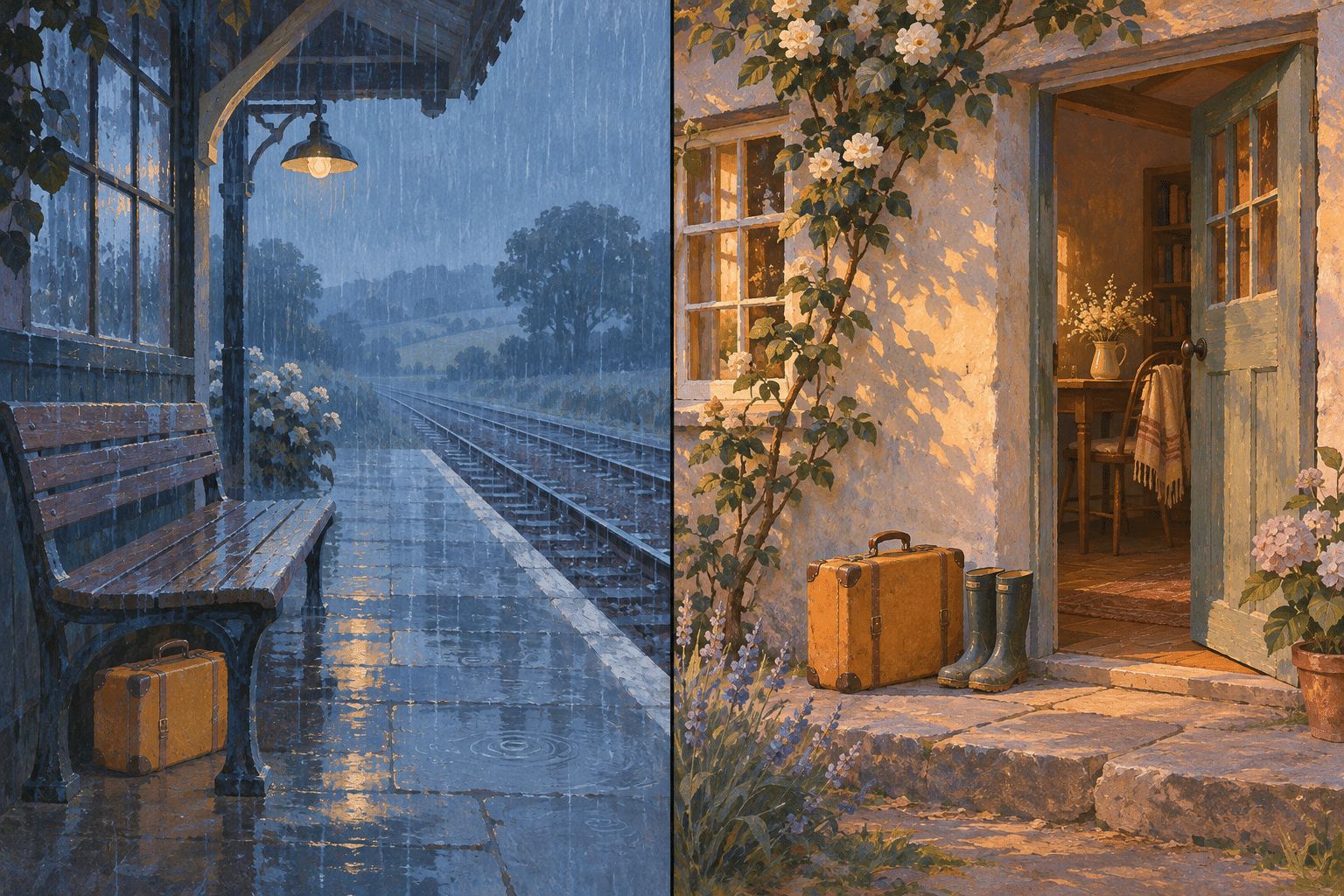
The new diptych makes time more explicit. A suitcase appears beneath a rainy station bench and again at a warm cottage threshold. Repetition connects the scenes, while the contrast in weather and light suggests a change. The two panels form one composed artwork; they are not counted as two independent examples.
Poetic dialogue without counterfeit history
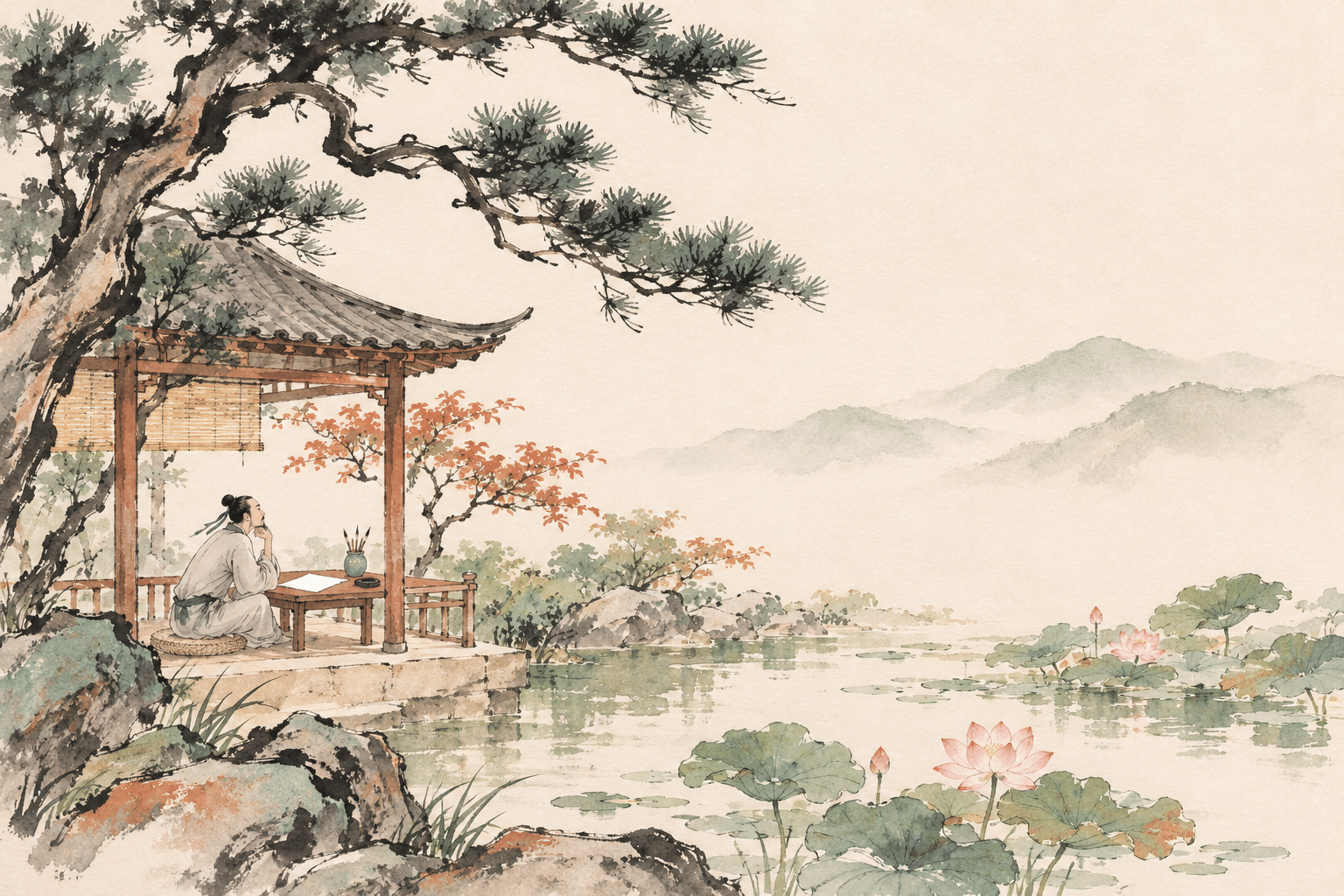
The garden study uses ink-like trees, pale washes and unpainted intervals around a seated writer. It is a contemporary generated interpretation of contemplation and landscape, not an antique Chinese painting or an authentic example of calligraphy. The deliberately blank sheet avoids presenting meaningless marks as a poem.
This distinction matters when looking back to the documented Gao Jian handscroll. A generic garden image cannot substitute for the specific inscriptions, intellectual relationships and viewing conventions of an actual work. Use the museum links to study that context, then describe clearly what your own new image borrows, invents or leaves out.
Colour can disagree with the sentence
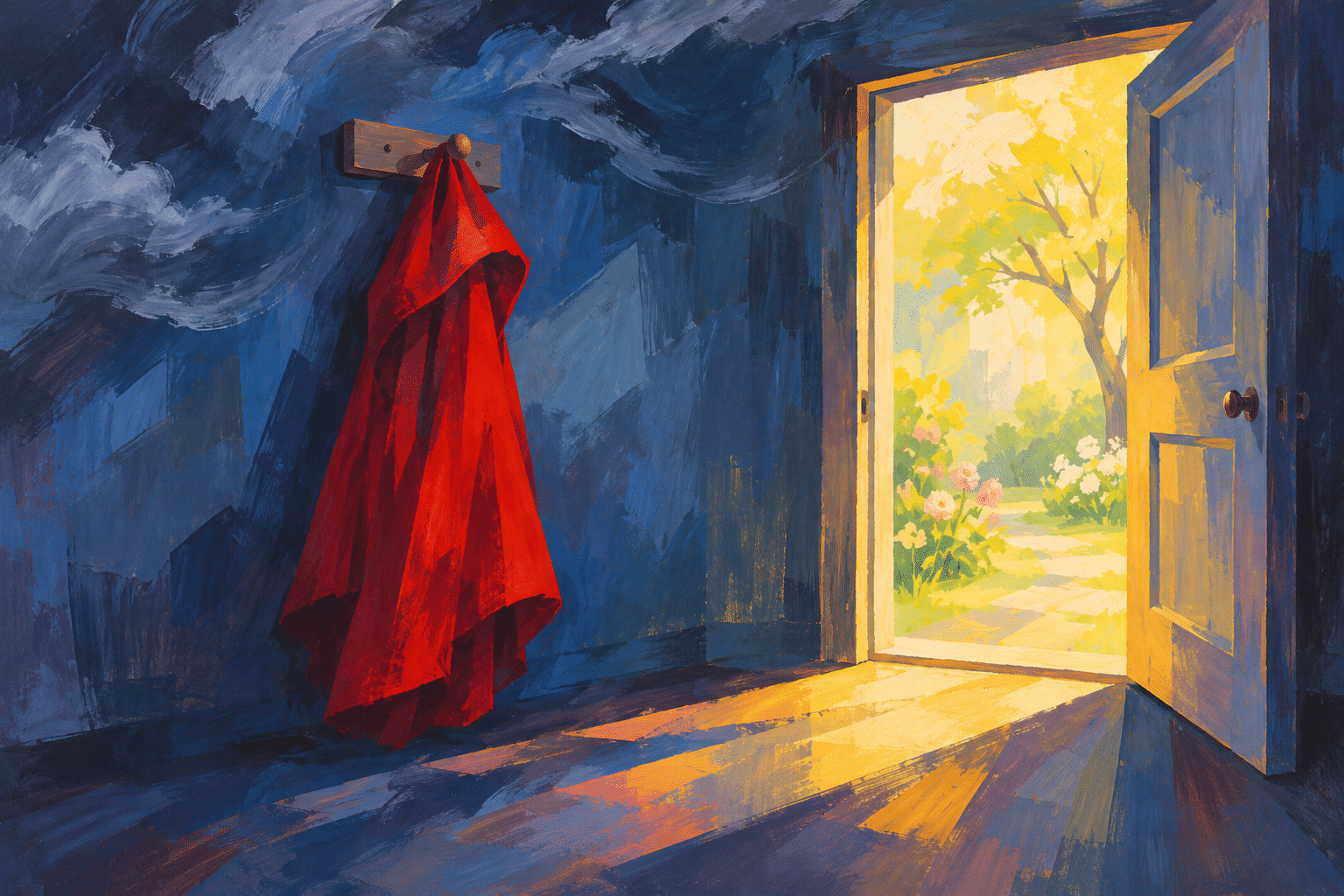
The red-cloak study begins with another original line: “She left the red cloak, but took the weather with her.” Blue brushwork makes the interior feel stormy, while a yellow garden shines beyond the door. The cloak supplies a strong presence without depicting its owner. It invites a reading, rather than providing an illustrated answer.
This is a useful experimental method: translate emotional weather into colour relationships, then resist adding literal clouds to explain everything. Compare a restrained still life with an expressive painted interior. Both can be literary, but the marks, contrasts and omissions do different work.
Use the picture without losing the text
Literary painting can serve book-related exhibitions, editorial illustration, personal responses to poems and independent narrative art. Record the title and author when you interpret an existing work, and distinguish that source from your own additions. The retained reader image here remains an AOI archive illustration with no documented relationship to a particular book.
When working with AI, give the system a concise visual situation and revise against the actual result. Ask whether a gesture or recurring object remains coherent, whether the scene needs its caption to function, and whether attractive detail has displaced the central thought. A convincing surface cannot establish historical provenance or literary accuracy.
Positive review — AOI editorial perspective
Literary painting can give a passage a second life through viewpoint, silence and sensory detail. In this gallery, the sealed letter delays an answer, while the repeated suitcase connects two moments without showing a traveler. The most effective images leave room for interpretation while making their visual relationships precise.
Negative review — AOI editorial perspective
The category easily slips into decorative books, nostalgic interiors and unexplained symbolism. A caption may promise a rich story that the image never stages. Reduce stock props, identify the actual source when there is one, and test whether light, gesture or composition contributes something beyond illustrating nouns.
Neutral review — AOI editorial perspective
This is a cross-period field of relationships between painting and text, encompassing different media and cultural practices. It offers useful narrative exercises and editorial applications, but it should not erase the differences between a European literary subject, a Chinese inscribed painting and a newly invented AI-assisted scene.
A small poetic detour
Original words from the AOI studio.
Poetry
A page lies open near the frame;
The picture never says its name.
Between the line and painted tree,
Another kind of story is free.
The letter keeps its folded light;
The harbour gathers into night.
A case returns; a door stays wide;
The missing voice is still inside.
No brush can tell the whole of rain,
No sentence hold the windowpane.
We leave a space between the two
For what the looking makes anew.
The prompt workshop
Original creative exercises. These prompts create new illustrations, not documentary evidence.
Start here · The unread letter
Original literary painting based on an invented line, “The letter waited until morning”: a sealed envelope on a table beside pale dawn light, one human presence suggested but unseen, quiet mood, no visible written text.
Richer scene · Garden and verse
Original painting of a scholar composing an original poem in a garden pavilion, ink-led trees, a pool and deliberate blank paper area, contemporary homage to words-and-images dialogue, no fake historical seals or legible invented calligraphy.
Experiment · What the text omits
Diptych based on an original short story about a journey: left panel shows an empty platform before departure, right shows a returned object after arrival; avoid depicting the traveler, let colour and viewpoint supply narrative, no text.
Your next inspiration
Discover another art style
Follow a visual thread to the next subject.
A smile from the studio
Jokes
The painting and the poem had a long discussion. The caption asked them both to be brief.