
Illustration approach · inspired by Lisbon azulejos
Explore Lisbon tile illustration through azulejo history, painted panels, geometric repeats, modern public art and practical AI image prompts.
A visual introduction
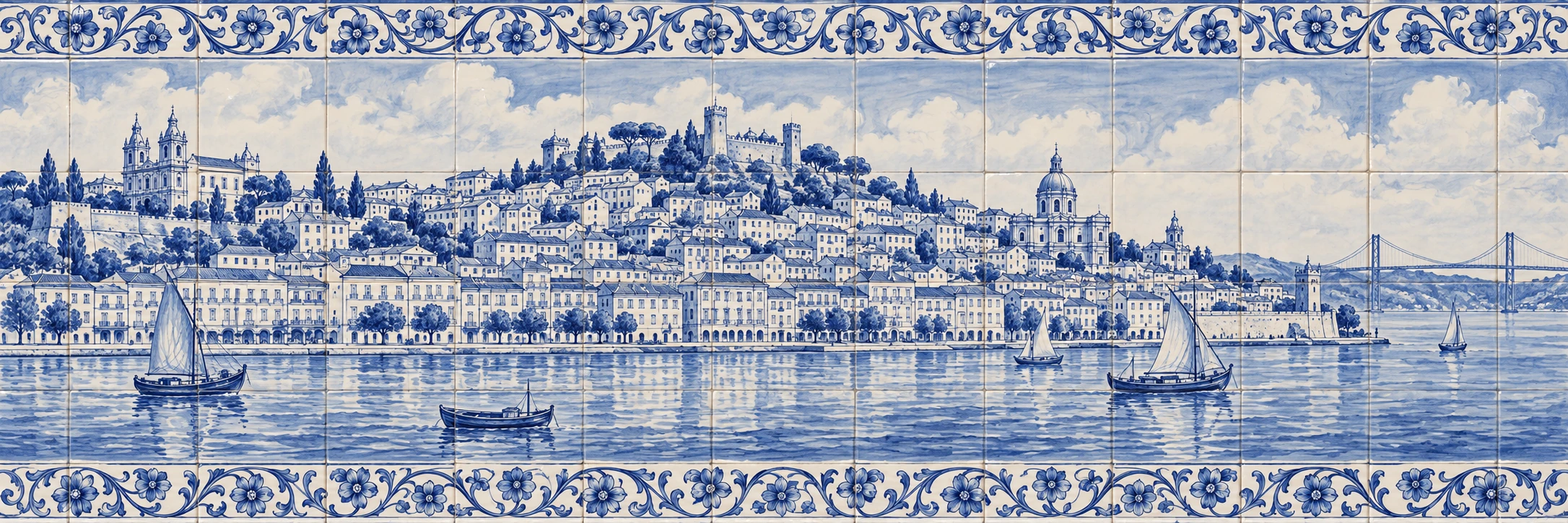
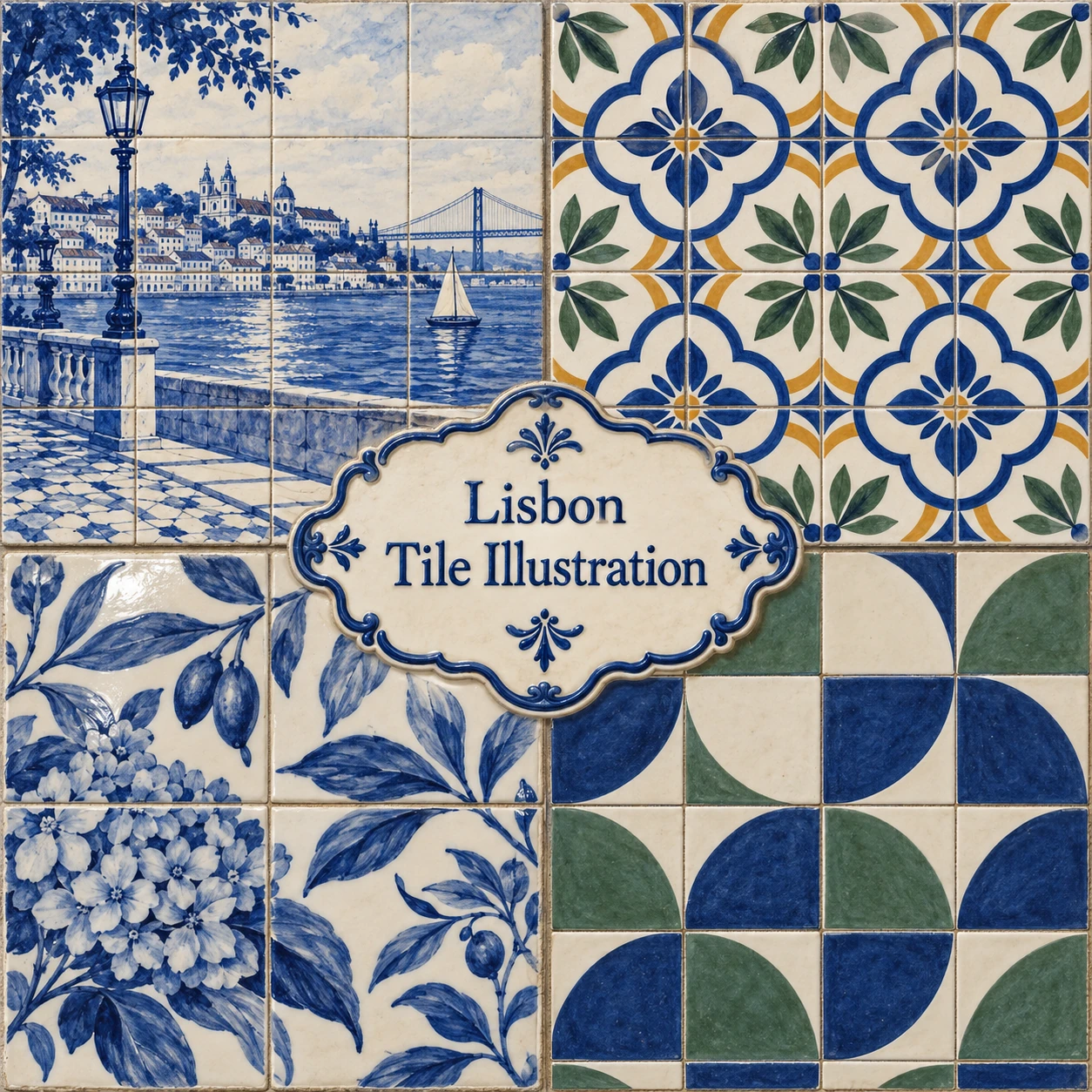
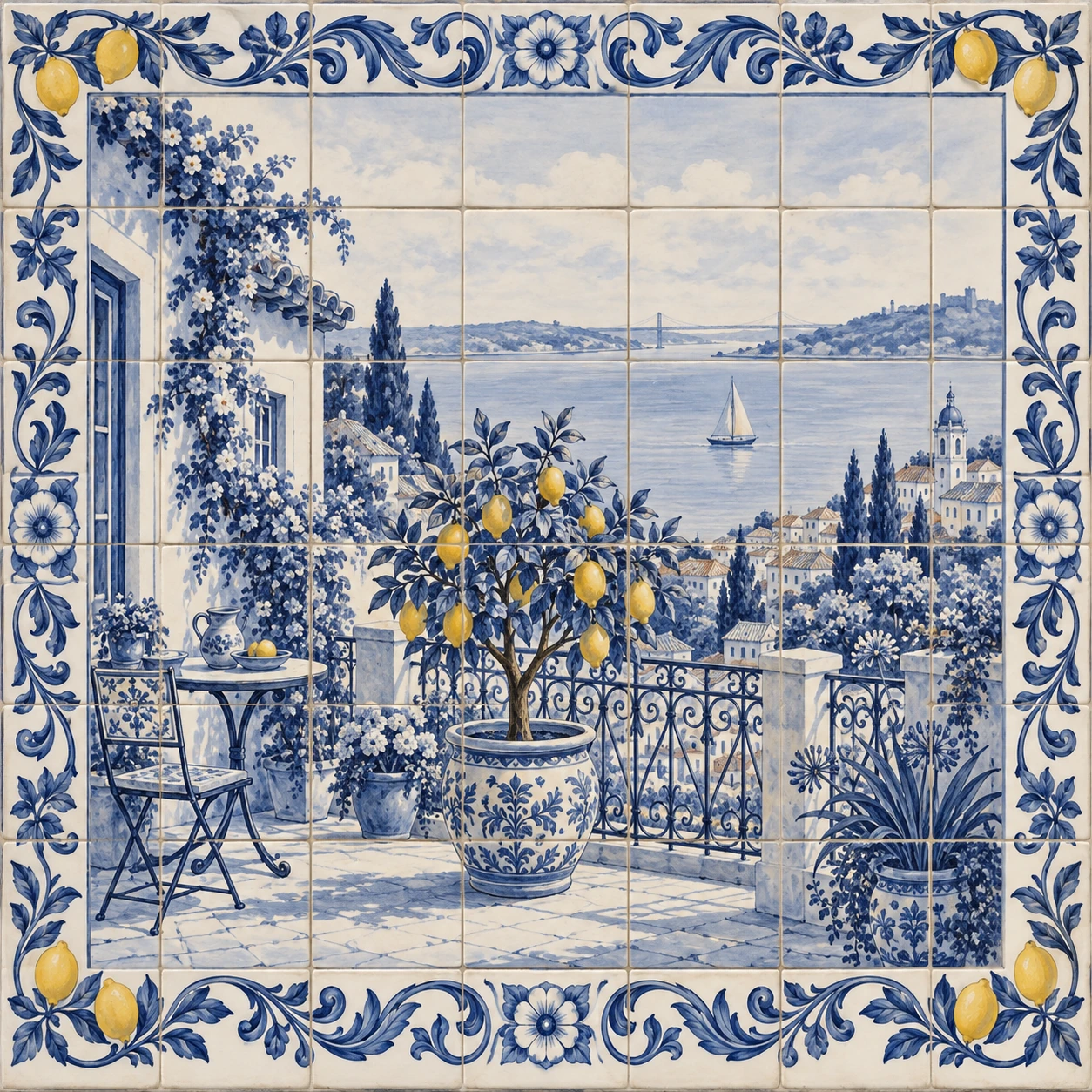
Three original AI-generated illustrations: a panoramic header, a collage with the style name at its center, and a standalone example. Captions distinguish these studies from historical objects and technical documentation.
Select an image for a closer look. Use the thumbnails, arrow keys or a swipe to compare examples. Zoom in to inspect details, or share the image that inspires you.
Creative toolbox · take this style further
Choose an input and a destination. Search sends your words to the chosen site; Copy & open puts them on your clipboard to paste there.
Create with AI
Turn your chosen input into an image prompt or a new creative direction.
ChatGPT
Copy your input and paste it into a ChatGPT conversation or image request.
Copy & open ChatGPT (new tab)Claude · Anthropic
Develop an image prompt or explore the style in a new Claude conversation.
Copy & open Claude · Anthropic (new tab)Midjourney
Paste your input into the Imagine bar on the Create page.
Copy & open Midjourney (new tab)Adobe Firefly
Copy your input, open Firefly, and paste it into the prompt field.
Copy & open Adobe Firefly (new tab)Leonardo.Ai
Copy your input, open Leonardo, and paste it into the generation field.
Copy & open Leonardo.Ai (new tab)Image search
Find visual references. Short, concrete keywords usually work best.
Lexica
Search AI images and prompts using your selected input.
Search with this input Lexica (new tab)Pexels
Search the photo and video library. Short keywords often work best.
Search with this input Pexels (new tab)Pixabay
Search photos, illustrations and other images.
Search with this input Pixabay (new tab)Unsplash
Search photographs using the style name or your own keywords.
Search with this input Unsplash (new tab)Wikimedia Commons
Search photographs, artworks and historical images. Check each file for its source and reuse terms.
Search with this input Wikimedia Commons (new tab)Art & research
Explore artists, collections and the ideas behind a style.
Wikipedia
Search for background reading. A style may not have its own article.
Search with this input Wikipedia (new tab)WikiArt
Copy your input into WikiArt’s search to explore artists and artworks.
Copy & open WikiArt (new tab)Europeana
Paste your keywords into the search to explore European museum, library and archive collections.
Copy & open Europeana (new tab)Inspiration
Discover portfolios and visual ideas from creative communities.
Instagram hashtags
Search a hashtag made from your input: spaces and punctuation are removed. Instagram may require sign-in.
Search with this input Instagram hashtags (new tab)ArtStation
Paste your input into artwork search for concept art, environments, characters and visual development.
Copy & open ArtStation (new tab)Behance
Paste your input into project search for illustration, design and visual storytelling.
Copy & open Behance (new tab)A closer look
Let painted marks and the ceramic grid cooperate. Distinguish a scene crossing many tiles from a repeating tile module; blue and white are one possibility within a much broader history.
What do we mean by Lisbon Tile Illustration?
Lisbon Tile Illustration is used here as a descriptive approach for contemporary images inspired by the city’s azulejos: glazed ceramic tiles, their painted imagery and their relationship with architecture. It is not the name of a documented historical movement. The underlying tile traditions are real; the label helps us discuss how their visual qualities can inform new illustration.
There are several possible starting points. A figurative panel can carry a continuous scene across a grid of tiles. A repeating module can organize an entire wall. An illustration can also depict a tiled facade within a larger city view. These are different compositional problems, and a useful prompt should choose among them.
Lisbon’s official tourism organization points to both old and modern tile work across the city, including work by Abel Manta and Maria Keil. That breadth matters. Treating azulejos as nothing but blue floral antiques makes a living architectural medium unnecessarily small. [1]
A panorama is more than a row of souvenirs
The Grande Panorama de Lisboa, held by the Museu Nacional do Azulejo, provides a striking historical reference. Museum With No Frontiers dates it to around 1700 and attributes it to Gabriel del Barco on stylistic grounds. It depicts Lisbon before the 1755 earthquake in blue-on-white faience. The catalogue gives a width of 2,247 centimetres: a little over twenty-two metres. Preserve “attributed” and “around” when discussing its authorship and date. [2]
The scale changes the act of looking. A large city image invites a viewer to move along it, discover connections and return to details. The tile joints divide the material support without necessarily dividing the subject into independent pictures. That tension between unit and whole is one of the most useful ideas to borrow for a new composition.
Our generated panorama is deliberately contemporary and invented. It includes a modern bridge-like structure among the waterfront forms and should not be read as a reconstruction of the historical panel or an accurate map. A historical-looking medium does not make every building inside it historically compatible.
Modern Lisbon: geometry in public space
The Lisbon Metro’s own art history records tile coverings designed by Maria Keil for the first stations, which opened in 1959. It describes her extensive contribution through the early 1970s and the later expansion to many artistic voices. Tile design belongs to modern public infrastructure as well as historic interiors. [3]
The operator’s Picoas record describes Keil’s use of multiple planes, changing proportions and blue, green and white. This offers a productive alternative to a skyline or flower panel: the image can be about rhythm, interval and architectural surface rather than an identifiable scene. [4]
A repeating unit is never only a small picture. Rotate it, mirror it or place it beside its neighbor and another structure appears. When designing a new pattern, inspect the junctions where four tiles meet. The most interesting figure may occur between modules rather than in the center of any single one.
Reading ceramic rather than printed paper
A convincing tile illustration needs two kinds of information: the painted design and the surface carrying it. Fine brush variation can suggest pigment, while restrained reflections and grout establish the ceramic setting. If every tile reflects a different imaginary light source, the scene becomes less believable even when the individual squares look polished.
Keep the grid coherent. In a front-facing panel, grout lines should make sense across the whole image. A perspective view can foreshorten the tiles, but should not randomly change their scale halfway through the wall. Models often produce a persuasive local texture while losing the larger arrangement.
Use wear sparingly and with intent. Cracks, chips and missing corners are not compulsory signs of cultural depth. A newly made, carefully painted tile can be beautiful without being artificially distressed. The design should survive the removal of its antique makeup.
Our three original illustrations
The banner turns an imagined waterfront into a long blue-and-white panel with floral borders. It uses the horizon to tie the small architectural marks together. The named collage broadens the vocabulary: a city view, a multicolored repeat, botanical brushwork and a modern geometric arrangement occupy separate panels.
The standalone terrace study brings the scale down. A lemon tree, table, railing and distant water create an intimate scene. Small yellow accents interrupt the cobalt palette without overwhelming it. The tile grid continues through the painted space, reminding us that this is an imagined decorated surface rather than a photograph through a window.
All three are original AI-generated interpretations. None is a photograph of an installed Lisbon panel, a replica of a museum work or evidence of ceramic manufacture. The captions retain that distinction so the images can be enjoyed without borrowing a false provenance.
Usability in AI art generation
This approach is useful for editorial art, decorative concept studies, fictional interiors and experiments with modular composition. Start with the intended format: “continuous scene across glazed square tiles” or “repeating geometric tile module.” Then describe palette, line quality, viewpoint and border. Do not ask the model to solve all formats at once.
Watch for broken grids, motifs that fail to join, lettering that changes between tiles and glossy highlights that erase the brushwork. A visually seamless-looking pattern is not necessarily a mathematically seamless repeat. Test the edges in a layout workflow before using it as a repeating production asset.
For a real ceramic commission, keep illustration development separate from the maker’s technical specifications, material tests and firing process. AI can propose a visual direction, but it does not certify glaze behavior or supply an installation plan. For a real Lisbon landmark, use verified references rather than trusting a generated skyline.
An exercise in joining
Design one simple leaf-and-arc module. Compare a straight repeat, alternating rotations and a four-tile grouping. Keep the palette fixed. Look for where the lines connect and where they accidentally create heavy knots. Then try a continuous landscape across the same grid and notice how differently the joints behave.
I like the moment when a small square stops behaving like an isolated object and begins contributing to a wall. It is a modest form of cooperation, and considerably better organized than most meetings. Leave enough quiet ceramic for the painted marks to become an invitation.
A small poetic detour
Original words from the AOI studio.
Poetry
A square of blue.
Then another.
The wall begins
to remember water.
The prompt workshop
Original creative exercises. These prompts create new illustrations, not documentary evidence.
A scene across the grid
Original Lisbon-inspired tile illustration, imagined riverside garden scene painted in fine cobalt brushwork across a coherent grid of ivory glazed square tiles, subtle grout and reflections, continuous scene, restrained floral border, no text or historical attribution.
Original AOI creative exercise; inspect the result against the guide rather than assuming the model followed every instruction.
A modular experiment
Contemporary ceramic tile design study inspired by Lisbon azulejos, repeating geometric arcs and leaves in blue green ochre and cream, coherent edge connections, straight front view, subtle glazed texture, no cracks or lettering; repeat requires separate technical checking.
Original AOI creative exercise; inspect the result against the guide rather than assuming the model followed every instruction.
A quiet terrace
Original contemporary azulejo-inspired illustration of a lemon tree on a terrace above imaginary river rooftops, blue and white with tiny yellow accents, tile grid visible across the scene, airy negative space, no museum replica or map claim.
Original AOI creative exercise; inspect the result against the guide rather than assuming the model followed every instruction.
Your next inspiration
Discover another art style
Follow a visual thread to the next subject.
People & works to explore
References discussed in this article. Consult the sources below for context.
Artists and practitioners
Gabriel del Barco — attributed maker of the Grande Panorama de Lisboa, circa 1700 [2]
Maria Keil — modern tile design for Lisbon Metro stations [3][4]
Paintings and other works
Grande Panorama de Lisboa — blue-on-white faience, circa 1700; attribution retained [2]
Picoas tile design by Maria Keil — blue, green and white planes [4]