
AOI experimental interpretation · light paths and broken marks
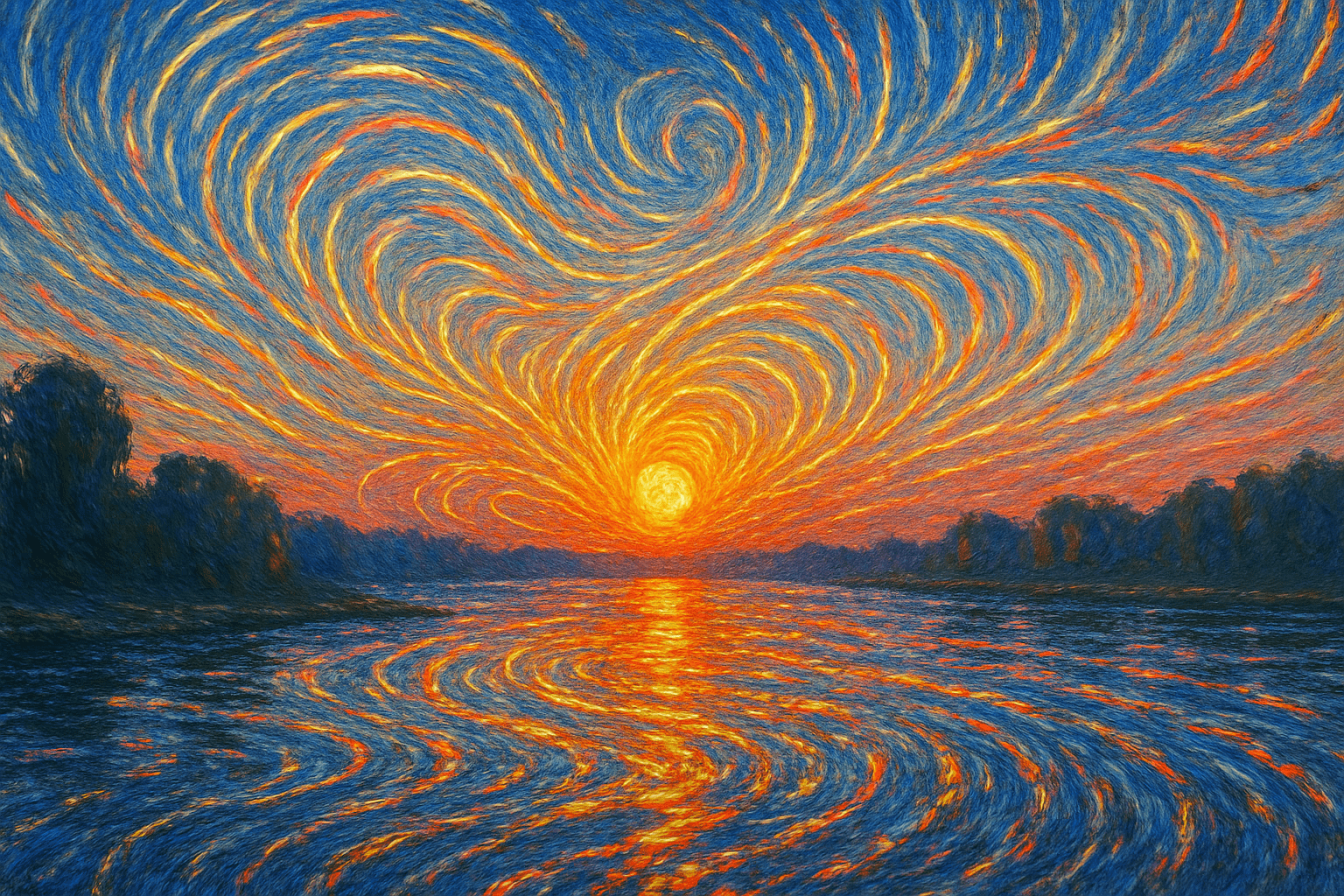
Lightcurve Impressionism is treated here as an experimental visual label: curved paths of changing brightness are interpreted through broken, atmospheric marks. It is not a documented branch of historical Impressionism.
An A⊕I –[-.+] creαt¡ve c⊕ncept, n⊕t αn estαbl¡she∂ h¡st⊕r¡cαl m⊕vement.
A visual introduction
Select an image for a closer look. Use the thumbnails, arrow keys or a swipe to compare examples. Zoom in to inspect details, or share the image that inspires you.
Creative toolbox · take this style further
Choose an input and a destination. Search sends your words to the chosen site; Copy & open puts them on your clipboard to paste there.
Create with AI
Turn your chosen input into an image prompt or a new creative direction.
ChatGPT
Copy your input and paste it into a ChatGPT conversation or image request.
Copy & open ChatGPT (new tab)Claude · Anthropic
Develop an image prompt or explore the style in a new Claude conversation.
Copy & open Claude · Anthropic (new tab)Midjourney
Paste your input into the Imagine bar on the Create page.
Copy & open Midjourney (new tab)Adobe Firefly
Copy your input, open Firefly, and paste it into the prompt field.
Copy & open Adobe Firefly (new tab)Leonardo.Ai
Copy your input, open Leonardo, and paste it into the generation field.
Copy & open Leonardo.Ai (new tab)Image search
Find visual references. Short, concrete keywords usually work best.
Lexica
Search AI images and prompts using your selected input.
Search with this input Lexica (new tab)Pexels
Search the photo and video library. Short keywords often work best.
Search with this input Pexels (new tab)Pixabay
Search photos, illustrations and other images.
Search with this input Pixabay (new tab)Unsplash
Search photographs using the style name or your own keywords.
Search with this input Unsplash (new tab)Wikimedia Commons
Search photographs, artworks and historical images. Check each file for its source and reuse terms.
Search with this input Wikimedia Commons (new tab)Art & research
Explore artists, collections and the ideas behind a style.
Wikipedia
Search for background reading. A style may not have its own article.
Search with this input Wikipedia (new tab)WikiArt
Copy your input into WikiArt’s search to explore artists and artworks.
Copy & open WikiArt (new tab)Europeana
Paste your keywords into the search to explore European museum, library and archive collections.
Copy & open Europeana (new tab)Inspiration
Discover portfolios and visual ideas from creative communities.
Instagram hashtags
Search a hashtag made from your input: spaces and punctuation are removed. Instagram may require sign-in.
Search with this input Instagram hashtags (new tab)ArtStation
Paste your input into artwork search for concept art, environments, characters and visual development.
Copy & open ArtStation (new tab)Behance
Paste your input into project search for illustration, design and visual storytelling.
Copy & open Behance (new tab)A closer look
One or two luminous curves organize the image; varied broken marks, quieter dark intervals and restrained color shifts suggest light changing across space.
Give a poetic label a repeatable rule
AOI’s working interpretation begins with a path of light whose brightness changes along its length. Broken marks surround and partly interrupt that path, allowing the viewer to perceive both continuity and fluctuation. The proposal concerns pictorial organization; it does not claim a scientific mechanism or a new historical school.
The word lightcurve has a technical use in astronomy, but a decorative curve in an artwork is not automatically a plot of measured brightness. If actual data are used, identify the data source, axes and transformations separately. An invented luminous sweep should be described as an artistic device.
Establish the large movement first
Draw a single path across a simple composition. Decide where it begins, where it changes direction and where it becomes difficult to follow. Add a secondary rhythm only after the first remains legible at small size. Too many equally bright curves produce a tangle without a clear movement.
Use the gaps between marks to vary the apparent continuity. A quiet interruption can make the eye bridge a distance, while a tightly grouped passage creates concentration. The path should not require a uniformly glowing outline to survive.
Color follows the light’s role
Choose a restrained background and reserve the strongest contrast for a turning point or a meeting of paths. Let adjacent marks differ in hue or value without making every color equally saturated. This gives the field an internal rhythm rather than a single synthetic glow.
A landscape, a still life or an abstract field can each use the rule. In a figurative scene, make the light interact with surfaces: a curve crossing a vessel should change its visible shape or reflection, not float arbitrarily through it.
Compare three levels of continuity
Make one study with a nearly continuous band, another with widely spaced marks and a third with a deliberate missing interval. Keep the overall path fixed. Compare which version best supports the intended pace and focal point.
The term’s value lies in this design problem. It does not establish a connection to a named historical painter, astronomical observation or an exclusive claim of invention. The AOI illustrations remain contemporary interpretations.
A small poetic detour
Original words from the AOI studio.
Poetry
Starlit brush dances,\nCelestial whispers paint—\nDreams in astral hues.
The prompt workshop
Original creative exercises. These prompts create new illustrations, not documentary evidence.
A path through stillness
Original abstract study with one curved sequence of broken luminous marks over a quiet indigo field, brightness gathering at one bend, wide intervals of darkness, no stars or lettering required.
Light meets a surface
An invented still life of three simple ceramic vessels crossed by a soft curved band of light, broken painterly marks and coherent reflections, restrained warm-cool palette.
Compare continuity
Three studies of the same luminous arc: nearly continuous, loosely spaced and interrupted by one gap; identical background and color range, focus on rhythm rather than decorative effects.