
Angle-dependent relief and optical technique
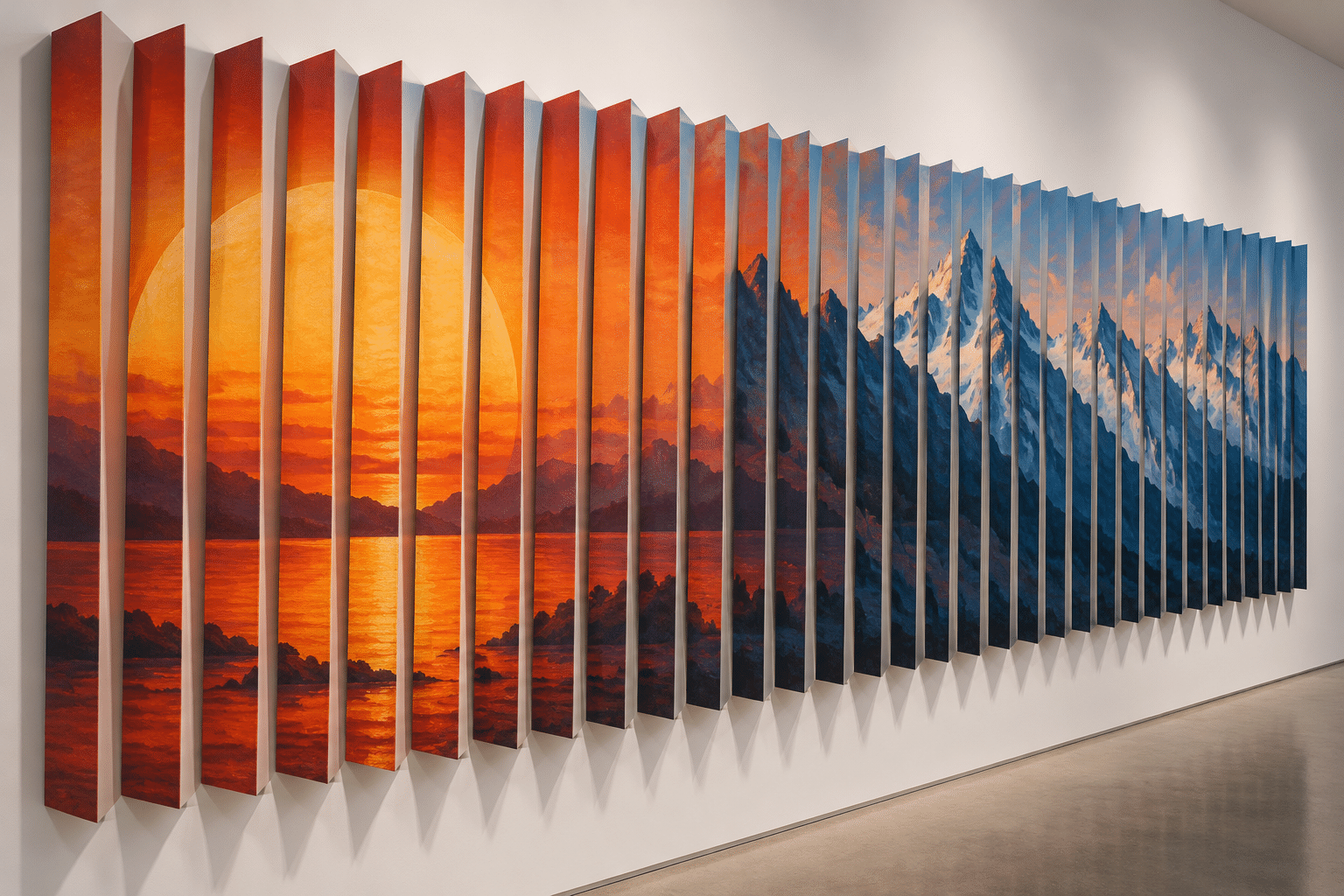
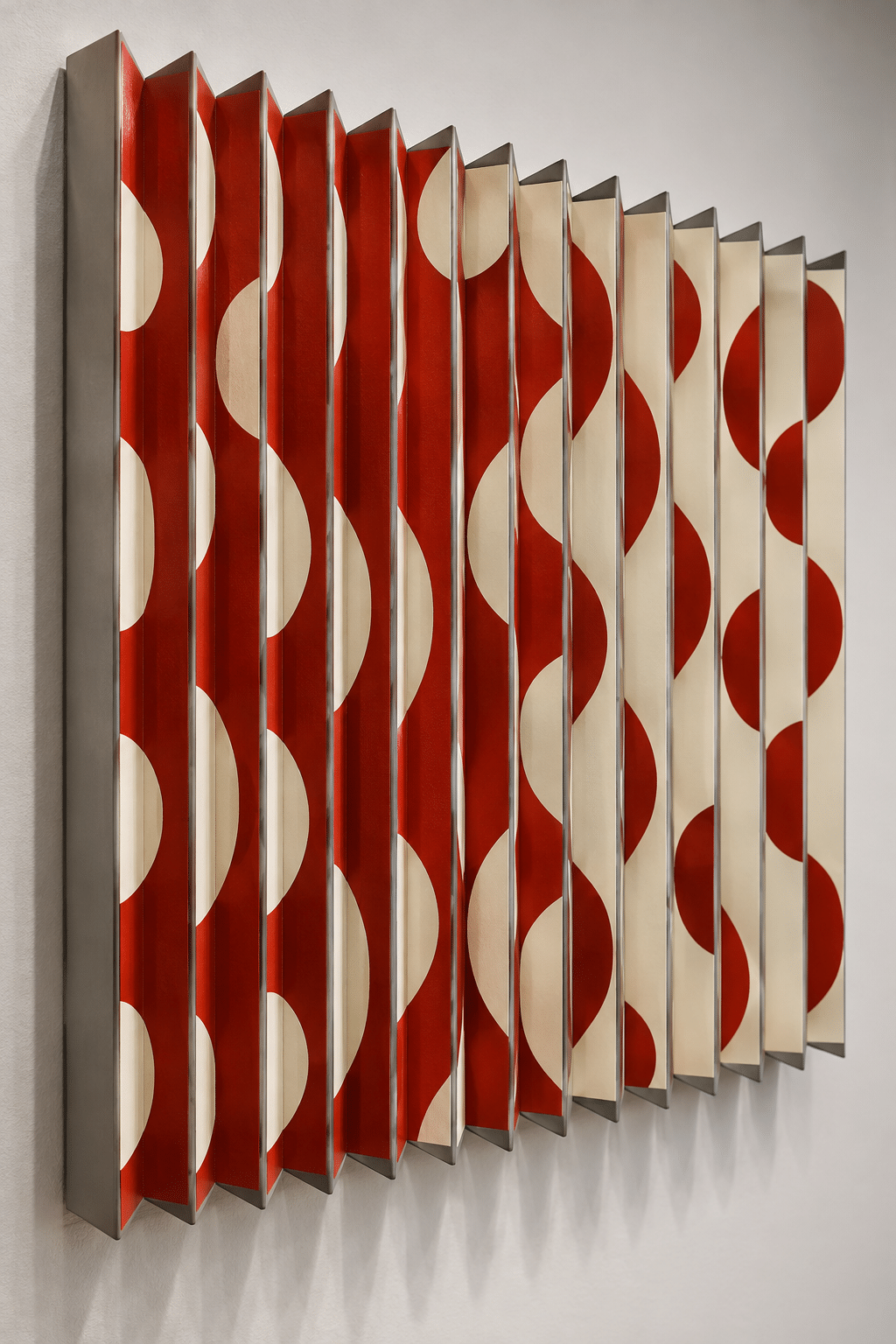
Lenticular Slats is used here as a descriptive label for faceted or slatted artworks whose visible image changes with viewing angle. Alternating faces carry different information, making the viewer’s movement part of the composition.
A visual introduction
Select an image for a closer look. Use the thumbnails, arrow keys or a swipe to compare examples. Zoom in to inspect details, or share the image that inspires you.
Creative toolbox · take this style further
Choose an input and a destination. Search sends your words to the chosen site; Copy & open puts them on your clipboard to paste there.
Create with AI
Turn your chosen input into an image prompt or a new creative direction.
ChatGPT
Copy your input and paste it into a ChatGPT conversation or image request.
Copy & open ChatGPT (new tab)Claude · Anthropic
Develop an image prompt or explore the style in a new Claude conversation.
Copy & open Claude · Anthropic (new tab)Midjourney
Paste your input into the Imagine bar on the Create page.
Copy & open Midjourney (new tab)Adobe Firefly
Copy your input, open Firefly, and paste it into the prompt field.
Copy & open Adobe Firefly (new tab)Leonardo.Ai
Copy your input, open Leonardo, and paste it into the generation field.
Copy & open Leonardo.Ai (new tab)Image search
Find visual references. Short, concrete keywords usually work best.
Lexica
Search AI images and prompts using your selected input.
Search with this input Lexica (new tab)Pexels
Search the photo and video library. Short keywords often work best.
Search with this input Pexels (new tab)Pixabay
Search photos, illustrations and other images.
Search with this input Pixabay (new tab)Unsplash
Search photographs using the style name or your own keywords.
Search with this input Unsplash (new tab)Wikimedia Commons
Search photographs, artworks and historical images. Check each file for its source and reuse terms.
Search with this input Wikimedia Commons (new tab)Art & research
Explore artists, collections and the ideas behind a style.
Wikipedia
Search for background reading. A style may not have its own article.
Search with this input Wikipedia (new tab)WikiArt
Copy your input into WikiArt’s search to explore artists and artworks.
Copy & open WikiArt (new tab)Europeana
Paste your keywords into the search to explore European museum, library and archive collections.
Copy & open Europeana (new tab)Inspiration
Discover portfolios and visual ideas from creative communities.
Instagram hashtags
Search a hashtag made from your input: spaces and punctuation are removed. Instagram may require sign-in.
Search with this input Instagram hashtags (new tab)ArtStation
Paste your input into artwork search for concept art, environments, characters and visual development.
Copy & open ArtStation (new tab)Behance
Paste your input into project search for illustration, design and visual storytelling.
Copy & open Behance (new tab)A closer look
Regular ridges divide an image into strips; one family of faces becomes dominant from one side while another appears from the opposite side.
Start with the physical distinction
A slatted or folded image can change because its angled faces hide and reveal painted strips. A lenticular print can change because a lens sheet directs different interlaced images toward different viewing positions. These are related experiences, but their mechanisms are not interchangeable.
This page concentrates on physical facets and slats. The title is a descriptive directory label, not a claim that every such work uses refracting lenses or belongs to one movement. Explaining the construction makes the visual effect easier to understand and prevents a striped flat picture from being mistaken for a functioning angle-dependent object.
An important artistic context
The Guggenheim’s account of Yaacov Agam describes works using painted strips and changing viewpoints. Fort Wayne Museum of Art’s agamograph activity demonstrates an accessible folded-paper approach. These sources place the viewer’s movement at the center of the experience rather than treating the object as a single fixed image.
The McClung Museum’s discussion of Agam’s Sea Sea provides a useful comparison with a work described through lenticular materials. Consult the actual medium of each object. A photograph of an optical work can document one view, but it cannot reproduce the full sequence encountered by moving in front of it.
Design two images and their meeting
Choose images that differ clearly in silhouette, value or palette. A warm circle and cool mountain forms may remain distinguishable when divided into strips; two equally detailed scenes may become confused at intermediate angles. Plan the relationship before cutting or interlacing anything.
The transition itself matters. From a central position, both face families may be partly visible, creating a third composite appearance. Decide whether that mixture should feel like a dissolve, a conflict or a geometric rhythm. A convincing work gives the intermediate view attention rather than only optimizing two endpoints.
Ridge spacing and viewing distance
Wide facets make the construction conspicuous and can produce a sculptural rhythm. Narrow facets may integrate more readily at a distance, but they demand more precise alignment. The scale of the image, the depth of the slats and the expected viewing path all affect the result.
Use a simple test panel before a large construction. Mark which image belongs on each face and inspect it from several positions. Small alignment errors accumulate across repeated elements. A successful digital mockup is not proof that the proposed geometry will work physically; the viewing relationship must be tested in the actual material.
Light is part of the structure
Side lighting can reveal the relief, but strong shadows may obscure painted information. Frontal diffuse light may preserve color while making the facets less obvious. Select illumination according to whether the object should read primarily as an image, a relief or a deliberate combination.
Glossy faces can add reflections that interfere with the intended transition. Matte paper and painted wood provide different results from reflective metal. Keep the material choice connected to the design. A dramatic rendering with impossible highlights may look persuasive while failing to explain how the object would be seen.
Useful applications and honest presentation
Faceted imagery can support exhibitions, book structures, installation studies and visual demonstrations of changing perspective. It offers a concrete way to make two related subjects occupy one surface. The relationship might be temporal, chromatic or conceptual; movement alone does not supply a meaningful theme.
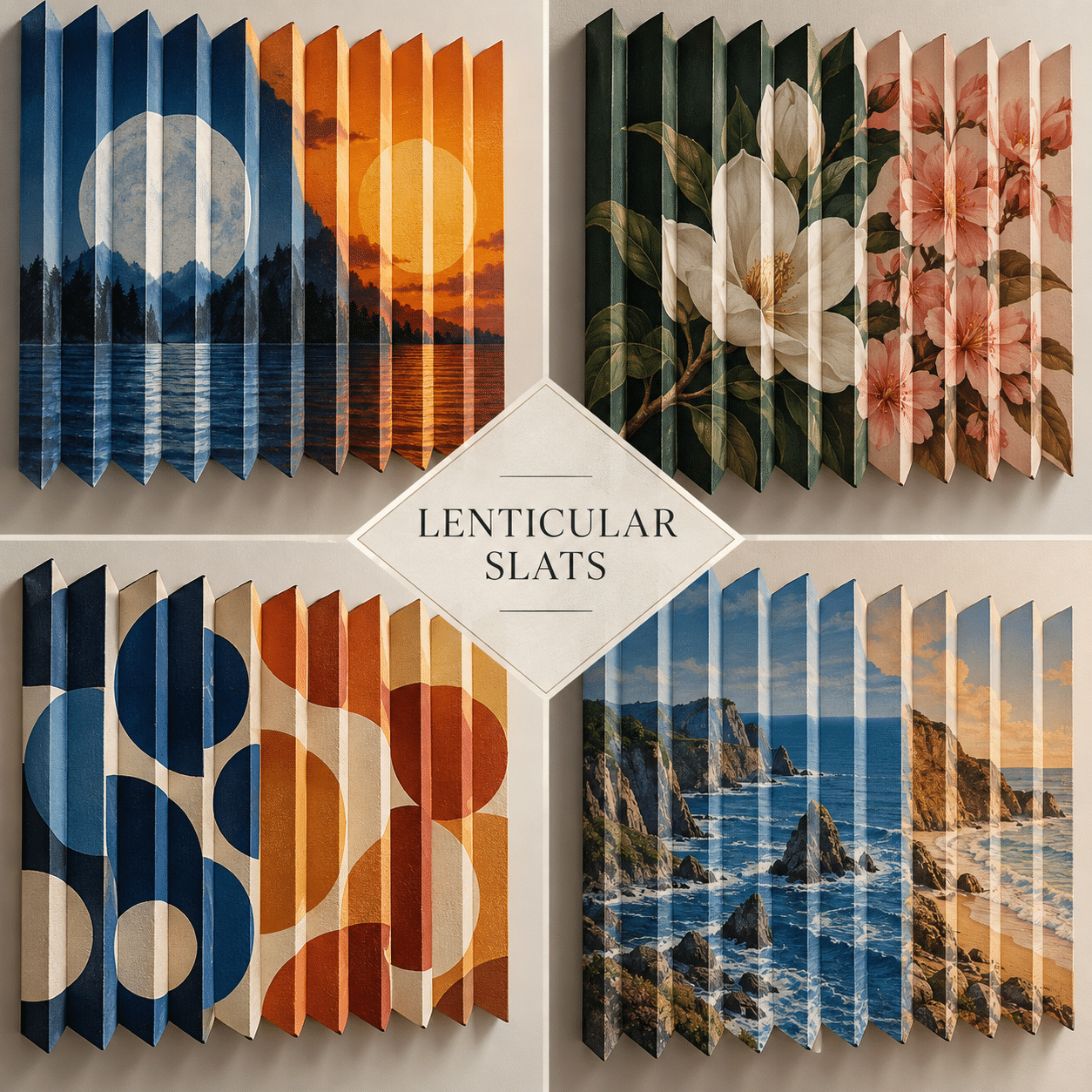
The new gallery contains static AI-generated design interpretations. They illustrate ridges, face families and possible image pairings, but do not establish that a fabricated object would produce a verified transition. For a finished physical work, document at least the intended viewing positions and, where useful, a short movement sequence.
A practical first experiment
Draw a dark circle on one sheet and a light angular form on another. Use a reliable folded-paper activity to distribute them across alternating faces. Observe which details survive from each side, then simplify the images where necessary. Keep the construction modest enough to revise.
Compare that physical result with a flat striped version. The difference reveals the central idea: the artwork is not only what has been painted, but what a particular position allows the viewer to see. That makes spatial arrangement an active part of the image.
A small poetic detour
Original words from the AOI studio.
Poetry
A Step to the Side
The circle waits along one face;
the mountain keeps the other blue.
I move, and neither leaves its place,
yet one gives way to something new.
The wall stays still. My passing feet
make separate painted moments meet.
The prompt workshop
Original creative exercises. These prompts create new illustrations, not documentary evidence.
Two face families
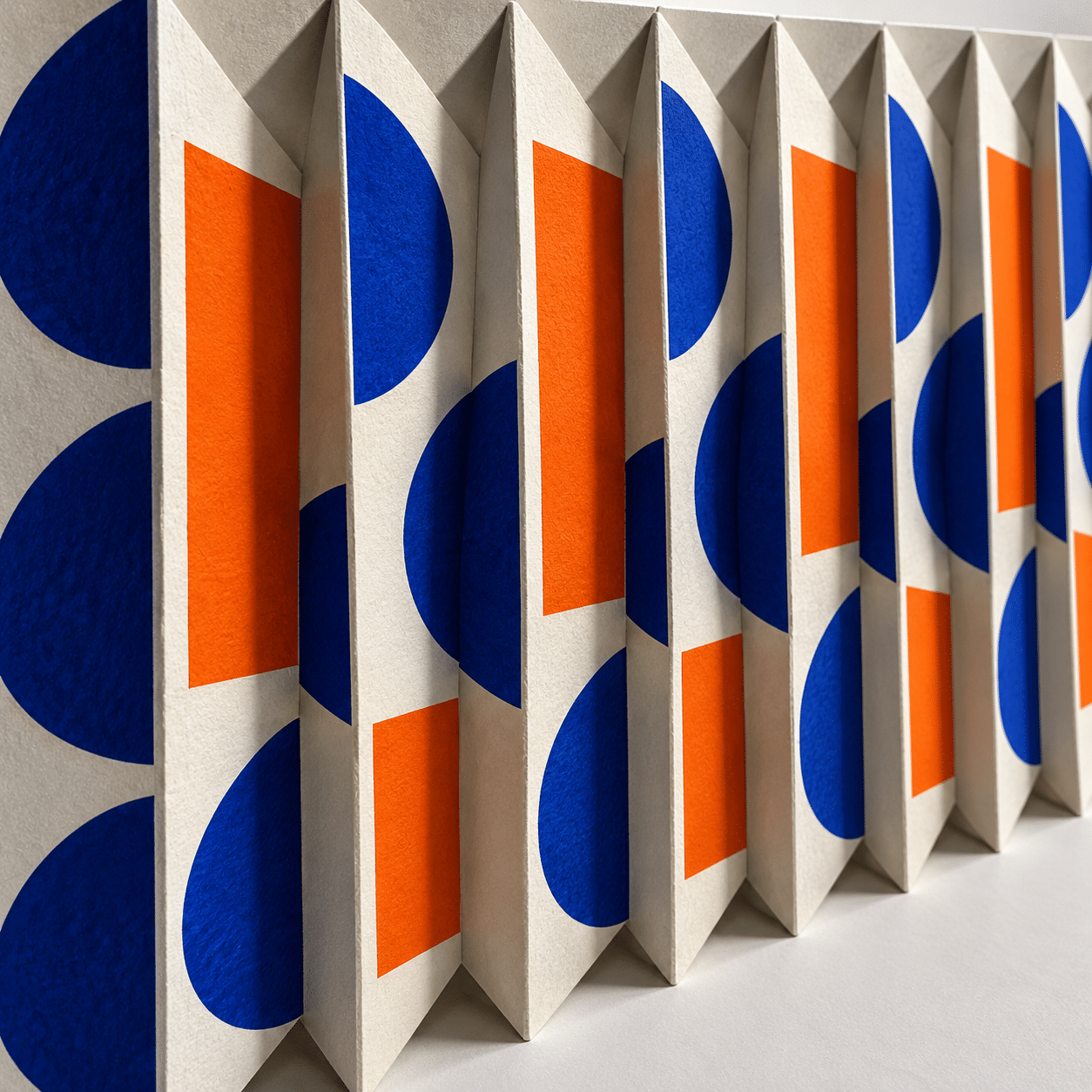
Create a static concept visualization of triangular folded slats, alternating faces painted with cobalt circles and orange rectangles, clear ridges and an oblique viewpoint. No claim of a tested optical mechanism.
A wall relief
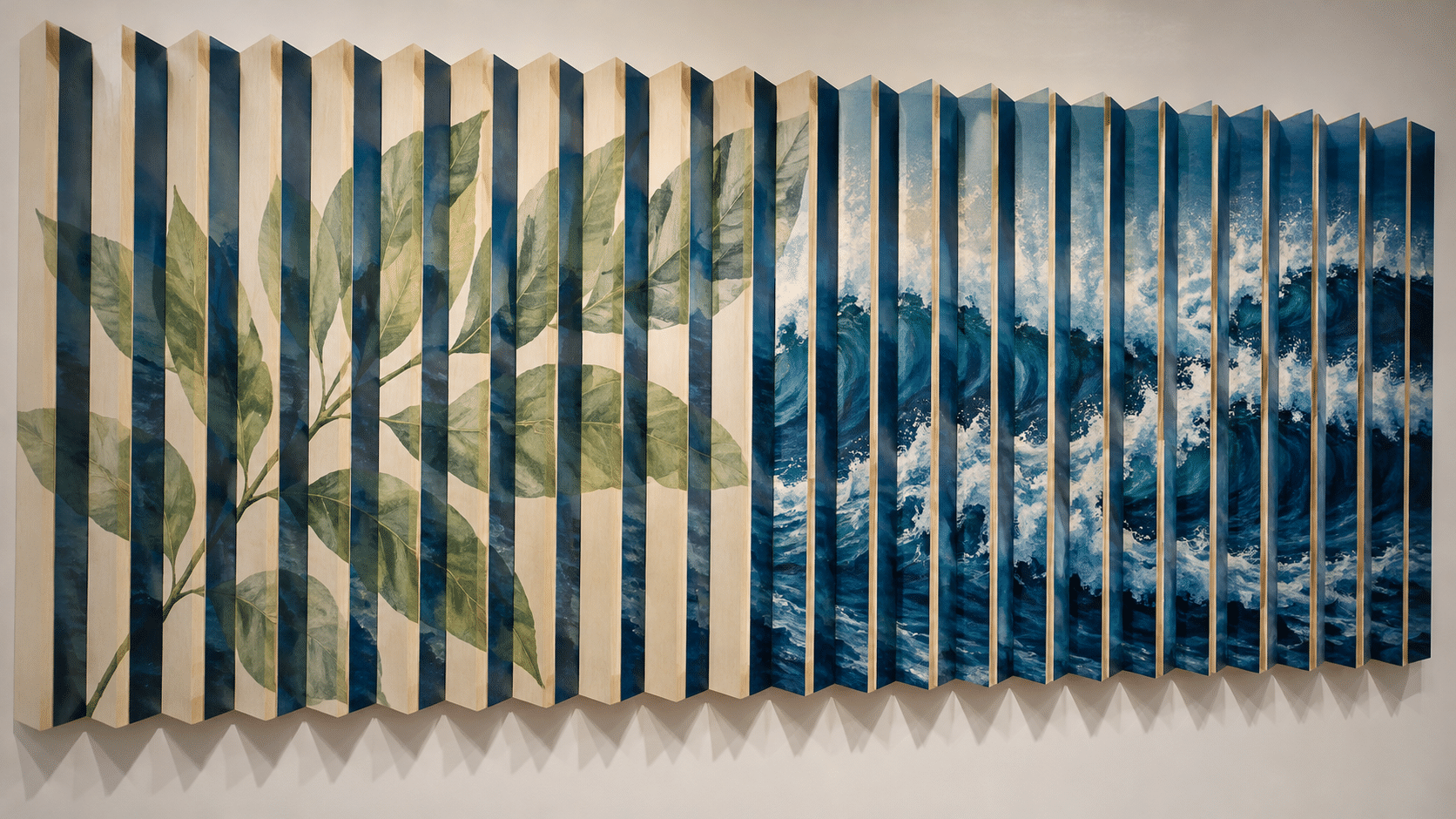
Create an imagined wooden slat relief with pale green leaves on one family of faces and deep blue waves on the other, regular facet spacing and coherent side light.
The intermediate view
Create an oblique design study of alternating red and cream geometric images on triangular metal slats, both face families partly visible, clean sculptural rhythm and no text.
A smile from the studio
Jokes
The artwork has two opinions. It lets you change yours by taking one step.