
Construction medium and visual reference
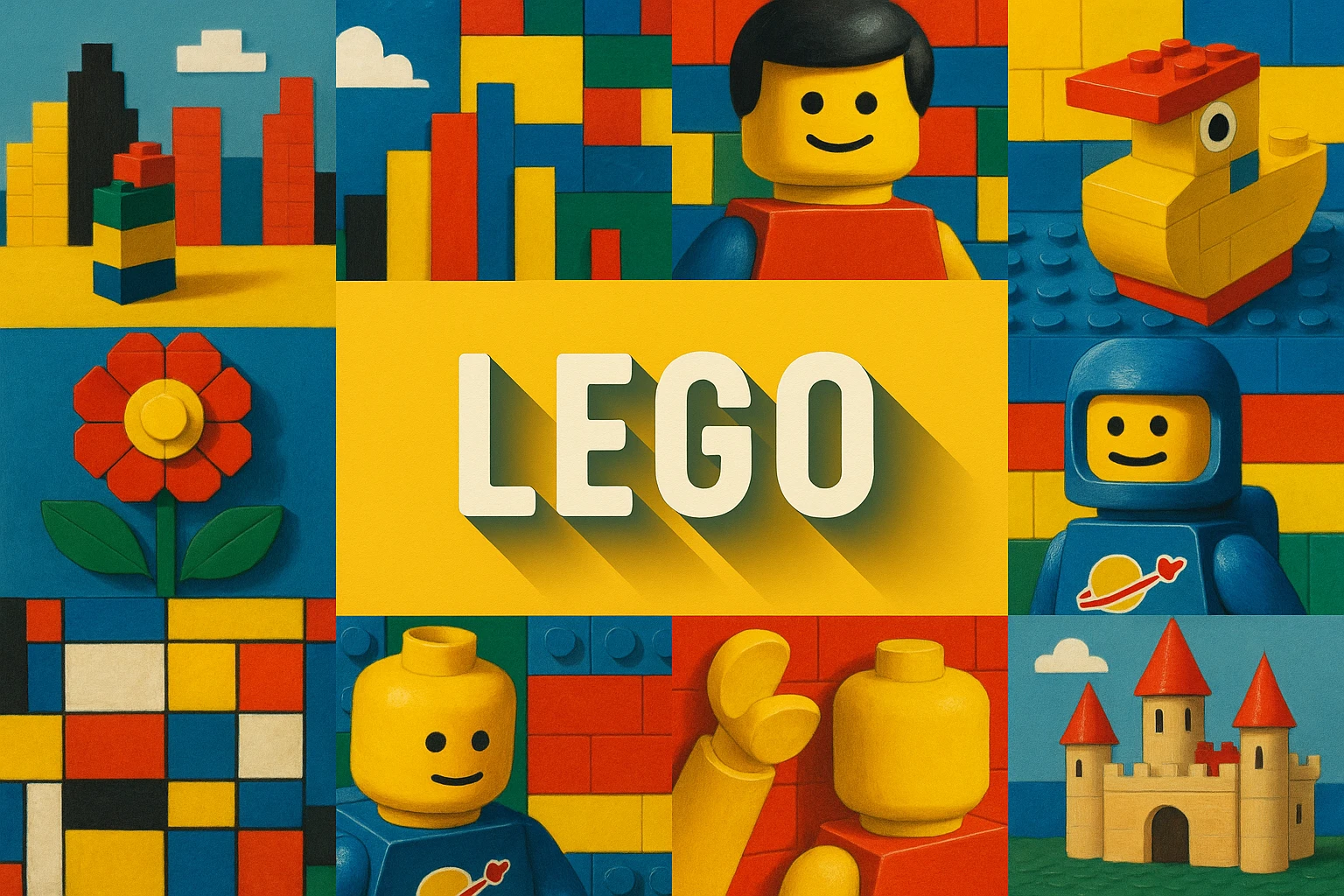
LEGO art uses a construction system as a medium for models, reliefs, mosaics and other visual experiments. It is not a single style: the arrangement of modules, color and scale determines the result.
A visual introduction
Select an image for a closer look. Use the thumbnails, arrow keys or a swipe to compare examples. Zoom in to inspect details, or share the image that inspires you.
Creative toolbox · take this style further
Choose an input and a destination. Search sends your words to the chosen site; Copy & open puts them on your clipboard to paste there.
Create with AI
Turn your chosen input into an image prompt or a new creative direction.
ChatGPT
Copy your input and paste it into a ChatGPT conversation or image request.
Copy & open ChatGPT (new tab)Claude · Anthropic
Develop an image prompt or explore the style in a new Claude conversation.
Copy & open Claude · Anthropic (new tab)Midjourney
Paste your input into the Imagine bar on the Create page.
Copy & open Midjourney (new tab)Adobe Firefly
Copy your input, open Firefly, and paste it into the prompt field.
Copy & open Adobe Firefly (new tab)Leonardo.Ai
Copy your input, open Leonardo, and paste it into the generation field.
Copy & open Leonardo.Ai (new tab)Image search
Find visual references. Short, concrete keywords usually work best.
Lexica
Search AI images and prompts using your selected input.
Search with this input Lexica (new tab)Pexels
Search the photo and video library. Short keywords often work best.
Search with this input Pexels (new tab)Pixabay
Search photos, illustrations and other images.
Search with this input Pixabay (new tab)Unsplash
Search photographs using the style name or your own keywords.
Search with this input Unsplash (new tab)Wikimedia Commons
Search photographs, artworks and historical images. Check each file for its source and reuse terms.
Search with this input Wikimedia Commons (new tab)Art & research
Explore artists, collections and the ideas behind a style.
Wikipedia
Search for background reading. A style may not have its own article.
Search with this input Wikipedia (new tab)WikiArt
Copy your input into WikiArt’s search to explore artists and artworks.
Copy & open WikiArt (new tab)Europeana
Paste your keywords into the search to explore European museum, library and archive collections.
Copy & open Europeana (new tab)Inspiration
Discover portfolios and visual ideas from creative communities.
Instagram hashtags
Search a hashtag made from your input: spaces and punctuation are removed. Instagram may require sign-in.
Search with this input Instagram hashtags (new tab)ArtStation
Paste your input into artwork search for concept art, environments, characters and visual development.
Copy & open ArtStation (new tab)Behance
Paste your input into project search for illustration, design and visual storytelling.
Copy & open Behance (new tab)A closer look
Repeated units, visible joins and stepped contours can create a coherent material language; the model should respect a consistent scale and construction logic.
The system creates possibilities and constraints
The LEGO Group's history explains the stud-and-tube connection developed and patented in 1958. The connection's role in holding elements together is more useful to understanding brick-based design than treating every stud as a decorative texture.
This overview concerns the construction system as a medium. The companion LEGO Bricks article concentrates on the visual behavior of individual modules. Neither page implies that every brick-inspired digital image is an official product or a physically buildable model.
Translate a subject rather than coating it
Choose the main silhouette and the level of simplification before adding individual pieces. A convincing model translates curves, planes and structural relationships into modules. Merely covering a smooth object with studs can leave its underlying geometry unrelated to the medium.
Test the subject at a small scale first. Which features are necessary for recognition? Which can be omitted? A strong profile may communicate more clearly than a large model filled with small, contradictory details.
Color can be structural
In a mosaic, color areas and the viewing distance determine how units form an image. In a sculpture, color can reinforce planes, separate components or intentionally disguise construction. Decide which role it serves rather than assigning a new color to every piece.
Keep the module scale consistent. A sudden unexplained change in stud size can make a generated scene feel incoherent. Joins, supports and contact points deserve particular attention where the model carries weight or spans a gap.
Buildability and illustration are different outcomes
A digital rendering can propose a striking construction without proving that the elements exist or connect as shown. If the goal is a real build, verify the parts, connections and stability through an appropriate design process.
For a visual study, label the result as an original brick-built concept. Avoid presenting invented packaging, set numbers or brand marks as genuine. The medium's interest lies in how a limited family of units can support a surprising range of forms, not in implying official endorsement.
The prompt workshop
Original creative exercises. These prompts create new illustrations, not documentary evidence.
A translated silhouette
Original brick-built concept of a small lighthouse, consistent module scale, clear stepped silhouette and plausible joints, no official packaging or set number.
A modular relief
Original construction-brick relief of a river landscape, color fields coordinated with changes in depth and readable from a distance.
One material vocabulary
Original brick-built abstract sculpture using a limited palette and repeated modules, deliberate negative space and visible structural relationships, concept rendering only.
Sources and further exploration
LEGO History — the stud-and-tube principle and its development