
Modular construction and brick-inspired imagery
A small repeated unit can build a large visual world. Brick-inspired art becomes convincing when the module controls the silhouette, surface and connections rather than appearing as a texture pasted over a smooth object.
A visual introduction
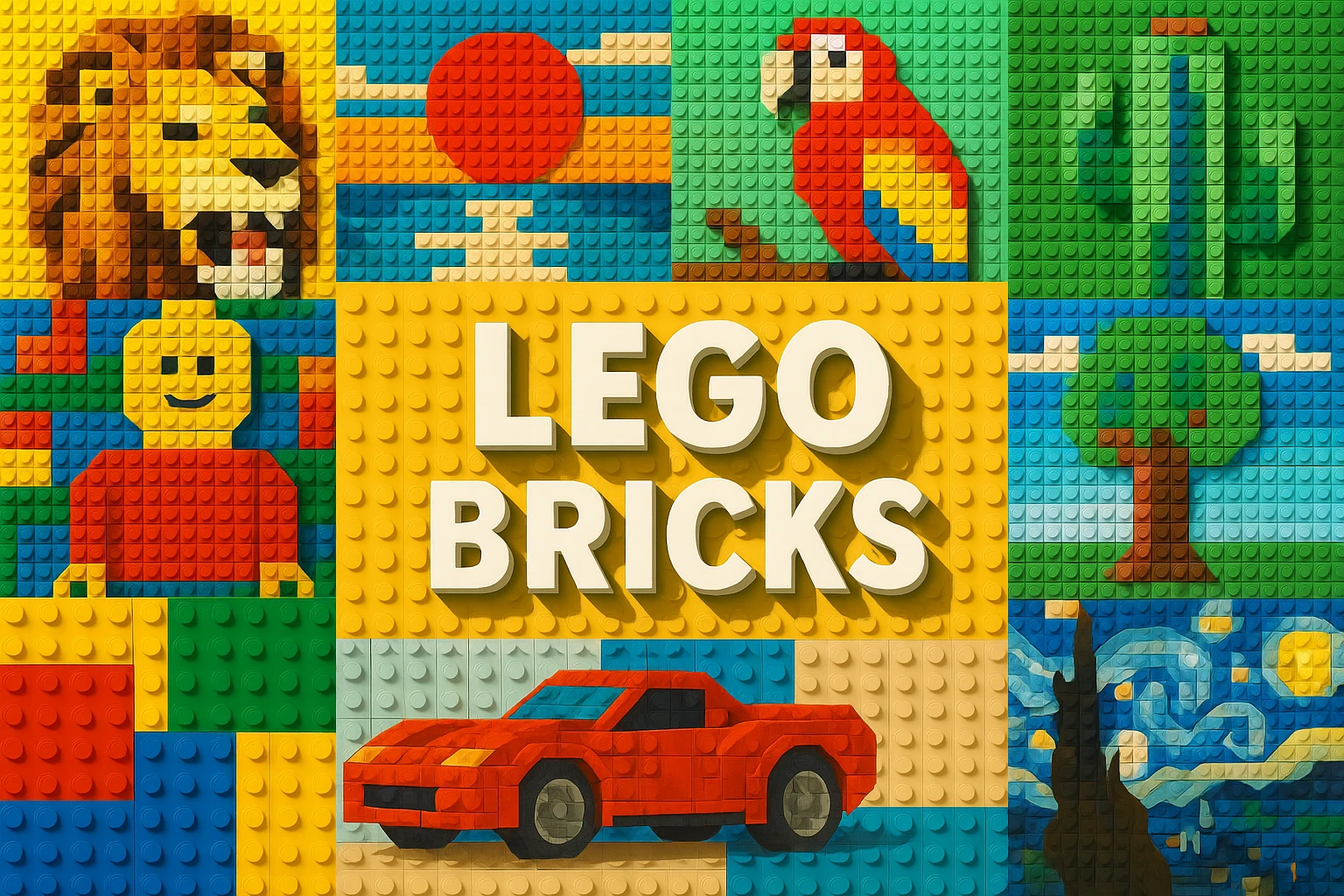
Compare the retained archive studies. The titled collage is modern editorial illustration; its panels are not reproductions of documented works.
Select an image for a closer look. Use the thumbnails, arrow keys or a swipe to compare examples. Zoom in to inspect details, or share the image that inspires you.

Creative toolbox · take this style further
Choose an input and a destination. Search sends your words to the chosen site; Copy & open puts them on your clipboard to paste there.
Create with AI
Turn your chosen input into an image prompt or a new creative direction.
ChatGPT
Copy your input and paste it into a ChatGPT conversation or image request.
Copy & open ChatGPT (new tab)Claude · Anthropic
Develop an image prompt or explore the style in a new Claude conversation.
Copy & open Claude · Anthropic (new tab)Midjourney
Paste your input into the Imagine bar on the Create page.
Copy & open Midjourney (new tab)Adobe Firefly
Copy your input, open Firefly, and paste it into the prompt field.
Copy & open Adobe Firefly (new tab)Leonardo.Ai
Copy your input, open Leonardo, and paste it into the generation field.
Copy & open Leonardo.Ai (new tab)Image search
Find visual references. Short, concrete keywords usually work best.
Lexica
Search AI images and prompts using your selected input.
Search with this input Lexica (new tab)Pexels
Search the photo and video library. Short keywords often work best.
Search with this input Pexels (new tab)Pixabay
Search photos, illustrations and other images.
Search with this input Pixabay (new tab)Unsplash
Search photographs using the style name or your own keywords.
Search with this input Unsplash (new tab)Wikimedia Commons
Search photographs, artworks and historical images. Check each file for its source and reuse terms.
Search with this input Wikimedia Commons (new tab)Art & research
Explore artists, collections and the ideas behind a style.
Wikipedia
Search for background reading. A style may not have its own article.
Search with this input Wikipedia (new tab)WikiArt
Copy your input into WikiArt’s search to explore artists and artworks.
Copy & open WikiArt (new tab)Europeana
Paste your keywords into the search to explore European museum, library and archive collections.
Copy & open Europeana (new tab)Inspiration
Discover portfolios and visual ideas from creative communities.
Instagram hashtags
Search a hashtag made from your input: spaces and punctuation are removed. Instagram may require sign-in.
Search with this input Instagram hashtags (new tab)ArtStation
Paste your input into artwork search for concept art, environments, characters and visual development.
Copy & open ArtStation (new tab)Behance
Paste your input into project search for illustration, design and visual storytelling.
Copy & open Behance (new tab)A closer look
Repeated studs, stepped contours, visible joints, modular color areas and consistent scale.
A system of connections
LEGO’s own history describes the stud-and-tube principle and the 1958 patent application for a building element. The connection system is the useful idea: repeated parts can be combined into stable, changeable structures. LEGO bricks are a manufactured construction system, not a historical painting movement.
For visual analysis, distinguish a physical build, a digital model and an image that only suggests bricks. A generated picture may show convincing plastic and studs while containing impossible joints. The archive illustrations here are visual interpretations, not construction instructions or official product photographs.
Let the module shape the subject
Choose a manageable subject such as a house, bird or small vehicle. Establish one brick size, then decide which details survive at that scale. A curved roof might become a stepped edge; a feather can become a block of color. The abstraction is strongest when those compromises are consistent across the whole image.
Build large masses first and use a few contrasting pieces to mark windows, eyes or moving parts. Keep the lighting simple enough to reveal the seams. In a digital study, check that studs align with the implied grid and that bricks do not melt into one another. For a physical model, verify stability with actual parts rather than trusting an illustration. The retained collage explores mosaics and small objects; the standalone house makes the change from colored units to recognizable architecture especially clear.
Design the silhouette before the stud pattern
Begin with a limited module and a simple silhouette. A small bird, vehicle or plant should remain recognizable when reduced to a few large stepped masses. Only then decide where exposed studs, tiles and joints help explain construction. Covering a smooth render with circular bumps does not produce a convincing assembled object.
Think about transitions between scales. A large wall can be relatively quiet while a hinge, eye or wheel provides a smaller point of concentration. Using the smallest possible units everywhere often makes the object noisy without making its structure more believable.
Treat color as a construction decision
Try one version with a restrained set of colors and another organized into contrasting component groups. In the first, shape must carry recognition; in the second, color can explain which parts connect or move. Avoid random color changes that imply individual pieces without contributing to the object’s larger organization.
A convincing image of a brick sculpture is not automatically a buildable model. If physical construction is the goal, check the connections, support and available elements in a suitable modeling or building process. An image alone cannot establish that hidden joints will hold.
Three useful studies
Make a compact animal in profile, a small room with an open wall, and an abstract arrangement with one unsupported-looking span. Each tests a different problem: contour, spatial access and structural credibility. In all three, judge how the repeated unit shapes the design. Describe generated work as a brick-inspired interpretation; do not present an invented object as an official product or a verified set.
The prompt workshop
Original creative exercises. These prompts create new illustrations, not documentary evidence.
A modular house
Create an original toy-brick illustration of a small red house with a yellow door and blue window frames on a green base. Show a consistent stud spacing, stepped roof and distinct piece joints under soft studio light. No logo, text or instruction labels.
Reduce a bird
Create an original small parrot assembled from visible modular plastic bricks. Use a limited red, yellow, blue and green palette; simplify the beak and tail into readable steps. Consistent scale and plausible connections, neutral background, no text.
Mosaic rhythm
Create an original shallow brick mosaic of a harbor at dusk. Use visible repeating studs, large areas of blue and orange, and a single pale boat as the focal point. Keep the module consistent; no lettering or brand marks.