
Drawing genre
Landscape drawing turns a view into a deliberate arrangement of marks. Learn how framing, value, edges and selective detail create depth across graphite, charcoal, ink and coloured-pencil studies.
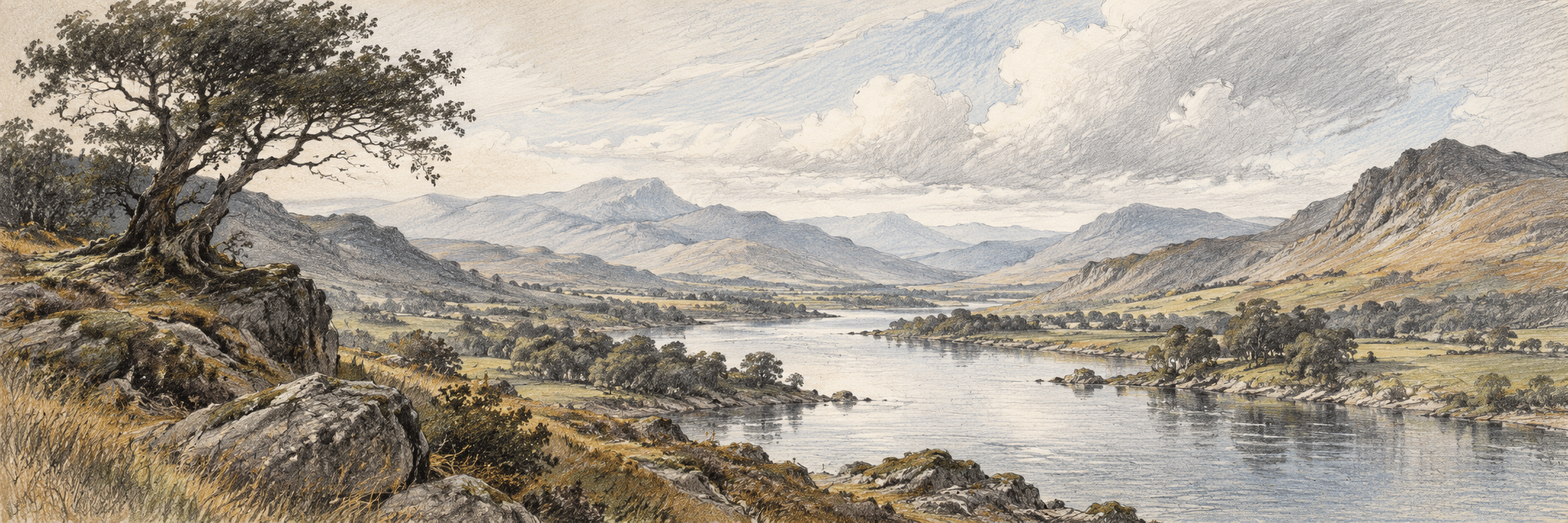
A visual introduction
Select an image for a closer look. Use the thumbnails, arrow keys or a swipe to compare examples. Zoom in to inspect details, or share the image that inspires you.
Creative toolbox · take this style further
Choose an input and a destination. Search sends your words to the chosen site; Copy & open puts them on your clipboard to paste there.
Create with AI
Turn your chosen input into an image prompt or a new creative direction.
ChatGPT
Copy your input and paste it into a ChatGPT conversation or image request.
Copy & open ChatGPT (new tab)Claude · Anthropic
Develop an image prompt or explore the style in a new Claude conversation.
Copy & open Claude · Anthropic (new tab)Midjourney
Paste your input into the Imagine bar on the Create page.
Copy & open Midjourney (new tab)Adobe Firefly
Copy your input, open Firefly, and paste it into the prompt field.
Copy & open Adobe Firefly (new tab)Leonardo.Ai
Copy your input, open Leonardo, and paste it into the generation field.
Copy & open Leonardo.Ai (new tab)Image search
Find visual references. Short, concrete keywords usually work best.
Lexica
Search AI images and prompts using your selected input.
Search with this input Lexica (new tab)Pexels
Search the photo and video library. Short keywords often work best.
Search with this input Pexels (new tab)Pixabay
Search photos, illustrations and other images.
Search with this input Pixabay (new tab)Unsplash
Search photographs using the style name or your own keywords.
Search with this input Unsplash (new tab)Wikimedia Commons
Search photographs, artworks and historical images. Check each file for its source and reuse terms.
Search with this input Wikimedia Commons (new tab)Art & research
Explore artists, collections and the ideas behind a style.
Wikipedia
Search for background reading. A style may not have its own article.
Search with this input Wikipedia (new tab)WikiArt
Copy your input into WikiArt’s search to explore artists and artworks.
Copy & open WikiArt (new tab)Europeana
Paste your keywords into the search to explore European museum, library and archive collections.
Copy & open Europeana (new tab)Inspiration
Discover portfolios and visual ideas from creative communities.
Instagram hashtags
Search a hashtag made from your input: spaces and punctuation are removed. Instagram may require sign-in.
Search with this input Instagram hashtags (new tab)ArtStation
Paste your input into artwork search for concept art, environments, characters and visual development.
Copy & open ArtStation (new tab)Behance
Paste your input into project search for illustration, design and visual storytelling.
Copy & open Behance (new tab)A closer look
Large connected value shapes; a clear viewing position; overlaps and changes of scale; varied mark density; foreground anchors and quieter distance; selective contours, hatching or broad tones adapted to the subject.
A genre with many purposes
Landscape drawing is a broad genre, not one historical movement. A drawing may record an observed place, test a composition, preserve a memory or invent an environment. Getty’s drawings collection describes the medium as both a means of investigation and an independent artistic outcome. A quick study and a carefully developed sheet can be equally purposeful.
The subject need not be a spectacular mountain or untouched countryside. A roadside tree, allotment, industrial edge or small stretch of river can offer a rich spatial problem. Decide what you want the viewer to notice before deciding how much detail the page should contain.
Frame the relationship that matters
Getty’s Framing the Landscape activity uses contrasting horizontal and vertical studies to make composition tangible. Orientation changes the relationship between a subject and its surrounding space. A tall sheet can emphasize the lift of a tree; a wide sheet may reveal how the same tree belongs to a larger setting.
Begin with small thumbnails. Place the horizon, the largest dark shape and the main opening. Try moving one element rather than polishing the first arrangement immediately. A useful composition gives the eye a reason to enter, a route to follow and somewhere to pause. Paths and rivers can help, but a strong pattern of light and dark can work without either.
Build depth before texture
Establish a few broad value groups before drawing leaves, stones or roof tiles. Overlap and relative scale can explain depth economically. A foreground form may interrupt the outline of a more distant shape; a sequence of related forms can diminish across the page. Keep the chosen viewpoint consistent.
Atmospheric softness is a useful option, not a rule to apply mechanically to every scene. Distant forms often benefit from simpler marks and reduced contrast, while a nearby focal area may carry sharper edges. Check the actual lighting idea: backlighting, fog and a dark distant ridge can change the expected pattern.
Let the material make a difference
Graphite supports controlled lines and gradual tonal development. Charcoal can establish broad dark masses and soft transitions quickly. Ink asks for deliberate decisions about line, hatching and the paper left untouched. Coloured pencil can describe temperature and surface through layered strokes. These are working possibilities rather than rigid divisions.
A tree does not require a separate mark for every leaf. Use clusters, directional rhythms and broken edges to suggest its structure. Change the mark when the material changes: a smooth water passage, rough bark and distant grass should not all receive identical texture. Leave quieter areas to make the detailed passages meaningful.
Observation, invention and honest presentation
The Smithsonian’s Landscape with Path through Forest by Edward Mitchell Bannister provides a historical example in chalk and charcoal. The NGV’s record of Peter Booth’s Drawing (Black landscape with spectres) shows how landscape drawing can also involve imaginative, unsettling imagery. The genre is broader than neutral topographical description.
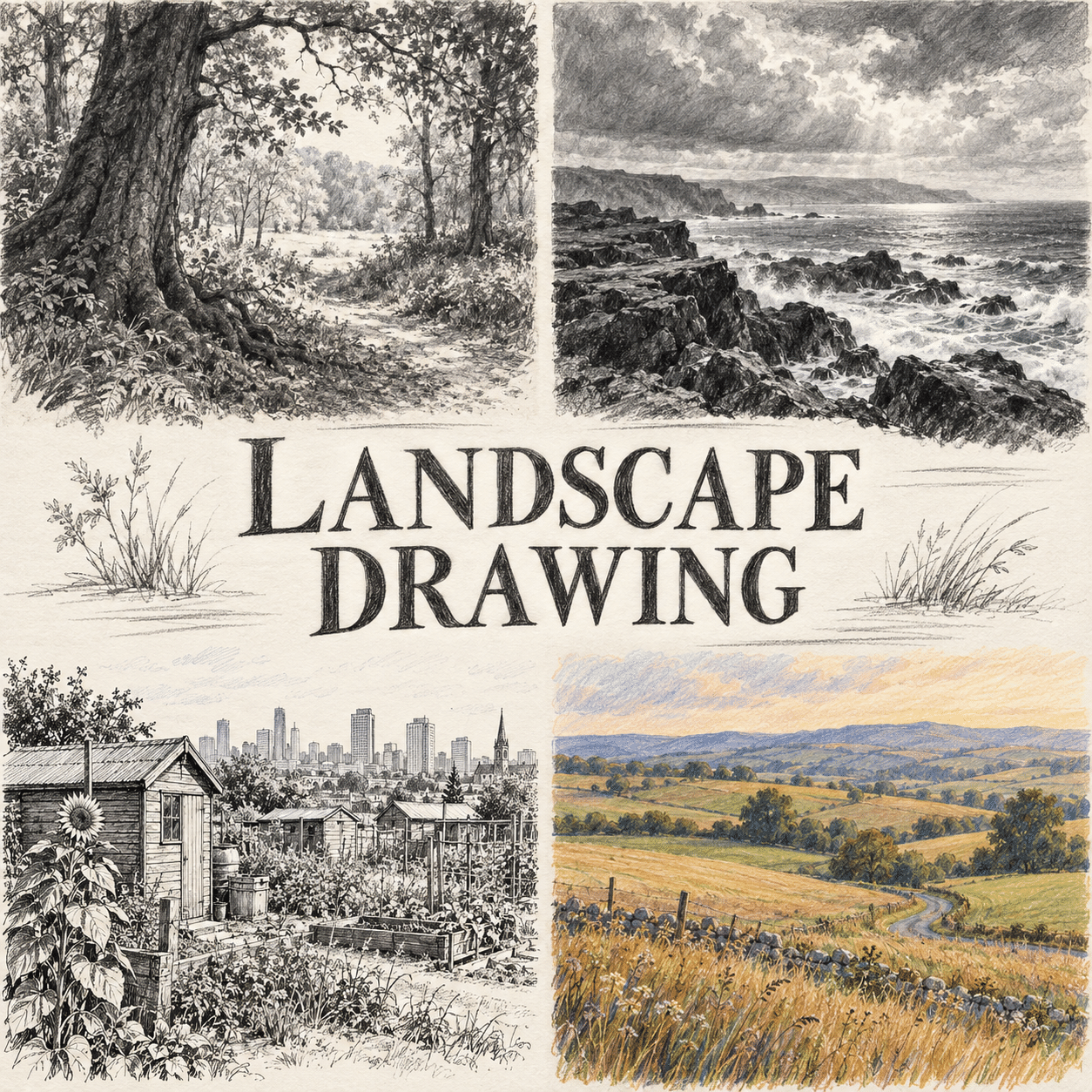
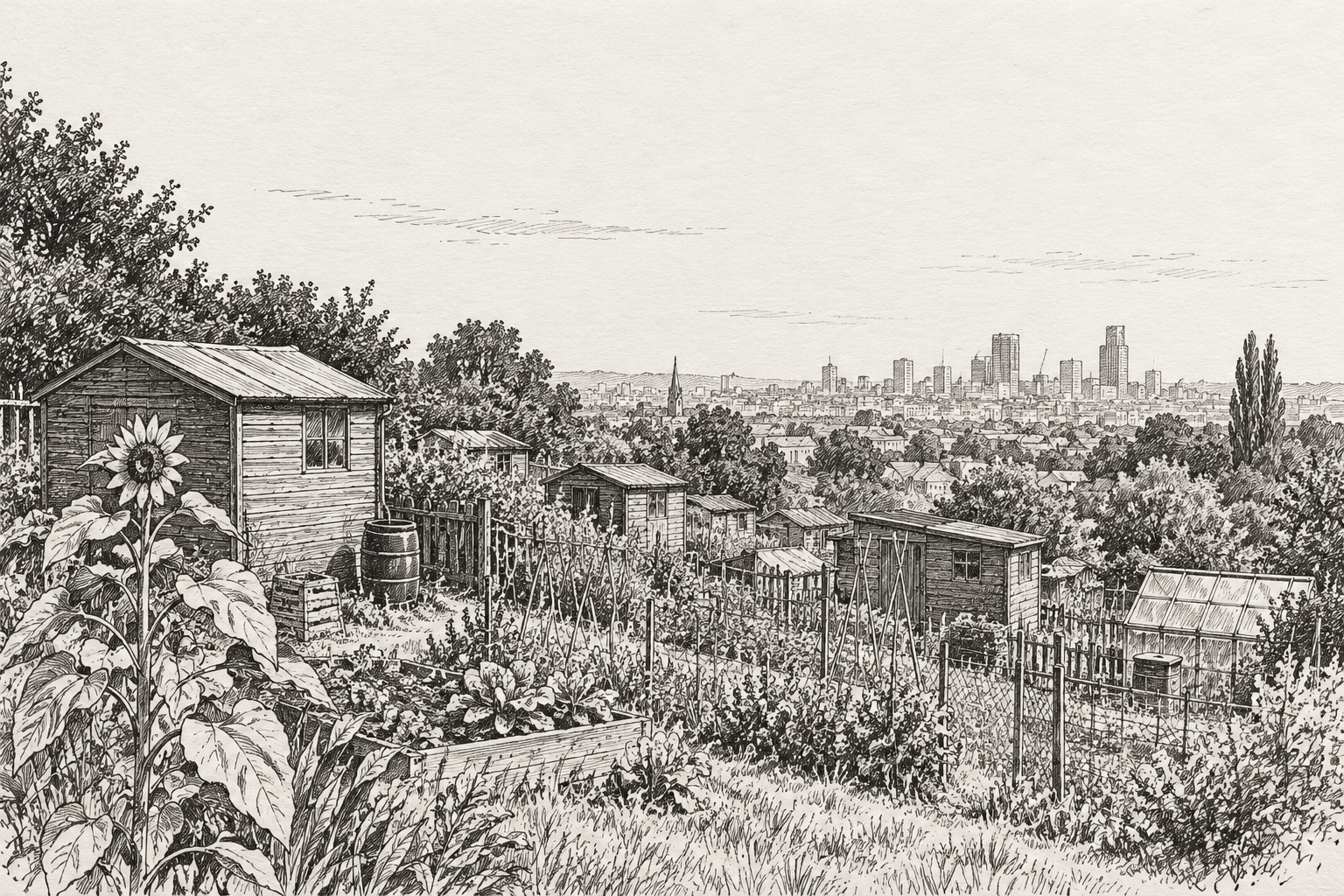
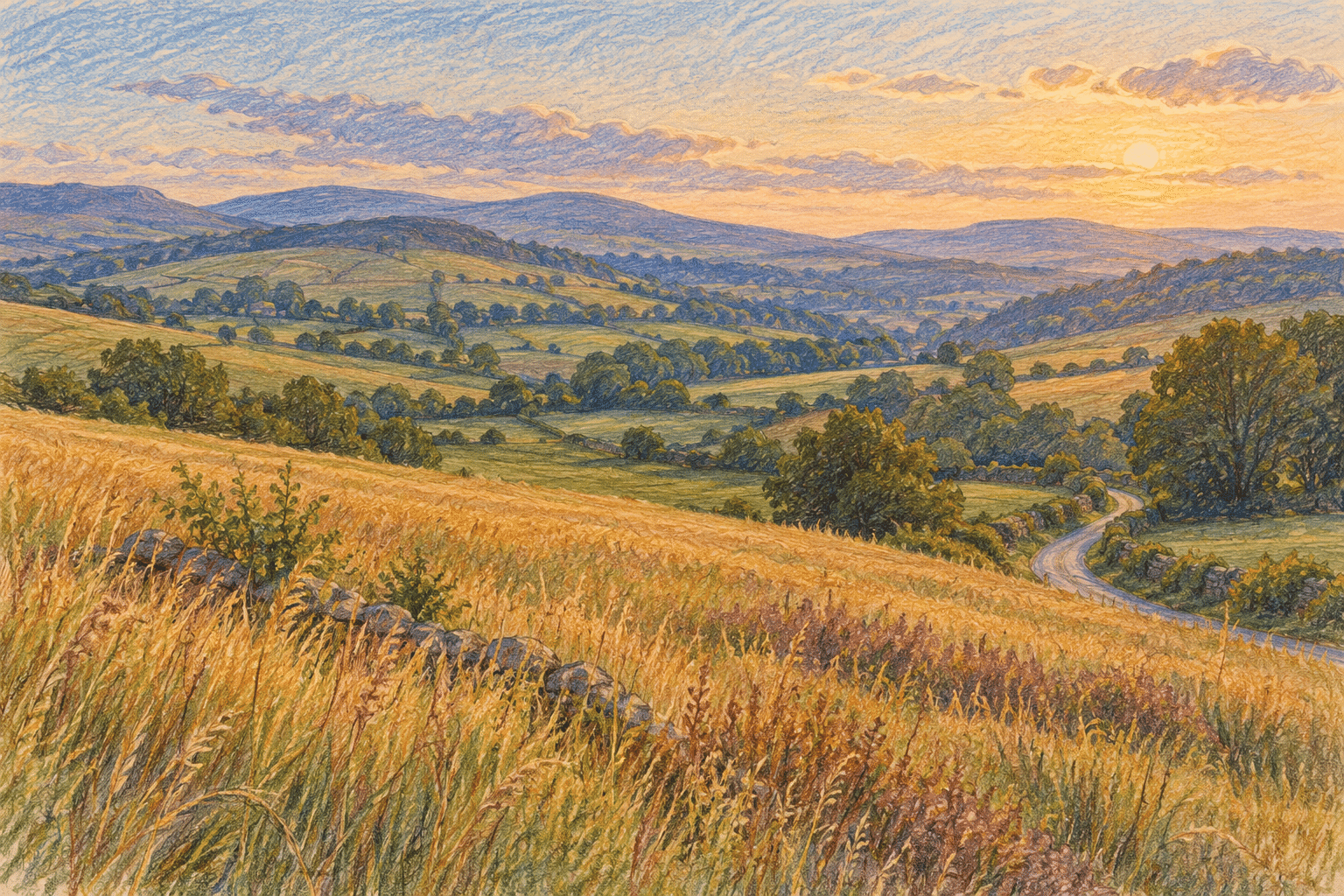
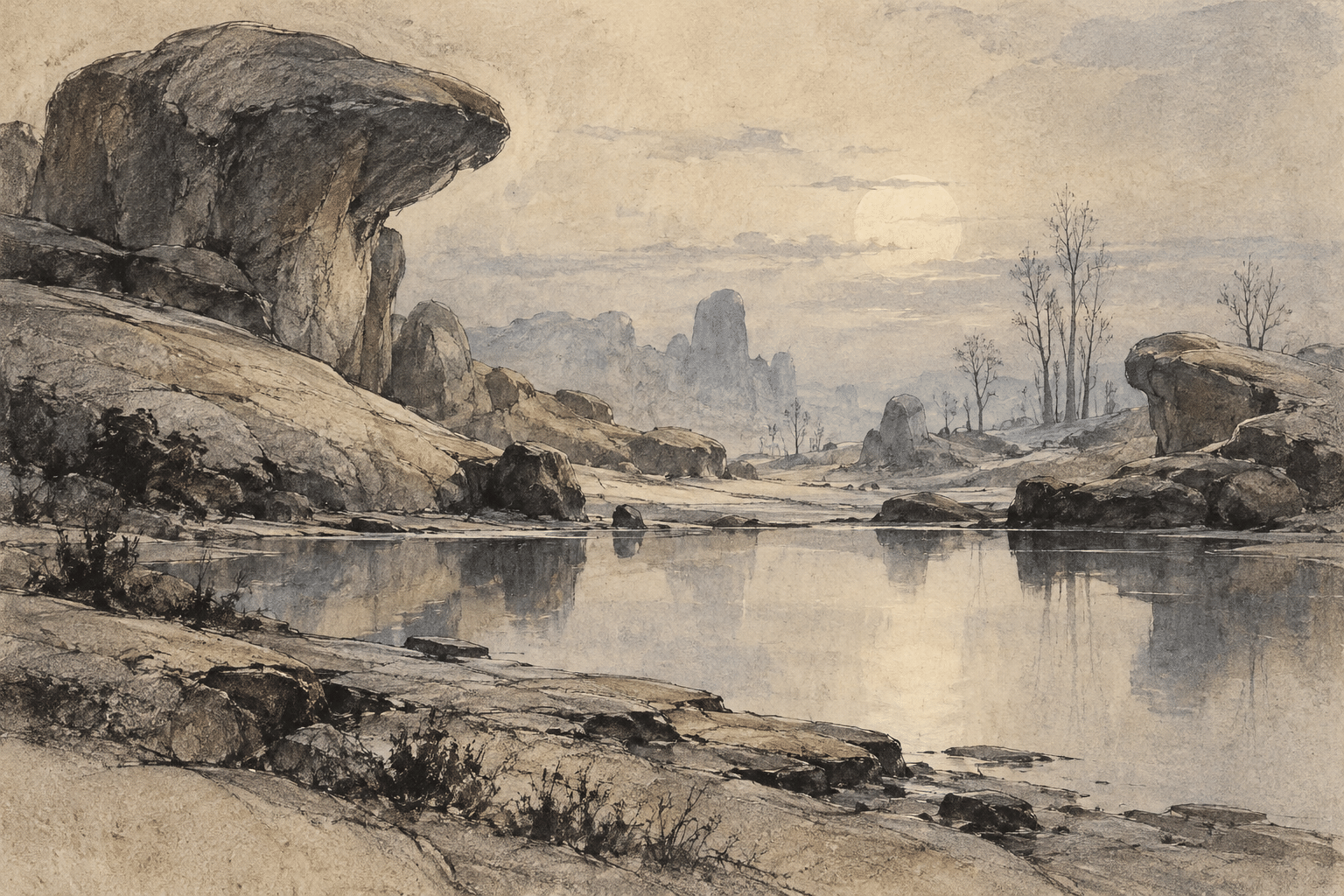
The new AI-generated gallery offers original interpretations of drawing media across a woodland, coast, city edge, open fields and an imagined landscape. These images are not physical drawings or records of real sites. Use them to compare visual strategies, then test those strategies through direct observation or a clearly stated imaginative project.
Positive editorial assessment — AI-authored
Landscape drawing can convey a strong sense of place with remarkably few means. A well-placed dark, an interrupted contour or a stretch of untouched paper can establish scale and atmosphere. Its immediacy makes the artist’s selection visible and invites the viewer to participate in completing the scene.
Critical editorial assessment — AI-authored
A common weakness is equal attention everywhere: every branch outlined, every stone shaded and every distance equally sharp. The result can be busy but spatially flat. Improve the drawing by simplifying large masses, varying edges and concentrating detail where it serves the composition’s main idea.
Neutral editorial assessment — AI-authored
Landscape drawing is a flexible genre for observation, planning and imaginative work. Its materials and degrees of finish vary widely. Evaluate a drawing through the relationship between its purpose and its decisions about framing, depth and marks, rather than through detail or realism alone.
A small poetic detour
Original words from the AOI studio.
Poetry
The paper keeps a piece of sky;
a darkened branch explains the near.
A lighter hill allows the eye
to find a distance drawn from here.
Not every leaf must leave a trace,
not every stone must make a claim.
A few marks give the silence place;
the rest remains outside the frame.
The prompt workshop
Original creative exercises. These prompts create new illustrations, not documentary evidence.
Three value woodland
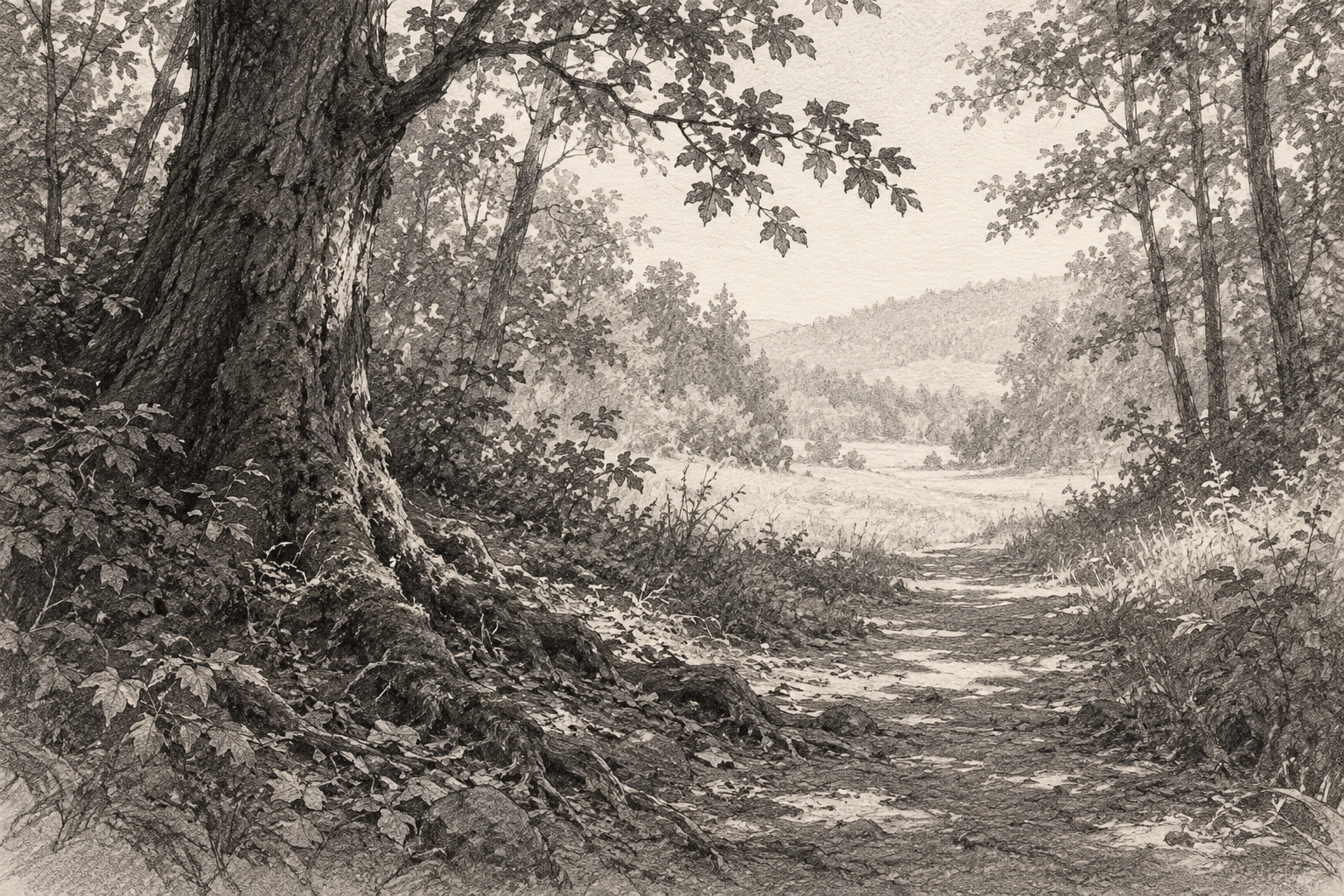
Original graphite landscape drawing of a woodland opening, one foreground tree, a middle-distance path and a pale clearing. Organize three main value groups before fine texture, selective sharp edges and generous paper light, no signature or real-location claim.
Charcoal coast
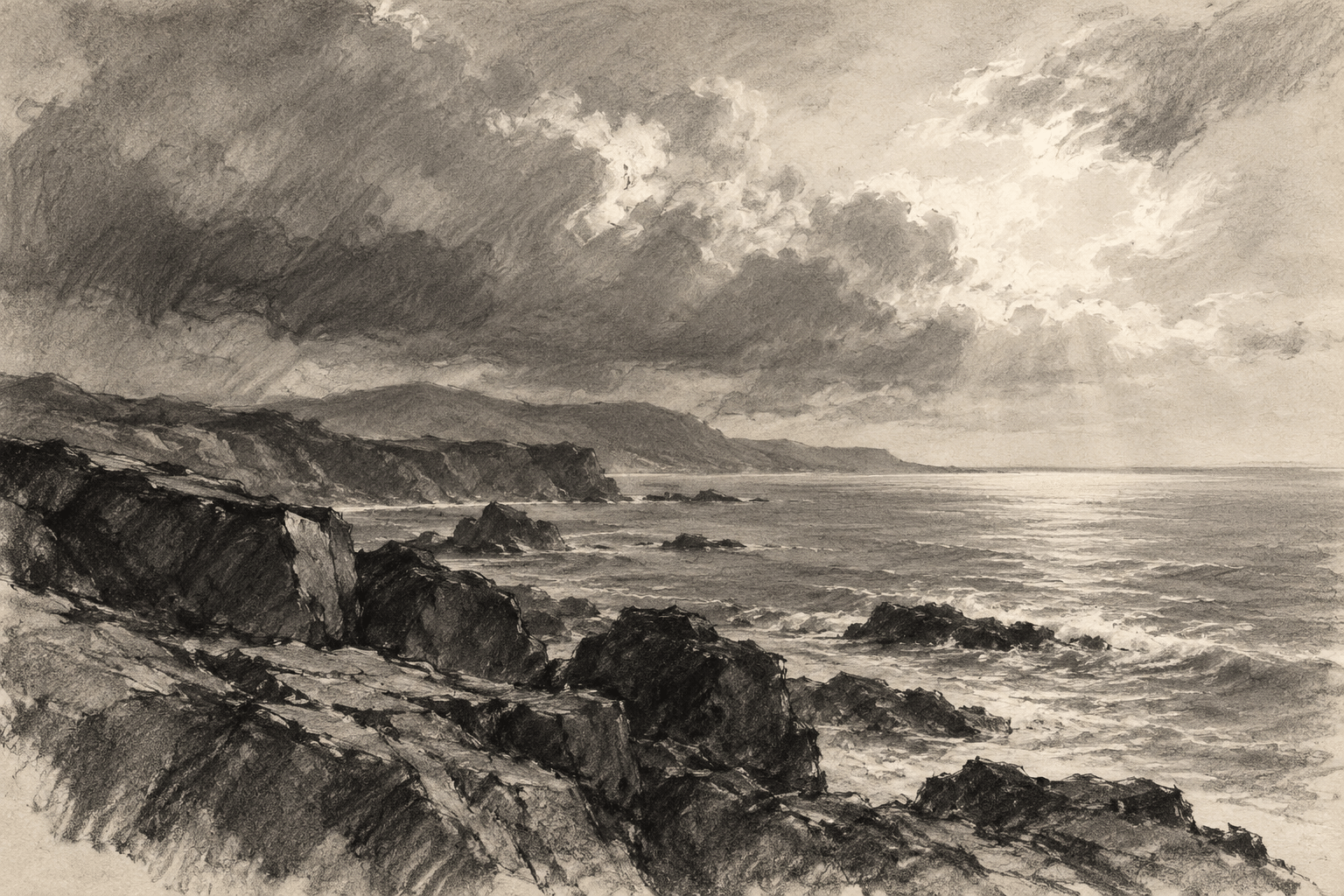
Original charcoal drawing of a low rocky coast beneath a broad cloudy sky, dark foreground anchor, soft distant shore and a few erased light passages. Varied edges, controlled tonal masses and visible paper, not a photograph filter.
A city edge in ink
Original pen-and-ink landscape drawing of allotment sheds beside a distant urban skyline, clear overlaps and scale changes, varied hatching, quiet sky and one focal foreground plant. No readable signs or copied artwork.
Your next inspiration
Discover another art style
Follow a visual thread to the next subject.
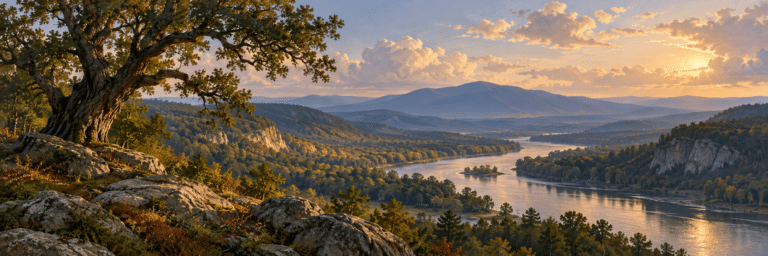
Hudson River School: Landscape, Light and the Composed View
Compare drawing with a historical landscape-painting movement.
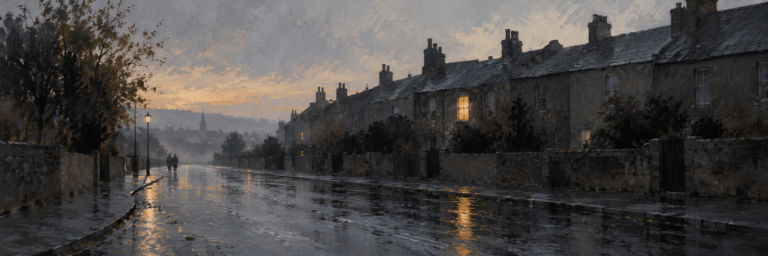
Australian Tonalism: Seeing the World as Relationships of Light
Explore the role of large tonal masses.
A smile from the studio
Jokes
The sketch had room for one more blade of grass. The composition asked whether it really needed the company.