
Sentimental decorative aesthetic · popular imagery and taste
Classic kitsch offers an immediate emotional invitation: the impossibly sweet kitten, the perfect cottage, the souvenir that keeps a holiday permanently sunny. Its visual excess can be affectionate, theatrical or knowingly playful.
A visual introduction
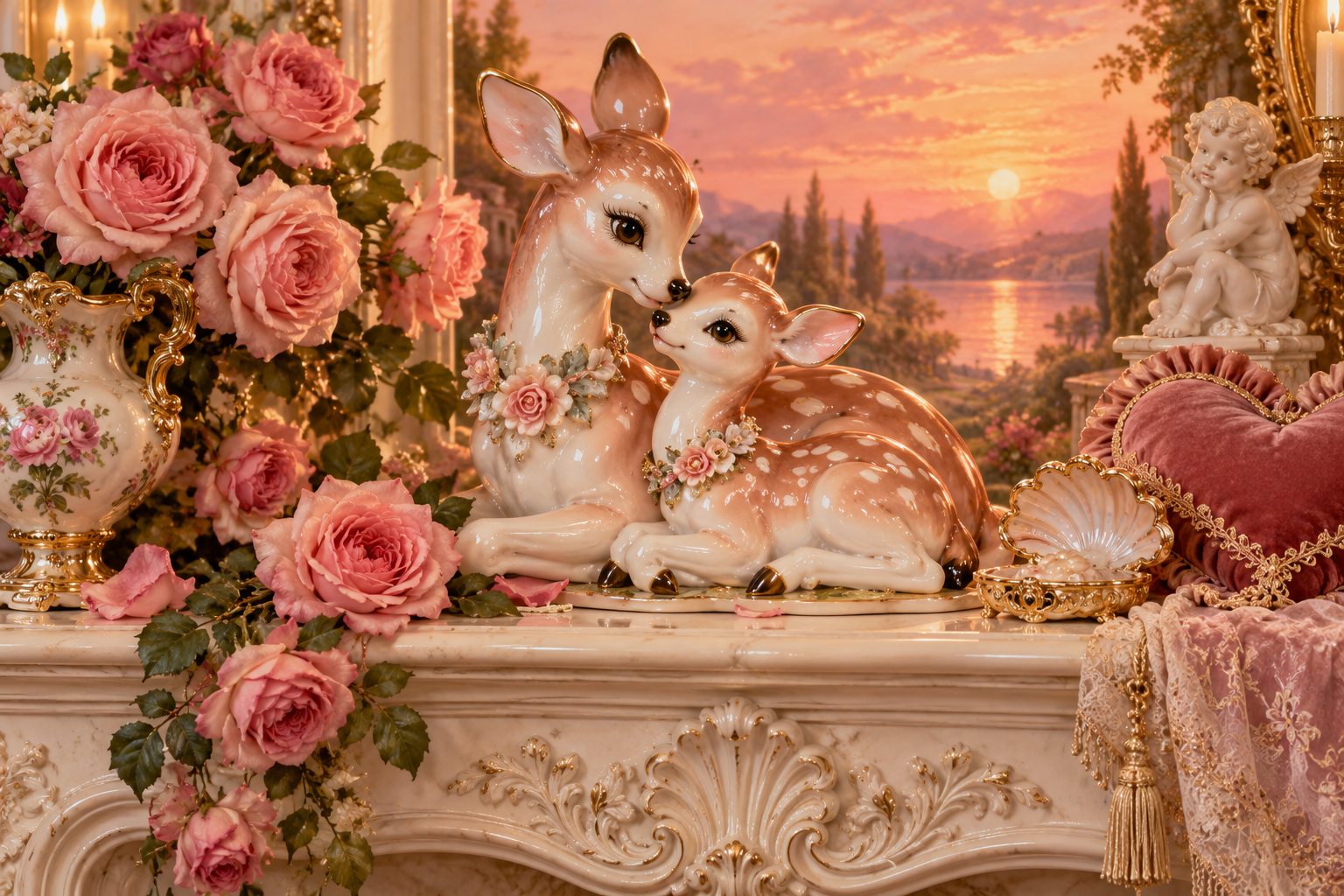
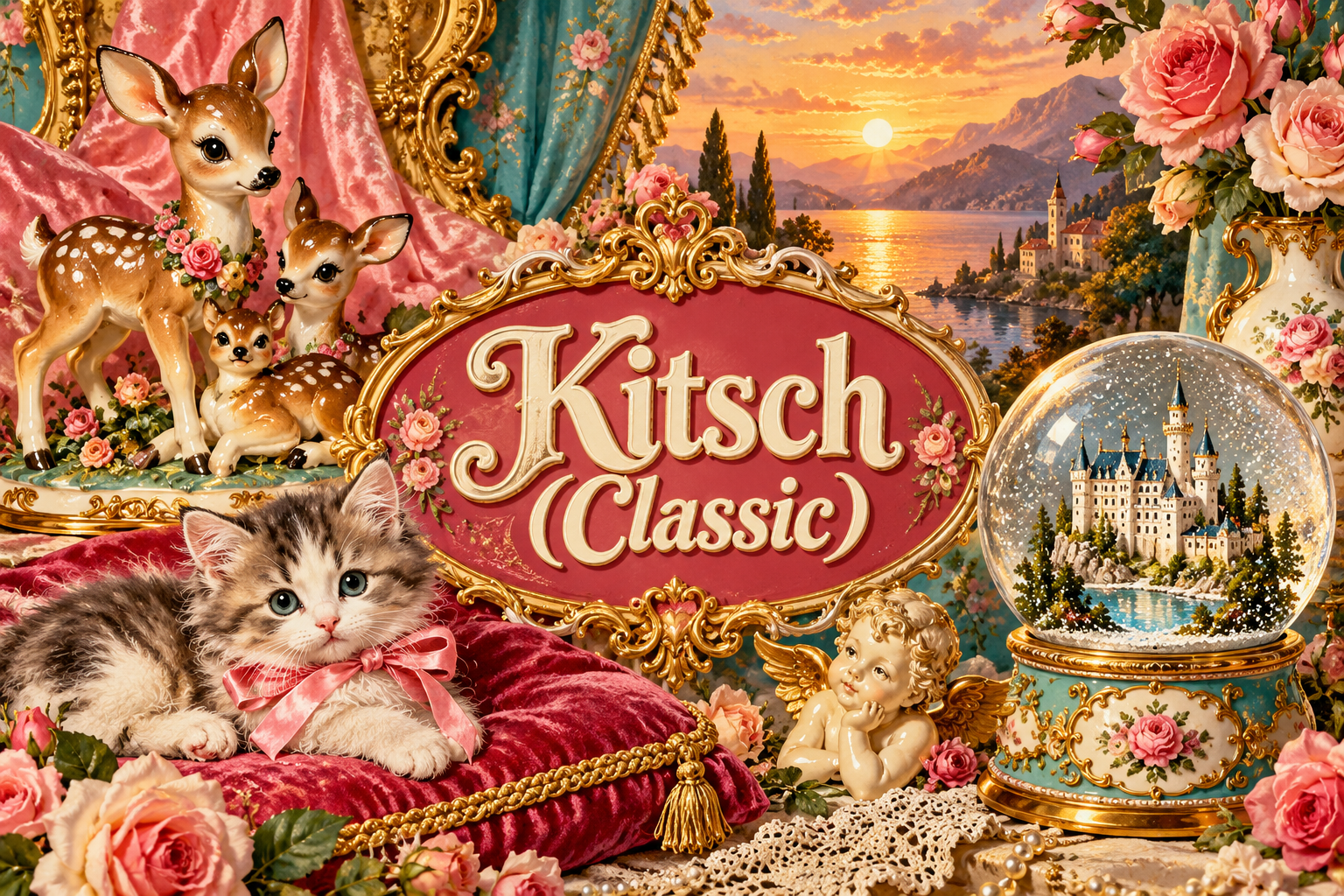
Five original AI-generated AOI interpretations: a dedicated banner, a centrally titled collage and three standalone studies. These illustrations demonstrate the principles discussed; they are not historical artworks.
Select an image for a closer look. Use the thumbnails, arrow keys or a swipe to compare examples. Zoom in to inspect details, or share the image that inspires you.
Creative toolbox · take this style further
Choose an input and a destination. Search sends your words to the chosen site; Copy & open puts them on your clipboard to paste there.
Create with AI
Turn your chosen input into an image prompt or a new creative direction.
ChatGPT
Copy your input and paste it into a ChatGPT conversation or image request.
Copy & open ChatGPT (new tab)Claude · Anthropic
Develop an image prompt or explore the style in a new Claude conversation.
Copy & open Claude · Anthropic (new tab)Midjourney
Paste your input into the Imagine bar on the Create page.
Copy & open Midjourney (new tab)Adobe Firefly
Copy your input, open Firefly, and paste it into the prompt field.
Copy & open Adobe Firefly (new tab)Leonardo.Ai
Copy your input, open Leonardo, and paste it into the generation field.
Copy & open Leonardo.Ai (new tab)Image search
Find visual references. Short, concrete keywords usually work best.
Lexica
Search AI images and prompts using your selected input.
Search with this input Lexica (new tab)Pexels
Search the photo and video library. Short keywords often work best.
Search with this input Pexels (new tab)Pixabay
Search photos, illustrations and other images.
Search with this input Pixabay (new tab)Unsplash
Search photographs using the style name or your own keywords.
Search with this input Unsplash (new tab)Wikimedia Commons
Search photographs, artworks and historical images. Check each file for its source and reuse terms.
Search with this input Wikimedia Commons (new tab)Art & research
Explore artists, collections and the ideas behind a style.
Wikipedia
Search for background reading. A style may not have its own article.
Search with this input Wikipedia (new tab)WikiArt
Copy your input into WikiArt’s search to explore artists and artworks.
Copy & open WikiArt (new tab)Europeana
Paste your keywords into the search to explore European museum, library and archive collections.
Copy & open Europeana (new tab)Inspiration
Discover portfolios and visual ideas from creative communities.
Instagram hashtags
Search a hashtag made from your input: spaces and punctuation are removed. Instagram may require sign-in.
Search with this input Instagram hashtags (new tab)ArtStation
Paste your input into artwork search for concept art, environments, characters and visual development.
Copy & open ArtStation (new tab)Behance
Paste your input into project search for illustration, design and visual storytelling.
Copy & open Behance (new tab)A closer look
Glossy ornaments, rounded forms, idealized animals, roses, pastel glows and gilded trim intensify familiar pleasures. Clear focal subjects and polished surfaces make sentiment quickly readable.
What classic means in this entry
Kitsch (Classic) names the familiar sentimental and decorative sense of kitsch: nostalgic pictures, sweet figurines, souvenirs and embellished domestic imagery. Classic is an editorial qualifier here, not a recognized historical period. The word kitsch can express admiration, amusement or dismissal depending on who uses it.
This entry updates AOI's older generic Kitsch page. Kitsch is not a synonym for Pop Art. Pop artists may use commercial or sentimental imagery, but a shared subject does not make the two categories identical. Nor should this decorative vocabulary be confused with the separate Kitsch movement associated with Odd Nerdrum.
A contested word, not a neutral quality meter
The Kunsthalle Erfurt glossary for The Cute Escape places kitsch within a history of judgment about taste. The label is therefore worth handling carefully: an object beloved by its owner can become someone else's example of excess. Price, ornament and popularity alone cannot determine artistic worth.
Ortlieb and Carbon's theoretical paper A Functional Model of Kitsch and Art examines how familiarity, emotional accessibility and social motivation may contribute to aesthetic appreciation. It offers a way to think about attraction to comforting imagery, not a diagnostic rule for every viewer or object.
Nerdrum's own account describes his Kitsch movement as a project of classical figurative painting originating in 1998. That is a distinct self-defined use of the word. It is included in the reading links for disambiguation, not presented as the source of porcelain fawns or souvenir snow globes.
Make the emotional cue unmistakable
Choose one promise: tenderness, nostalgia, romantic abundance or an idealized home. Then select a subject that carries it. Large gentle eyes and rounded bodies can encourage an affectionate response; a warmly lit cottage surrounded by flowers can suggest welcome. The image should have a clear emotional center before decoration multiplies.
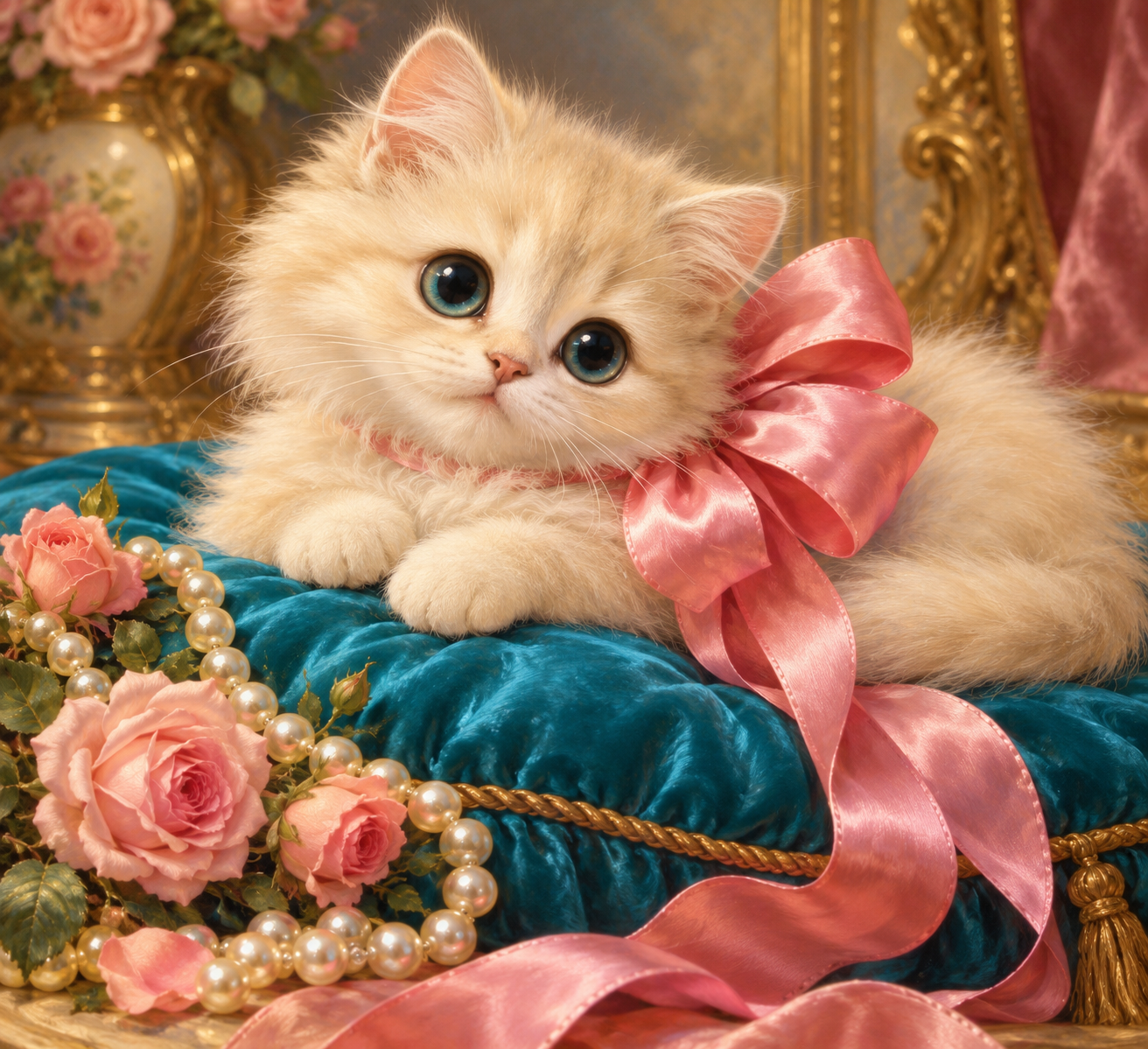
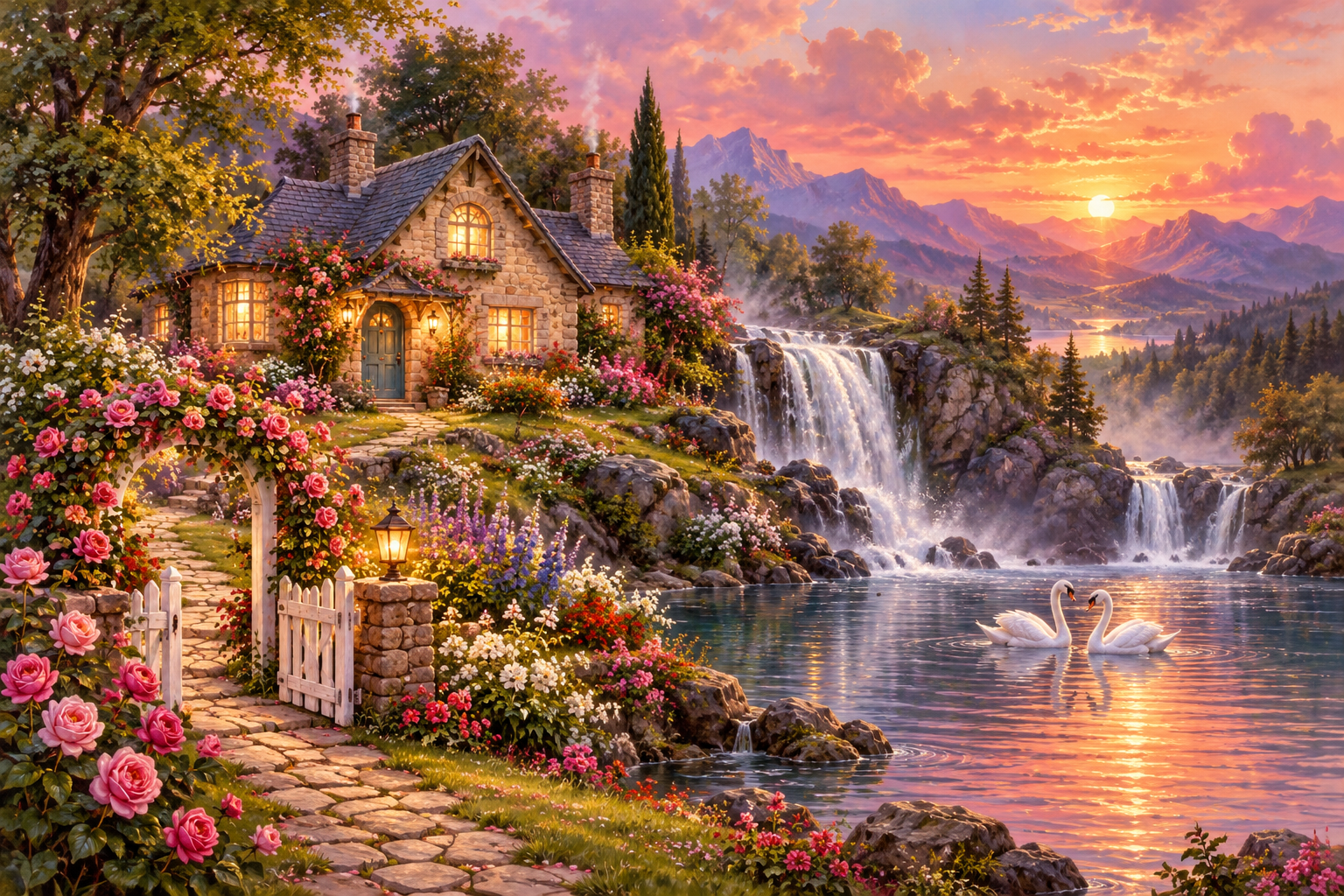
Exaggeration works best when it remains organized. In the kitten study, a turquoise cushion separates the pale fur from pink roses and ribbon. In the landscape, a path and illuminated cottage guide the eye through abundant flowers and sunset reflections. The motif is sweet, but the composition still needs direction.
Surface supplies another layer of pleasure
Glossy ceramic, satin, velvet, gilt and sparkling glass offer different kinds of visual attraction. Give each material its own highlight behavior. Porcelain can carry compact bright reflections; velvet can have broad dark folds; glass needs edges and reflections that agree with the object inside.
Pastels are a common route, not a requirement. Deep turquoise or wine red can anchor a sugary palette, and a dark background can make gold more emphatic. Reserve the brightest highlights for selected details. If every rose, eye and glitter particle has equal emphasis, the image becomes tiring rather than generous.
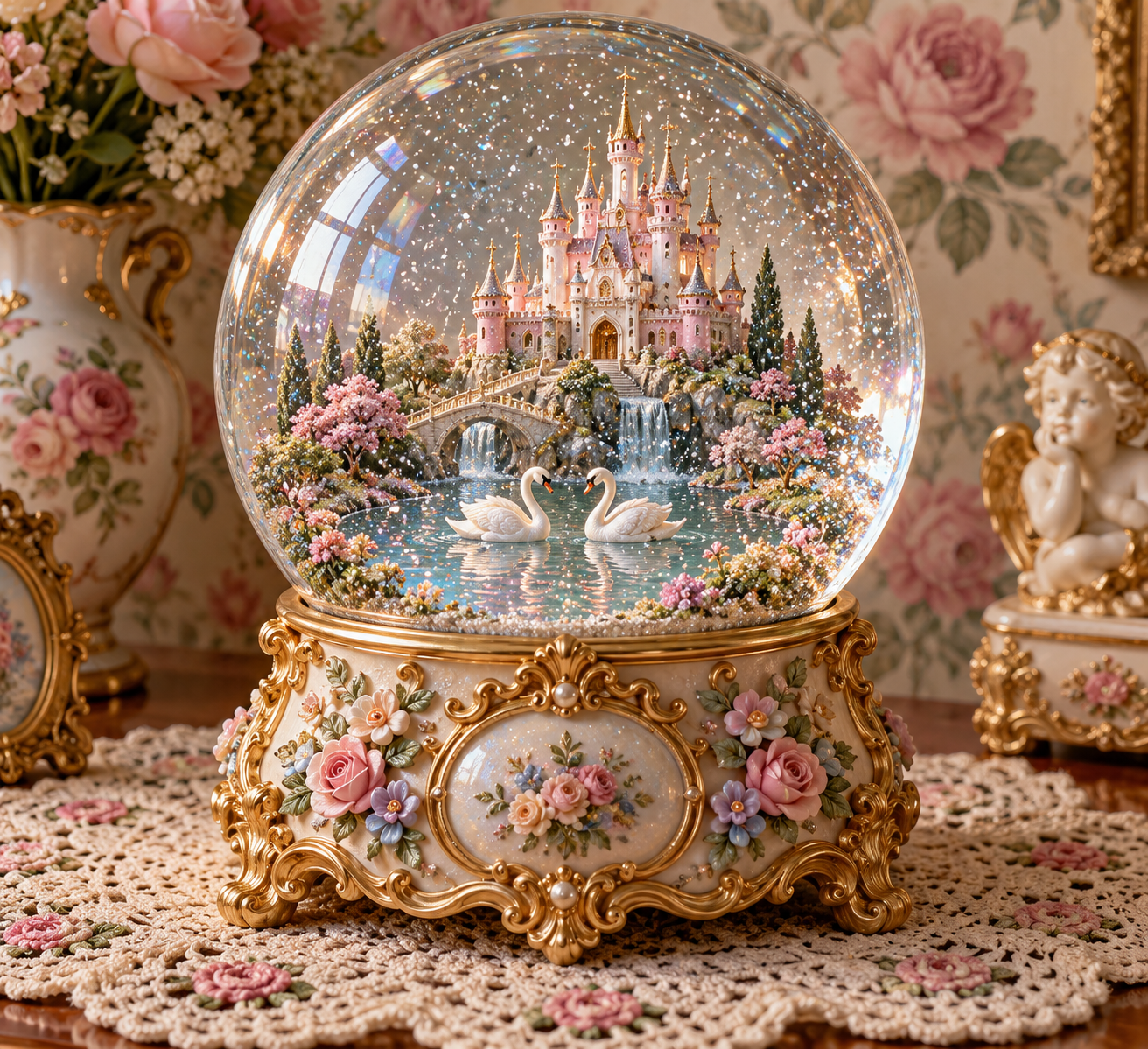
The snow-globe study turns an imaginary castle into a miniature world. Its enclosure, decorative base and suspended sparkle matter as much as the building. A convincing container allows the impossible idyll to feel like a treasured object.
Earnestness, camp and the viewer's position
An earnest image asks viewers to enjoy the sentiment directly. A camp reading can find pleasure in theatrical exaggeration and its awareness of performance. These responses can coexist; adding a joke to a caption does not automatically change how an object was made or originally valued.
Avoid making the people who cherish such objects the punchline. Humor can come from the escalating decoration, the impossible weather or the determined optimism of the scene. The AOI studies use affection and excess without claiming that all popular taste is naive.
Suitable uses include decorative illustration, nostalgic packaging concepts, playful still lifes and stories about memory or collecting. A serious historical or personal subject may require a different emotional register. Consider what a polished comforting finish leaves out as well as what it offers.
Control excess instead of adding everything
Begin with the main subject, one supporting texture and a limited palette. Add ornament around the focal structure, then remove an element that competes with it. Deliberate abundance is easier to read when some areas stay quiet.
Check anatomy, reflections and spatial joins even in a deliberately exaggerated image. A sweet animal still needs a coherent body. A snow globe needs a believable base. Cliché becomes more interesting when a specific relationship, material or small narrative gives the familiar subject a reason to be there.
A small poetic detour
Original words from the AOI studio.
Poetry
The little weather
Inside the globe the snow comes down
on towers that will never leak.
Two swans patrol a perfect town;
no winter wind can make them weak.
The porcelain fawn beside the rose
has never learned a forest's fear.
A ribbon shines. The curtain glows.
Someone once chose to keep them here.
I dust the gold, then let it stay:
a little weather for a harder day.
The prompt workshop
Original creative exercises. These prompts create new illustrations, not documentary evidence.
Give sentiment a focal point
Create an original classic kitsch illustration of a gentle kitten on turquoise velvet, with a pink satin ribbon and a few roses. Exaggerate sweetness while preserving coherent anatomy and a clear face. Use polished soft light and no text.
Keep the face more important than the ornament.
Make a souvenir world
Design an imaginary castle snow globe on a gilded floral base, with suspended sparkle and a tiny swan pond. Give the glass convincing reflections and place it against a softly patterned background.
The container and materials make the miniature world persuasive.
Compose an impossible welcome
Paint an idealized cottage beside a waterfall at peach sunset, with roses, two swans and warmly lit windows. Use one winding path to organize the abundance and keep a quiet area of water.
Try sincere warmth first; add theatrical excess deliberately.
Your next inspiration
Discover another art style
Follow a visual thread to the next subject.

A smile from the studio
Jokes
The cottage painter added a sunset, a waterfall, two swans and enough roses to concern the local botanist. The client studied it carefully. “Could it be a little more comforting?” The painter switched on every window. “Better. But what if it rains?” After a long pause, the painter added a second rainbow and a gazebo with central heating.