
Artist study
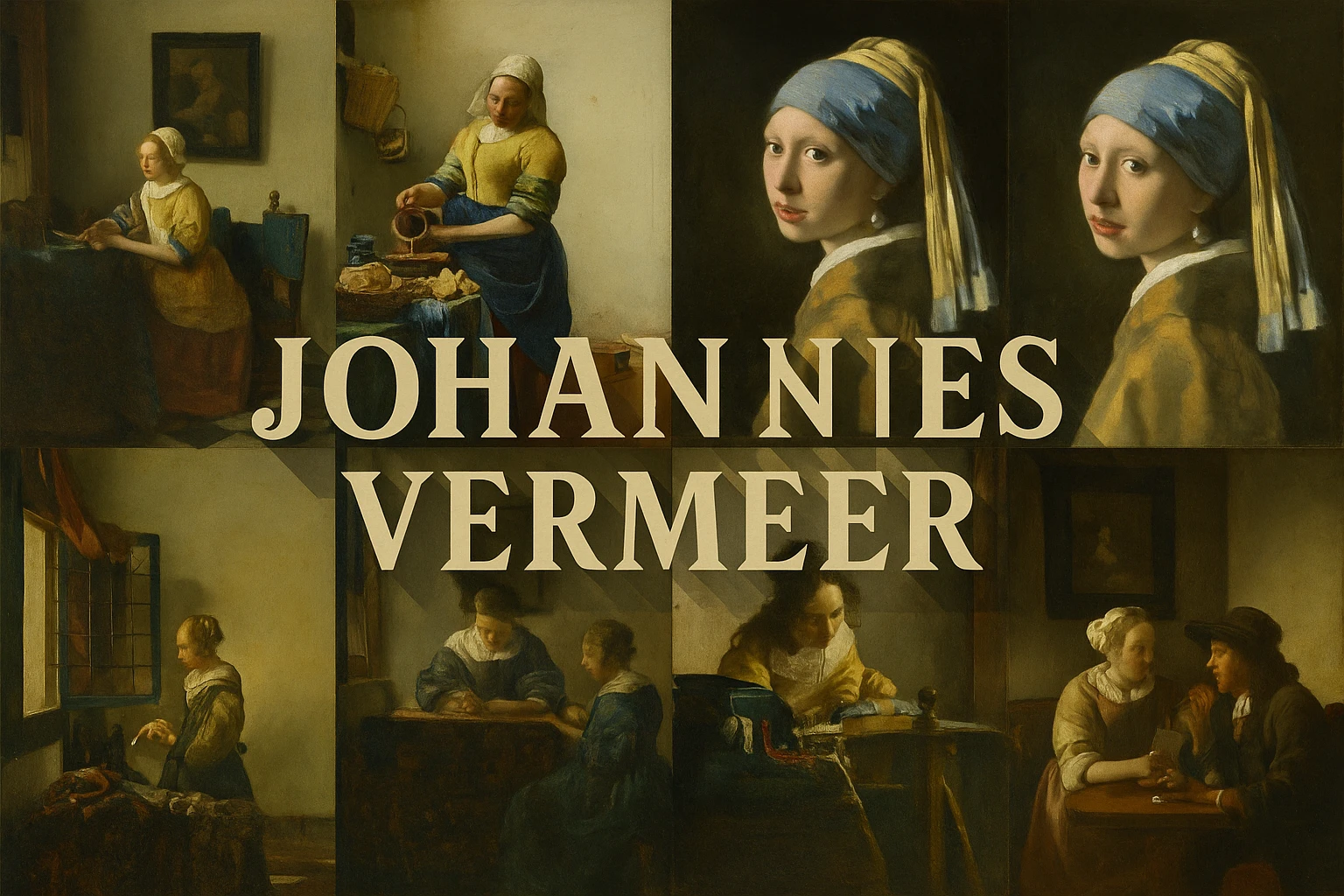
Johannes Vermeer (1632–1675) was a Delft painter whose work rewards attention to light, spacing, color and the staging of ordinary actions. His paintings are constructed images, not simply photographs in paint.
A visual introduction
Select an image for a closer look. Use the thumbnails, arrow keys or a swipe to compare examples. Zoom in to inspect details, or share the image that inspires you.
Creative toolbox · take this style further
Choose an input and a destination. Search sends your words to the chosen site; Copy & open puts them on your clipboard to paste there.
Create with AI
Turn your chosen input into an image prompt or a new creative direction.
ChatGPT
Copy your input and paste it into a ChatGPT conversation or image request.
Copy & open ChatGPT (new tab)Claude · Anthropic
Develop an image prompt or explore the style in a new Claude conversation.
Copy & open Claude · Anthropic (new tab)Midjourney
Paste your input into the Imagine bar on the Create page.
Copy & open Midjourney (new tab)Adobe Firefly
Copy your input, open Firefly, and paste it into the prompt field.
Copy & open Adobe Firefly (new tab)Leonardo.Ai
Copy your input, open Leonardo, and paste it into the generation field.
Copy & open Leonardo.Ai (new tab)Image search
Find visual references. Short, concrete keywords usually work best.
Lexica
Search AI images and prompts using your selected input.
Search with this input Lexica (new tab)Pexels
Search the photo and video library. Short keywords often work best.
Search with this input Pexels (new tab)Pixabay
Search photos, illustrations and other images.
Search with this input Pixabay (new tab)Unsplash
Search photographs using the style name or your own keywords.
Search with this input Unsplash (new tab)Wikimedia Commons
Search photographs, artworks and historical images. Check each file for its source and reuse terms.
Search with this input Wikimedia Commons (new tab)Art & research
Explore artists, collections and the ideas behind a style.
Wikipedia
Search for background reading. A style may not have its own article.
Search with this input Wikipedia (new tab)WikiArt
Copy your input into WikiArt’s search to explore artists and artworks.
Copy & open WikiArt (new tab)Europeana
Paste your keywords into the search to explore European museum, library and archive collections.
Copy & open Europeana (new tab)Inspiration
Discover portfolios and visual ideas from creative communities.
Instagram hashtags
Search a hashtag made from your input: spaces and punctuation are removed. Instagram may require sign-in.
Search with this input Instagram hashtags (new tab)ArtStation
Paste your input into artwork search for concept art, environments, characters and visual development.
Copy & open ArtStation (new tab)Behance
Paste your input into project search for illustration, design and visual storytelling.
Copy & open Behance (new tab)A closer look
A limited set of objects, carefully related planes and selective accents can create a concentrated space in which a small action becomes the visual center.
Look at decisions rather than a formula
The Rijksmuseum's technical studies reveal underlayers, pigment choices and compositional changes in Vermeer's paintings. These findings make an important point: the apparently effortless final image emerged through decisions and revision.
Avoid reducing his work to a window on the left and a blue garment. Begin by observing a particular painting's arrangement. What overlaps what? Which edge is sharpest? How does the surrounding space alter the importance of a face, hand or object?
Light establishes relationships
A convincing interior needs a consistent light situation. Establish the illuminated wall, shadowed planes and brightest small accents together. Reflections should respond to their materials rather than appear as identical white dots on every surface.
For a practical study, use one simple room and a single task. Reduce secondary objects until the main action reads clearly. Then add only what changes the balance, depth or meaning of the scene. Quietness can be the result of active editing.
Color and geometry cooperate
A strong color area can hold the eye within an otherwise restrained arrangement. Compare its size and position with nearby neutral passages. The interest lies in the relationship, not in prescribing one universal “Vermeer palette.”
Check the perspective of tables, floor lines and window openings before refining texture. A small error in a dominant plane can unsettle the entire interior. Soft edges can suggest focus and atmosphere, but should not hide unresolved spatial construction.
Respect the difference between evidence and speculation
Technical imaging can demonstrate particular changes and materials; it does not by itself settle every theory about optical devices or intention. Avoid presenting a debated working method as a universal explanation of the paintings.
In a new interpretation, choose an original action and arrangement rather than reproducing a famous scene with altered props. Compare two versions with different object counts and explain why one feels more concentrated. The retained AOI illustrations are modern interpretations; they are not Vermeer originals or evidence of his technique.
The prompt workshop
Original creative exercises. These prompts create new illustrations, not documentary evidence.
A quiet task
Original painterly interior of an adult folding a plain cloth beside a window, one clear light source, coherent table perspective and restrained blue accents, no copied Vermeer composition.
Objects removed
Original daylight interior with a chair, a bowl and a person reading a small note, carefully balanced wall space, selective edges and no decorative clutter.
Light without a figure
Original study of an empty room corner, a glazed jug and a folded linen, precise relationships between wall light, shadow and reflection, quiet geometric composition.
Sources and further exploration
Rijksmuseum — technical imaging, materials and compositional revision