
AOI creative lens · introspection, absorbed activity and personal space
Introvertism is used here as a descriptive creative label for art concerned with inward attention. It is not presented as a verified historical movement, a personality test or a compulsory palette of grey. Quiet rooms, absorbed figures and abstract relationships can all support the idea. This revised guide explains how to build that attention into a picture while keeping historical references and psychological claims in their proper places.
A visual introduction
Two new AI-generated studies and a retained AOI archive illustration. Historical comparisons are identified separately in the text and sources.
Select an image for a closer look. Use the arrow keys or gallery controls to compare the illustrations.

Creative toolbox · take this style further
Choose an input and a destination. Search sends your words to the chosen site; Copy & open puts them on your clipboard to paste there.
More tools
Additional destinations selected for this article.
ChatGPT
Copy your input and paste it into a ChatGPT conversation or image request.
Copy & open ChatGPT (new tab)Claude · Anthropic
Develop an image prompt or explore the style in a new Claude conversation.
Copy & open Claude · Anthropic (new tab)Midjourney
Paste your input into the Imagine bar on the Create page.
Copy & open Midjourney (new tab)Adobe Firefly
Copy your input, open Firefly, and paste it into the prompt field.
Copy & open Adobe Firefly (new tab)Leonardo.Ai
Copy your input, open Leonardo, and paste it into the generation field.
Copy & open Leonardo.Ai (new tab)Lexica
Search AI images and prompts using your selected input.
Search with this input Lexica (new tab)Pexels
Search the photo and video library. Short keywords often work best.
Search with this input Pexels (new tab)Pixabay
Search photos, illustrations and other images.
Search with this input Pixabay (new tab)Unsplash
Search photographs using the style name or your own keywords.
Search with this input Unsplash (new tab)Wikipedia
Search for background reading. A style may not have its own article.
Search with this input Wikipedia (new tab)WikiArt
Copy your input into WikiArt’s search to explore artists and artworks.
Copy & open WikiArt (new tab)Instagram hashtags
Search a hashtag made from your input: spaces and punctuation are removed. Instagram may require sign-in.
Search with this input Instagram hashtags (new tab)A closer look
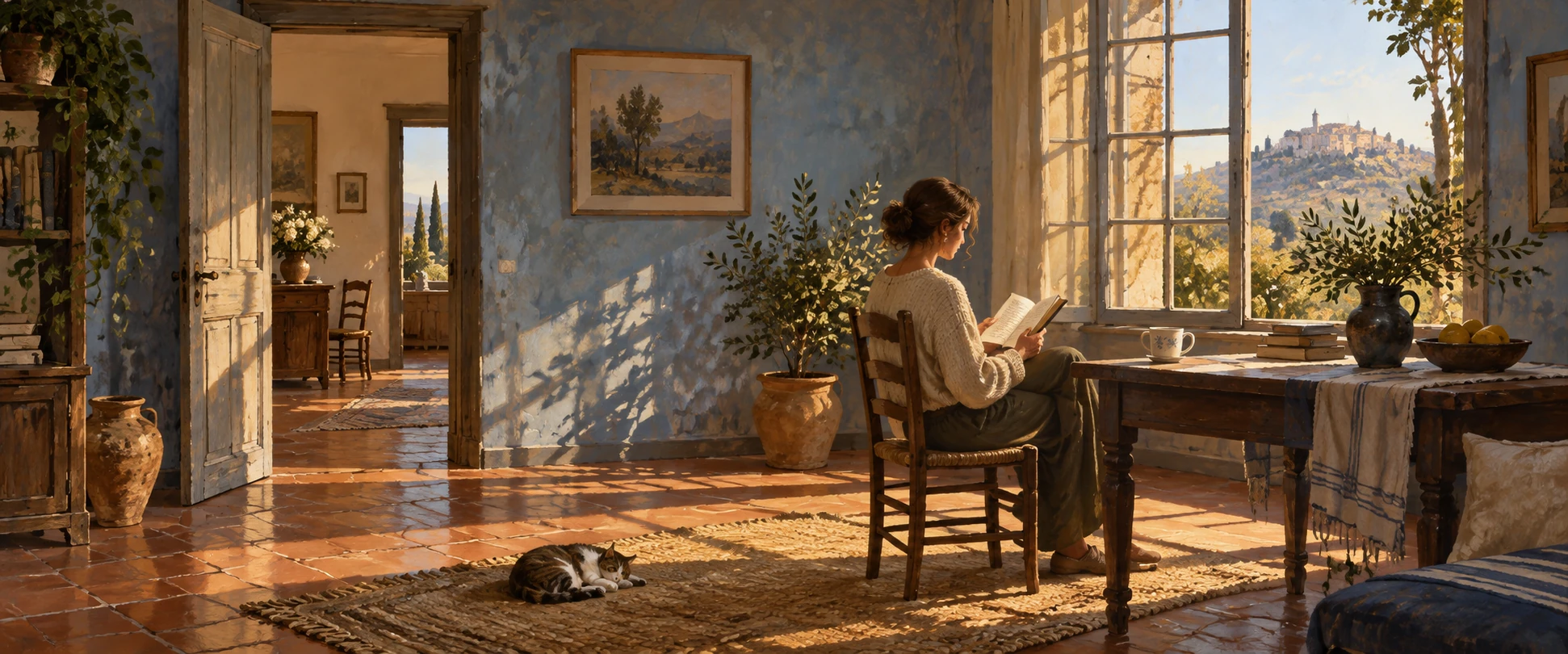
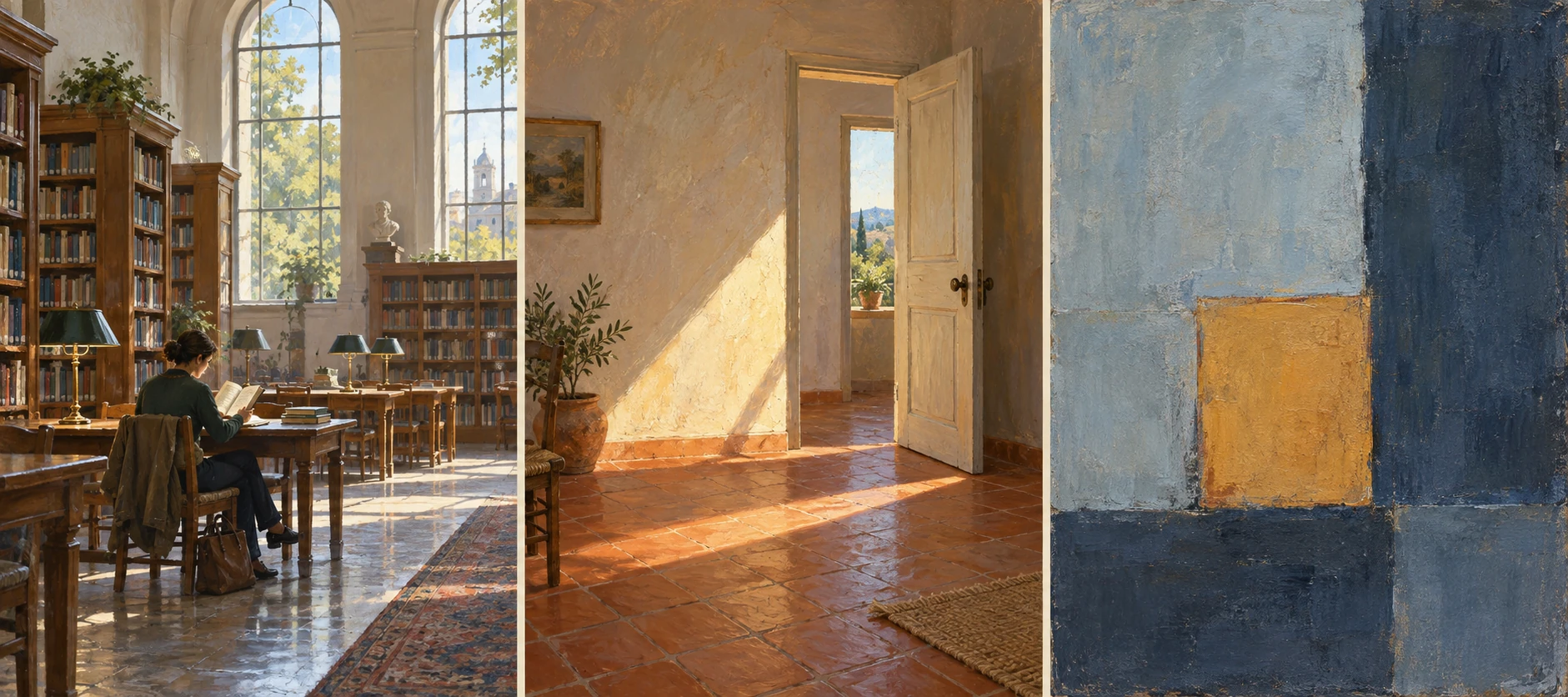
The new banner pictures a reader absorbed in an ordinary activity, with warm light and room to breathe. The comparison collage moves from a reader to an empty interior and then to abstraction. The older window-side figure is retained as an example of a different mood. These are AOI illustrations, not works by the historical artists discussed below and not evidence of a depicted person’s personality.
A useful label needs an honest boundary
An inward-looking picture can be valuable without belonging to a formally documented school. In this entry, Introvertism is a working idea: organise an image so that attention seems to turn toward a private activity, an internal relationship or an unspoken possibility. That definition is an editorial proposal for making and looking. It does not establish a founder, a manifesto or a membership list.
The earlier page attributed the term to Roger Fry in 1915 in connection with Walter Sickert. We could not substantiate that claim in the sources reviewed, so it has been removed. The previous lists of supposedly introvertist artists and blanket claims about introverts being better at multitasking, risk-taking or decision-making have also been retired. A database entry should not convert a plausible-sounding paragraph into a historical certificate.
A picture is not a personality assessment
The American Psychological Association describes introversion as an orientation toward the private inner world and places it on a continuum of attitudes and behaviours. That definition does not provide a painting style or a method for identifying someone's personality from a pose. It is useful here chiefly as a boundary around what the word can responsibly be asked to mean. [1]
A figure looking down may be reading, resting, waiting or simply adjusting a sleeve. An empty chair may suggest anticipation as readily as loneliness. Describe what the image shows before deciding what its people feel. “A seated reader beside a window” is an observation; “an introvert unable to connect” is a story added by the viewer. If you want the latter story, establish it through narrative context rather than treating a turned head as proof.
This also gives the artist more freedom. Inward attention can be pleasurable, concentrated, unsettled, playful or unresolved. A bright palette can sustain it. So can a crowded setting in which a small action receives unusual attention. Solitude, silence, sadness and introversion should not be treated as interchangeable labels for the same picture.
Two historical works worth comparing
Vilhelm Hammershøi's Interior in Strandgade, Sunlight on the Floor, 1901, is catalogued by SMK as an oil painting measuring 46.5 by 52 centimetres. The museum explains that his homes served as both studio and subject. This offers a concrete route into the painting: the organisation of lived space, its furnishings and the relationship between figures and surroundings. It does not make Hammershøi a member of an Introvertist movement. [2]
Edward Hopper's Nighthawks, 1942, provides a different comparison. The Art Institute of Chicago discusses its spaced stools, spare counters, architecture and ordered light. The scene contains several people, yet their relationships remain open to interpretation. Inwardness need not require a single isolated person. Physical distance and the viewer's position can matter as much as facial expression. [3]
Use these works as questions, not templates to copy. What role does the room play? How does light organise attention? How much explanation is withheld? The comparison is our editorial exercise, while the titles, dates and material context come from the linked institutions. The artists retain their own histories instead of being recruited into a newly convenient category.
Build attention through spacing and action
Start with something specific: a person rereading one line, hands repairing a small object, a cup left beside an unfinished drawing. A concrete activity is more suggestive than the instruction “look introspective”. It gives posture and objects a reason to exist. Decide which part of the action matters, then make the surrounding space support it.
Next, control the intervals. The distance between a chair and a door can imply access, hesitation or simply generous architecture. A small figure within a large room places weight on the room itself. A close view of hands can exclude the room and concentrate attention on touch. Neither composition is automatically more inward-looking; each sets a different relationship between the viewer and the activity.
Colour should serve that relationship. In our new banner, warm light and cool walls keep the room visually active while the reader remains absorbed. The quietness comes from the organisation of attention, not from removing all colour. In the abstract panel, a small warm shape has room around it without becoming disconnected from the larger planes. Read the interval before assigning it an emotion.
Usability in AI art generation
Introvertism is useful as a project brief but unreliable as a stand-alone model keyword. Translate it into visible instructions: an absorbed action, a clear viewing position, a chosen amount of empty space, a coherent light source and a restrained number of competing details. “A reader concentrating in a lively library, surrounding movement softened” gives a model more to work with than a personality label alone.
Watch for automatic stereotypes. Some outputs may turn inward attention into a hunched figure in a dark corner, or replace ambiguity with conspicuous tears and theatrical despair. Those choices might suit a particular story, but they should be decisions rather than defaults. Ask for relaxed posture, ordinary activity or warm daylight when those better express your intention. Review the resulting image rather than assuming the prompt was followed.
For a controlled experiment, preserve one room and change only the activity or crop. Compare a reader seen from across the room with a close view of the same hands and book. If a generator changes the architecture or person substantially, treat it as another proposal rather than claiming a controlled comparison. An image editor with explicit masks may be more useful when preserving particular details matters.
The limitation is interpretive as well as technical. AI can suggest visual cues; it cannot certify a character's interior life or an artist's personality. Caption a generated image as an illustration of absorbed attention or chosen solitude when that is what you designed. Avoid diagnosing the subject. The more precise description is usually the more interesting one.
A three-part exercise in room and thought
Make three studies: an absorbed person, a room without a person, and an abstract arrangement. Keep one colour relationship across all three. Then explain where your eye pauses in each, naming a visible feature rather than an emotion. If the studies feel related, identify the shared formal decision. That is a more useful result than simply making three pictures that look sad.
The older window-side illustration remains in the gallery because its enclosed space and turned figure offer a valid comparison. It is one possible mood, not the definition of the label. Let the new images broaden the conversation. A quiet picture should be allowed a full life; it need not apologise for declining to shout.
A small poetic detour
Original words from the AOI studio.
Poetry
The door stays open.
Inside, a page turns slowly.
The room does not ask.
The prompt workshop
Original creative exercises. These prompts create new illustrations, not documentary evidence.
Starting point: absorbed activity
Original painterly illustration of a reader beside a window, relaxed posture, generous space around the figure, warm daylight and cool walls, clearly observed activity, no compulsory sadness or theatrical tears.
Original AOI exercise; a generated image is not historical or documentary evidence.
Richer composition: quiet within company
A person absorbed in mending a small object at a shared workshop table, other people softly present in the distance, attention concentrated through light and spacing, warm lively palette, no claim about personality.
Original AOI exercise; a generated image is not historical or documentary evidence.
Experiment: inwardness without a person
Nonfigurative painting, one small ochre rectangle within loosely nested blue-grey planes, asymmetrical intervals and tactile pigment, compare a spacious version and a close crop, no human silhouette or text.
Original AOI exercise; a generated image is not historical or documentary evidence.
People & works to explore
References discussed in this article. Consult the sources below for context.