
Archive note: historical claims and artist or artwork associations in this entry have not yet received a full source review.
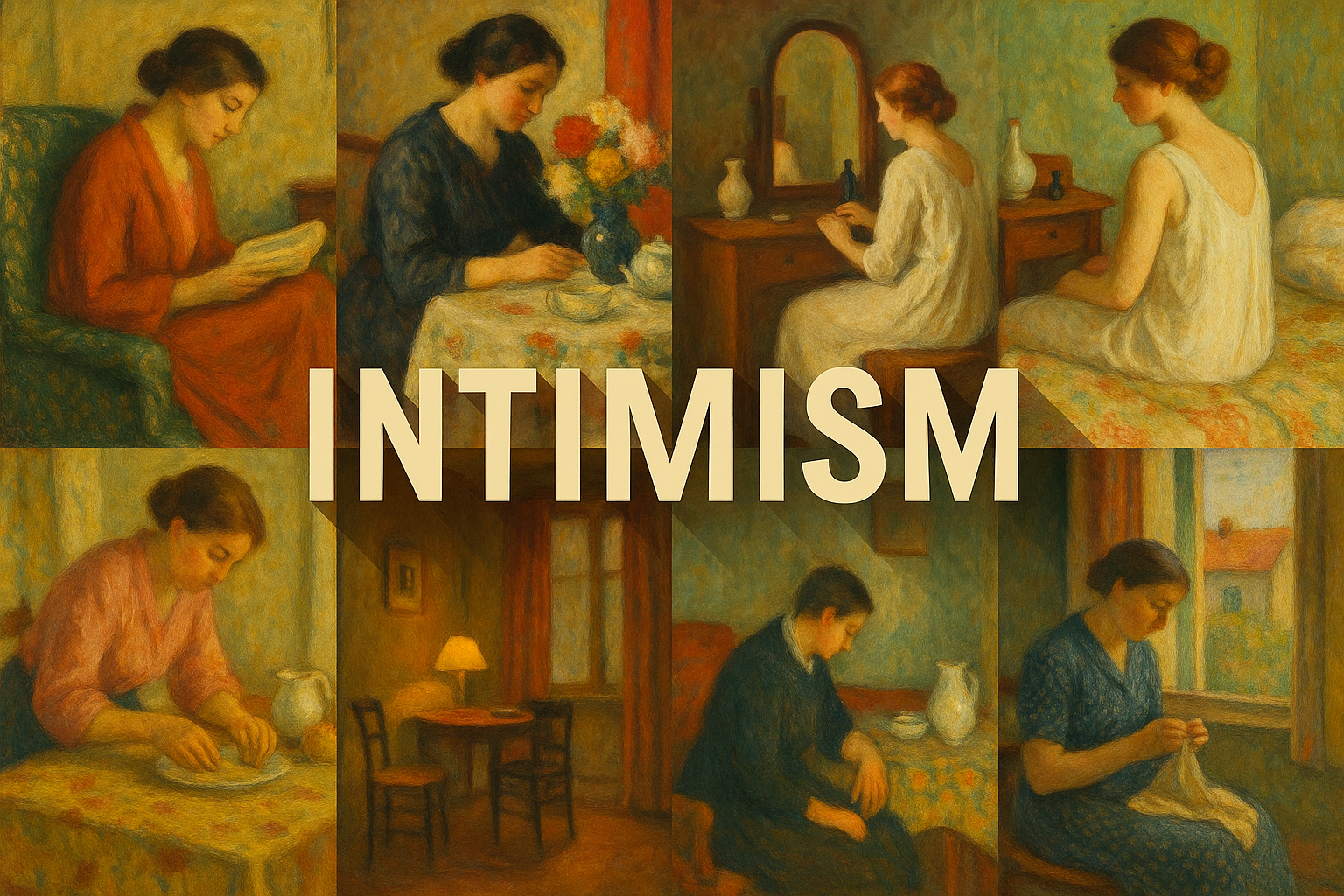
Intimism
Interiors bloom with gentle hues; characters recline in tender exchanges. Spaces are intimate, not grand, and colors dance quietly, crafting a visual poetry that celebrates small, cherished moments.
AOI thinking about Intimism [+_~]-/
Overview and quick facts
Quick brushstrokes capture everyday warmth, like sunlight kissing a quiet breakfast table. Embracing the domestic and serene, Intimism is a soft whisper of life lived in cozy corners.
Can understand it also, as:
Domestic Impressionism
Categorize it as:
Impressionism, Modernism
.: Dreaming :.
Light through lace curtains, \nQuiet moments softly breathe— \nLife's gentle embrace.
:. Thought is power .:
Detailed description
Born from the hearth, Intimism serenades the ordinary with its intimate charm. Its canvases are diary entries, capturing private scenes with delicate strokes and muted palettes. It delves into the soulful silence of domestic spaces, elevating the mundane to the monumental. In quiet rooms, soft colors bloom like whispers; bodies captivate with unassuming grace. This subtle style breathes life into the overlooked—the tender glances and half-smiles that populate everyday life. It’s a serenade to life’s quieter notes, an homage to the ephemeral beauty of home.
Archive notes — claims to verify
1. Intimism emphasizes domestic scenes and private interiors.
2. It often features soft brushstrokes and muted tones.
3. It elevates ordinary, everyday life into art.
4. Prominent during the late 19th to early 20th century.
5. Focuses on emotional and psychological depth.
Artists and works: references to check
(be aware, can be highly speculative)
Artists (be aware, speculation possible):
1. Pierre Bonnard (1867-1947) 2. Édouard Vuillard (1868-1940) 3. Henri Matisse (1869-1954) 4. Félix Vallotton (1865-1925)
Artworks (be aware, speculation possible)
1. “The Luncheon” by Pierre Bonnard 2. “Interior with Nude in Green Armchair” by Édouard Vuillard 3. “The Red Room” by Henri Matisse
Epoch
Late 19th to early 20th century
Creative tools and further exploration
Search results are starting points for exploration, not evidence for the historical claims or attributions in this legacy entry.