
Participatory visual communication
Internet memes are formats and instances of communication that circulate and change through reuse. An image macro is one familiar form, but memes can also involve sequences, video, phrases and other repeatable structures.
A visual introduction
Select an image for a closer look. Use the thumbnails, arrow keys or a swipe to compare examples. Zoom in to inspect details, or share the image that inspires you.
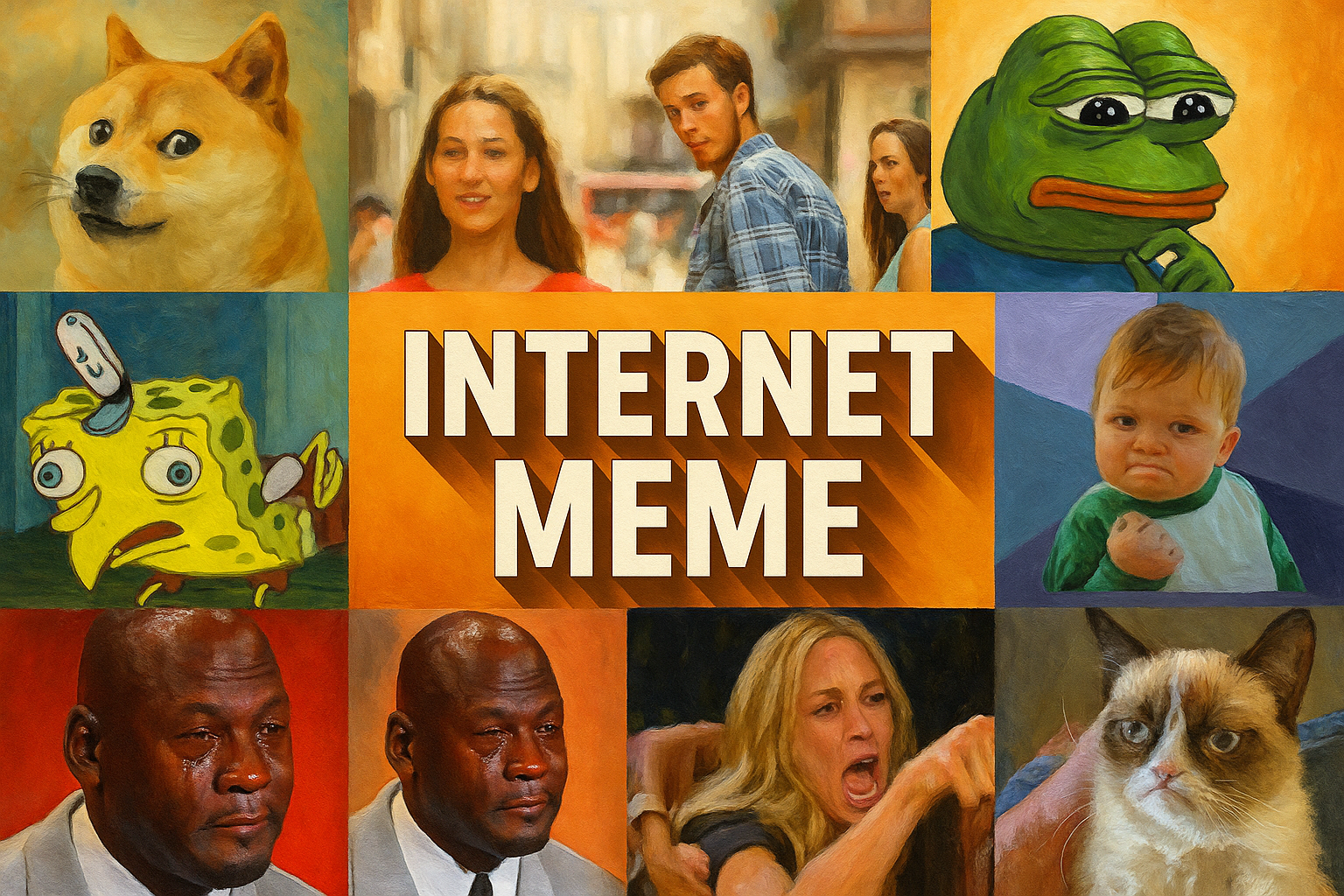
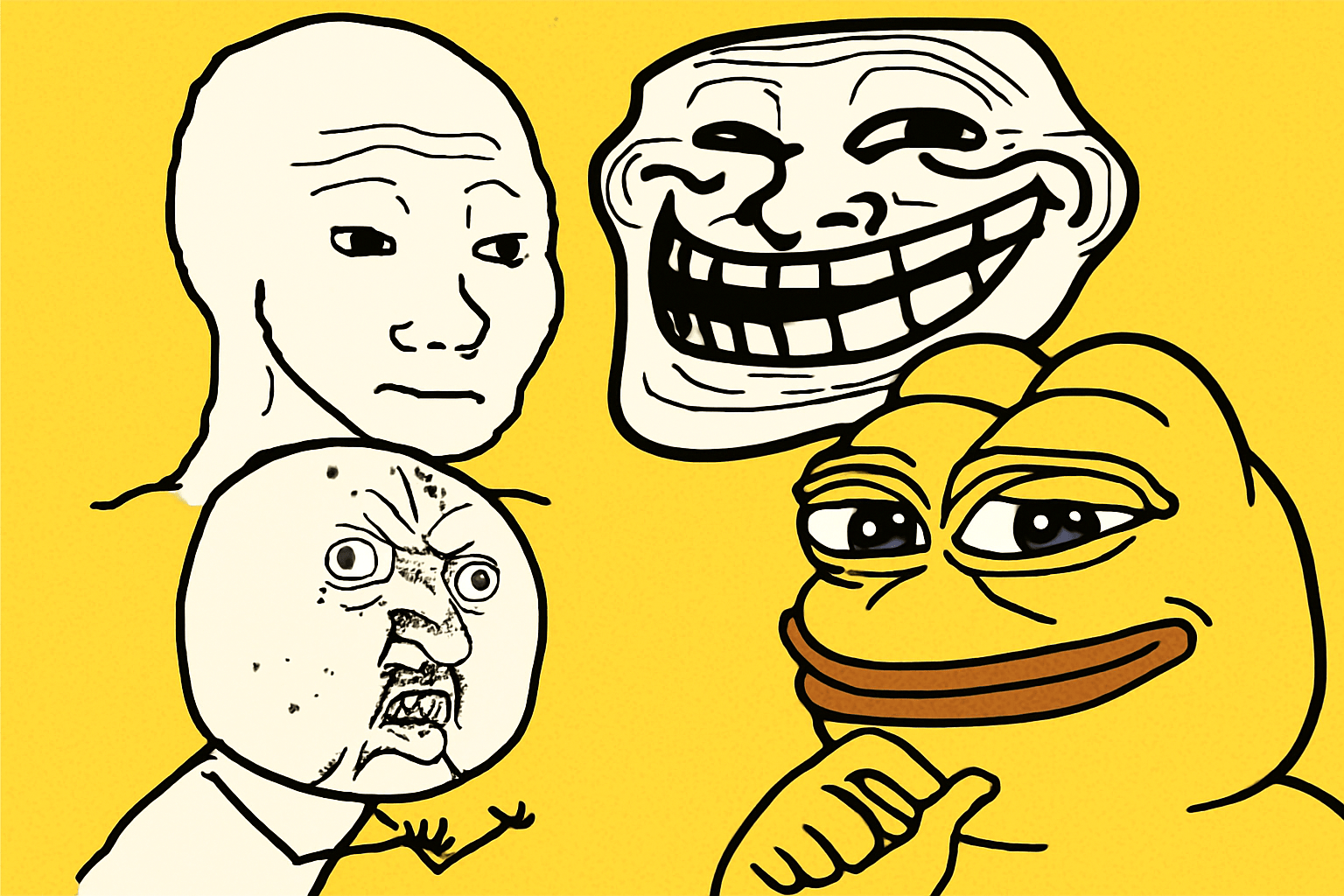
Creative toolbox · take this style further
Choose an input and a destination. Search sends your words to the chosen site; Copy & open puts them on your clipboard to paste there.
Create with AI
Turn your chosen input into an image prompt or a new creative direction.
ChatGPT
Copy your input and paste it into a ChatGPT conversation or image request.
Copy & open ChatGPT (new tab)Claude · Anthropic
Develop an image prompt or explore the style in a new Claude conversation.
Copy & open Claude · Anthropic (new tab)Midjourney
Paste your input into the Imagine bar on the Create page.
Copy & open Midjourney (new tab)Adobe Firefly
Copy your input, open Firefly, and paste it into the prompt field.
Copy & open Adobe Firefly (new tab)Leonardo.Ai
Copy your input, open Leonardo, and paste it into the generation field.
Copy & open Leonardo.Ai (new tab)Image search
Find visual references. Short, concrete keywords usually work best.
Lexica
Search AI images and prompts using your selected input.
Search with this input Lexica (new tab)Pexels
Search the photo and video library. Short keywords often work best.
Search with this input Pexels (new tab)Pixabay
Search photos, illustrations and other images.
Search with this input Pixabay (new tab)Unsplash
Search photographs using the style name or your own keywords.
Search with this input Unsplash (new tab)Wikimedia Commons
Search photographs, artworks and historical images. Check each file for its source and reuse terms.
Search with this input Wikimedia Commons (new tab)Art & research
Explore artists, collections and the ideas behind a style.
Wikipedia
Search for background reading. A style may not have its own article.
Search with this input Wikipedia (new tab)WikiArt
Copy your input into WikiArt’s search to explore artists and artworks.
Copy & open WikiArt (new tab)Europeana
Paste your keywords into the search to explore European museum, library and archive collections.
Copy & open Europeana (new tab)Inspiration
Discover portfolios and visual ideas from creative communities.
Instagram hashtags
Search a hashtag made from your input: spaces and punctuation are removed. Instagram may require sign-in.
Search with this input Instagram hashtags (new tab)ArtStation
Paste your input into artwork search for concept art, environments, characters and visual development.
Copy & open ArtStation (new tab)Behance
Paste your input into project search for illustration, design and visual storytelling.
Copy & open Behance (new tab)A closer look
Recognition supplies a framework while a changed detail supplies the new point; the relation between text, image and context matters more than decorative finish.
Separate the format from the particular example
The MLA Style Center advises citing the specific meme instance being discussed, since a format may have many contributors and appearances. This is a useful principle for visual analysis as well as attribution.
Ask which parts repeat and which change. A recurring image may support different captions, while a repeated sentence pattern may work with many images. Understanding that division helps explain the joke or argument without pretending that one example represents every use.
Make the relationship clear
A successful variation usually gives the viewer enough information to recognize the pattern and understand the change. Too much explanation can slow that connection; too little can leave the intended audience guessing at missing context.
For an original exercise, write the underlying contrast in plain language. Then choose an image or sequence that makes it visible. A familiar template is useful only if its associations support the new idea rather than distract from it.
Readability is part of timing
Text placement, line breaks and image order affect how a viewer encounters the point. Keep essential words legible at the expected size. A deliberate rough appearance can coexist with careful control of those details.
In a two-panel format, check that the difference between panels is immediately understandable. In an image macro, avoid covering the expression or object on which the caption depends. Visual clutter can obscure even a strong comic premise.
Circulation changes meaning
A meme may be affectionate in one setting and hostile in another. Consider the likely audience and what assumptions the image asks them to share. Do not use an identifiable person's photograph to imply an invented statement or event without making the fictional context clear.
Credit the source of a particular example where known, and distinguish original illustration from reused material. The prompts here develop new situations and leave room for carefully added text. They do not claim that a generated image is already viral, culturally established or endorsed by a community.
The prompt workshop
Original creative exercises. These prompts create new illustrations, not documentary evidence.
A simple contrast
Original two-panel humorous illustration contrasting an elaborate plan for organizing a desk with the same desk still covered in ordinary objects, clear continuity and no text.
One altered detail
Original gentle visual joke of an adult proudly watering a realistic-looking plastic plant, readable action and uncluttered composition, space for a short caption.
A reusable original format
Original three-panel reaction sequence featuring a fictional character moving from confidence to confusion to amused acceptance, consistent design and no copied meme image.
Sources and further exploration
MLA Style Center — identifying and citing particular meme instances