
Participation and responsive art
Interactive art makes the participant’s action part of the work’s behavior or form. Its defining feature is the relationship between an action and a response, rather than one recognizable palette or visual effect.
A visual introduction
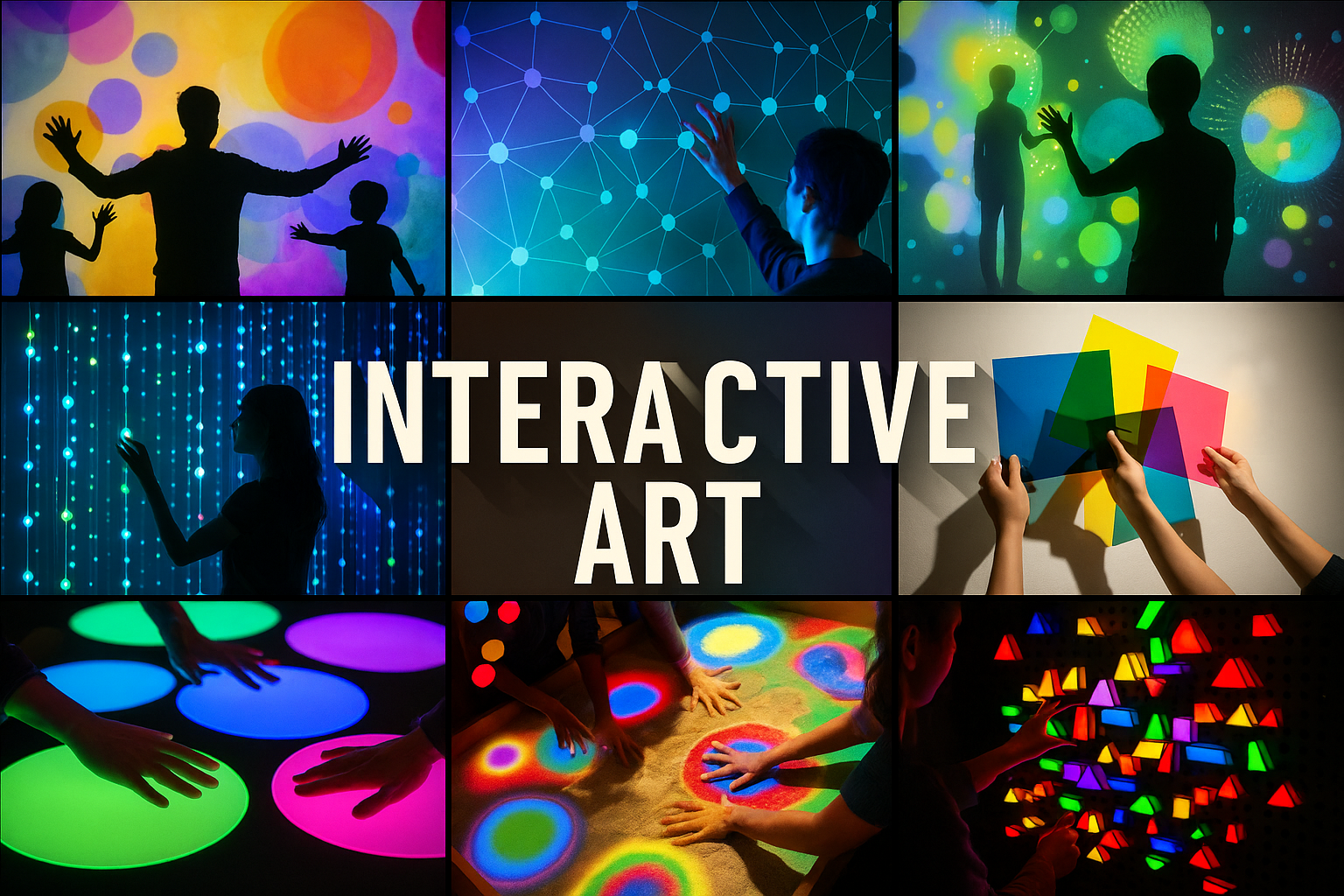
Compare the retained archive illustrations with the practical principles below. These images illustrate ideas; they do not document the cited artists’ works.
Select an image for a closer look. Use the thumbnails, arrow keys or a swipe to compare examples. Zoom in to inspect details, or share the image that inspires you.
Creative toolbox · take this style further
Choose an input and a destination. Search sends your words to the chosen site; Copy & open puts them on your clipboard to paste there.
Create with AI
Turn your chosen input into an image prompt or a new creative direction.
ChatGPT
Copy your input and paste it into a ChatGPT conversation or image request.
Copy & open ChatGPT (new tab)Claude · Anthropic
Develop an image prompt or explore the style in a new Claude conversation.
Copy & open Claude · Anthropic (new tab)Midjourney
Paste your input into the Imagine bar on the Create page.
Copy & open Midjourney (new tab)Adobe Firefly
Copy your input, open Firefly, and paste it into the prompt field.
Copy & open Adobe Firefly (new tab)Leonardo.Ai
Copy your input, open Leonardo, and paste it into the generation field.
Copy & open Leonardo.Ai (new tab)Image search
Find visual references. Short, concrete keywords usually work best.
Lexica
Search AI images and prompts using your selected input.
Search with this input Lexica (new tab)Pexels
Search the photo and video library. Short keywords often work best.
Search with this input Pexels (new tab)Pixabay
Search photos, illustrations and other images.
Search with this input Pixabay (new tab)Unsplash
Search photographs using the style name or your own keywords.
Search with this input Unsplash (new tab)Wikimedia Commons
Search photographs, artworks and historical images. Check each file for its source and reuse terms.
Search with this input Wikimedia Commons (new tab)Art & research
Explore artists, collections and the ideas behind a style.
Wikipedia
Search for background reading. A style may not have its own article.
Search with this input Wikipedia (new tab)WikiArt
Copy your input into WikiArt’s search to explore artists and artworks.
Copy & open WikiArt (new tab)Europeana
Paste your keywords into the search to explore European museum, library and archive collections.
Copy & open Europeana (new tab)Inspiration
Discover portfolios and visual ideas from creative communities.
Instagram hashtags
Search a hashtag made from your input: spaces and punctuation are removed. Instagram may require sign-in.
Search with this input Instagram hashtags (new tab)ArtStation
Paste your input into artwork search for concept art, environments, characters and visual development.
Copy & open ArtStation (new tab)Behance
Paste your input into project search for illustration, design and visual storytelling.
Copy & open Behance (new tab)A closer look
Look for a readable invitation to act, a perceptible response and a relationship between the participant, the material and the surrounding space.
The response is part of the artwork
Rafael Lozano-Hemmer’s Pulse Room, created in 2006, provides a concrete example. His project description explains that a sensor records a participant’s heartbeat and makes a bulb flash to that rhythm. Earlier participants’ recordings move through the installation’s array of lights. The viewer contributes to the work’s changing state; the bulbs alone do not explain the piece.
An interactive work can involve physical materials, movement, sound or digital systems. Technology is a possible means, not the definition. A moving animation that ignores the viewer’s actions may be dynamic without being interactive. Likewise, a picture of someone touching a screen cannot prove that an actual response exists. Describe the action, the change and how a participant recognizes the connection.
Design the invitation and the consequence
For a small original study, choose one action and one visible consequence: turning a handle changes a shadow, moving a colored sheet changes an overlap, or stepping closer changes a projected pattern. Make the relationship easy to discover before adding more options. Test whether a new participant can understand what changed without an explanation from the maker.
Compose the space around the encounter. Leave room for bodies and movement, make the active area distinct and consider a way to participate from different heights or positions. The retained poster and collage are static illustrations of interaction ideas, not functioning installations or photographs of Pulse Room. Use them to sketch a proposal, then show the proposed before-and-after states. A successful image can explain an idea, but a working prototype is needed to test its behavior.
The prompt workshop
Original creative exercises. These prompts create new illustrations, not documentary evidence.
A physical color experiment
Design an original installation proposal with three translucent colored panels that visitors can slide across a white illuminated surface. Show one adult participant, reachable handles and clearly overlapping colors. Calm gallery setting, readable construction, no text or logos.
Action and response
Create a two-panel concept illustration of the same small interactive artwork: a visitor turns a large wooden wheel and the shadow on the wall changes from narrow to broad. Keep viewpoint and lighting consistent so the causal relationship is visible. No text.
Shared movement
Illustrate an imagined installation where two participants move separate handles that jointly alter a hanging fabric canopy. Show plausible connections, ample circulation space and a clear shared result. This is a proposal, not a documented existing artwork; no text.
Sources and further exploration
Rafael Lozano-Hemmer: Pulse Room, project description and mechanism