
Spatial art practice
Explore installation art through space, light, objects and duration, with documented works, seven visual studies and prompts for original spatial proposals.
A visual introduction
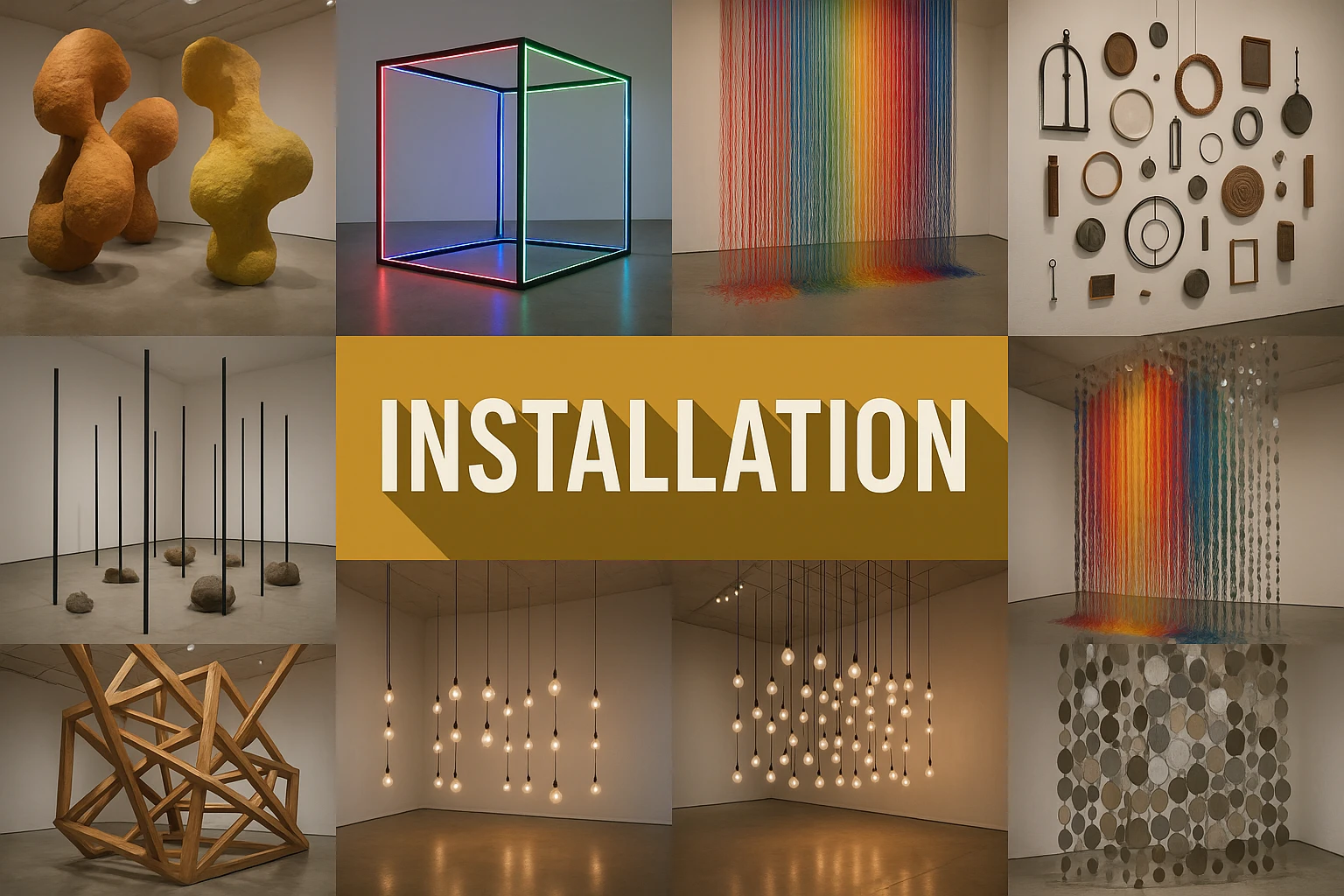
Six new AI-generated spatial proposals join the reviewed archive collage. Compare scale, routes, light, layers and materials; these images do not reproduce the cited artists’ works.
Select an image for a closer look. Use the thumbnails, arrow keys or a swipe to compare examples. Zoom in to inspect details, or share the image that inspires you.
Creative toolbox · take this style further
Choose an input and a destination. Search sends your words to the chosen site; Copy & open puts them on your clipboard to paste there.
Create with AI
Turn your chosen input into an image prompt or a new creative direction.
ChatGPT
Copy your input and paste it into a ChatGPT conversation or image request.
Copy & open ChatGPT (new tab)Claude · Anthropic
Develop an image prompt or explore the style in a new Claude conversation.
Copy & open Claude · Anthropic (new tab)Midjourney
Paste your input into the Imagine bar on the Create page.
Copy & open Midjourney (new tab)Adobe Firefly
Copy your input, open Firefly, and paste it into the prompt field.
Copy & open Adobe Firefly (new tab)Leonardo.Ai
Copy your input, open Leonardo, and paste it into the generation field.
Copy & open Leonardo.Ai (new tab)Image search
Find visual references. Short, concrete keywords usually work best.
Lexica
Search AI images and prompts using your selected input.
Search with this input Lexica (new tab)Pexels
Search the photo and video library. Short keywords often work best.
Search with this input Pexels (new tab)Pixabay
Search photos, illustrations and other images.
Search with this input Pixabay (new tab)Unsplash
Search photographs using the style name or your own keywords.
Search with this input Unsplash (new tab)Wikimedia Commons
Search photographs, artworks and historical images. Check each file for its source and reuse terms.
Search with this input Wikimedia Commons (new tab)Art & research
Explore artists, collections and the ideas behind a style.
Wikipedia
Search for background reading. A style may not have its own article.
Search with this input Wikipedia (new tab)WikiArt
Copy your input into WikiArt’s search to explore artists and artworks.
Copy & open WikiArt (new tab)Europeana
Paste your keywords into the search to explore European museum, library and archive collections.
Copy & open Europeana (new tab)Inspiration
Discover portfolios and visual ideas from creative communities.
Instagram hashtags
Search a hashtag made from your input: spaces and punctuation are removed. Instagram may require sign-in.
Search with this input Instagram hashtags (new tab)ArtStation
Paste your input into artwork search for concept art, environments, characters and visual development.
Copy & open ArtStation (new tab)Behance
Paste your input into project search for illustration, design and visual storytelling.
Copy & open Behance (new tab)A closer look
Read the room as a whole: routes, intervals, scale, sightlines and changes over time matter alongside individual objects.
The space participates
Installation in art is not software setup, interior decoration or a synonym for any sculpture placed in a room. The work organizes an experience across a space. A viewer may have to move, wait, look through an opening or notice a relationship between separated elements. Some installations respond closely to a particular site; others can be reconfigured according to an artist’s instructions.
There is no mandatory calm or minimalist appearance. An installation may be spare, crowded, quiet, theatrical, temporary or materially fragile. A useful description explains what the arrangement does rather than calling every room immersive.
Start with a documented work
MoMA’s installation collection includes James Turrell’s Frontal Passage (1994), Pipilotti Rist’s Ever Is Over All (1997), Martin Creed’s Work No. 227, The Lights Going On And Off (2000) and Sarah Sze’s Triple Point (Pendulum) (2013). These named examples offer different starting points for investigating light, moving image, duration and arrangements of things. They are not interchangeable templates, and the AOI gallery does not reproduce them. [1]
Duration can be the material
Martin Creed’s Work No. 227, The Lights Going On And Off (2000) uses an electrical timer with five seconds of light followed by five seconds of darkness. MoMA describes a bare gallery whose changing visibility redirects attention to the room itself. A photograph of one phase cannot fully convey that alternation. [2]
This is a useful challenge to the assumption that an installation must contain spectacular objects. Ask what the visitor experiences only by staying. A pause, a repeated interval or a sound arriving from another place may organize attention as strongly as a large sculpture. Describe the sequence precisely instead of using “immersive” as a substitute for observation.
Images occupy a room differently from a screen
Pipilotti Rist’s Ever Is Over All (1997) is a two-channel video with colour and sound. MoMA describes adjacent projections that bring a flower-filled scene into relation with a woman walking along a street and unexpectedly breaking car windows. Their juxtaposition, slow motion and soundtrack complicate the apparent calm. This is a specific work, not a general recipe for decorative video walls. [3]
For an original proposal, consider whether two images compete, converse or interrupt one another. A viewer may turn their head and miss part of one sequence while following the other. Scale and placement make that attention physical. The gallery’s water-and-reed projection study is an unrelated imagined arrangement, not footage from Rist’s work.
The site can be revealed as well as transformed
Olafur Eliasson’s The weather project (2003), made for Tate Modern’s Turbine Hall, combined a semicircular illuminated screen, a mirrored ceiling and artificial mist to suggest an indoor sun. The studio explains that visitors could also see how the illusion was constructed from other positions. Encountering the apparatus was part of the available experience, rather than something the image simply concealed. [4]
Sarah Sze’s Triple Point (Pendulum) (2013) offers another approach to spatial relationships. MoMA records materials including salt, water, stone, string, projection and a pendulum, and describes a tension between the arrangement and its apparent precariousness. A room can hold many small relationships rather than one dominant spectacle. [5]
Design a relationship, then an object
For an original proposal, draw the floor plan before deciding how dramatic the objects should look. Mark where a visitor first sees the work, where a second view becomes possible and whether a route is required. Give distances and scale a role: a small interval can create intimacy; a repeated interval can create rhythm or expectation.
A visualisation can show the material arrangement but cannot by itself deliver duration, sound, touch or the bodily experience of moving through a real site. Label it as a proposal. If a work is intended for construction, its access routes, supports and technical systems need separate practical development.
Compare the encounter
Try three views of one imagined installation: entrance, centre and exit. Keep the objects fixed. If the three views reveal no changing relationship, reconsider why the work occupies space. Avoid generic glowing cubes used only as a shorthand for contemporary art.
This entry provides a spatial reading and proposal workshop. AOI also has an Installation Art entry; it remains a separate record. Use the related link for comparison rather than assuming the two records document different historical movements.
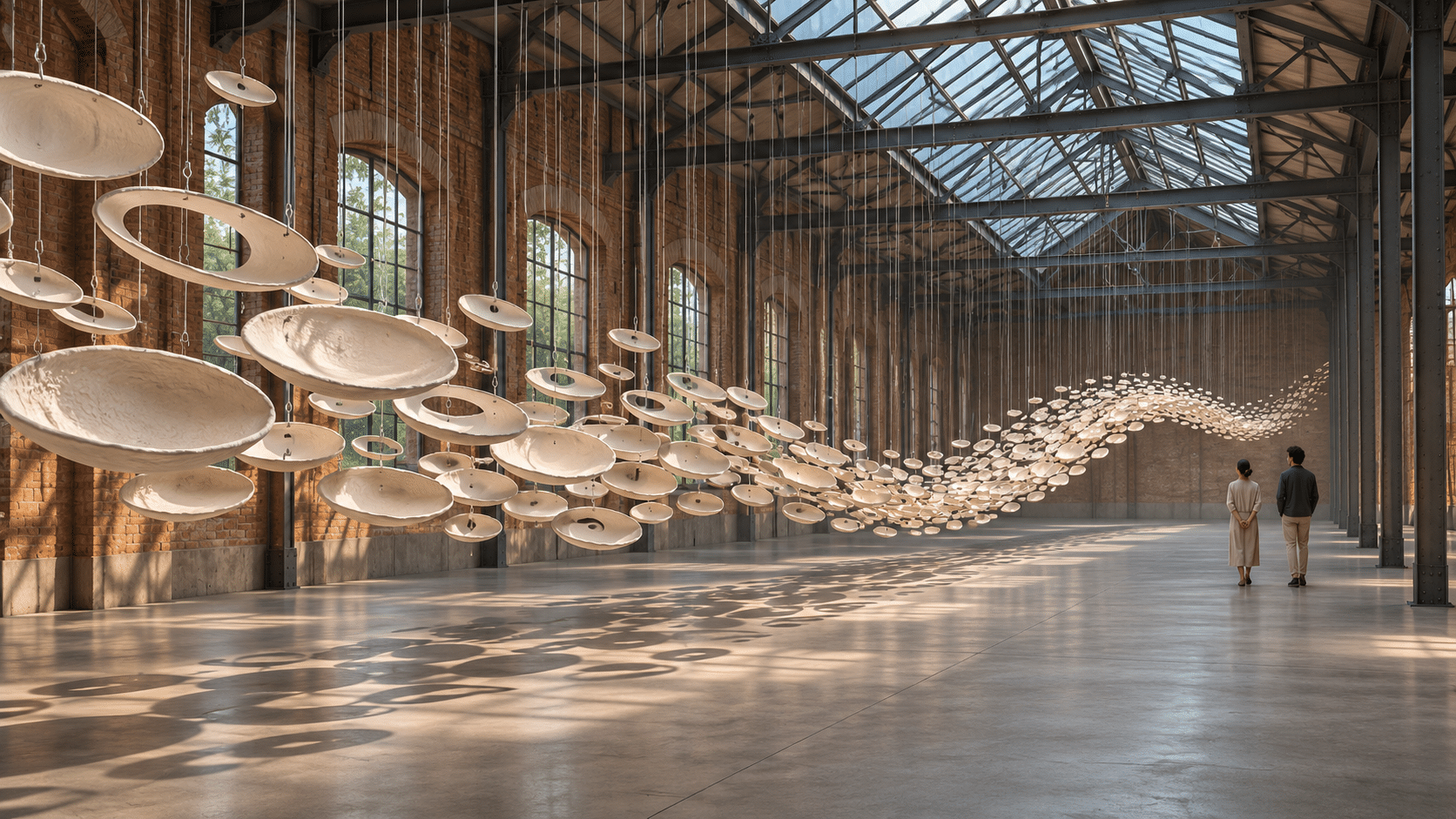
A suspended wave: scale through repetition
The new banner proposes a long sweep of ivory ceramic-looking ovals suspended on visible cables in a former industrial hall. Some pieces are open rings, others shallow dish-like forms. Their changing height creates a wave that is read across the room; the small visitors and clear floor beside it provide a sense of scale. Brick, steel and daylight remain active parts of the image.
The individual unit is less important than the intervals between units and the route alongside them. Imagine moving closer: the continuous wave would break into separate objects and cables. From farther away, the overall profile would return. That shift between part and whole gives the proposal a reason to occupy a large space. The rendering does not verify loads or a suspension design.
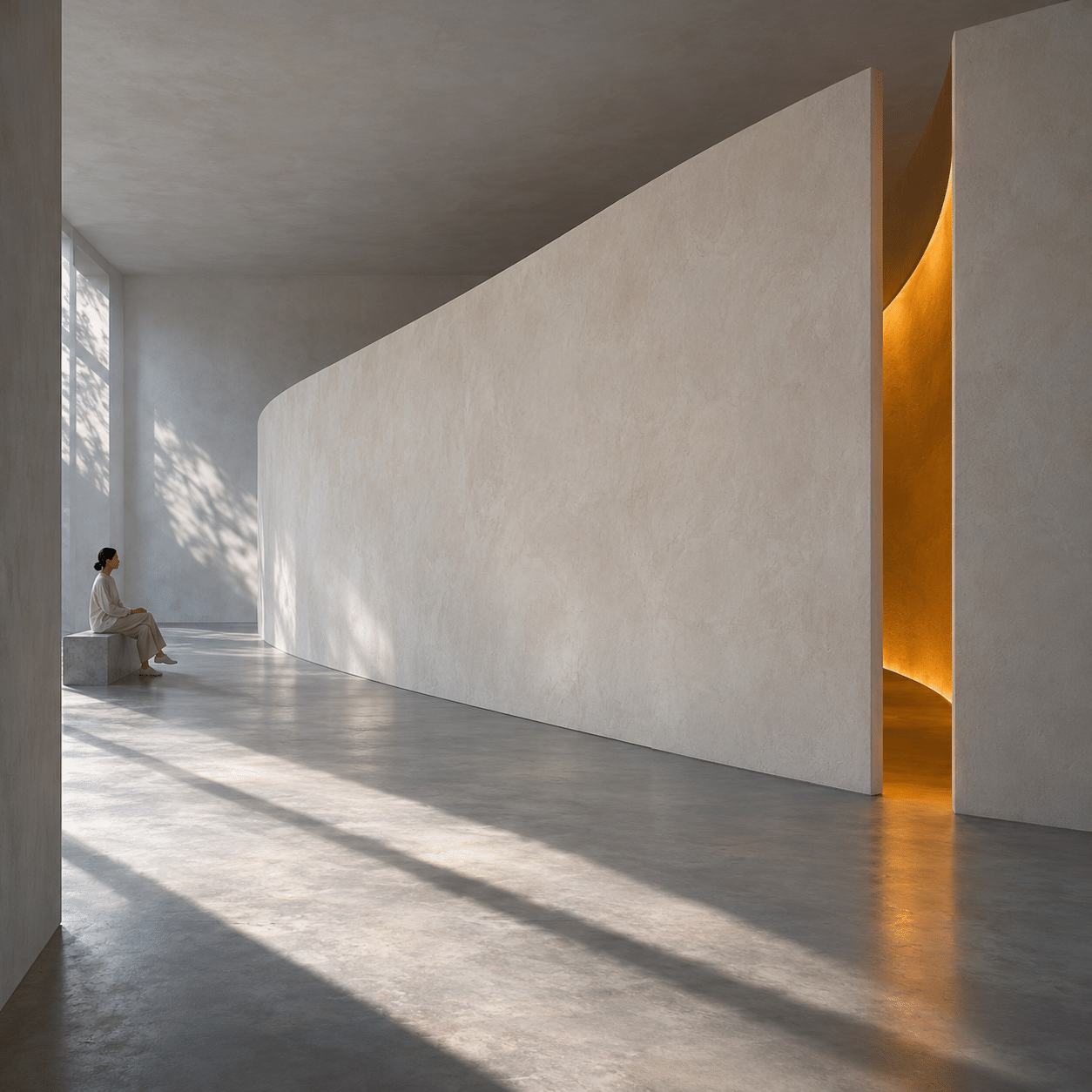
An opening makes an unseen space matter
The curved-wall study concentrates on a narrow amber opening within a cool pale room. Most of the inner surface is withheld. The long outer wall, the seated figure and the light on the floor make the opening feel consequential. It is a proposal about expectation and partial access, rather than simply a brightly lit object.
Try sketching the same wall from the entrance and from beside the opening. What can be inferred before the interior is seen? Does the second position offer a meaningful change? A route should develop the encounter rather than merely make the visitor walk farther. Leave practical access and the proposed viewing sequence distinct in the design notes.
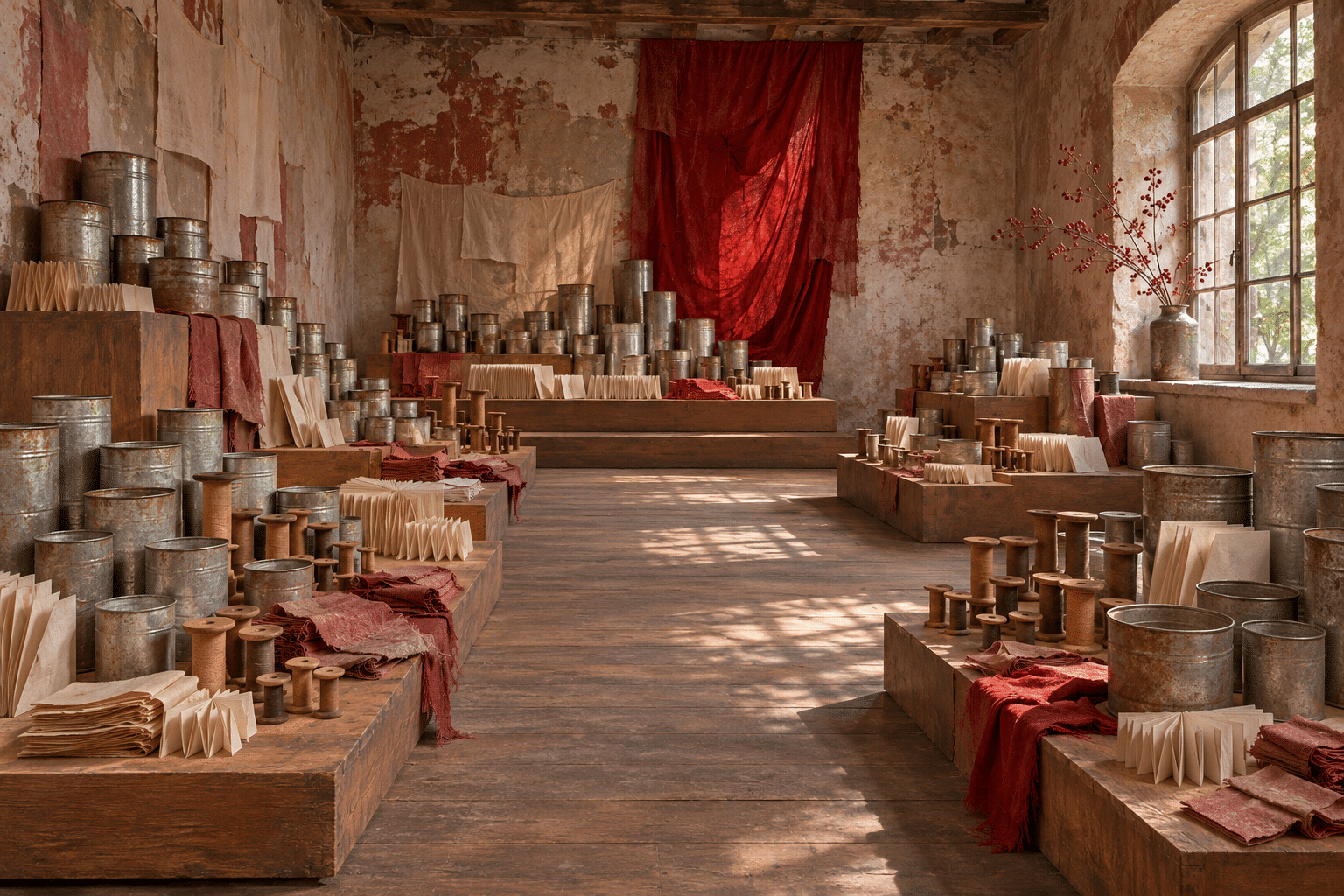
Ordinary objects can make a spatial archive
The material-arrangement study places tin vessels, wooden spools, folded paper and red cloth on low stepped platforms. An open route divides the clusters. Worn walls and window light connect the repeated objects to the imagined room. The crimson fabric is a focal accent among quieter metal, wood and paper textures.
These are invented objects in an invented setting. They should not be described as evidence of a real community, workplace or historical event. If an actual installation draws on collected objects, their sources and meanings deserve research. For this exercise, investigate how grouping, repetition and gaps create a sense of order without inventing a documentary story.
Layers change with your position
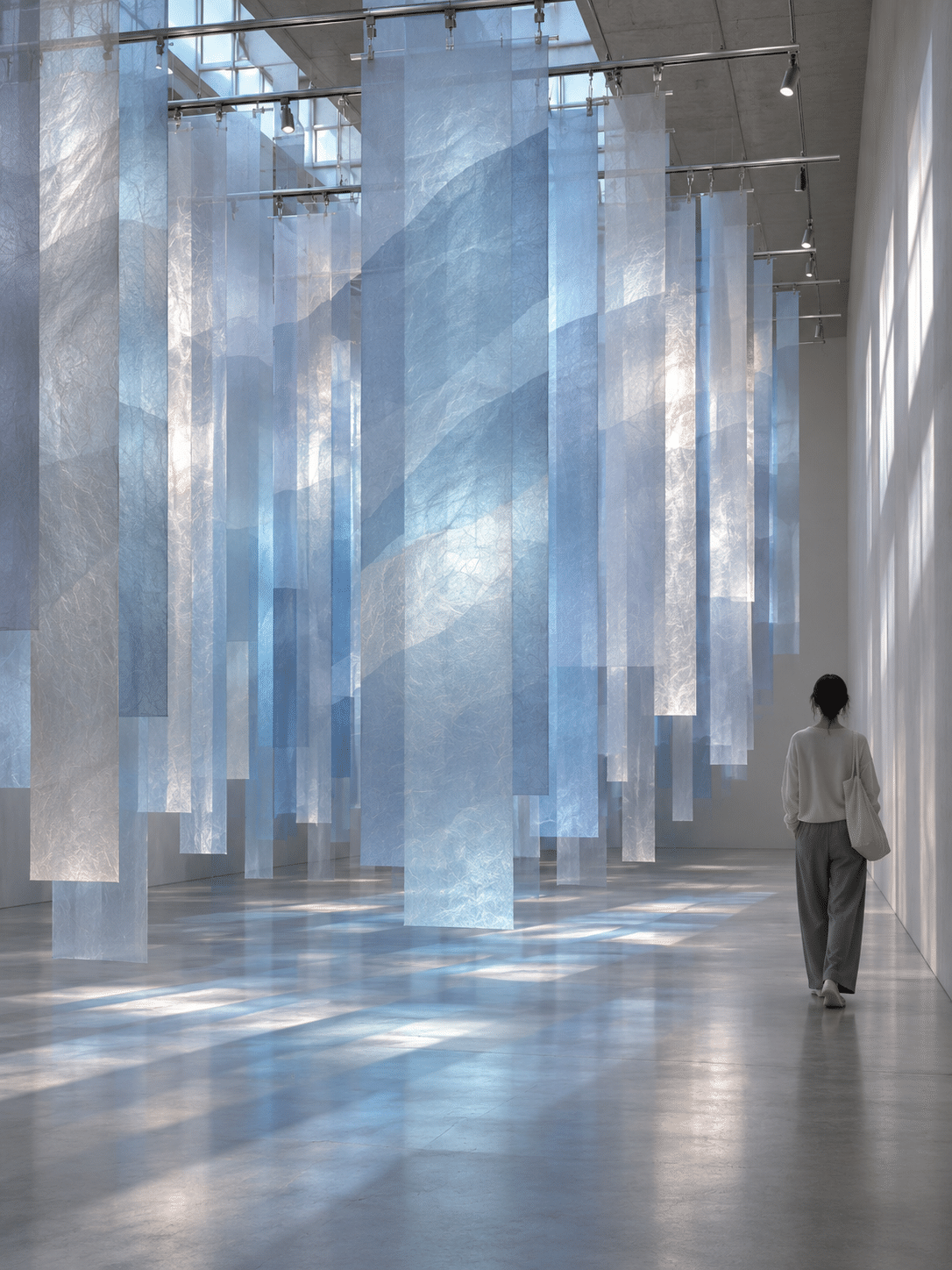
The tall blue-gray paper study uses broad translucent strips hanging at unequal lengths. Rails and clips remain visible. A participant at the side gives scale while the layered surfaces overlap in daylight. Near and distant sheets share a colour family but differ in apparent opacity.
Compare this image with the banner: both use suspension, but one emphasizes a continuous profile and the other changing layers. The difference lies in thickness, spacing, transparency and the available sightlines. Avoid treating every hanging object as the same idea. A simple material can produce a specific spatial question when its relationships are carefully chosen.
Projection and the place to sit
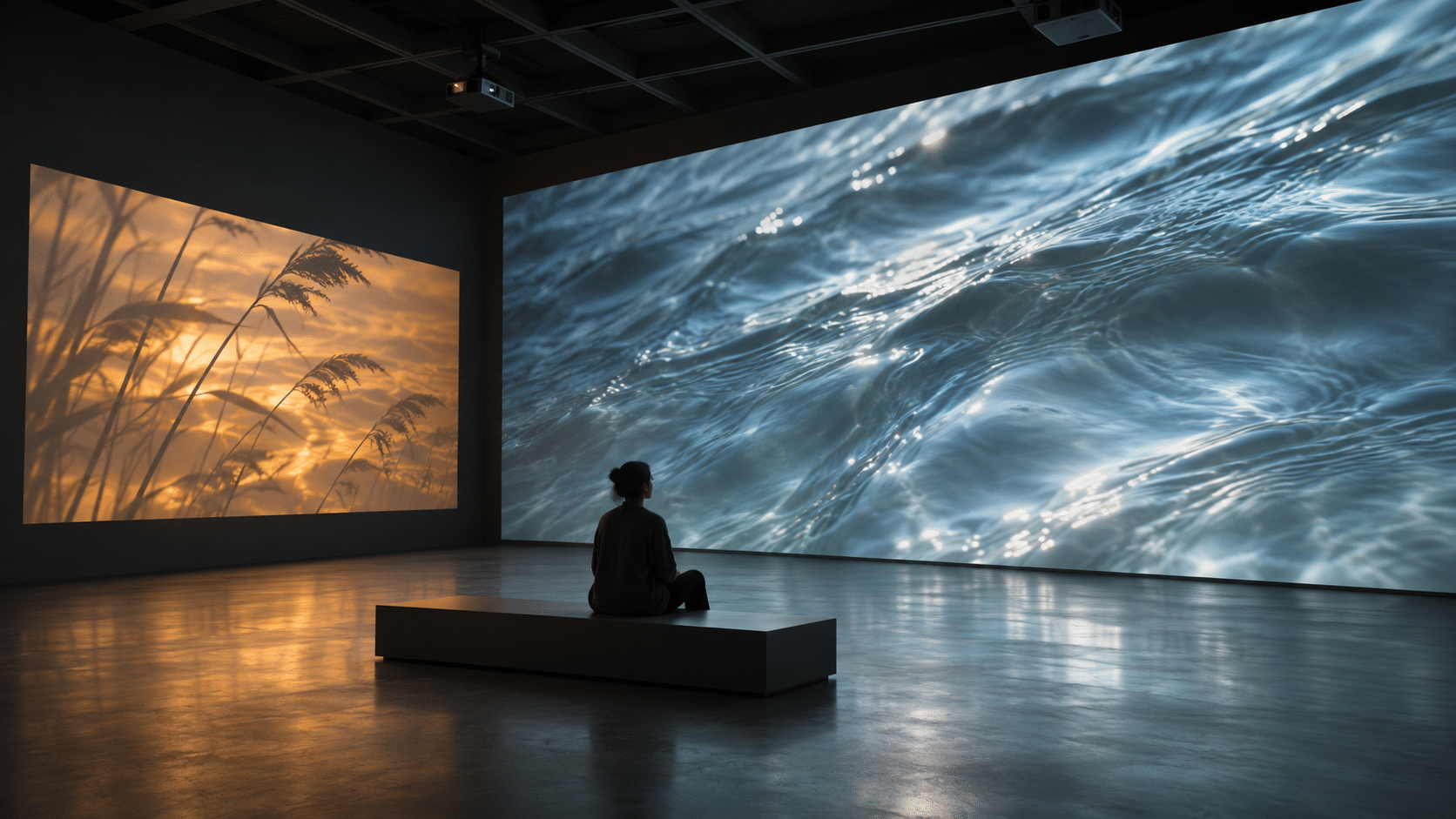
In the dark-room proposal, a broad blue water image meets a smaller amber reed image across adjacent walls. A bench places the viewer between them. The different scales ask the eye to move from surface detail to silhouette, while reflections extend the projected colour onto the floor.
This is a still illustration of a possible moving-image installation. It has no actual video duration or soundtrack. A developed proposal should specify how sequences begin, repeat and relate, whether a visitor can enter midway and how sound is contained or shared. The bench is also a decision about time: it suggests that looking may take longer than passing through.
Outside, the room has weather
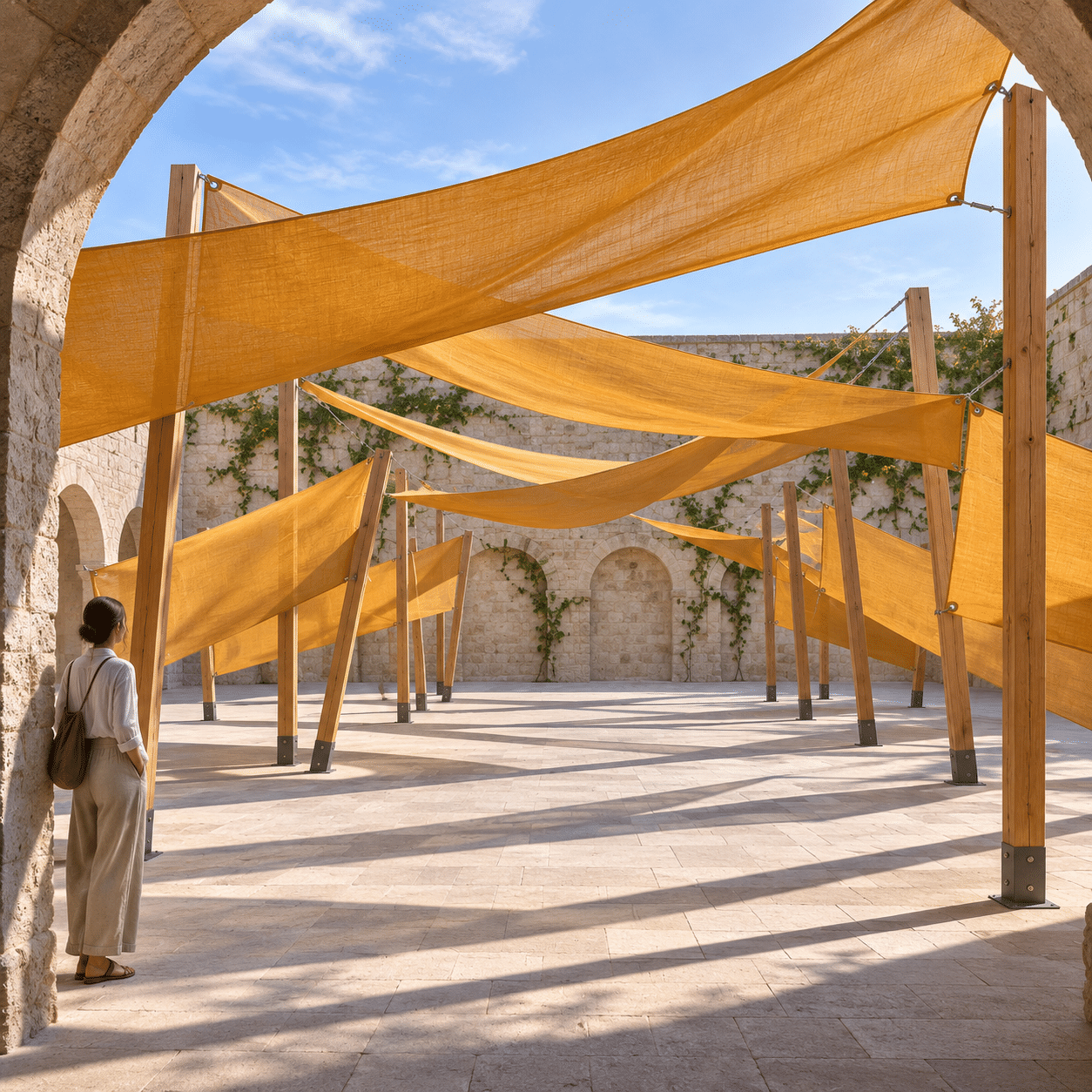
The courtyard study stretches ochre textile bands between timber supports. The stone arch frames the entrance view, while diagonal shadows cross the paving. The open sky and climbing greenery give the proposal a different context from the indoor gallery. Slightly curved fabric suggests movement, but a still image cannot show the effects of wind over time.
A real outdoor installation would need to respond to its site rather than simply transplant an indoor arrangement. Light changes direction; materials weather; routes serve people who may not have come to see art. Record those conditions as part of the artistic brief. The illustrated attachments are visual suggestions, not a verified construction or engineering plan.
A useful proposal includes more than a hero image
Prepare a floor-plan sketch, two or three views and a short account of what changes over time. Identify the first encounter, a place to pause and the exit. State what is fixed and what may vary if the work is installed elsewhere. A work tied to one site may lose essential meaning when moved; a reconfigurable work needs clear decisions about what remains consistent.
Distinguish the intended experience from what a rendering can prove. Generated images can explore proportion, atmosphere and materials, but not actual acoustics, structural performance or access. Test the important relationship with a small model or prototype. Consider different heights and ways of moving, and allow observation without forced participation.
The retained collage offers a broader archive of imagined objects, light, threads and hanging forms. Its central title is clear, and it remains useful beside the six more focused new proposals. All gallery images are interpretations, not photographs of the historical works discussed above. The existing related Installation Art entry remains separate; the two names do not establish two different historical movements.
Positive review — AOI editorial perspective
Installation can make scale, distance and duration expressive materials. A viewer discovers relationships by moving or waiting, and an ordinary room can become newly perceptible. The strongest proposals here offer distinct spatial questions: a wave read across a hall, an obscured interior, layered paper and competing projections.
Negative review — AOI editorial perspective
The approach can rely on spectacular atmosphere while leaving the actual encounter underdeveloped. A beautiful single view may conceal an arbitrary route, weak material choices or a concept that does not survive another angle. Develop the sequence of attention, test the defining relationship and explain why this work needs this space.
Neutral review — AOI editorial perspective
Installation is a spatial practice using objects, light, sound, images and other materials in relation to an environment and its viewers. It can overlap with sculpture, performance and interactive art without being identical to them. This guide combines documented examples with original static proposals; it does not certify a buildable exhibition.
A small poetic detour
Original words from the AOI studio.
Poetry
The room begins before the door,
a pale reflection on the floor.
One step divides the hanging line;
the parts and whole no longer rhyme.
A wall keeps amber out of sight,
a paper edge receives the light.
We sit between two moving seas
and give the images our knees.
The objects wait; the shadows go.
The route reveals what frames cannot show.
We leave a space we cannot keep,
still turning corners in our sleep.
The prompt workshop
Original creative exercises. These prompts create new illustrations, not documentary evidence.
A changing interval
Original installation proposal in a plain daylight gallery: seven suspended translucent sheets spaced progressively farther apart, a clear accessible path beside them, gentle coloured shadows, one standing adult for scale. Believable supports; no claim of an existing exhibition.
Light behind the wall
Visualize an original room-scale installation with one curved freestanding wall and warm light visible only through a narrow opening. Show entrance sightline, floor contact and generous empty space. No copied artist work or signage.
Three viewpoints
Create a visual study of an imagined arrangement of low ceramic forms and overhead thread lines. Use one consistent room, plausible scale and clear intervals. Focus on what changes when the viewer moves, not ornamental clutter.
People & works to explore
References discussed in this article. Consult the sources below for context.
Artists and practitioners
James Turrell
Pipilotti Rist
Martin Creed
Sarah Sze
Olafur Eliasson
Paintings and other works
James Turrell — Frontal Passage (1994)
Pipilotti Rist — Ever Is Over All (1997)
Martin Creed — Work No. 227, The Lights Going On And Off (2000)
Sarah Sze — Triple Point (Pendulum) (2013)
Olafur Eliasson — The weather project (2003)
A smile from the studio
Jokes
The installation asked the photographer for a portrait. “From which side?” “That is the first question.”
Sources and further exploration
[1] MoMA — Installation: collection works and artist discussions
[2] MoMA — Martin Creed, Work No. 227 (2000); timer and duration
[3] MoMA — Pipilotti Rist, Ever Is Over All (1997); two-channel video and spatial juxtaposition
[4] Studio Olafur Eliasson — The weather project (2003); site, illusion and visible construction
[5] MoMA — Sarah Sze, Triple Point (Pendulum) (2013); material relationships and precariousness