
Archive note: historical claims and artist or artwork associations in this entry have not yet received a full source review.

Ink Wash Painting
Shades flow like rivers on rice paper; they drift, merge, and whisper secrets in monochrome language. Ink wash captures landscapes and fleeting spirits with fluid elegance, where emptiness speaks as profoundly as the brush’s touch.
AOI thinking about Ink Wash Painting [+_~]-/
Overview and quick facts
Emerging from a delicate dance between water and ink, this art style paints the intangible, celebrating both presence and absence in soft, flowing strokes that breathe life into silence.
Can understand it also, as:
Sumi-e, Ink Painting, Brush Painting
Categorize it as:
Impressionism, Minimalism
.: Dreaming :.
Soft strokes on paper,
Shadows dance with empty space—
Serenity inked.
:. Thought is power .:
Detailed description
Originating in ancient China, ink wash painting presents more than image; it evokes atmosphere and emotion. A testament to balance, contrasts are portrayed through subtle gradations of tone, achieving depth without defined lines. Artists dance with the unpredictable nature of water, inviting happy accidents, where one stroke decides the fate of a script. The technique resonates with Zen philosophy, embodying simplicity and intuition.
Archive notes — claims to verify
1. Known as "sumi-e" in Japan.
2. Utilizes simplicity to convey spiritual insight.
3. Relies heavily on the quality of the brush stroke.
4. Experienced resurgence in contemporary mixed-media art.
5. Has roots in Chinese calligraphy traditions.
Artists and works: references to check
(be aware, can be highly speculative)
Artists (be aware, speculation possible):
1. Sesshū Tōyō 2. Zhang Daqian 3. Shitao 4. Xia Gui 5. Kano Eitoku 6. Hasegawa Tōhaku
Artworks (be aware, speculation possible)
1. “Summer Mountain” by Xia Gui 2. “Pine Trees” by Hasegawa Tōhaku 3. “Landscape after Wang Meng” by Zhang Daqian
Epoch
Ancient China (5th Century AD) to Present
Creative tools and further exploration
Search results are starting points for exploration, not evidence for the historical claims or attributions in this legacy entry.
- Practical AI tools and critical guidance
- Build a repeatable image workflow
- Search Wikipedia for this subject
- Search Lexica for visual interpretations
- Browse the Art Style Database
Creative studies to try
Explore these collected prompts as creative interpretations. They are starting points for image-making, not reproductions of historical artworks or evidence about a tradition.
Visual cues: ink rhythm, paper breath, graceful asymmetry
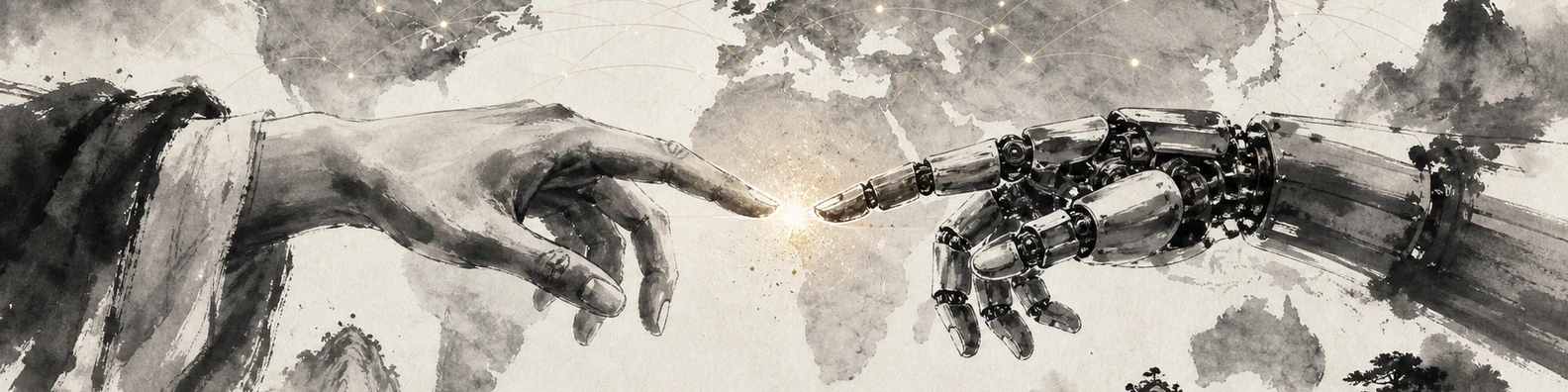
Study 1 — Ink Wash Painting
Ultra-wide panoramic banner, a human hand and a sleek robotic hand reaching toward each other, fingertips almost touching, a bright luminous spark of intelligence between them, a subtle world map behind them with global data network lines, symbolizing human-AI collaboration and digital transformation, rendered in Ink Wash Painting style, with refined composition, distinctive materials, elegant lighting, high-detail artistic finish, high quality, high detail, balanced composition, no text, no logo, no watermark, exact aspect ratio 1584:396
Prompt source: 1001 Art Styles. Select the text to copy, then adapt the subject and composition.