
Photographic technique
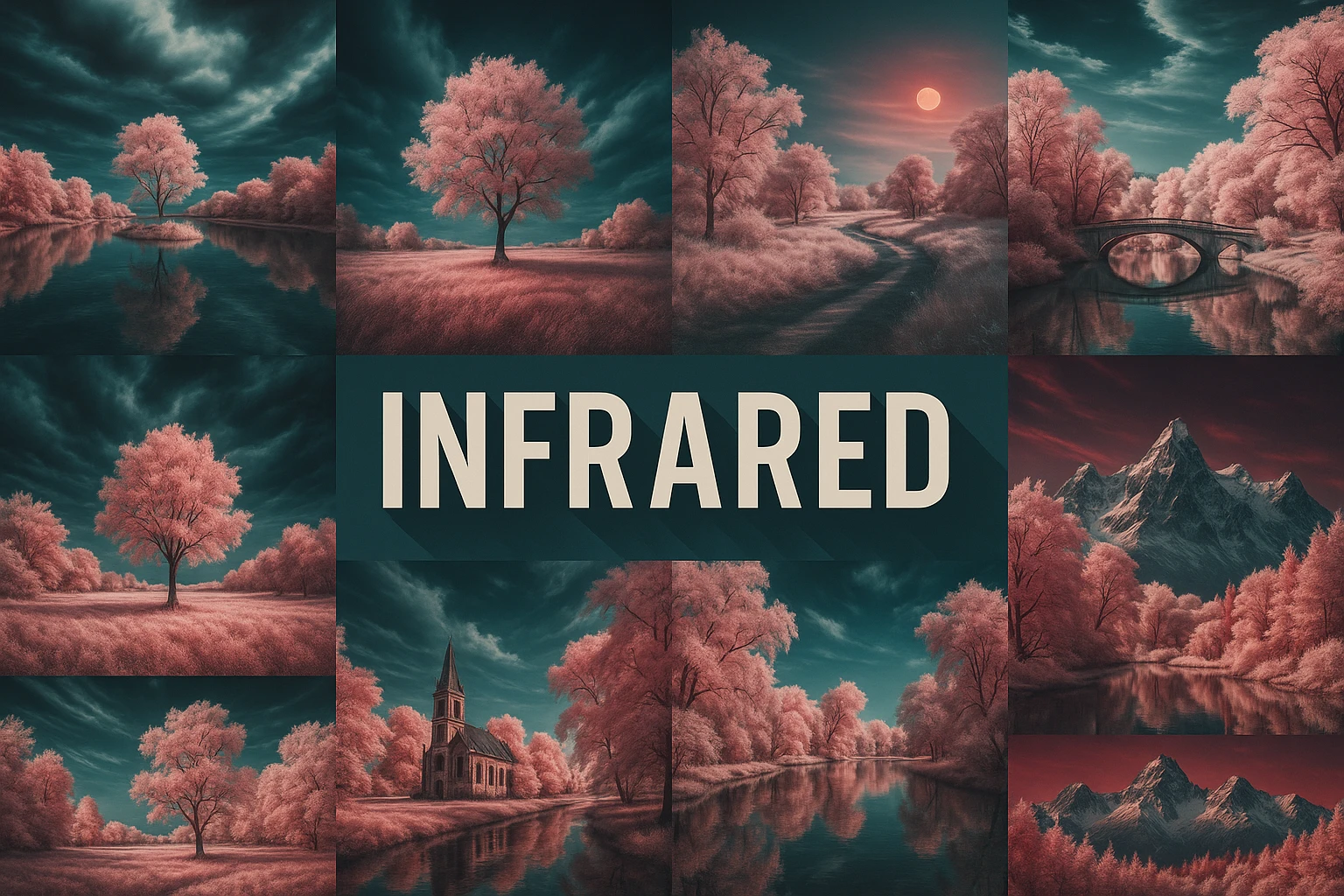
Artistic infrared photography commonly records near-infrared light reflected by a scene. It differs from thermal imaging, and its unfamiliar tones depend on the capture system and processing rather than a universal color recipe.
A visual introduction
Select an image for a closer look. Use the thumbnails, arrow keys or a swipe to compare examples. Zoom in to inspect details, or share the image that inspires you.
Creative toolbox · take this style further
Choose an input and a destination. Search sends your words to the chosen site; Copy & open puts them on your clipboard to paste there.
Create with AI
Turn your chosen input into an image prompt or a new creative direction.
ChatGPT
Copy your input and paste it into a ChatGPT conversation or image request.
Copy & open ChatGPT (new tab)Claude · Anthropic
Develop an image prompt or explore the style in a new Claude conversation.
Copy & open Claude · Anthropic (new tab)Midjourney
Paste your input into the Imagine bar on the Create page.
Copy & open Midjourney (new tab)Adobe Firefly
Copy your input, open Firefly, and paste it into the prompt field.
Copy & open Adobe Firefly (new tab)Leonardo.Ai
Copy your input, open Leonardo, and paste it into the generation field.
Copy & open Leonardo.Ai (new tab)Image search
Find visual references. Short, concrete keywords usually work best.
Lexica
Search AI images and prompts using your selected input.
Search with this input Lexica (new tab)Pexels
Search the photo and video library. Short keywords often work best.
Search with this input Pexels (new tab)Pixabay
Search photos, illustrations and other images.
Search with this input Pixabay (new tab)Unsplash
Search photographs using the style name or your own keywords.
Search with this input Unsplash (new tab)Wikimedia Commons
Search photographs, artworks and historical images. Check each file for its source and reuse terms.
Search with this input Wikimedia Commons (new tab)Art & research
Explore artists, collections and the ideas behind a style.
Wikipedia
Search for background reading. A style may not have its own article.
Search with this input Wikipedia (new tab)WikiArt
Copy your input into WikiArt’s search to explore artists and artworks.
Copy & open WikiArt (new tab)Europeana
Paste your keywords into the search to explore European museum, library and archive collections.
Copy & open Europeana (new tab)Inspiration
Discover portfolios and visual ideas from creative communities.
Instagram hashtags
Search a hashtag made from your input: spaces and punctuation are removed. Instagram may require sign-in.
Search with this input Instagram hashtags (new tab)ArtStation
Paste your input into artwork search for concept art, environments, characters and visual development.
Copy & open ArtStation (new tab)Behance
Paste your input into project search for illustration, design and visual storytelling.
Copy & open Behance (new tab)A closer look
Bright foliage, dark water or skies and altered relationships between materials can reorganize a familiar landscape; monochrome and false-color treatments reveal different aspects of the result.
Distinguish reflected infrared from heat imaging
NASA explains that near-infrared observations can reveal differences in how surfaces reflect light, while thermal infrared concerns emitted radiation. The familiar white-foliage landscape effect should therefore not be described as a heat map. It also does not necessarily require an infrared lamp; sunlight can provide reflected infrared illumination.
The camera, filters and processing determine what is recorded and how it appears. Nikon's practical account discusses both an external-filter approach and a converted camera. An ordinary camera's internal filtering can make the external-filter approach require long exposures. Exact behavior depends on the equipment and conditions.
Find a useful material contrast
Begin with a scene containing different kinds of surfaces: vegetation, water, stone and sky. Near-infrared reflectance can separate them differently from visible-light color. Do not assume that a striking visible-light composition will retain the same hierarchy after capture.
Look for a clear arrangement of large values. Bright foliage may become the dominant mass, so give it a deliberate relationship to the darker areas. A small tree against water can be more readable than an entire frame filled with equally bright leaves.
Choose monochrome or false color deliberately
Monochrome emphasizes tonal relationships and structure. False-color processing assigns recorded information to visible colors, which can make the result unfamiliar without making it arbitrary. Keep a record of the approach if the image is being used to communicate anything about the scene beyond artistic interpretation.
Color swapping in an ordinary photograph can imitate part of the appearance, but it cannot recover infrared measurements that were never captured. Similarly, a generated infrared-like image is a visual proposal, not sensor data. This distinction is essential when imagery is presented as evidence.
Let movement and detail serve the scene
If the setup requires a long exposure, moving leaves and water may blur while buildings remain stable. Decide whether that contrast helps the picture. Inspect focus and fine edges rather than relying only on an unusual palette to make the image interesting.
The prompts here explore tonal possibilities with invented settings. For actual photographic work, use the documentation for the specific camera and filter. Avoid unsupported lists of famous infrared practitioners or invented artworks as substitutes for a clear explanation of the method.
The prompt workshop
Original creative exercises. These prompts create new illustrations, not documentary evidence.
Tonal contrast
Original infrared-inspired monochrome landscape concept, one pale leafy tree beside dark water, clear stone bank and organized sky values, no claim of real sensor capture or thermal measurement.
A restrained false-color study
Invented garden scene interpreted with near-infrared-like tonal relationships and restrained false color, distinct vegetation, paving and water, coherent light, no rainbow heat-map treatment.
Movement against structure
Original infrared-inspired concept of pale wind-moved foliage around a still stone pavilion, deliberate contrast between soft leaves and precise architecture, balanced dark intervals, no scientific data labels.
Sources and further exploration
NASA — visible, near-infrared and thermal observations
Nikon — practical infrared capture approaches and limitations