
Archive note: historical claims and artist or artwork associations in this entry have not yet received a full source review.
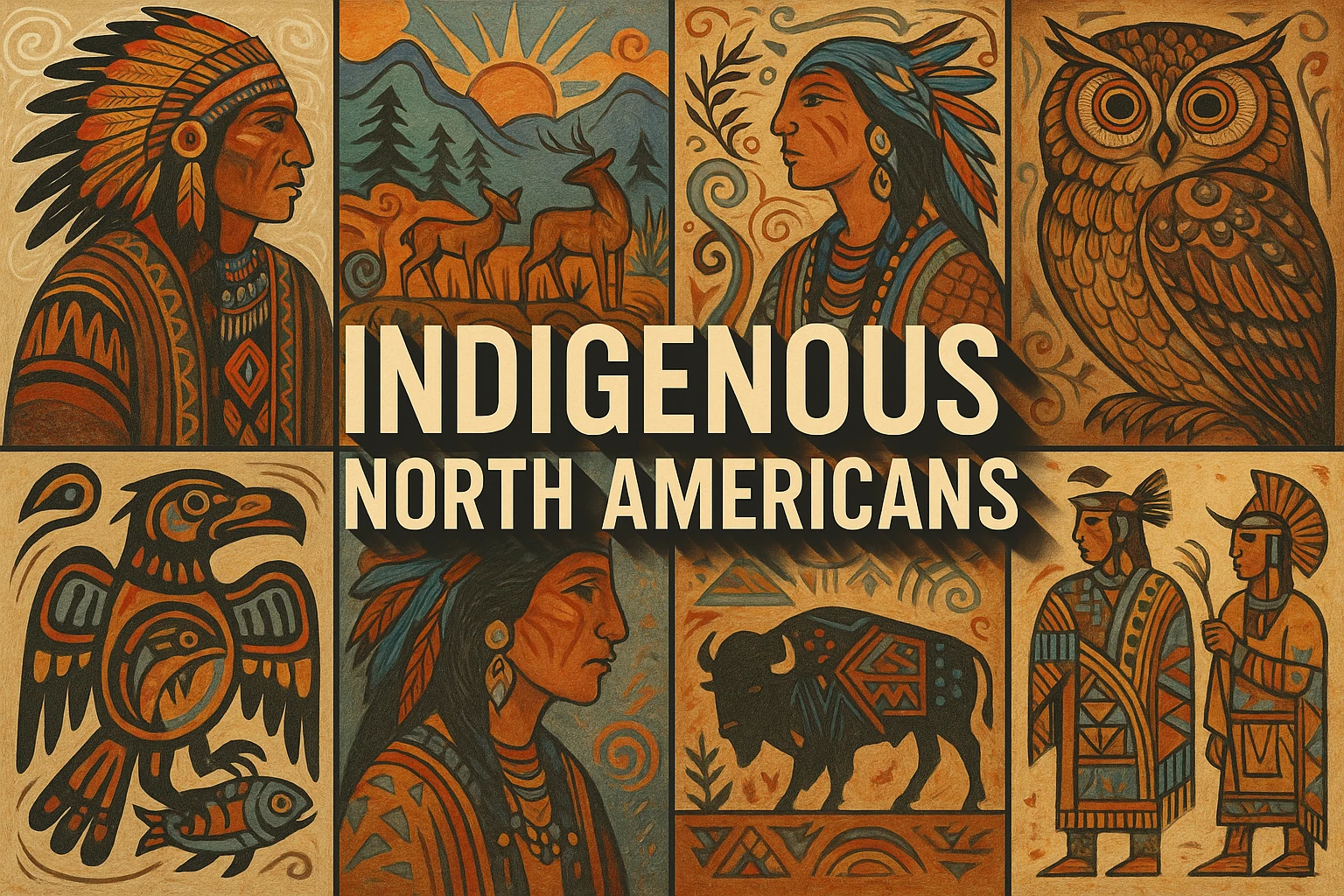
Indigenous North Americans
Indigenous North American art is characterized by its use of bright colors and bold patterns. Additionally, Indigenous North American artists often use symbolism to communicate their stories and beliefs.
AOI thinking about Indigenous North Americans [+_~]-/
Overview and quick facts
Indigenous North American art is characterized by a focus on natural subjects, such as animals, plants, and landscapes. The style is often brightly colored and features intricate patterns. Indigenous North American artists often use symbolism to communicate their stories and beliefs.
Can understand it also, as:
Native Americans, American Indians, First Nations
Categorize it as:
Impressionism, Modernism
Detailed description
Indigenous North American art is some of the oldest and most varied in the world. From the intricate and colorful beadwork of the Plains Indians to the monumental stone carvings of the Inuit, the art of Native Americans is as varied as the cultures that created it. Famous Indigenous North American artists include the Plains Indian ledger artist George Catlin, the Haida carver Charles Edenshaw, and the Inuit sculptor Kenojuak Ashevak. Some of the most famous Indigenous North American artworks include the Ghost Dance shirt of the Lakota Sioux, the Raven and the First Men by the Haida artist Robert Davidson, and the Inuit sculpture The Enchanted Owl by Kenojuak Ashevak.
Archive notes — claims to verify
1. Indigenous North Americans are the original inhabitants of North America.
2. They are also known as Native Americans, American Indians, First Nations, and Aboriginal peoples.
3. There are an estimated 5.2 million Indigenous people in the United States and another 1.6 million in Canada.
4. Indigenous peoples in North America have a rich and diverse history and culture.
5. Many Indigenous peoples were forcibly relocated or confined to reservations by the US and Canadian governments.
6. Indigenous peoples have often been marginalized and discriminated against by the majority cultures in North America.
7. Indigenous peoples have made significant contributions to the cultures of North America.
8. Indigenous peoples have a unique relationship with the land and the natural world.
9. Many Indigenous peoples still practice their traditional religions and ceremonies.
10. The languages spoken by Indigenous peoples in North America are also unique and diverse.
11. The term "Indigenous" is used to describe people who are native to a particular place.
12. "North America" is a large continent that includes many different countries and cultures.
13. "Indigenous North Americans" refers specifically to the original inhabitants of the continent of North America.
14. There are many different Indigenous peoples in North America, each with their own distinct culture and history.
15. The term "Native American" is often used to describe all Indigenous peoples in North America, but it is not a universally accepted term.
16. "First Nations" is a term used to describe Indigenous peoples in Canada.
17. "Aboriginal" is a term used to describe Indigenous peoples in both the United States and Canada.
18. Indigenous peoples in North America have a long and complex history of interaction with Europeans and other settlers.
19. Indigenous peoples in North America have been subjected to many forms of discrimination and violence.
20. There is a growing movement among Indigenous peoples in North America to assert their rights and preserve their cultures.
Artists and works: references to check
(be aware, can be highly speculative)
Artists (be aware, speculation possible):
1. George Catlin (1796-1872) 2. Karl Bodmer (1809-1893) 3. John James Audubon (1785-1851) 4. Samuel Morse (1791-1872) 5. William Henry Jackson (1843-1942) 6. Edward S. Curtis (1868-1952) 7. Frederic Remington (1861-1909) 8. Charles M. Russell (1864-1926) 9. Winold Reiss (1886-1953) 10. Allan Houser (1914-1994) 11. R.C. Gorman (1931-2005) 12. Jaune Quick-to-See Smith (1940-) 13. James Lavadour (1954-) 14. Kay WalkingStick (1935-) 15. Robert Davidson (1946-)
Artworks (be aware, speculation possible)
1. “The Scream” by Edward Hopper (1942) 2. “Nighthawks” by Edward Hopper (1942) 3. “American Gothic” by Grant Wood (1930) 4. “Christina’s World” by Andrew Wyeth (1948) 5. “Wagon Wheel” by Georgia O’Keeffe (1927) 6. “One Hundred and Fifty-Second Street” by Georgia O’Keeffe (1926) 7. “The Starry Night” by Vincent van Gogh (1889) 8. “The Yellow House” by Vincent van Gogh (1888) 9. “The Sleeping Gypsy” by Henri Rousseau (1897) 10. “The Dream” by Henri Rousseau (1910) 11. “The Snake Charmer” by Henri Rousseau (1907) 12. “The Blue Boat” by Pablo Picasso (1901) 13. “The Old Guitarist” by Pablo Picasso (1903) 14. “Les Demoiselles d’Avignon” by Pablo Picasso (1907) 15. “Guernica” by Pablo Picasso (1937)
Epoch
The art style of Indigenous North Americans can be dated back to the prehistoric era.
Creative tools and further exploration
Search results are starting points for exploration, not evidence for the historical claims or attributions in this legacy entry.