
Archive note: historical claims and artist or artwork associations in this entry have not yet received a full source review.

High Renaissance
Luminous frescoes and harmonious forms, a symphony of symmetry and balance. Evoking divine serenity, every brushstroke an ode to human perfection, embodying grace and equilibrium. A feast for the soul.
AOI thinking about High Renaissance [+_~]-/
Overview and quick facts
Artists sculpting divinity with pigments. This golden age sparked a rebirth in beauty, perspective, balance, and grace. The pinnacle of human creativity, captured on canvas and stone.
Can understand it also, as:
Renaissance Mastery, Golden Age of Art
Categorize it as:
Classical Renaissance, Humanism
.: Dreaming :.
In Renaissance light,
Master brushes paint God's grace—
Timeless beauty dawns.
:. Thought is power .:
Detailed description
High Renaissance art embodies grandeur with exquisite precision; a culmination of classical principles blended with visionary mastery. It marries science with beauty, crafting timeless legacies in frescoes, easel paintings, and sculptures that evoke the sublime. Artists wielded light and shadow to breathe life onto canvas. Grand panoramas unfold through meticulous balance and spatial illusion. This epoch embraced humanism, reflecting man’s contemplate of divine and earthly realms—a kaleidoscope of human experience.
Archive notes — claims to verify
1. Leonardo da Vinci's "The Last Supper" redefined narrative complexity.
2. Michelangelo's Sistine Chapel ceiling remains a testament to divine inspiration.
3. Raphael synthesized grace with grandeur in "The School of Athens."
4. Flourished primarily in Italy during the late 15th to early 17th century.
5. Iconically used linear perspective to achieve three-dimensionality in art.
Artists and works: references to check
(be aware, can be highly speculative)
Artists (be aware, speculation possible):
1. Leonardo da Vinci (1452-1519) 2. Michelangelo Buonarroti (1475-1564) 3. Raphael Sanzio (1483-1520) 4. Titian (c. 1488-1576) 5. Correggio (1489-1534)
Artworks (be aware, speculation possible)
1. Mona Lisa by Leonardo da Vinci 2. Sistine Chapel Ceiling by Michelangelo 3. The School of Athens by Raphael 4. Bacchus and Ariadne by Titian 5. Assumption of the Virgin by Correggio
Epoch
Late 15th to early 17th century
Creative tools and further exploration
Search results are starting points for exploration, not evidence for the historical claims or attributions in this legacy entry.
- Practical AI tools and critical guidance
- Build a repeatable image workflow
- Search Wikipedia for this subject
- Search Lexica for visual interpretations
- Browse the Art Style Database
Creative studies to try
Explore these collected prompts as creative interpretations. They are starting points for image-making, not reproductions of historical artworks or evidence about a tradition.
Visual cues: classical balance, studied anatomy, historical calm
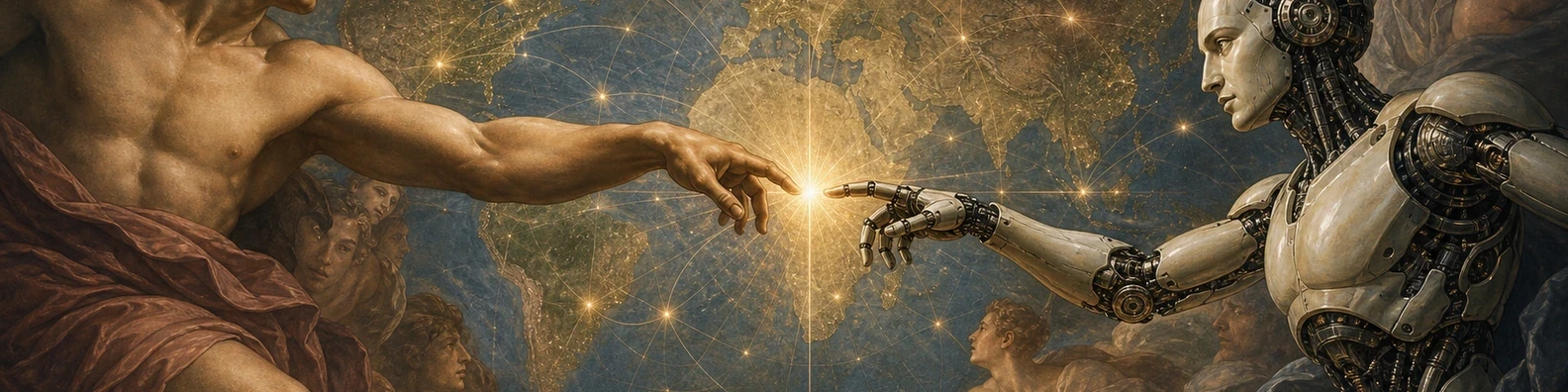
Study 1 — High Renaissance
Ultra-wide panoramic banner, a human hand and a sleek robotic hand reaching toward each other, fingertips almost touching, a bright luminous spark of intelligence between them, a subtle world map behind them with global data network lines, symbolizing human-AI collaboration and digital transformation, rendered in High Renaissance style, with dramatic gesture, refined anatomy, theatrical lighting, rich painterly depth, high quality, high detail, balanced composition, no text, no logo, no watermark, exact aspect ratio 1584:396
Prompt source: 1001 Art Styles. Select the text to copy, then adapt the subject and composition.