
Speculative genre and visual approach
Explore high fantasy through coherent invented worlds, extraordinary architecture and everyday life, with original artworks, world-building exercises and prompts.
A visual introduction
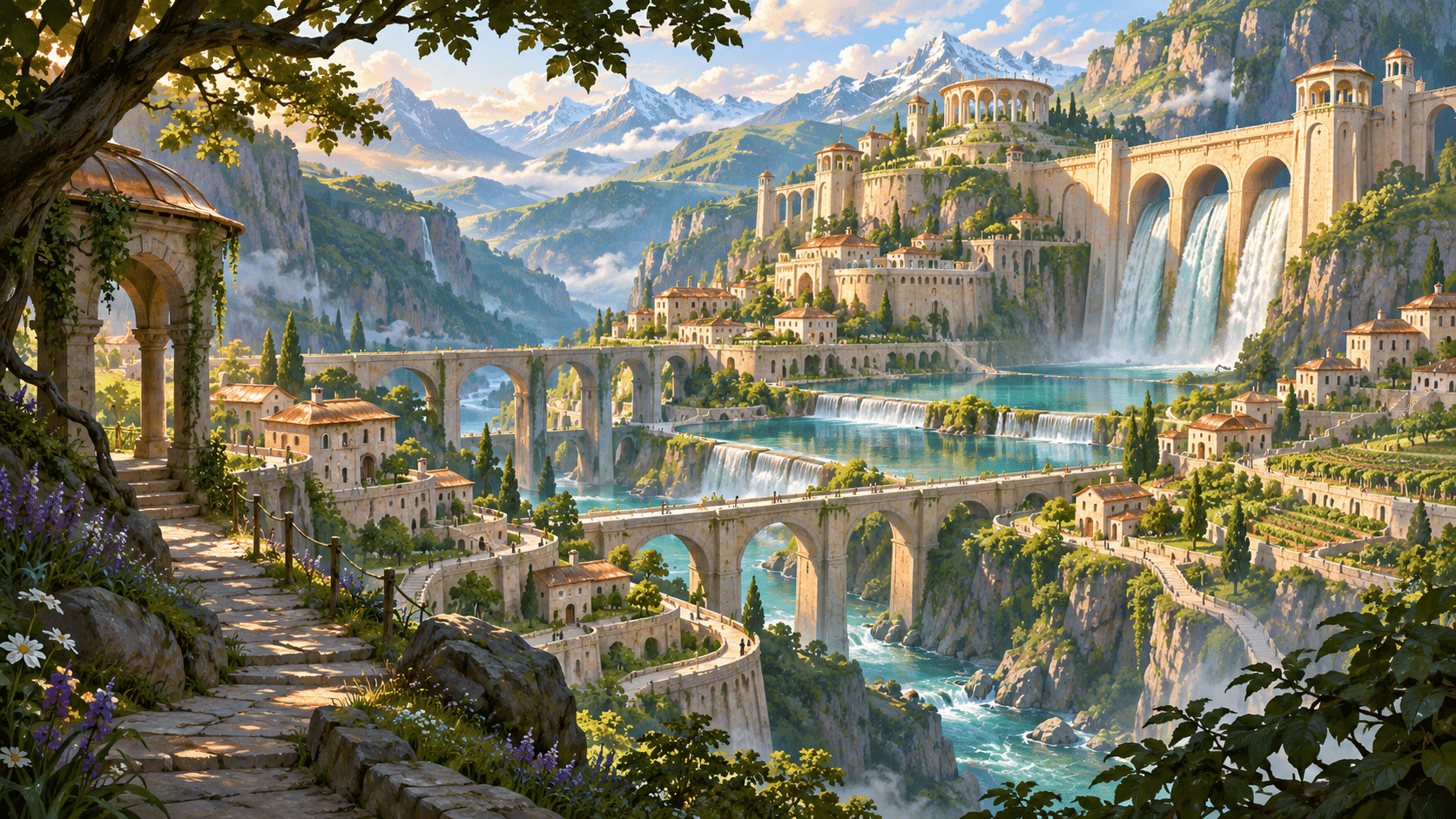
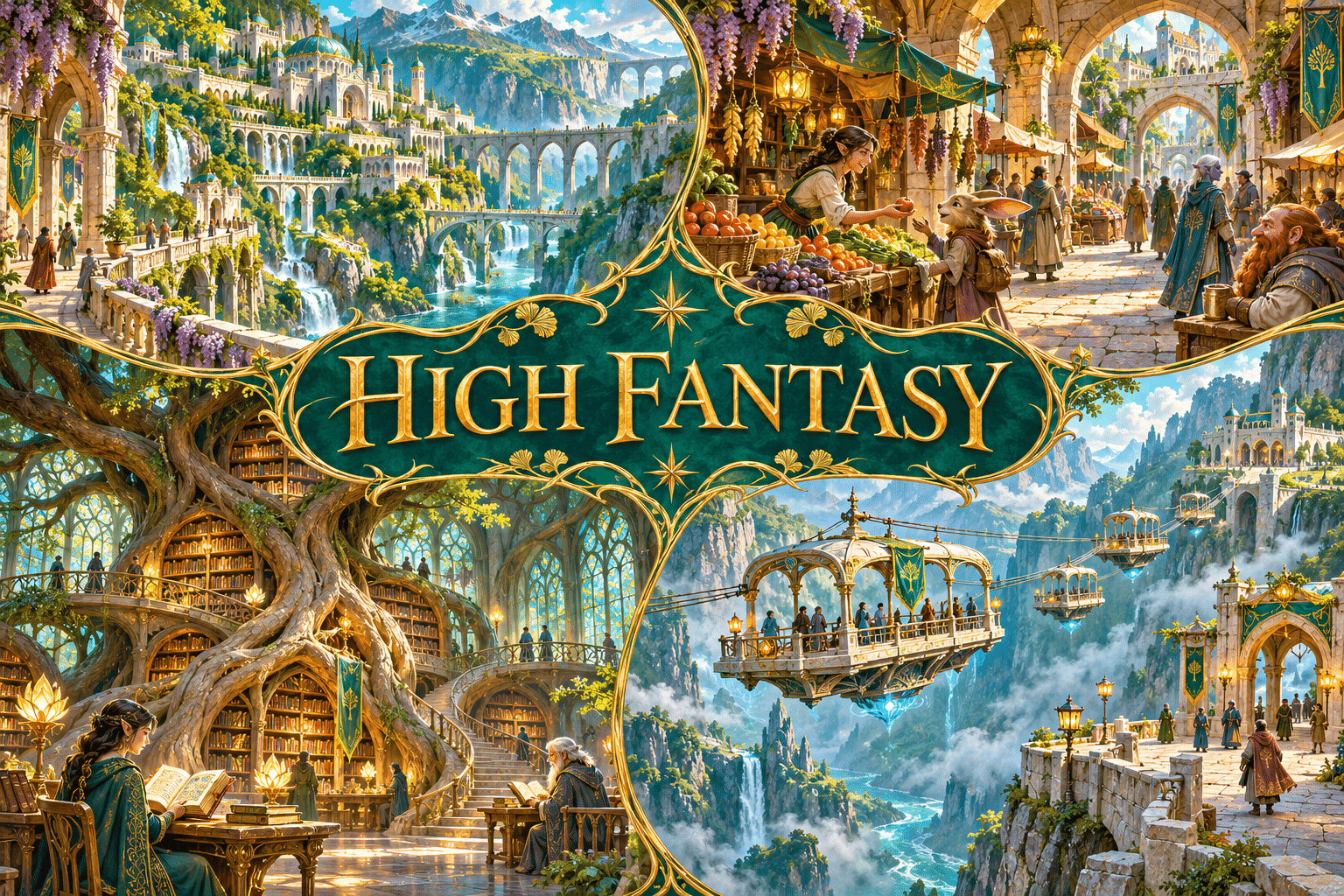
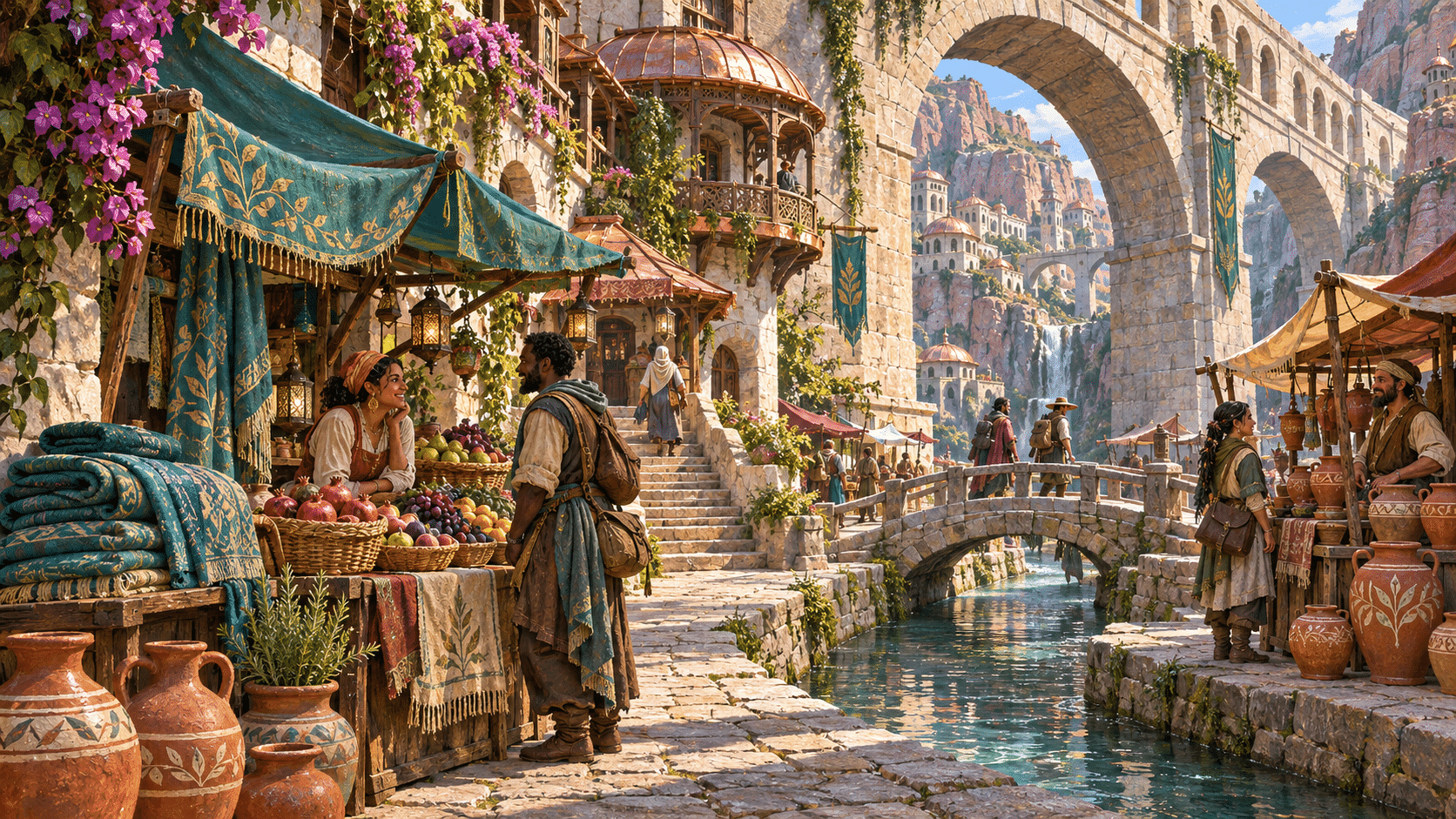
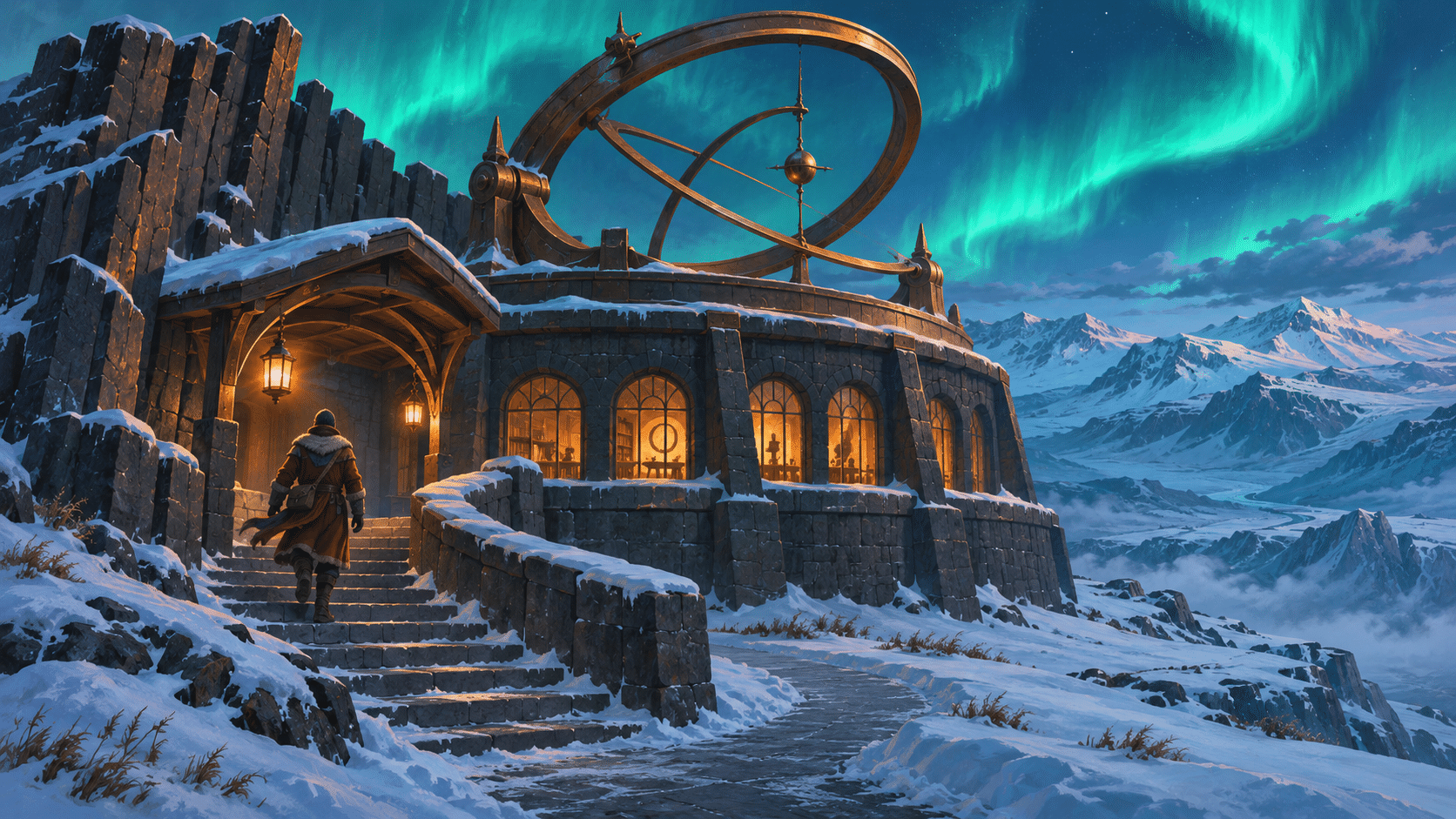
Six new AI-generated artworks add a water-city banner, centrally titled collage and four standalone settings: market, observatory, floating transport and root library. A reviewed earlier character-led illustration remains as the fifth example. These are original fantasy concepts, not depictions of named fictional locations or verified architectural designs.
Select an image for a closer look. Use the thumbnails, arrow keys or a swipe to compare examples. Zoom in to inspect details, or share the image that inspires you.
Creative toolbox · take this style further
Choose an input and a destination. Search sends your words to the chosen site; Copy & open puts them on your clipboard to paste there.
Create with AI
Turn your chosen input into an image prompt or a new creative direction.
ChatGPT
Copy your input and paste it into a ChatGPT conversation or image request.
Copy & open ChatGPT (new tab)Claude · Anthropic
Develop an image prompt or explore the style in a new Claude conversation.
Copy & open Claude · Anthropic (new tab)Midjourney
Paste your input into the Imagine bar on the Create page.
Copy & open Midjourney (new tab)Adobe Firefly
Copy your input, open Firefly, and paste it into the prompt field.
Copy & open Adobe Firefly (new tab)Leonardo.Ai
Copy your input, open Leonardo, and paste it into the generation field.
Copy & open Leonardo.Ai (new tab)Image search
Find visual references. Short, concrete keywords usually work best.
Lexica
Search AI images and prompts using your selected input.
Search with this input Lexica (new tab)Pexels
Search the photo and video library. Short keywords often work best.
Search with this input Pexels (new tab)Pixabay
Search photos, illustrations and other images.
Search with this input Pixabay (new tab)Unsplash
Search photographs using the style name or your own keywords.
Search with this input Unsplash (new tab)Wikimedia Commons
Search photographs, artworks and historical images. Check each file for its source and reuse terms.
Search with this input Wikimedia Commons (new tab)Art & research
Explore artists, collections and the ideas behind a style.
Wikipedia
Search for background reading. A style may not have its own article.
Search with this input Wikipedia (new tab)WikiArt
Copy your input into WikiArt’s search to explore artists and artworks.
Copy & open WikiArt (new tab)Europeana
Paste your keywords into the search to explore European museum, library and archive collections.
Copy & open Europeana (new tab)Inspiration
Discover portfolios and visual ideas from creative communities.
Instagram hashtags
Search a hashtag made from your input: spaces and punctuation are removed. Instagram may require sign-in.
Search with this input Instagram hashtags (new tab)ArtStation
Paste your input into artwork search for concept art, environments, characters and visual development.
Copy & open ArtStation (new tab)Behance
Paste your input into project search for illustration, design and visual storytelling.
Copy & open Behance (new tab)A closer look
Repeated design principles, believable scale and visible everyday use connect extraordinary settings to the lives within them.
A genre, not one fixed painting style
High fantasy commonly refers to fantasy set in a substantially imagined world. The Encyclopedia of Science Fiction discusses this distinction while warning that genre terms are not used with perfect consistency. For visual art, the useful starting point is a world with its own relationships, rather than a checklist of castles, elves and dragons.
An image can suggest such a world through landscape, architecture, clothing, tools and the consequences of magic. High fantasy can be painted loosely, drawn in line, rendered digitally or developed through other media. “High” does not measure artistic quality, and a monumental battle is not required in every scene. The illustrations here are original AOI concepts rather than scenes from a named book or film.
World-building needs more than scenery
The Tolkien Estate describes drawing, painting, maps, languages and writing as connected parts of Tolkien’s creative process. Images could develop alongside a story or help bring a scene into focus before it was written. That is a useful example of world-building through several forms, not a universal template that every fantasy world must copy.
Choose what makes your own setting distinctive. Climate, travel, materials, food and social relationships can shape architecture and clothing. A spectacular skyline becomes more persuasive when its inhabitants appear able to live and move within it.
Establish a visual rule and vary it
Select a few recurring shapes or construction principles. They can connect buildings, tools and ornament without making every object identical. Variations should respond to purpose: a bridge, dwelling and ceremonial space need different proportions.
Avoid combining unrelated historical motifs solely because each looks impressive. If the world contains multiple cultures or periods, show how their differences arose and interact. Visual variety benefits from an underlying logic.
Scale requires human reference
A large structure feels monumental when doors, paths, vegetation or figures establish its size. Perspective and atmospheric depth should support the comparison. Adding tiny people to an incoherent landscape does not automatically create believable grandeur.
Include evidence of activity. A repaired stair, a market opening or a worn route can suggest time and use. These details should reinforce the scene's main action rather than compete with it as separate attractions.
Magic should have visible consequences
Decide what an extraordinary phenomenon changes in the world. Does it affect transport, labor, weather or the form of a building? A meaningful consequence gives the image more substance than a glowing object surrounded by decorative particles.
For an original study, pair a broad establishing view with a close everyday scene from the same place. Check whether materials, scale and rules remain consistent. The result can communicate a world with its own identity while avoiding copied characters, emblems or architecture from an existing franchise.
Begin with a route through the world
The Tolkien Estate’s map collection shows how geography formed part of an evolving creative process. One working map grew as extra sheets were attached; other maps helped organize the action. This suggests a useful studio exercise: draw a route before decorating the destination. Where does someone arrive, obtain supplies and go next?
For the new water-city banner, bridges, stepped pools and paths establish a network through the canyon. Pale stone and copper roofs repeat across the view. The design is an imaginative illustration, not a verified engineering proposal, but those recurring relationships make its grandeur easier to understand. A spectacular setting becomes more specific when its routes can be read.
Move from the distant view to daily life
The market study uses related materials at a smaller scale. A narrow channel, short footbridge, baskets, folded textiles and pots make the monumental aqueduct part of an inhabited place. The figures are engaged in ordinary exchange. Their presence gives the image a social purpose without requiring an elaborate caption about a royal dynasty.
Try a pair of images from the same invented location: one broad establishing view and one everyday task. Compare roof materials, openings, light and clothing. AI-generated pictures may drift between designs, so treat consistency as something to inspect. A series should not rely on the viewer overlooking changed architecture or contradictory scale.
Give the extraordinary a practical consequence
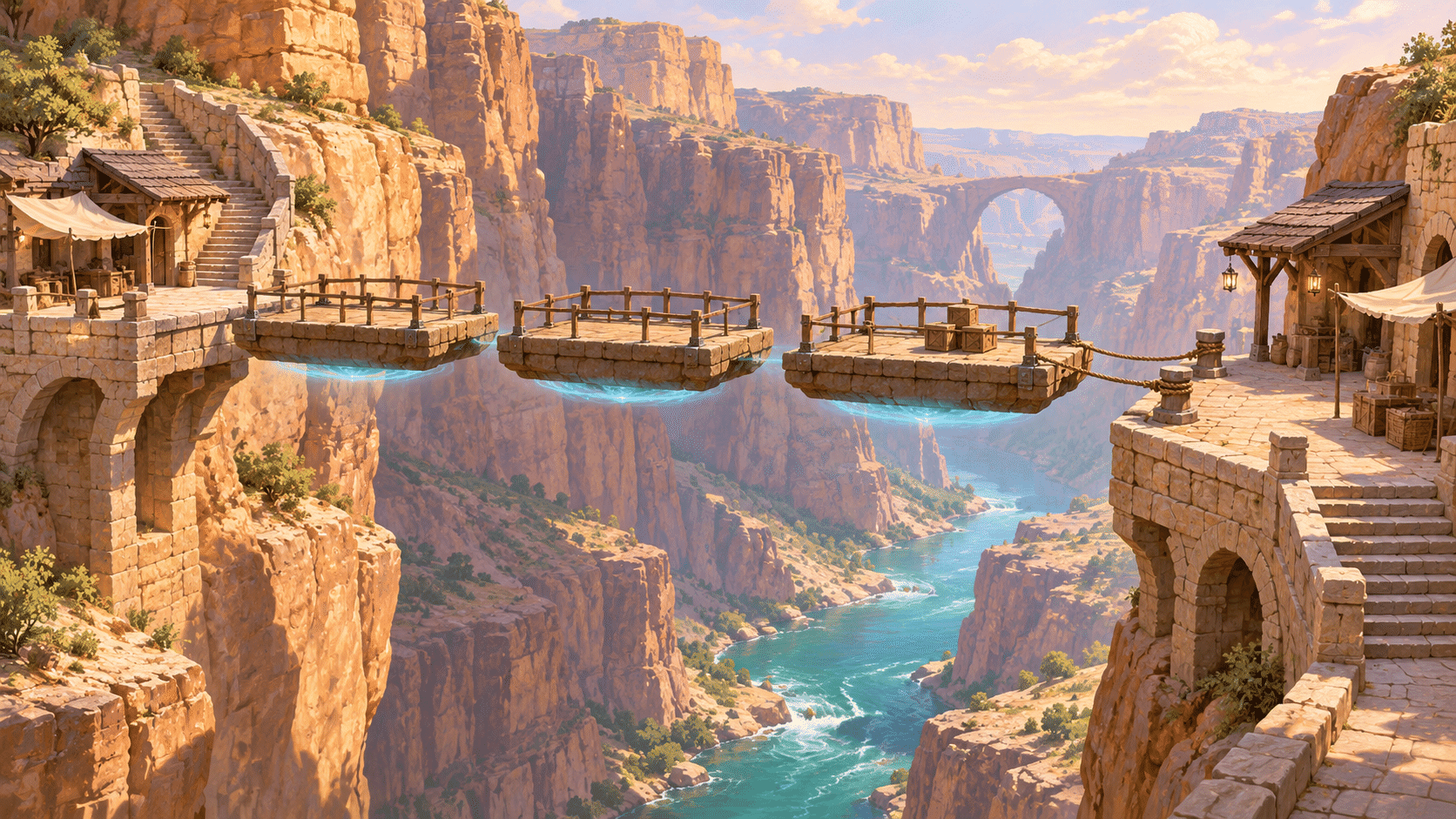
The ferry study proposes hovering stone platforms as a transport system. Railings, ropes, crates and built landings make the phenomenon relevant to everyday movement. It remains a magical premise, not an explanation of physical levitation. The useful question is what people do differently because the premise exists.
Develop the idea through consequences: who controls the crossing, where does cargo wait, and what happens when the platforms cannot travel? A still image cannot answer everything. It can, however, show one meaningful relationship clearly. Adding more glowing objects is less informative than making the landing and the hovering platform legible.
Change the setting without losing a design logic
The observatory study moves to a snowy plateau. A low stone enclosure, sheltered stair and warm windows respond to the exposed setting, while an invented bronze ring instrument supplies the extraordinary focal point. The keeper is small enough to establish scale without competing with the building. The instrument is a fantasy design, not a functioning astronomical model.
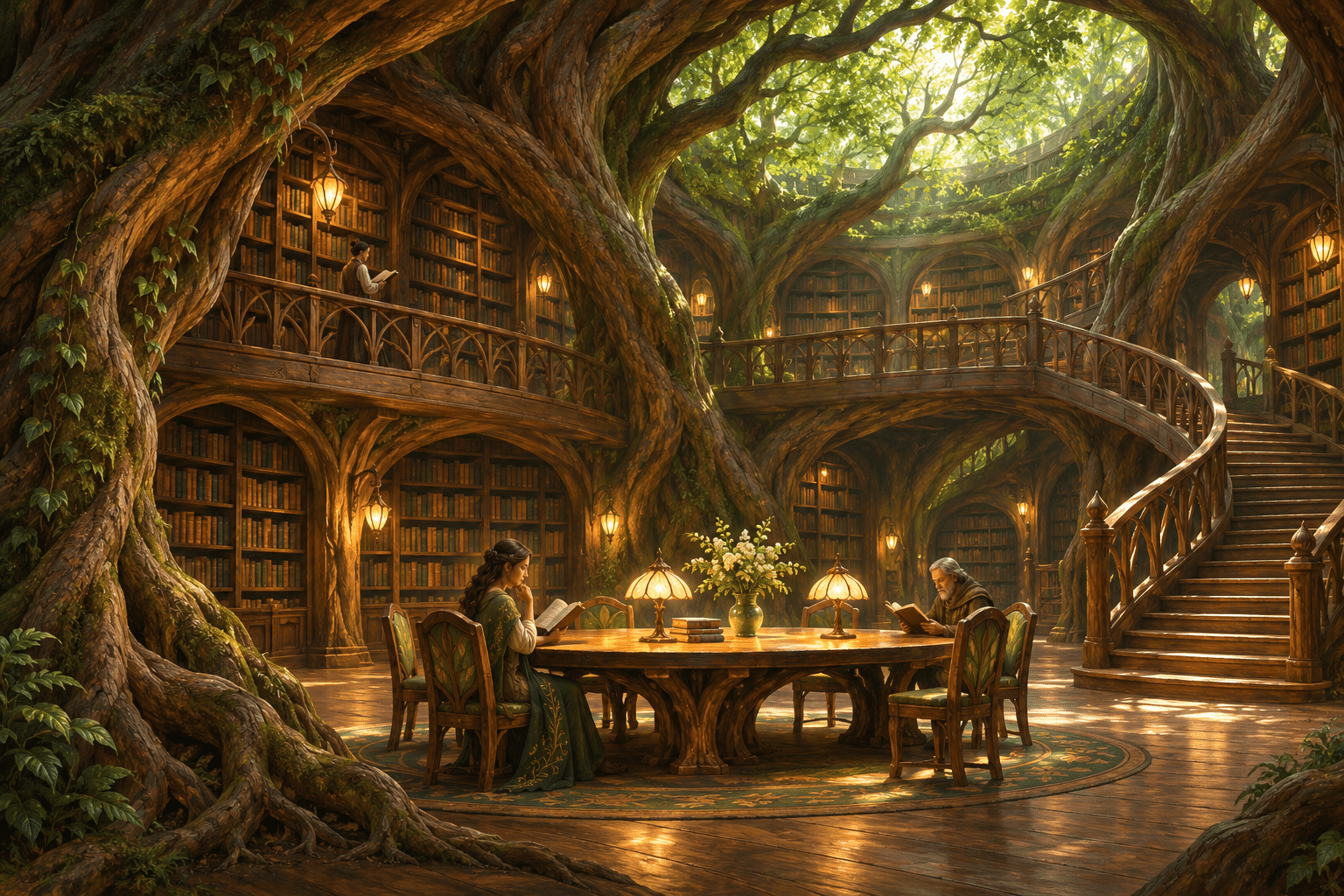
The library instead organizes space around enormous tree roots. Timber galleries, shelves and a broad stair connect the reading area to the larger structure. Warm local light and green daylight give different parts of the interior distinct roles. Both scenes ask how a place supports activity; neither depends on a battle to feel consequential.
Question inherited defaults
In her response to the Earthsea film adaptation, Ursula K. Le Guin explains that making most Earthsea inhabitants people of colour deliberately challenged familiar expectations in fantasy. She also values scenes of practical daily work and questions a simple equation of moral resolution with defeating a villain. Her comments concern her own books and their adaptation; they are not rules imposed on every fantasy creator.
For an original world, examine who is pictured as a traveler, scholar, craftsperson or ruler. Do not use appearance as an automatic shorthand for virtue, danger or intelligence. Cultural references deserve specific research rather than a mixture of motifs treated as interchangeable decoration. In an adaptation, respect what the source actually says about characters and setting.
Use the gallery as a set of visual questions
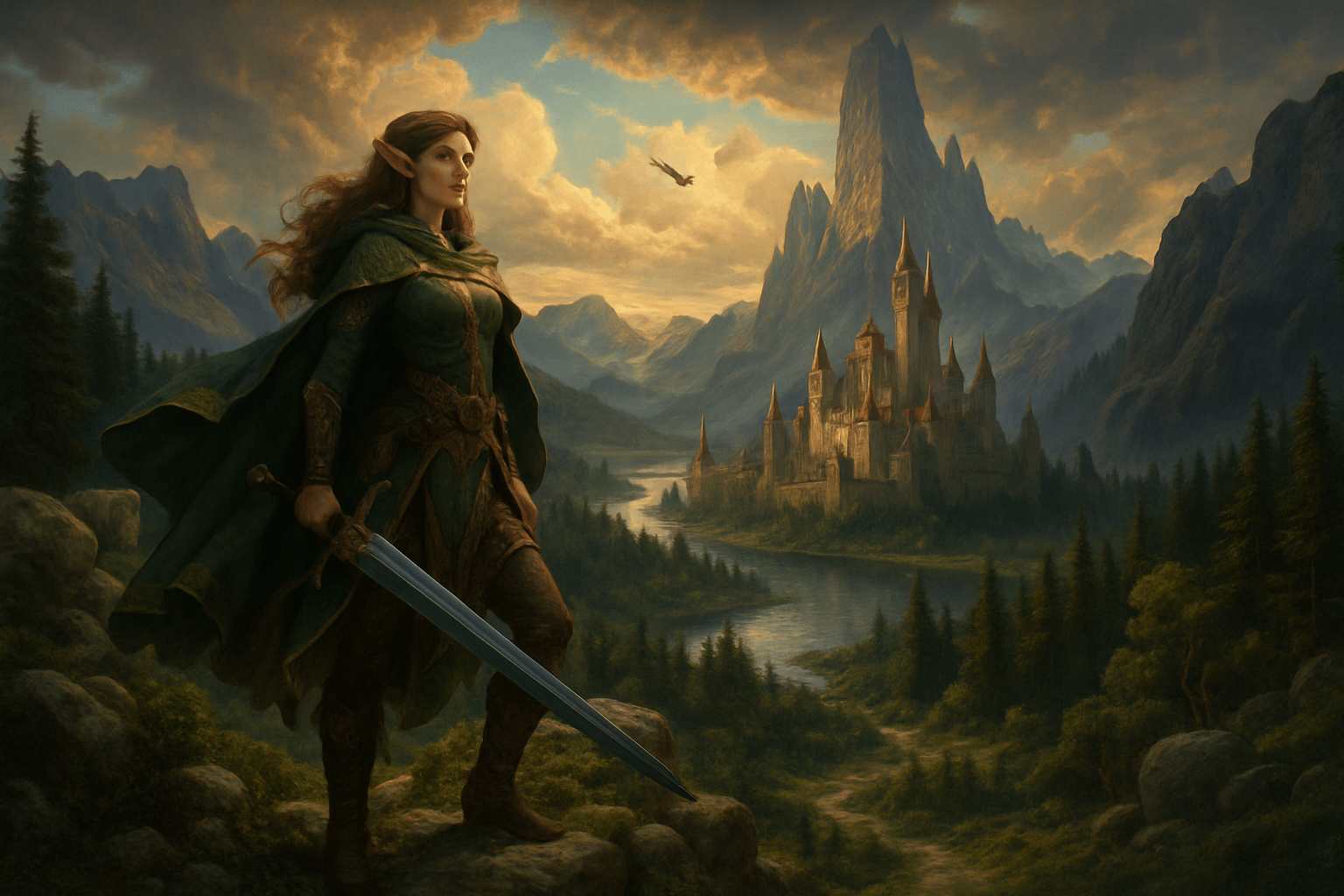
The retained elf-like traveler before a mountain castle represents a recognizable character-led fantasy image. The new market, observatory, ferry and library broaden the range toward trade, inquiry, transport and reading. The collage gathers several of these possibilities around the complete central title HIGH FANTASY. It is an editorial overview, not a map of one fully documented fictional universe.
Start a prompt with a subject and a consequence: a market beneath a waterway, a library shaped by roots, or a landing built for floating cargo. Then specify the viewpoint, materials and focal light. Inspect doors, stairs, bridges, hands and scale relationships in the result. Generated detail is not proof of a coherent plan, and a captivating image can still require substantial design work before it supports a larger story.
Positive review — AOI editorial perspective
High fantasy can connect the wonder of an extraordinary setting to recognizable human activity. The new gallery is strongest where a visual premise has consequences: water organizes a city, hovering stone suggests transport, and living roots shape a library. The contrast between a large view and a close daily scene makes the imagined world easier to enter.
Negative review — AOI editorial perspective
The genre’s visual vocabulary can harden into monumental castles, tiny cloaked figures and decorative magic. Scale may conceal incoherent routes, while borrowed cultural motifs substitute for a developed setting. Test the design at human scale, examine its social assumptions and remove details that have no role beyond looking impressive.
Neutral review — AOI editorial perspective
High fantasy is a broad genre framework rather than a single visual technique. Different works emphasize different kinds of world-building, narrative and atmosphere. These AI-generated images explore several settings independently of existing franchises. Their value is in the visual questions they open, not in proving a complete world or a buildable architectural plan.
A small poetic detour
Original words from the AOI studio.
Poetry
Beyond the gate, the market wakes.
A basket waits beside the stair.
The water passes under stone;
a bridge holds sunlight in the air.
The mountain keeps its ring of snow.
A lamp is lit before the night.
Somewhere a reader turns a page
beneath a root that gathers light.
The world is wide, but here it starts:
a route, a task, a place to stay.
We give the distant towers their life
by walking through an ordinary day.
Earlier haiku:
Ancient lands unfold,
Heroes clad in gleaming gold,
Mysteries untold.
The prompt workshop
Original creative exercises. These prompts create new illustrations, not documentary evidence.
An inhabited city
Original high-fantasy city built around a distinctive water system, coherent materials and routes, visible everyday activity and no borrowed franchise landmarks.
Life beneath grandeur
Original fantasy market at the base of a monumental structure, believable scale, practical stalls and consistent architectural motifs.
A consequential magic
Original fantasy settlement where a clearly defined levitating-stone phenomenon changes bridges and transport, coherent visual rules and restrained spectacle.
A smile from the studio
Jokes
The floating ferry was late again. Apparently, it had become too attached to the dock.
Sources and further exploration
The Encyclopedia of Science Fiction — Fantasy: the high/low distinction and its limitations
The Tolkien Estate — Painting: visual art within the creative process
The Tolkien Estate — Maps: geography developed alongside the stories
Ursula K. Le Guin — her response to Tales from Earthsea: character, daily life and representation