
Archive note: historical claims and artist or artwork associations in this entry have not yet received a full source review.

Hard-Edge Painting
Picture blocks of color, precise edges defining space. Chromatic purity reigns in symmetry or asymmetry. It’s a dance where hues hold hands invisibly, yet remain unblended and apart.
AOI thinking about Hard-Edge Painting [+_~]-/
Overview and quick facts
Sharp as a knife, bold colors clash. Geometry speaks. Lines sing an anthem of precision in the flat expanse. A feast of form, stripped to essence.
Can understand it also, as:
Delimited Color Field, Geometric Abstraction
Categorize it as:
Modernism, Minimalism
.: Dreaming :.
Colors hold their space,
Edge meets edge with bold intent—
Silence sings in form.
:. Thought is power .:
Detailed description
Hard-Edge Painting emerged in the mid-20th century, thrumming with the pulse of simplicity and stark precision. Its advocates embraced the farewell to the whimsical brush stroke, favoring the austere choir of pigment blocks. The movement distills color into an unyielding narrative, freezing swaths of intense, solid hues on the canvas. Perfectly contoured, colors speak without the need for blending, a geometric parade with each shape and shade maintaining its own distinct voice yet harmonizing into a singular composition. The style reverberates with modernist aspirations, echoing an ethos of clarity and distilled minimality—a true ode to form and boundary.
Archive notes — claims to verify
1. Hard-Edge Painting emphasizes sharp contours.
2. It rose to prominence in the 1950s and 1960s.
3. The style emerges as a reaction to Abstract Expressionism.
4. Hard-Edge artists use uniform surfaces and pure colors.
5. The movement is closely associated with Minimalism.
Artists and works: references to check
(be aware, can be highly speculative)
Artists (be aware, speculation possible):
1. Ellsworth Kelly 2. Kenneth Noland 3. Frank Stella 4. Al Held 5. Leon Polk Smith
Artworks (be aware, speculation possible)
1. “Red, Blue, Green” by Ellsworth Kelly 2. “Stripe Series” by Kenneth Noland 3. “Empress of India” by Frank Stella 4. “New Mural” by Al Held
Epoch
1950s-1960s
Creative tools and further exploration
Search results are starting points for exploration, not evidence for the historical claims or attributions in this legacy entry.
- Practical AI tools and critical guidance
- Build a repeatable image workflow
- Search Wikipedia for this subject
- Search Lexica for visual interpretations
- Browse the Art Style Database
Creative studies to try
Explore these collected prompts as creative interpretations. They are starting points for image-making, not reproductions of historical artworks or evidence about a tradition.
Visual cues: geometry, flat planes, disciplined negative space; Flat color separated by exact boundaries
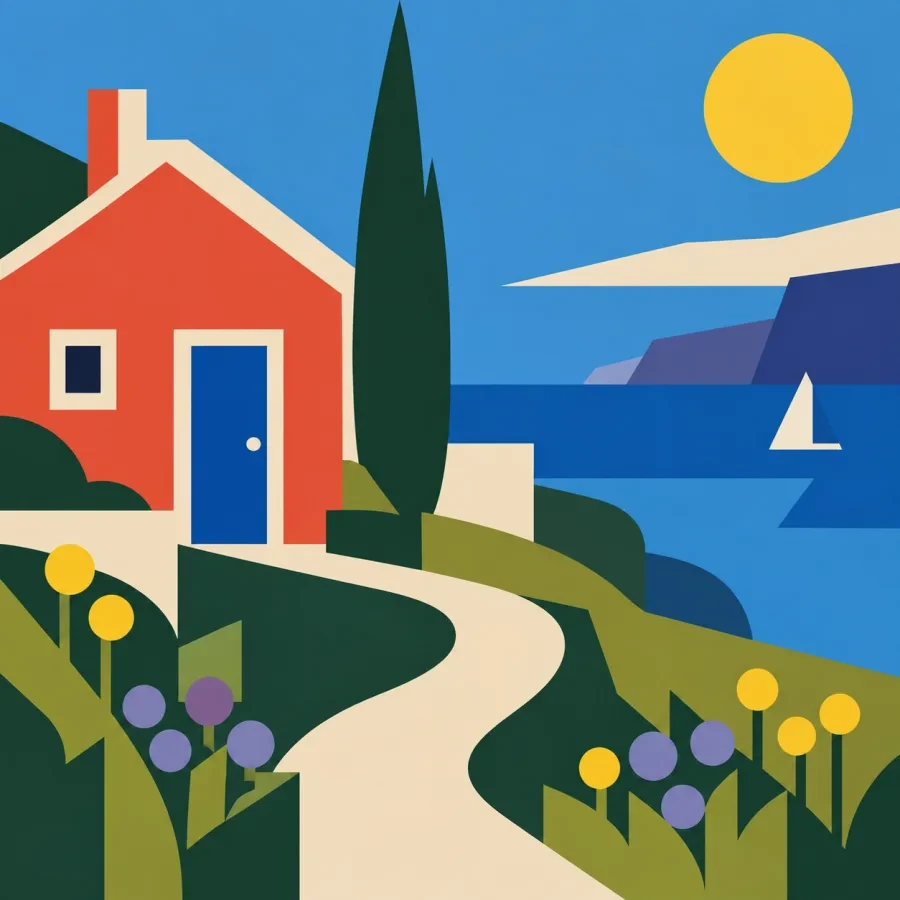
Study 1 — Hard-edge Painting
Ultra-wide panoramic banner, a human hand and a sleek robotic hand reaching toward each other, fingertips almost touching, a bright luminous spark of intelligence between them, a subtle world map behind them with global data network lines, symbolizing human-AI collaboration and digital transformation, rendered in Hard-edge Painting style, with refined composition, distinctive materials, elegant lighting, high-detail artistic finish, high quality, high detail, balanced composition, no text, no logo, no watermark, exact aspect ratio 1584:396
Prompt source: 1001 Art Styles. Select the text to copy, then adapt the subject and composition.
Study 2 — Hard-Edge Painting
Apply the following visual approach to my subject or project, preserving its core content and purpose. Transform the subject into clean geometric zones with perfectly defined edges, uniform matte color, and deliberate optical relationships. Treat this as a contemporary interpretation, not a historical artifact. Adapt the composition to my subject. Do not add text unless my project calls for it.
Prompt source: Emergent Mind Style Atlas. Select the text to copy, then adapt the subject and composition.