
Historical ceramic traditions · painted pottery
Greek vase painting brings image and vessel into a single object. Its histories include geometric bands, black-figure silhouettes, red-figure drawing and white-ground decoration. A useful reading considers the pot’s shape and use alongside the painted scene; black and terracotta are not simply a modern two-colour palette applied to an arbitrary surface.
A visual introduction
Select an image for a closer look. Use the thumbnails, arrow keys or a swipe to compare examples. Zoom in to inspect details, or share the image that inspires you.
Creative toolbox · take this style further
Choose an input and a destination. Search sends your words to the chosen site; Copy & open puts them on your clipboard to paste there.
Create with AI
Turn your chosen input into an image prompt or a new creative direction.
ChatGPT
Copy your input and paste it into a ChatGPT conversation or image request.
Copy & open ChatGPT (new tab)Claude · Anthropic
Develop an image prompt or explore the style in a new Claude conversation.
Copy & open Claude · Anthropic (new tab)Midjourney
Paste your input into the Imagine bar on the Create page.
Copy & open Midjourney (new tab)Adobe Firefly
Copy your input, open Firefly, and paste it into the prompt field.
Copy & open Adobe Firefly (new tab)Leonardo.Ai
Copy your input, open Leonardo, and paste it into the generation field.
Copy & open Leonardo.Ai (new tab)Image search
Find visual references. Short, concrete keywords usually work best.
Lexica
Search AI images and prompts using your selected input.
Search with this input Lexica (new tab)Pexels
Search the photo and video library. Short keywords often work best.
Search with this input Pexels (new tab)Pixabay
Search photos, illustrations and other images.
Search with this input Pixabay (new tab)Unsplash
Search photographs using the style name or your own keywords.
Search with this input Unsplash (new tab)Wikimedia Commons
Search photographs, artworks and historical images. Check each file for its source and reuse terms.
Search with this input Wikimedia Commons (new tab)Art & research
Explore artists, collections and the ideas behind a style.
Wikipedia
Search for background reading. A style may not have its own article.
Search with this input Wikipedia (new tab)WikiArt
Copy your input into WikiArt’s search to explore artists and artworks.
Copy & open WikiArt (new tab)Europeana
Paste your keywords into the search to explore European museum, library and archive collections.
Copy & open Europeana (new tab)Inspiration
Discover portfolios and visual ideas from creative communities.
Instagram hashtags
Search a hashtag made from your input: spaces and punctuation are removed. Instagram may require sign-in.
Search with this input Instagram hashtags (new tab)ArtStation
Paste your input into artwork search for concept art, environments, characters and visual development.
Copy & open ArtStation (new tab)Behance
Paste your input into project search for illustration, design and visual storytelling.
Copy & open Behance (new tab)A closer look
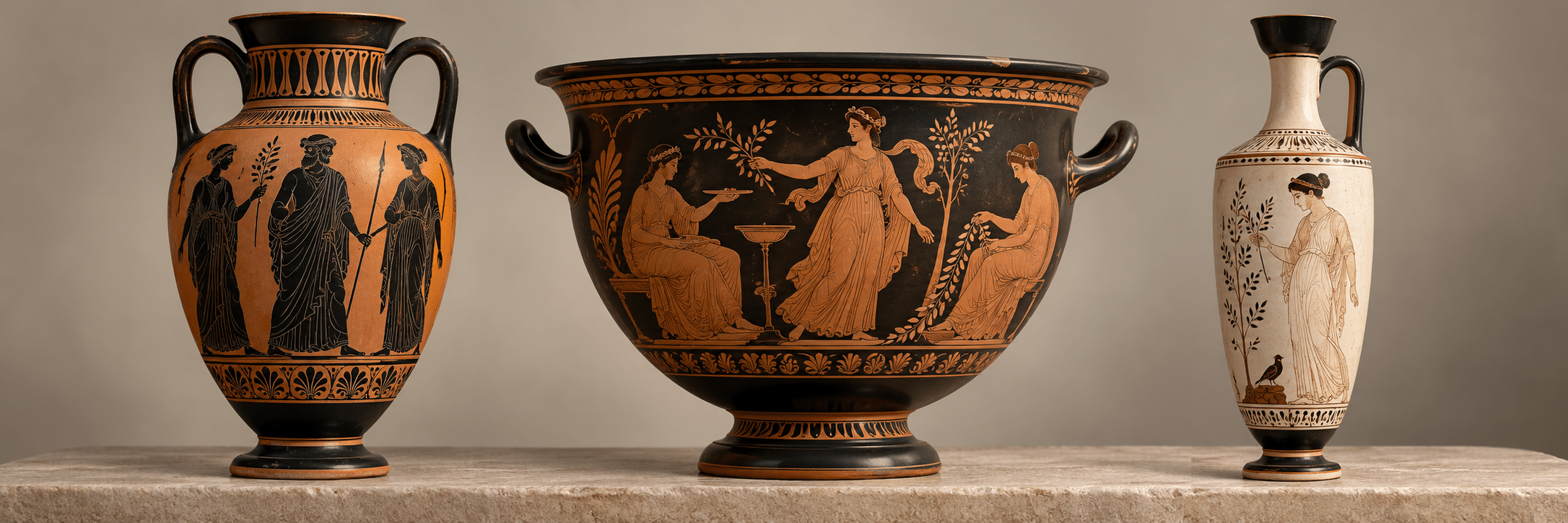
Follow the relationship between the vessel’s curve, its handles, the framing ornament and the figures. In black-figure decoration dark silhouettes stand against the clay-coloured ground; in red-figure the reserved clay figures emerge from a dark field. The new gallery uses clearly labelled invented vessels to compare those visual relationships.
A broad tradition, not one timeless style
The Museum of Cycladic Art traces changes from Proto-Geometric circles and bands through increasingly elaborate Geometric organization and narrative figures. The decoration could emphasize the neck, belly and spaces between handles rather than ignore the object’s structure. [1]
Black- and red-figure painting form a major later chapter, particularly in Athenian fine pottery. The Met’s overview concentrates on their use from the sixth through fourth centuries BCE. [2] That focus should not be mistaken for the full geographical or chronological range of Greek ceramics.
Begin with a specific object record whenever possible. Place of production, date, vessel type, technique and surviving condition are more informative than a generic label such as ancient vase. A modern interpretation can explore formal principles without claiming to reproduce a complete historical tradition.
Black-figure and red-figure: read the reversal
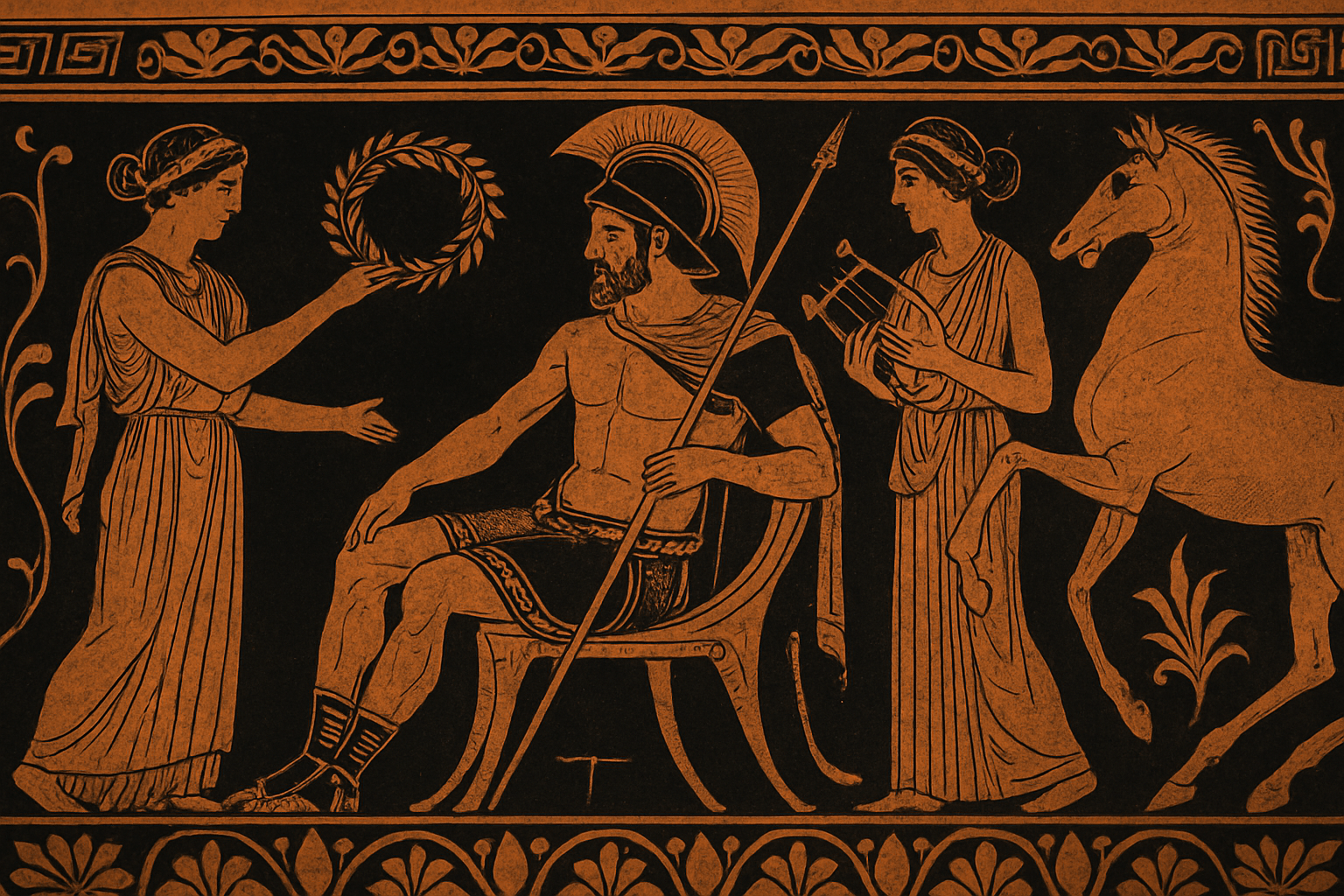
In black-figure work, dark silhouettes were applied with a refined clay preparation, and incised lines could articulate internal details. Red-figure reverses the main arrangement: figures retain the clay colour while the surrounding field is dark, with details drawn in lines. The Met explains both as complementary ceramic processes. [2]
This is not simply black paint versus red paint. Clay preparation and firing help produce the characteristic contrast. The University of Colorado’s collection essay explains the use of slip and the role of iron-bearing clay in the fired black surface. [3]
For looking, compare where detail sits. An incision cuts into a dark mass; a drawn line articulates a reserved light form. In a digital exercise, preserve that distinction rather than placing identical white outlines on every figure in both methods.
The vessel is part of the composition
A broad shoulder, narrow neck and projecting handles create different kinds of space. Imagine the picture turning away around the body of the pot. A figure near the edge may disappear as the object rotates; a handle can interrupt a band or establish a boundary.
Plan the largest decorative zones before adding narrative. Let the main scene occupy a deliberate field, use smaller bands to connect or separate parts, and keep the rim legible. Ornament becomes more convincing when its scale changes with its position rather than covering every area with the same dense pattern.
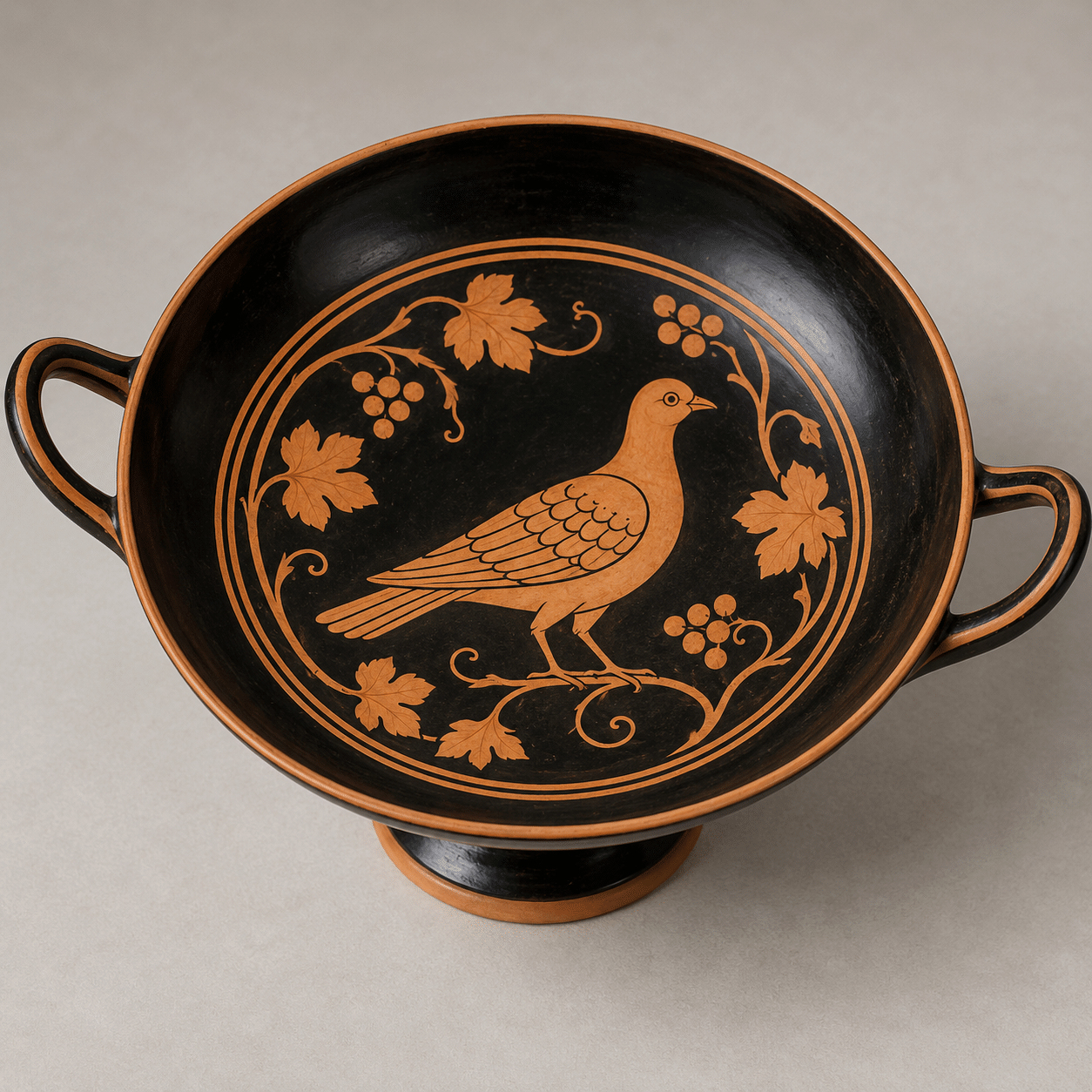
The Met identifies vessel functions through its collection examples: an amphora as a jar, a krater for mixing wine and water, a kylix as a drinking cup and a lekythos as an oil flask. [2] Form and function supply context even when the painted subject seems to lead elsewhere.
Beyond the familiar black and terracotta pair
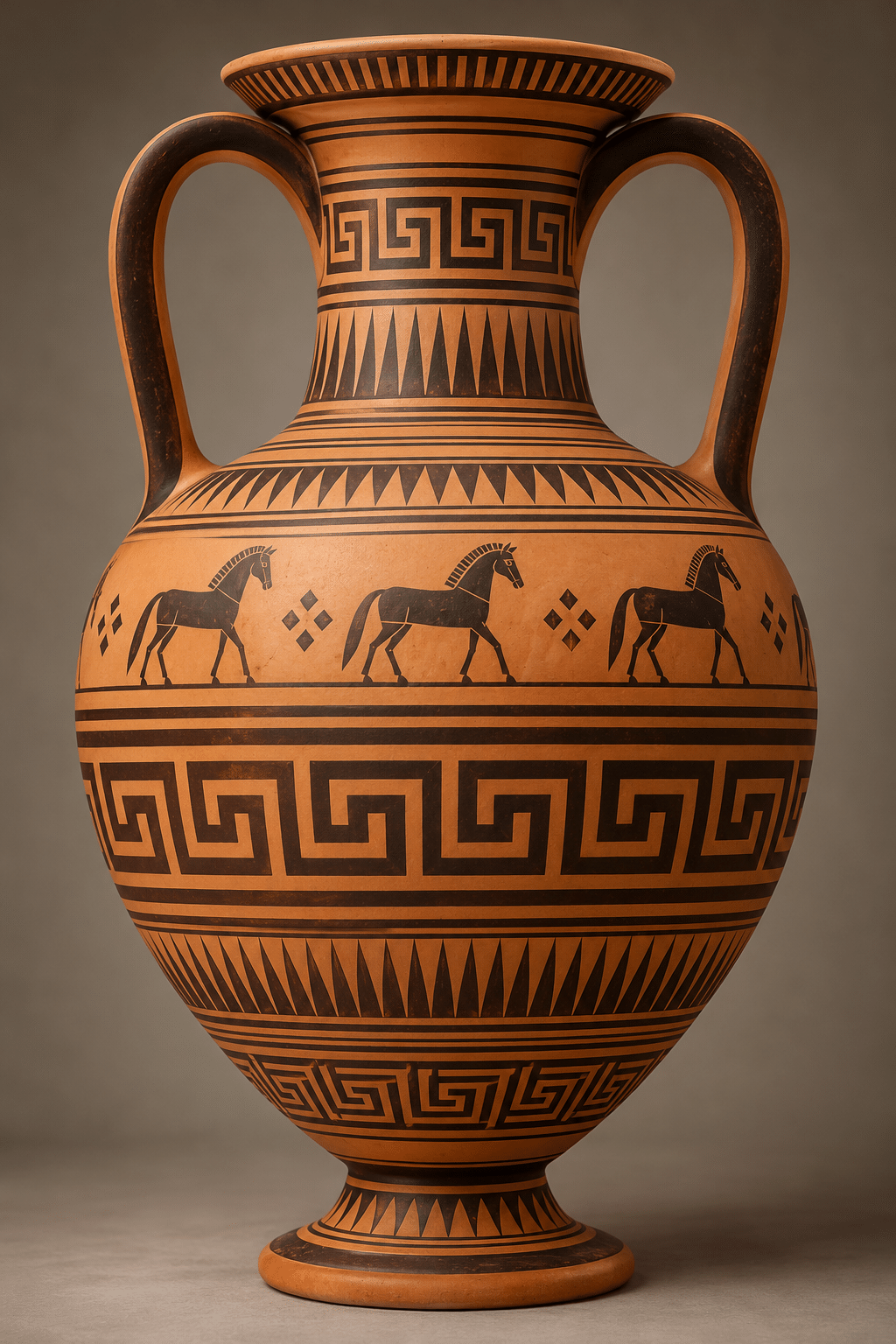
Geometric pottery offers a different problem: repeated linear motifs organize the vessel, while schematic figures can occupy bands and panels. [1] Its economy should be studied on its own terms instead of treated merely as an incomplete version of later naturalistic drawing.
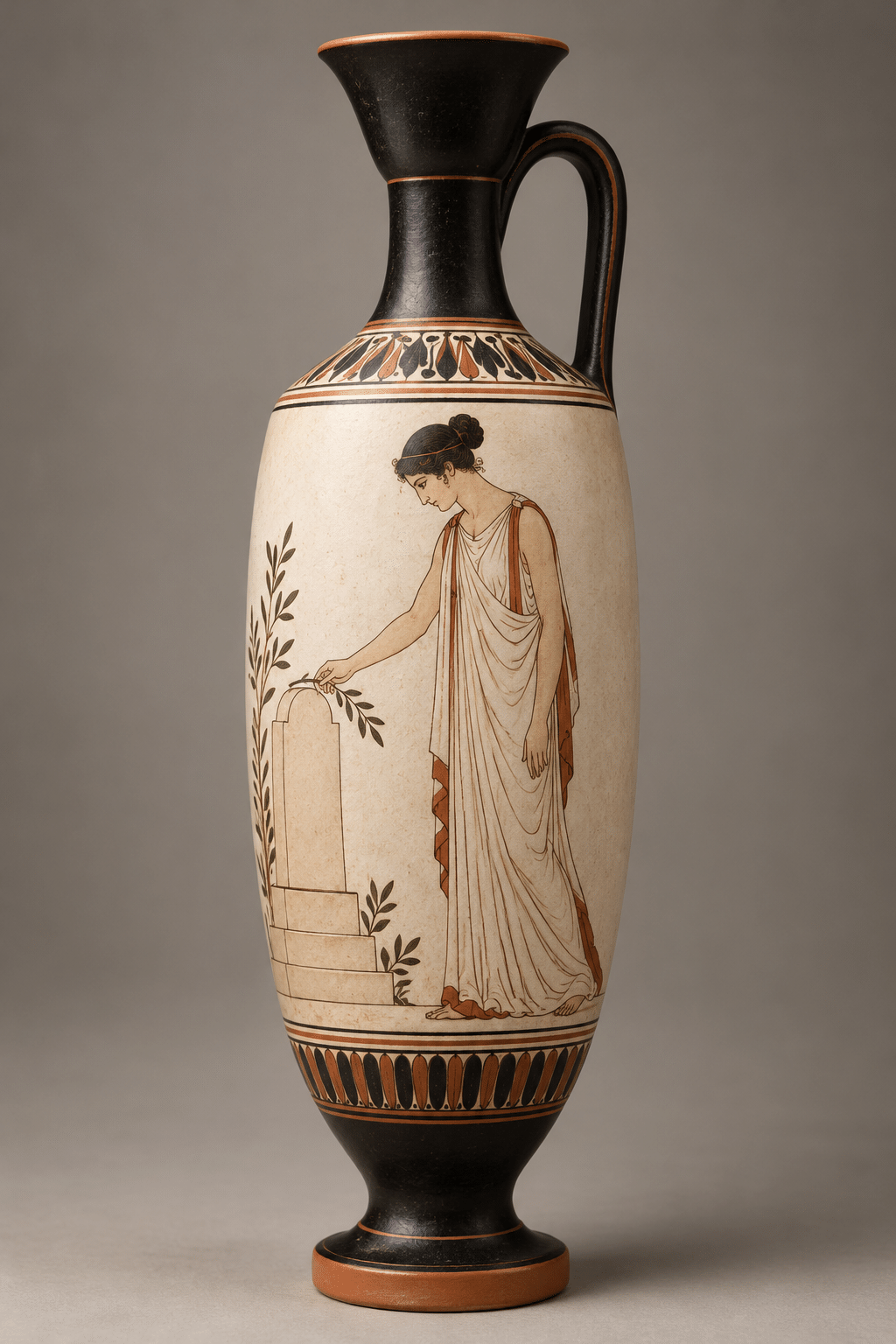
White-ground lekythoi also broaden the picture. The Canellopoulos Museum explains their fifth-century BCE funerary use and the combination of outlined figures with coloured details on a white background. [4] The quieter line and pale field produce a different visual relationship from a densely black-glossed vessel.
The new white-ground example is an invented study, not a reconstruction of a particular burial object. Its caption identifies the interpretation. Respectful historical explanation is more valuable than fabricated inscriptions, invented excavation stories or an artificially authoritative museum label.
Reading a scene without inventing a story
Describe what is visible before naming a myth: the number of figures, their gestures, objects, clothing and direction of attention. Attributes and inscriptions can support an identification, but a generated spear or bird does not establish a specific ancient narrative.
Ask how the scene fits its field. Are bodies arranged in a procession, paired in an encounter or isolated in a central space? Does a repeated motif create rhythm around the circumference? The intervals between figures may carry as much compositional weight as the incised or drawn details.
A painted scene is evidence of representation, not an unfiltered photograph of ancient life. Read the object with its cataloguing information and archaeological context where known. Unknown provenance should remain unknown; visual plausibility cannot fill that gap.
Five new studies and a stronger featured image
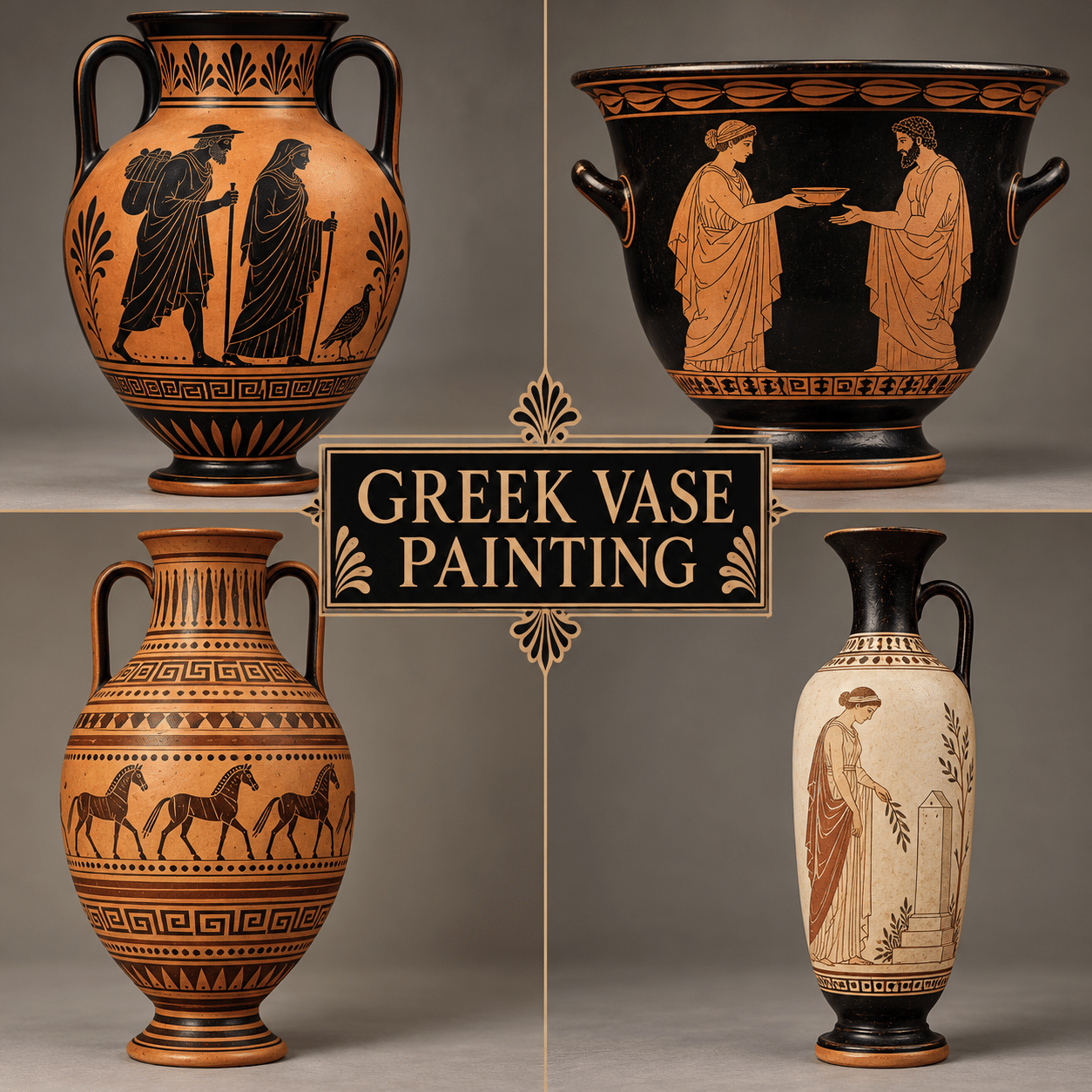
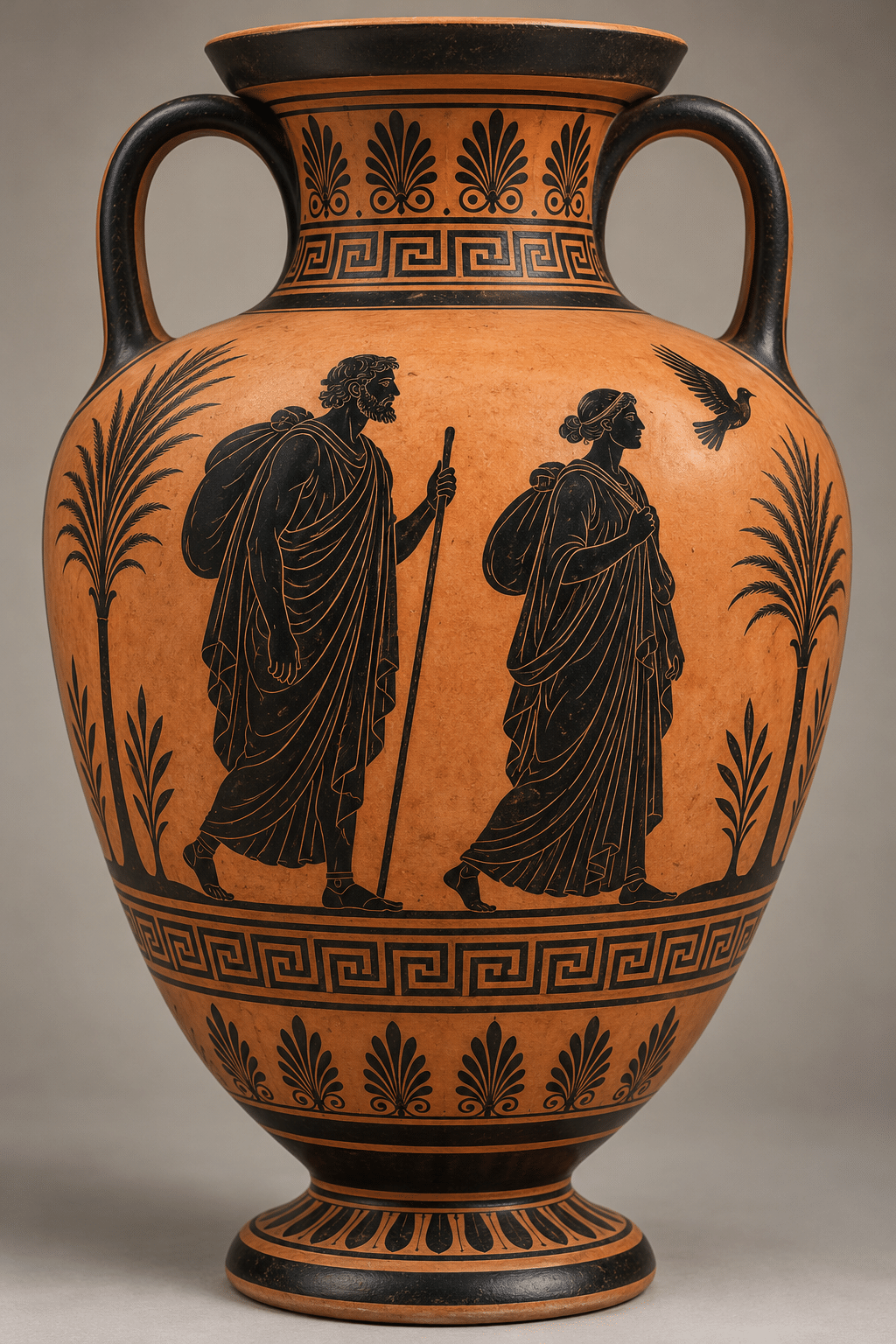
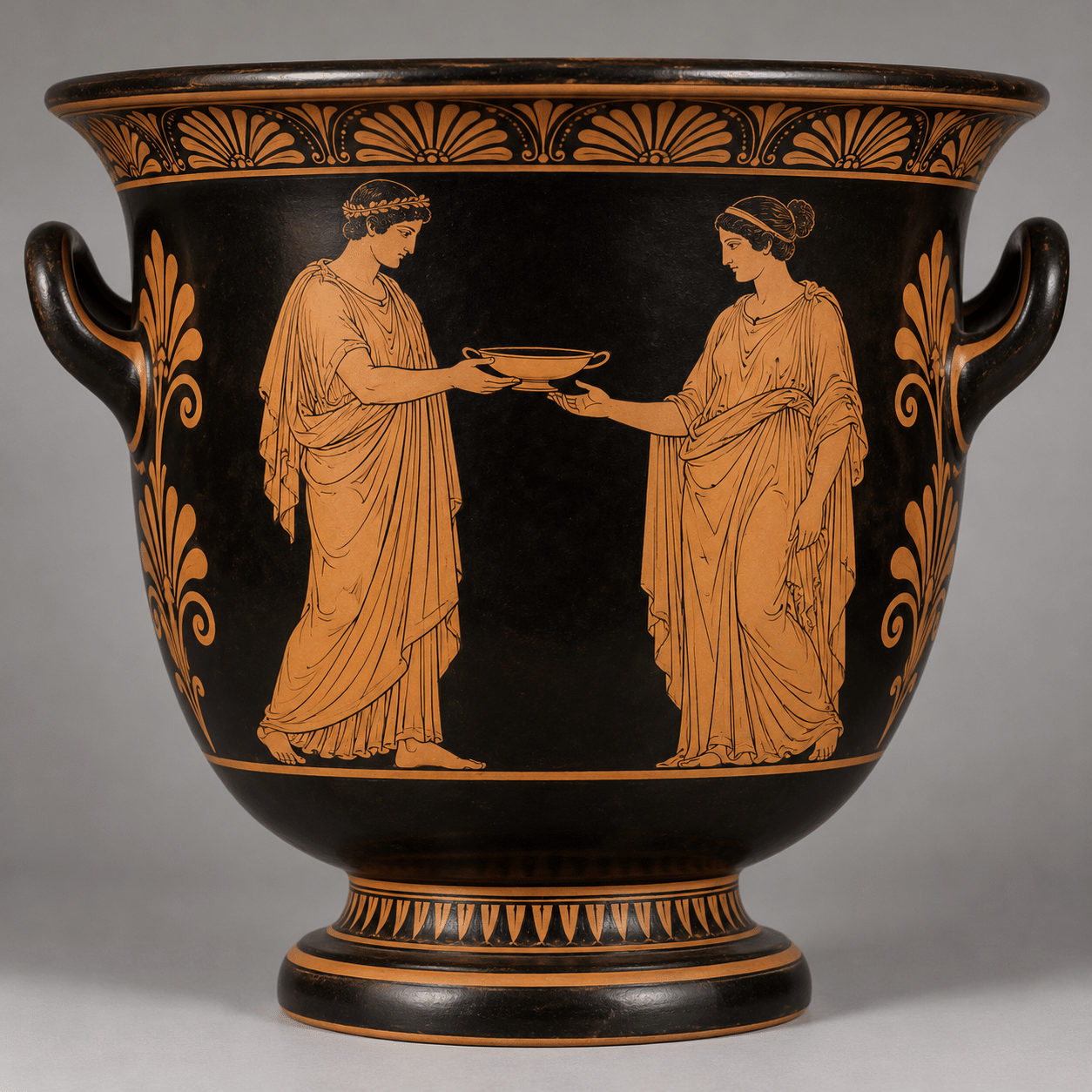
A black-figure amphora tests silhouette and internal incisions. A red-figure krater tests reserved figures and drawn garment lines. A Geometric vessel tests bands, spacing and repeated schematic animals. A white-ground lekythos tests restrained outline and empty space. A shallow cup study uses a circular field for a single bird and vine motif.
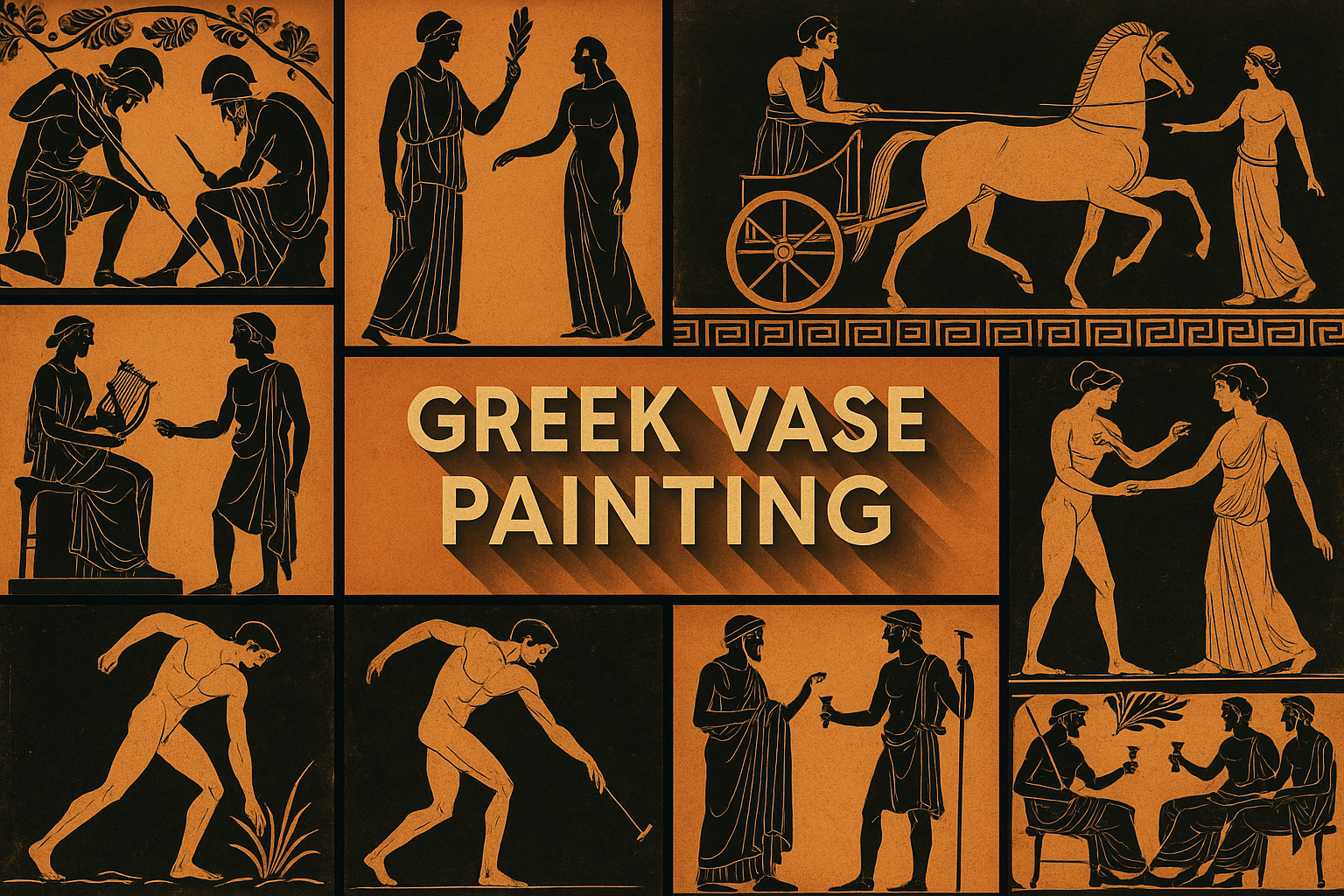
The dedicated banner groups contrasting vessel forms, while the centrally titled collage compares techniques. All new objects are AI-generated educational interpretations. They are not archaeological finds, museum photographs or objects attributed to named ancient painters.
A practical design sequence
Choose a vessel silhouette first and keep its lip, foot and handles structurally plausible. Divide it into a few decorative zones. Select one technique for the main study, then choose a scene with a clear action and enough room for the figures.
Specify the contrast explicitly in a prompt: black silhouettes on terracotta with fine incised details, or terracotta figures reserved against black with dark drawn details. Add the vessel form, viewing angle and a restrained border scheme. Avoid asking for every Greek ornament at once.
At review, check the handles and foot, the continuity of bands around the curve and the distinction between the figure and background. Remove stray pseudo-writing. A convincing illustration can teach composition, but it cannot validate an ancient firing process or authenticate an object.
Positive editorial assessment — AI-authored
The strongest works make shape, ornament and narrative mutually dependent. A limited contrast can carry surprisingly varied gesture and rhythm, while the vessel’s curve turns looking into an active process. The tradition rewards attention to both craftsmanship and pictorial decisions.
Critical editorial assessment — AI-authored
Generic imitations often mix techniques, overload the surface with borders or attach impossible handles. They may also invent mythological identities and archaeological authority. Improve a study by selecting one clear method, simplifying the framing and labelling the modern interpretation honestly.
Neutral editorial assessment — AI-authored
Greek vase painting encompasses changing ceramic practices rather than one uniform style. This overview introduces selected techniques and ways to read the relationship between image and vessel. Institutional sources supply historical context; the generated gallery is comparative illustration, not artifact evidence.
A small poetic detour
Original words from the AOI studio.
Poetry
The handle interrupts the line,
the shoulder turns the figures round;
a darkened field, a clay reserve,
a story held above the ground.
The cup keeps space within its rim,
the bird returns the watching eye.
We turn the vessel in the light
and let the painted forms pass by.
The prompt workshop
Original creative exercises. These prompts create new illustrations, not documentary evidence.
Black-figure contrast
Create an invented two-handled amphora with black silhouettes of two cloaked travellers and a small bird on a terracotta field. Fine incised internal details, restrained geometric borders, coherent handles and foot, neutral studio background. Educational interpretation, no inscriptions or archaeological claims.
Reverse figure and field
Create an invented broad red-figure krater with two draped adults exchanging a shallow bowl. Terracotta figures reserved against a lustrous black field, dark drawn garment lines, a simple band below the scene and structurally coherent handles. No copied artifact or lettering.
Let the vessel organize the pattern
Create an invented Geometric-style amphora with carefully spaced meanders, narrow dark bands and a small frieze of schematic horses. Let the neck, shoulder and belly determine the scale of decoration. Restrained terracotta and dark brown, no pseudo-writing or false museum label.
A smile from the studio
Jokes
The border wanted another band of ornament. The potter reminded it that the figures still needed somewhere to stand.
Sources and further exploration
[1] Museum of Cycladic Art — Geometric pottery and the relation of decoration to form
[2] The Met — Athenian black- and red-figure processes and vessel examples
[3] University of Colorado Boulder — slip as a ceramic material
[4] Canellopoulos Museum — white-ground lekythos and funerary context