AOI creative concept
Glyphwave is a fictional AOI design brief in which a small family of invented marks travels through a composition like a wave. The interest lies in repetition and variation: a loop opens, a square breaks, a hook stretches. These marks suggest a visual language without claiming to translate an actual one.
An AOI creative concept, not an established historical movement.
A visual introduction
Open any image to look closer, then browse the examples.
Creative toolbox · take this style further
Choose an input, adjust it, then open a tool. Search links pass your text to the destination. Copy & open copies it for you to paste into the generator; you start generation there.
ChatGPT
Copy your input and paste it into a ChatGPT conversation or image request.
Copy & open ChatGPT (new tab)Claude · Anthropic
Develop an image prompt or explore the style in a new Claude conversation.
Copy & open Claude · Anthropic (new tab)Midjourney
Paste your input into the Imagine bar on the Create page.
Copy & open Midjourney (new tab)Adobe Firefly
Copy your input, open Firefly, and paste it into the prompt field.
Copy & open Adobe Firefly (new tab)Leonardo.Ai
Copy your input, open Leonardo, and paste it into the generation field.
Copy & open Leonardo.Ai (new tab)Lexica
Search AI images and prompts using your selected input.
Search with this input Lexica (new tab)Pexels
Search the photo and video library. Short keywords often work best.
Search with this input Pexels (new tab)Pixabay
Search photos, illustrations and other images.
Search with this input Pixabay (new tab)Unsplash
Search photographs using the style name or your own keywords.
Search with this input Unsplash (new tab)Wikipedia
Search for background reading. A style may not have its own article.
Search with this input Wikipedia (new tab)WikiArt
Copy your input into WikiArt’s search to explore artists and artworks.
Copy & open WikiArt (new tab)Instagram hashtags
Search a hashtag made from your input: spaces and punctuation are removed. Instagram may require sign-in.
Search with this input Instagram hashtags (new tab)A closer look
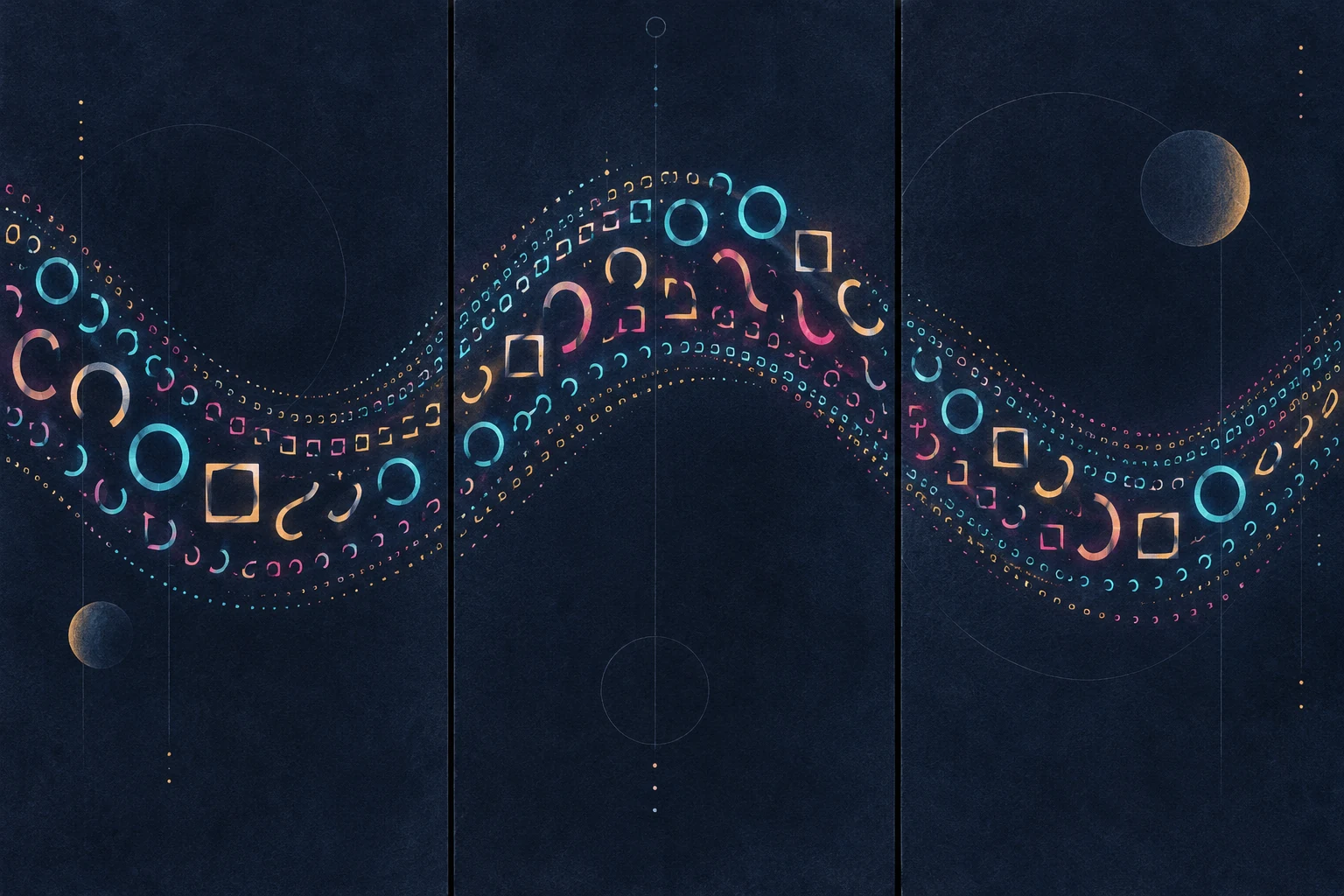
Cyan loops, amber fragments and pink hooks follow undulating rows across a dark blue triptych. Large marks establish the route; tiny repeated marks keep the rhythm between them. The quiet upper areas stop the luminous pattern from filling every inch.
Invent a vocabulary before decorating the page
Start with three shapes that can be recognised at several sizes. Give each one a small number of permitted changes: rotation, an opening in its contour, or a longer tail. Then arrange them along a curve. The viewer should be able to recognise related forms without needing a key. If every mark is unique, you have a collection of ornaments rather than a visual system.
The word glyph can invite a false promise of hidden meaning. Here it refers to designed marks, not to a discovered alphabet or an ancient code. No historical school, founding collective or documented exhibition history is claimed for Glyphwave. Earlier database notes supplied speculative names and origins; this entry replaces them with an explicit creative brief.
Make the wave visible without drawing its outline
The illustration builds a moving band from separated shapes. Their alignment lets the eye infer a continuous route even though no solid ribbon contains them. Changes in scale add a second rhythm: a large loop interrupts the stream, then smaller fragments carry it onward. That combination makes the system feel both orderly and unsettled.
Try removing half the marks. If the route survives, those remaining shapes are doing structural work. If it disappears, restore only the marks that reconnect the sequence. This is a useful defence against the decorative habit of adding glow until the composition appears expensive. More light is not necessarily more information.
Keep invented writing honest
Avoid copying a living writing system merely to produce an atmosphere of mystery. If you do use real text, check its meaning, spelling, orientation and typography with an appropriate source. An unreadable mark is not automatically harmless decoration when it resembles a culturally specific sign.
For a digital version, keep the vocabulary on one layer and the placement rules on another. This lets you revise the rhythm without redrawing every symbol. When using an image model, ask for abstract loops and broken geometric contours rather than a secret script. Review the output for accidental letters and unintended symbols. The satisfying mystery is how a few marks build a whole image, not a fabricated claim that the image contains forbidden knowledge.
The prompt workshop
Original creative exercises. These prompts create new illustrations, not documentary evidence.
A small alphabet without words
Design an original abstract triptych with loops, broken squares and hooked lines following a broad wave. Deep indigo ground, restrained cyan, amber and pink, large negative spaces. Repeat a consistent shape vocabulary at several scales. No readable text, real scripts, religious signs or logos.