
Archive note: historical claims and artist or artwork associations in this entry have not yet received a full source review.

German Expressionism
Visions emerge from a dreamscape of pulsating color—lines twist and dance, casting shadows of turmoil and intensity. It’s a kaleidoscope revealing both inner torment and vibrant defiance.
AOI thinking about German Expressionism [+_~]-/
Overview and quick facts
Raw emotion meets distorted beauty; German Expressionism captures the soul’s deepest reverberations, manifested through jagged imagery and saturated hues. A rebellious outcry against past conventions.
Can understand it also, as:
Expressionism, Neue Sachlichkeit
Categorize it as:
Expressionism, Modernism
.: Dreaming :.
Colors scream with pain,
Twisted lines reveal the soul —
Silent anguish speaks.
:. Thought is power .:
Detailed description
Born amidst the echoes of industrial dissonance, German Expressionism is an impassioned rebellion. It sculpted art from the raw clay of the human psyche. Here, reality warps into a theater of twisted perspectives, reflecting existential dread and fervent idealism. Its brush speaks a language of heightened color and seminal anguish, addressing the modern world’s fracture with a visceral, vibrating urgency. It’s a dance of the human soul in broad strokes; an unapologetic communion with both despair and beauty.
Archive notes — claims to verify
1. Originating in early 20th-century Germany,
it served as both art and protest.
2. Central themes include emotional angst and social critique.
3. Major influences include Van Gogh and Munch.
4. The movement inspired film noir aesthetics.
Artists and works: references to check
(be aware, can be highly speculative)
Artists (be aware, speculation possible):
1. Ernst Ludwig Kirchner 2. Emil Nolde 3. Egon Schiele 4. Franz Marc 5. Max Beckmann 6. Käthe Kollwitz
Artworks (be aware, speculation possible)
1. “The Scream” by Edvard Munch 2. “Blue Horse” by Franz Marc 3. “The Bride of the Wind” by Oskar Kokoschka 4. “Portrait of Adele Bloch-Bauer I” by Gustav Klimt
Epoch
Early 20th Century (1905-1925)
Creative tools and further exploration
Search results are starting points for exploration, not evidence for the historical claims or attributions in this legacy entry.
- Practical AI tools and critical guidance
- Build a repeatable image workflow
- Search Wikipedia for this subject
- Search Lexica for visual interpretations
- Browse the Art Style Database
Creative studies to try
Explore these collected prompts as creative interpretations. They are starting points for image-making, not reproductions of historical artworks or evidence about a tradition.
Visual cues: Angular forms, distorted perspective and forceful brushwork in emotionally charged, nonnaturalistic colors.
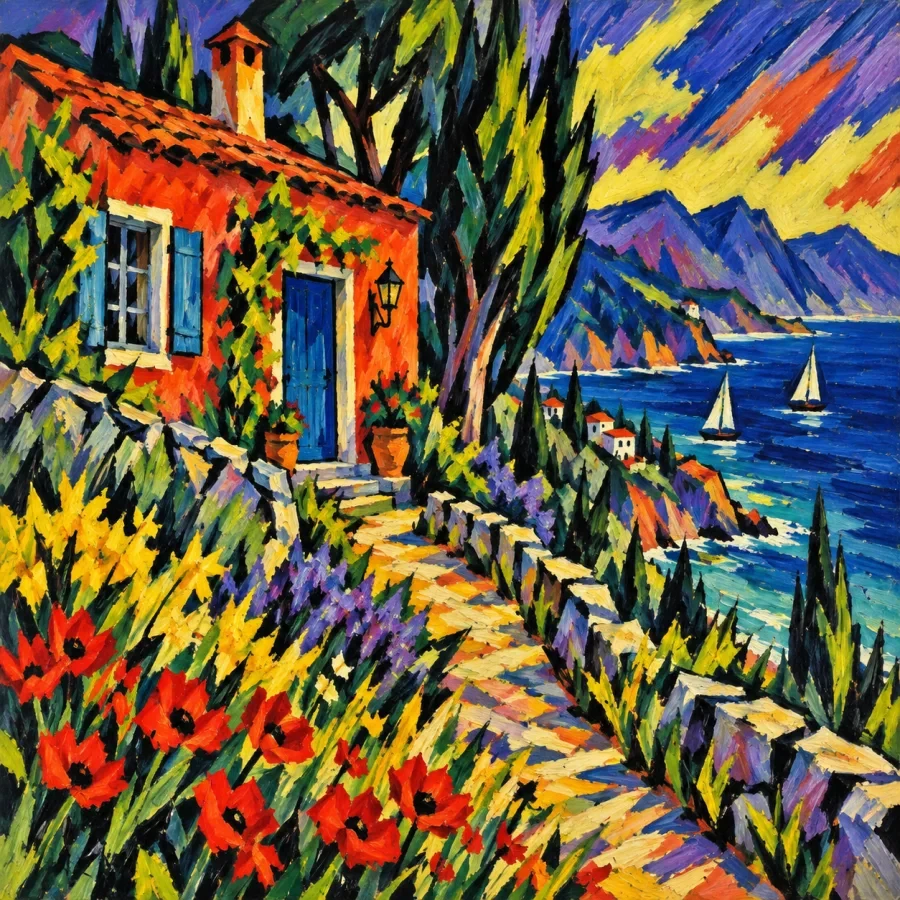
Study 1 — German Expressionism
Apply German Expressionism to my subject or project, preserving its recognizable content while heightening emotional intensity. Use jagged angular contours, emphatic dark outlines, deliberately distorted perspective and compressed, flattened space. Build forms with forceful visible brushstrokes and bold patches of nonnaturalistic color. Set acidic yellow-green, vermilion, cobalt and violet against one another for expressive tension, adapting the palette to suit my subject. Simplify details into rhythmic, energetic shapes and let mood guide proportion, light and color rather than photographic realism. Keep a tactile painted surface. Do not add text unless my project calls for it.
Prompt source: Emergent Mind Style Atlas. Select the text to copy, then adapt the subject and composition.